Wakamatsu Castle (Dunshu Castle) completion guide | History, light points and communication news – detailed information
Is this Wakamatsu Castle?
Wakamatsu Castle (Japanese: Wakamatsu Castle, 罗马字: Wakamatsu-jo) is a Japanese castle fort located in Otemachi, Aizuwakamatsu City. Usually called Dunshu Castle, its former name was Kurokawa Castle. Named Aizuwakamatsu Castle, chosen as one of Japan’s 100 Famous Castles.
Wakamatsu Castle was built as a stepped fort on the plains, which consisted of castle towers on the west, north, second and third levels. The work is centered on the administration of the Aizu domain, the politics of the Aizu region, and the core of the culture and culture of Chuto. This is especially true during the period of the Boshin War, which was at the end of the Jiang Era, and Wakamatsu Castle was famous for its unparalleled defense, and for a long time, it was attacked for a long time.
Nowadays, the Wakamatsu Castle ruins are mainly designated as “Dunya Castle Park”, most of which are designated as national historical monuments. After the construction of the castle tower, “Wakamatsu Castle Castle Museum” was opened overseas, and it is a representative tourist attraction in Aizu City, attracting a large number of visitors all year round.
Historical background of Wakamatsu Castle
From medieval times to early modern times
The history of Wakamatsu Castle was traced back to the Nanboku-cho era. It was first constructed in 1384 (the first year of Shitoku), when Naomori Ashina’s residence in Odagaki area was completed. At first, it was just a simple private residence, and the family was a powerful feudal lord in the Aizu area, and the fort was equipped with various functions.
The Asana clan was established in the Aizu area, and ended the war in 1589 (Tensho 17). During the war in Sugiuehara, the Asana clan was replaced by Masamune, and the Asana clan passed away. Masamune Ida moved to Kurokawa Castle, however, Hideyoshi’s retainer Hideyoshi Heisada Oshu, and other orders left Aizu.
The large-scale reconstruction of the Gamo clan’s castle fort, the establishment of the envoy, and the modernization of the fort.
In 1590 (Tensho 18), Hideyoshi became the lord of the Gamo clan and the Aizu domain, with an area of 420,000 koku. In 1592 (first year of the Bunroku era), the castle was completely renovated from the beginning of the clan’s history, and the castle was remodeled to become the new headquarters for the modernization of the castle.
Gamo clan completed the construction of the seven-level castle tower of Hiroyuki Ichiza, and the castle town was opened. The name of Wakamatsu no Minamoto and his death was Wakamatsu no Mori in Hino City, Omi Province. Ujiha was well versed in tea ceremony, and was a high school student of Sen no Rikyu.In this case, he built a tea room in the castle.
Kageyoshi Uesugi and Naoe Kaneto era
In 1598, the Gamo clan moved to Utsunomiya, and Uesugi Kageyoshi became the lord of the Aizu domain, with an area of 1.2 million koku. The victory and the famous military strategist Naoe Kane joined together with Aizu Castle and the opening of the castle town. However, Yuyu and others supported the Western Army during the War of War, which was destroyed in 1601 with 300,000 koku.
Gamo clan’s death and Kato clan’s era
After the battle of Kanbara, Hideyuki Gamo entered Aizu again, and the Taji Gamo clan succeeded in 1627, and Kato Yoshiaki succeeded him. During the Kato Showa period (1639-1643), Aizu Castle was extensively renovated, the castle tower was rebuilt, and five layers were constructed. The first seat of the tower was established in 1874.
Aizu Matsudaira family history after the Edo period
In 1643, after the removal of Akimasa Kato, Masayuki Hoshina, the half-brother of Iemitsu Tokugawa, was appointed lord of the Aizu domain, with a stipend of 230,000 koku. Masayuki Seiri was the founder of the Aizu Matsudaira family, which was secretly affiliated with the Tokugawa Shogunate, and was the ninth chief of the Aizu domain.
In the late Edo period, the lord of the Aizu domain, Matsudaira Katamori, was in charge of the Kyoto Shuho, supported the shogunate, and the new organization of the Emperor, Sonnojosho faction. However, after Yasuhiro was in Taisei (Emperor Kyoji), during the Boshin war, the core capabilities of the army of the Seiyuwara shogunate, and the army of the new government.
Battle of Boshin and Castle Battle
In 1868 (4th year of the Edo era), Wakamatsu Castle was part of the Battle of Boshin, a battle field during the Aizu War. Starting on August 23rd, the Aizu domain’s new government army carried out a ferocious attack that lasted approximately one month.
There were approximately 5,000 peasants in the castle, strong resistance, and among them were poor women, children, and children. When the new government’s army was used, it was the first to advance, and the great fires of the castle were fired, and thousands of pieces were fired. However, on September 22, the lord of the Matsudaira Katamori domain decided to surrender and Joike was attacked.
In this case, the story of the battle of the castle, the history of the current defeat, and the tragic story of the suicide of the white tiger army, and the heroism of the female warriors who fought with their halberds.
Changes since the Meiji era
Meiji government general in charge of Wakamatsu Castle and the Ministry of Defense. In 1874 (Meiji 7), the entire castle tower was built and removed, and the stone burial mound was put on hold. The city fortress site was opened in 1934, and was designated as a national historical monument.
In 1965 (Showa 40), under the initiative of civilians, the castle tower was used for construction, and its original appearance was restored. The interior has been renovated into a local cultural history museum, an art exhibition hall, and a cultural historical site. In 2000 (Heisei 12), Hoshii Hiroshi (Nanya Sotoya) established the construction method of the modern construction method of the Nansho River (Nanchoya) and completed the wood construction repair.
In 2011 (Heisei 23), construction of the building was completed, and the red tiles were used after the Edo period, and the exterior of the fort was closer to its original appearance.
Castle tower and construction features
Structure and performance of the castle tower
Wakamatsu Castle’s castle tower has been renovated for the longest time in its history. The first castle tower was built by Ayu Gamo, and seven layers were built by Hiroya, but the earthquake occurred in Qiyu. Later, during the Shōsho period in Kato, the castle tower was rebuilt with five layers, and the first one was maintained, and the removal of the tower was stopped during the Meiji period.
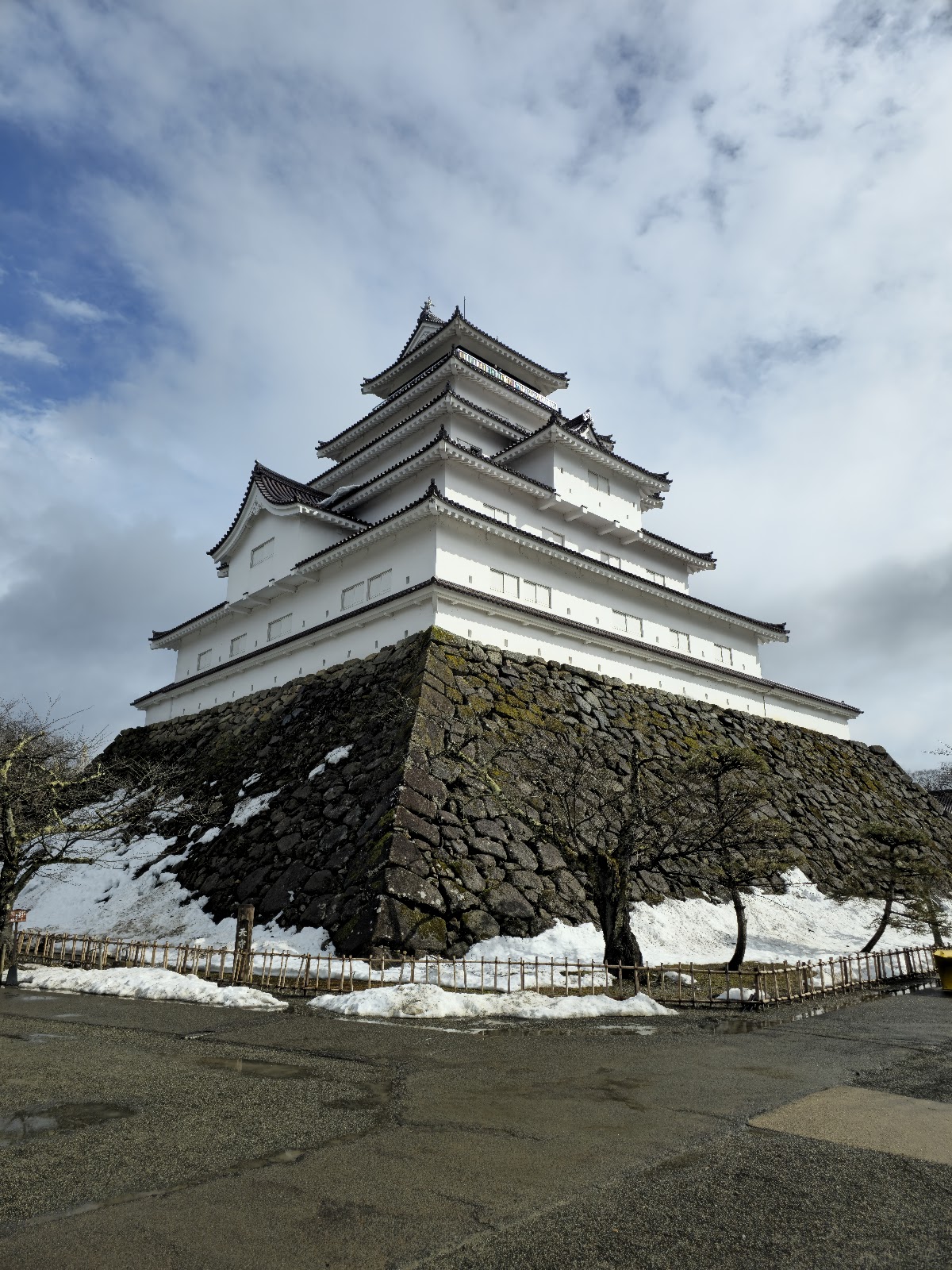
The existing castle tower was repaired in 1965 (Showa 40), with five outer layers, seven inner layers, and a height of approximately 28 meters. A magnificent panoramic view of Mt. Wabandai in the Aizu Basin.
Red tile castle tower gate
Wakamatsu Castle’s main tower was written by Akihiro, and his first special expedition was a red tile roof. In 2011 (Heisei 23), the castle tower was replaced with a new red tile from the Edo period. This red tile is a glass tile unique to the Aizu area and has cold-resistant characteristics.
If you look at the red tile castle tower in Japan, it is one of the highlights of Wakamatsu Castle. Of course, this is the season when the flowers are blooming, the red tiles, the white tiles and the red flowers are mixed together, the composition is complete, and the picture book is absolutely beautiful, and it attracts many visitors to see it.
Tenshu Ayoyo Pheasant Fish (Dead Fish Fish)
A pheasant fish (a type of pheasant-shaped creature) in the castle tower’s house. The pheasant is a fireproof decoration element used during the construction of the fort, and it is also a powerful decoration. The existing pheasant is in the process of being repaired, and when you look at it immediately, you can also feel the ability to see the crystal light.
Construction of the city center
阶梘style cloth station
Wakamatsu Castle is a typical troupe-style plain castle fort. A ladder-like construction is a tower-like castle, hence the name for its outstanding defensive ability.
The main castle of Wakamatsu Castle is the western outer castle, the northern outer castle, and the two outer castles and the three outer castles. Each castle wall has a structure in which the city is separated from the city by the river, the formation of one layer is progressing, and the other layers are blocked by enemy invasion.
Features of Ishijou
The construction techniques of the stone tombs at Wakamatsu Castle differed from time to time. During the Gamo clan’s time, the main stone coffin method was used to make stone coffins, and the Kato clan used advanced techniques for repair and installation, such as the cutting of clover (Kishiki) and Wakiri Hagi (cut stone).
That’s what it means to get one, and the main castle is surrounded by a stone citadel high in the mountains. Many primitive stone tombs are now perfectly preserved, and the construction techniques of the fort construction have been fully understood by the masters.
护城川YO水护城川
The defense system of Wakamatsu Castle was combined with the water and water castles. The water level of the city is to the north, the east side of the fort, and the water level of the city is to the west and south. Part of the castle river has been used since the current production, and the original appearance of the stone wall has been postponed.
Castle Tower Yojo Gate
Wakamatsu Castle during its heyday. The main defense work of the main castle tower, located on the south side of the main castle tower, was completed in 2000. This is a uniform construction of wooden structures during the Eiji era, which is a rare investment in the construction techniques of the time.
Wakamatsu Castle Castle Local History Museum Ryoten
Museum exhibits
As of now, the work inside the castle towerWakamatsu Castle Tenshuo Local History MuseumExhibition outside the area, exhibits of the history and culture of the Itsu area. The main themes of the museum’s different towers are the history of the Tsu clan, the Boshin War, castle town culture, weapons armor, etc.
The exhibits are particularly rich in the conflict between the battles and the battle, the comprehensive description of the materials for the siege, the exhibits of the white tiger army, and the weapons used at the time. In addition to this, the literature of Matsudaira Katamori Sokan, the lord of the Aizu domain, and the literature of the government of the Aizu domain are also exhibited.
Part-time view
A magnificent panoramic view of the Aizu Basin. Enjoy the beautiful views of Mt. Bandai, Mt. Yasori, Aizuwakamatsu City, and the beautiful scenery of the four seasons. As the red leaves bloom in the spring and the red leaves fall in the fall, it is a warm welcome card.
Dungu City Park Liang Point
Famous Celebrity Victory
Dungeon City Park is a famous winning place, and has been recognized as one of the “Japan’s 100 Greatest Winners”. Approximately 1,000 Yoshino oak trees have been planted in the park, and the beautiful oak flowers are in full bloom in mid-to-late April. The red tile castle tower is surrounded by beautiful flowers, and the beauty is not won. The night curtain descends, the lights shine, and the night curtain is beautiful.
Tonka Tea Room
The tea room was built by Sen no Rikyu’s son Shoan. At that time, Mr. Gamo was living in Aizu Edo. The current construction was completed in 1990, and the tea room was built so that guests could not visit the original soup.
Minami Sori Takuya Yosei Hiroshi
In 2000, the construction method of the modern construction method was completed in 2000. After the construction techniques have been refined, visitors can take a closer look at the exquisite craftsmanship of the modern craftsmen, and comprehensively integrate the Japanese woodworking techniques.
Black Iron Gate
The black iron gate is the main gate of the castle tower, and it has been completely repaired, and the structure of the square-shaped gate is solid. The iron plate covers the gate, and the defense power is strong. ## Local information and transportation
Basic information
- Location: 1-1 Otemachi, Fukushima, Aizuwakamatsu City
- Opening time: 8:30am – 5:00pm (last entry time 4:30pm)
- Closed date: Open all year round
- Gate ticket: 410 yuan for adults, 150 yuan for junior high and elementary school students (limited to the castle tower. If you have access to the tea room)
- Management organization: Aizuwakamatsu Tourist Office (general corporate consumer goods)
Transportation method
Sitting electric car:
- From JR Aizuwakamatsu Station, take a 20-minute walk from “Town Town Line Traveler – Mt. Haibara,” and get off the train at “Yojo Iriguchi” and walk for 5 minutes.
From JR Aizuwakamatsu Station, it takes about 15 minutes to get there, and you can get there by car at the “Tanjo North Exit” or “Tonjo Sannomaru Exit”.
Runway route:
- Departs from the Aizuwakamatsu IC on the Banetsu Expressway, approximately 15 minutes away.
- From the North East Expressway “Koriyama JCT”, approximately 60 minutes away.
Car stop information
Dungeon City Park Tourist Parks:
- Nishidemaru bus stop: Approximately 200 cars, normal car reading rate: 200 yen per hour (afterwards, 100 yen per hour)
- Tokyo Bus Stop: Approximately 130 cars, same as Nishidemaru Bus Stop
- South Exit Parking Area: Approximately 35 cars
When you want to travel, you can visit the park and visit the park, and you can sit on public transportation tools. There are no parking spaces for disabled people in the park.
Zhoujian Travel Scenic Spots
Below are some sightseeing spots near Dungeon City:
- Fukushima Museum: A comprehensive natural museum, with a rich history and Japanese culture in Aizu.
- Grand Garden: Aizu Matsudaira family garden, designated as a national scenic beauty.
- Raishu Mountain: White Tiger Army’s Self-exhaustion Land, the historical ruins of the Yiyi Temple.
- Aizu Samurai Residence: The residence of Ryo Nishihara, a high-ranking vassal of the Aizu domain.
- Nanomachi Street: An old-fashioned business district full of Ichijo, a Japanese store for commemorative goods.
The best season to explore
Wakamatsu Castle is beautiful throughout the four seasons, but the best time to visit is:
- Spring season (mid-late April): The opening of lilac flowers, the appearance of the red tile tower, the beauty of the castle tower, and the beauty of the castle.
- Autumn (late October to early November): Autumn leaves are in full bloom, the autumn sun is bright and sunny, Mt. Bandai can be seen further away, and the scenery is beautiful.
- Winter season (January to February): A unique winter weather with a white snowy sky and a castle tower.
Cultural significance of Wakamatsu Castle
Japan’s 100 Famous Jonoichi
Wakamatsu Castle is one of Japan’s 100 most famous castles, selected by the Japan Castle Fortress Association, and ranked 12th in the ranking list. Since Wakamatsu Castle’s place has been selected as the symbol of Bushido in Aizu, it has been given an important historical status during the Boshin War, its production has been perfected as a mountain castle, and its production has been the cultural center of the Aizu area.
Aizu Bushido Elegance
The spirit of “Aizu Bushido” conquers Wakamatsu Joyazo. The work is a history reviewer of Aizu samurai loyalty and bravery during the Boshin War, a tragic story of the White Tiger, and a female heroic battle, which touched the hearts of many people in the depths.
District Expedition
Nowadays, Wakamatsu Castle is still a symbol of Aizu-Wakamatsu City and a rare sight for citizens. The design element of Wakamatsu Castle was acquired by Ichiya, and the core composition of the district was recognized as the same. An interactive place for all kinds of urban activities and for all citizens and tourists.
Protection and use of Wakamatsu Castle
Productivity Culture Protection
Wakamatsu Castle site is designated as a national cultural heritage site, and the root of the “Cultural Quality Protection Law” is followed by reasonable protection management.石墙、护城川等銤城川等迗迗过进一步进行诵测和认褍、并续续结训确认传给给代.
Number existence calculation
In recent years, we have made progress in acquiring the latest technology protection and development work. In this case, we will try out the new history of history, for example, use 3D drawing technology to record the progress of the program, and then use VR technology to present the scene at the height of its development.
Use for travel resources
Wakamatsu Castle is a representative tourism resource in the Aizu area, and the local investment is huge. Aizu Wakamatsu Tourist Bureau Provides effective local information and improves customer service.
The museum exhibits and exhibits inside the castle tower are regularly updated, and visitors can visit the museum each time they visit. In addition, we have received many instructions for foreign tourists, such as providing multiple language instructions.
Conclusion
Wakamatsu Castle (Tsuruga Castle) is a historical castle fort dating back to around 630 years, and is a historical and Japanese culture in the Aizu area where elephants were conquered. The Gamo clan’s generals rebuilt and rebuilt the modern castle fort, raided it during the Boshin War, re-arrived at modern restoration work, and compiled a history of the fortifications.
The red-tiled castle tower, the solid stone burial mound, the beautiful scenery of oak flowers and the four seasons, and the contents of the rich museum exhibits, which leave a deep impression on those who love the history of the country, and which are also owned by visitors. When I arrived in Aizu, I was forced to walk slowly, detail the taste of the castle, and experience the history and culture of Aizu.
Wakamatsu Castle is located in Aizu City’s heart, and in general, it has received many people’s joy and protection.