Nagakura Castle (Ibaraki Prefecture) Complete Guide: A Thorough Explanation of the History and Highlights of the Satake Clan’s Mountain Castle
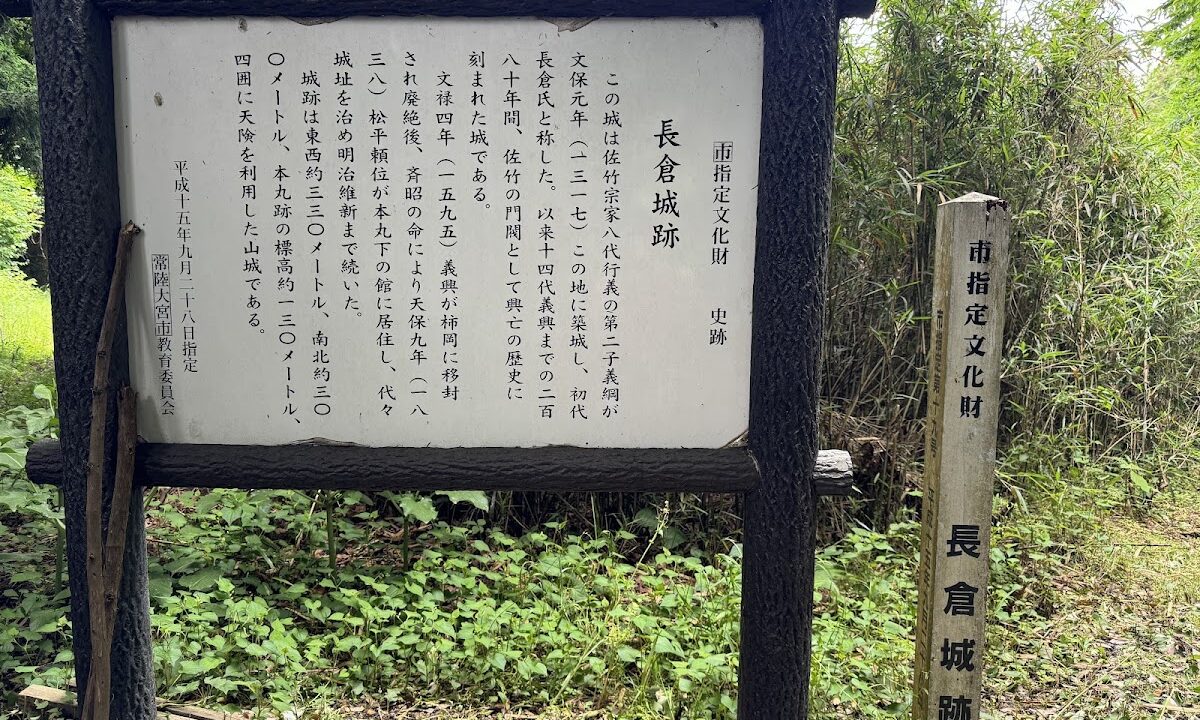
Located in Hitachiomiya City, Ibaraki Prefecture, Nagakura Castle is a mountain castle built in the Middle Ages by the Nagakura clan, a branch of the Satake clan. Built on a mountaintop approximately 130 meters above sea level, this castle is known for its particularly impressive large-scale vertical moats, even within Ibaraki Prefecture. Currently designated as a historical site by Hitachiomiya City, it attracts considerable attention among castle enthusiasts.
This article comprehensively explains everything you need to know before visiting Nagakura Castle, from its historical background and layout to specific highlights and access methods.
Basic Information on Nagakura Castle
Location: Nagakura, Hitachiomiya City, Ibaraki Prefecture
Castle Type: Mountain Castle
Construction Period: Around Bunpo 1 (1317)
Builder: Nagakura Yoshitsuna
Elevation: Approximately 130m (Relative Height Approximately 60m)
Remains: Earthworks, baileys, moats, vertical moats
Designation: Hitachiomiya City Historic Site
Main Lords: Nagakura Clan (a branch of the Satake clan)
Nagakura Castle was built on a mountain located northeast of Sosenji Temple, and its remains can still be clearly seen today. It is one of the best-preserved medieval mountain castles in Ibaraki Prefecture, and a valuable historical site where one can experience the castle-building techniques of the time.
History of Nagakura Castle
Construction and the Establishment of the Nagakura Clan
Nagakura Castle is believed to have been built around Bunpo 1 (1317) by Nagakura Yoshitsuna. Nagakura Yoshitsuna was the second son of Satake Yukiyoshi, a powerful daimyo of Hitachi Province. He settled in the Nagakura area and adopted the name Nagakura, marking the beginning of the Nagakura clan.
The Satake clan was a prestigious samurai family descended from the Minamoto clan, and ruled northern Hitachi Province from the Kamakura period. The family expanded its influence by branching out into various regions, and the Nagakura clan played a key role, building Nagakura Castle as a base of power in the area.
The Nagakura Clan in the Sengoku Period
During the Sengoku period, while serving the main Satake family, the Nagakura clan played a crucial role in protecting strategic points along the Nakagawa River basin. Nagakura Castle was located on the border between Naka County and Asatsuma Village, serving as an important boundary marker.
The Nagakura hackberry tree, which still stands today, is designated a natural monument of Ibaraki Prefecture and is said to have been planted as a boundary tree within the territory of the Satake clan, the lords of Nagakura Castle. This tree is a valuable reminder of the territorial control of that time.
Castle Abandonment and the Edo Period
After Toyotomi Hideyoshi’s siege of Odawara in 1590, the Satake clan unified Hitachi Province. However, after the Battle of Sekigahara, in 1602, they were transferred to Akita. It is believed that Nagakura Castle was abandoned at this time.
Later, in 1838, during the Edo period, Matsudaira Yoriyoshi, under the orders of Tokugawa Nariaki, the lord of the Mito domain, built the Nagakura Jinya (fortified residence) at the southern foot of Nagakura Castle. This was a separate facility from Nagakura Castle, established as part of the domain’s administrative reforms during the late Edo period.
Structure and Layout of Nagakura Castle
Overall Layout
Nagakura Castle is a typical medieval mountain castle with multiple enclosures centered around the mountaintop at an altitude of approximately 130m. The relative height is approximately 60m, and the approach to the castle from the foot of the mountain utilizes the steep terrain.
The castle’s central area consists of the main enclosure (1st enclosure) and 2nd enclosure, surrounded by multiple smaller enclosures. Defensive features include earthworks, moats, and, notably, a large group of vertical moats.
Characteristics of the Main Enclosure (1st Enclosure)
The main enclosure is located at the highest point of the castle and is surrounded by earthworks. The enclosure is relatively flat, suggesting it housed the lord’s residence and important facilities. From the main enclosure, one can overlook the surrounding terrain, indicating its military surveillance function.
A castle wall approximately 8 meters high surrounds the main enclosure, and looking up from the lower enclosures reveals the imposing presence of the straight-lined wall. This difference in elevation speaks to the castle’s high defensive capabilities.
2nd Enclosure and Group of Lower Enclosures
2nd enclosure is located south of the main enclosure, separated from it by a moat. The second enclosure is also surrounded by an earthen rampart, forming an important defensive line protecting the main enclosure.
Several lower enclosures are arranged in a stepped pattern around the second enclosure, functioning as defensive positions. From these lower enclosures, one can look up at the ramparts of the main and second enclosures, confirming the multi-layered defensive structure.
One of Ibaraki Prefecture’s Largest Vertical Moats
The greatest highlight of Nagakura Castle is its massive vertical moat, reaching nearly 10 meters in width. In particular, vertical moats 2 and 3 boast an extremely rare scale for castles in Ibaraki Prefecture, and the continuous arrangement of such large vertical moats is a rare example within the prefecture.
Vertical moats are defensive structures dug vertically into slopes, serving to prevent attacks from the enemy’s flanks and limiting attack routes. The vertical moats of Nagakura Castle are sufficiently deep, conveying the scale of the large-scale civil engineering work of the time.
When you actually visit these trenches, you’ll be overwhelmed by their scale and power. Experiencing the three-dimensional feel and spatial expanse, which cannot be conveyed through photographs or drawings alone, is arguably the greatest appeal of visiting Nagakura Castle.
Moats and Cut Slopes
The castle grounds feature multiple moats, clearly demarcating each enclosure. These moats, dug to cut across ridges, played a crucial role in preventing enemy incursions.
Furthermore, cut slopes (artificially carved steep slopes) are formed around each enclosure, demonstrating ingenuity in making climbing difficult. These remains are still clearly visible today, providing valuable resources for learning about the defensive techniques of medieval castles.
Highlights and Notes on Nagakura Castle
Highlight 1: A Series of Vertical Moats Approximately 10 Meters Wide
As mentioned above, the greatest highlight of Nagakura Castle is its massive group of vertical moats. In particular, the vertical moats 2 and 3 located on the western slope of the castle are approximately 10 meters wide and quite deep. Such a large-scale series of vertical moats is extremely rare among castles in Ibaraki Prefecture, making them a memorable feature for visitors.
Walking along the bottom of the vertical moats, the towering earthworks on either side give the feeling of walking through a gigantic trench. This impressive sight can only be truly appreciated by visiting in person.
Highlight 2: The Castle Walls of the Main and Second Enclosures
The castle walls of the main and second enclosures, viewed from the lower enclosure, reach a height of approximately 8 meters and their straight, continuous appearance is very impressive. These walls were formed by artificially carved cliffs, demonstrating the advanced civil engineering techniques of the time.
Earthworks surround the top of the walls, creating a structure that allows the defenders to attack from a superior position. This difference in elevation visually demonstrates the castle’s defensive strength.
Highlight 3: Clearly Remaining Enclosures and Earthworks
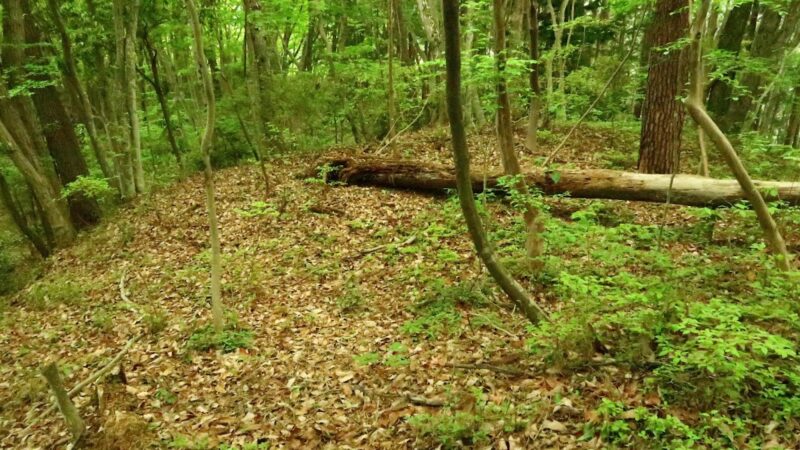
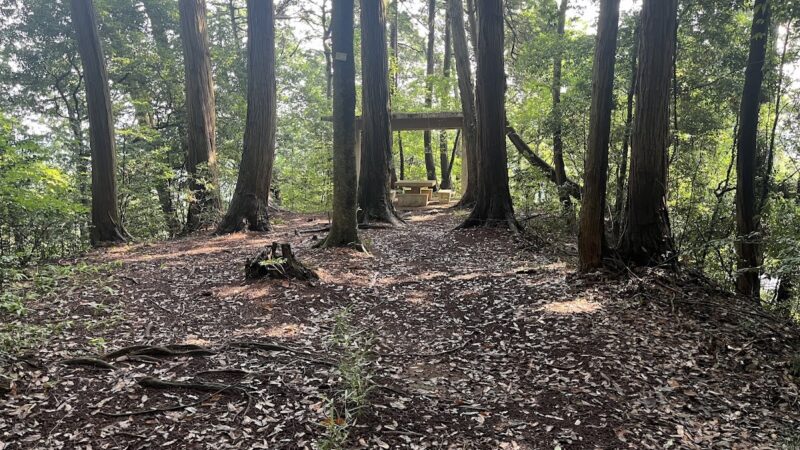
Each enclosure of Nagakura Castle remains clearly visible today, allowing you to see its flat surfaces and surrounding earthworks. The earthworks of the main enclosure, in particular, are remarkably well-preserved, retaining much of their original shape.
Walking through the enclosures, you can truly appreciate the spatial layout of a medieval castle. The size and arrangement of each enclosure allow you to imagine the castle’s function and how it was used.
Highlight 4: Nagakura’s Hackberry Tree (Prefectural Designated Natural Monument)
Near the castle is Nagakura’s Hackberry Tree, designated a natural monument of Ibaraki Prefecture. This tree is said to have been planted as a boundary tree within the territory of the Satake clan, the lords of Nagakura Castle, and at the time marked the boundary between Naka-go and Asatsuma-go.
Estimated to be several hundred years old, this hackberry tree is a living witness to the history of Nagakura Castle. We highly recommend visiting this tree when you visit the castle ruins.
Average Visiting Time and Difficulty
The average visiting time for Nagakura Castle is approximately 40-50 minutes. A visit focusing on the main enclosure takes about 30 minutes, while a detailed visit including the moats and outer baileys may take over an hour.
As it is a mountain castle, a certain level of physical fitness and comfortable clothing and shoes are necessary. Particular caution is needed when walking within the moats and on the slopes, as some areas can be slippery.
Access and Visiting Information
Access by Car
Nearest Interchange: Approximately 20km (30 minutes by car) from the Naka Interchange on the Joban Expressway.
From the Naka Interchange, take National Route 118 and a prefectural road to the Nagakura area of Hitachiomiya City. Using Sosenji Temple as a landmark will make it easier to find. There is no dedicated parking lot around the castle ruins, but there are a few parking spaces on the shoulder of the road.
Access by Public Transportation
Nearest Station: Approximately 10km from Hitachi-Omiya Station on the JR Suigun Line
Taking a taxi from Hitachi-Omiya Station is convenient. The journey takes approximately 15-20 minutes. Since the number of local buses is limited, it is recommended to check the timetable in advance.
Points to Note When Visiting
- Clothing: As it is a mountain castle, comfortable clothing and non-slip shoes (such as trekking shoes) are recommended.
- Season: Spring to autumn is suitable for visiting, but in summer, the vegetation can be overgrown, making it difficult to see the remains.
- Equipment: Bringing drinking water, insect repellent, and a bear bell is recommended.
- Weather: The ground can become slippery during and after rain, so avoid visiting or exercise extreme caution.
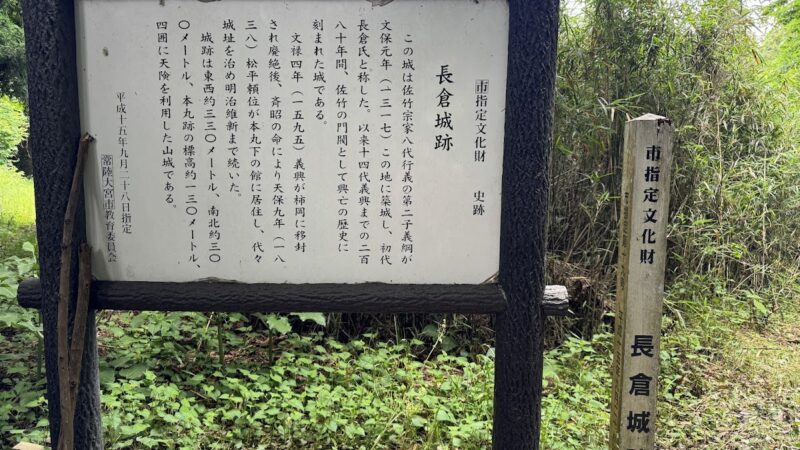
- Information: While there are information boards, reviewing materials such as a map of the castle layout beforehand will deepen your understanding.
Related Historical Sites in the Surrounding Area
Nagakura Jinya Ruins
At the southern foot of Nagakura Castle lies the Nagakura Jinya Ruins from the late Edo period. Built in 1838 by Matsudaira Yoriyoshi at the command of Tokugawa Nariaki, the lord of the Mito domain, it is from a different era than Nagakura Castle, but it is an important historical site for understanding the history of the Nagakura area.
Noguchi Castle and Noda Castle
Around Nagakura Castle are other castles associated with the Satake clan, such as Noguchi Castle and Noda Castle. These castles also retain medieval remains, and visiting them together with Nagakura Castle allows for a comprehensive understanding of the medieval castles in this region.
Gozenyama (Hitachiomiya City)
Nagakura Village, to which Nagakura Castle once belonged, merged with Gozenyama Village in 1956 (Showa 31). The Gozenyama area has many other medieval historical sites, making it an attractive area for historical walks.
Nagakura Castle Ratings and Reviews
In the castle enthusiast community “Kojodan,” Nagakura Castle has an average rating of 2.86 points (out of 5 points) based on 15 ratings. Visitors have offered the following feedback:
- “The scale of the vertical moats is magnificent, making it one of the finest historical remains in Ibaraki Prefecture.”
- “The castle walls around the main enclosure are clearly visible, providing a good understanding of the structure of a medieval mountain castle.”
- “Access is somewhat inconvenient, but it’s well worth the visit.”
- “The remains are well-preserved and suitable for photography.”
Many visitors particularly praise the scale and impressive nature of the vertical moats. However, some have pointed out the lack of signage and the difficulty of visiting during overgrown seasons.
Recommended Photography Spots at Nagakura Castle
When visiting Nagakura Castle, the following points are recommended for photography:
- Photography from inside the vertical moat: Capture the towering earthworks on both sides.
- Angle looking up at the main castle wall from the lower enclosure: Express the imposing presence of the 8-meter-high castle wall.
- View from the main enclosure: Capture the surrounding terrain and scenery.
- Details of the earthworks: Record the cross-section and shape of the well-preserved earthworks.
- Panoramic view of the moat: Capture an overhead view of the moat structure that demarcates the enclosure.
A wide-angle lens is effective for capturing the expanse of the vertical moat and castle wall. Also, the morning light makes the remains stand out three-dimensionally, so a morning visit is recommended for photography.
Reference Materials for Learning About Nagakura Castle
If you would like to learn more about Nagakura Castle, the following resources may be helpful:
Books and Documents
- “Medieval Castles and Residences of Ibaraki Prefecture” (Ibaraki Prefectural Board of Education)
- “Comprehensive Survey of Japanese Castles, Volume 3: Ibaraki, Tochigi, and Gunma” (Shin Jinbutsu Oraisha)
- “History of Hitachiomiya City” (Hitachiomiya City)
- Articles related to Nagakura Castle in various castle research journals
Websites
- Kojodan: Contains numerous visitor photos and reviews
- Jokaku Hourouki: Detailed layout maps and photos are helpful
- Hitachiomiya City Official Website: Basic information on the city’s historical sites can be found
- Ibaraki Prefectural Board of Education: Information on related cultural properties such as Nagakura’s hackberry tree is available
Obtaining a Layout Map
Obtaining a layout map before your visit will significantly deepen your understanding on-site. Referencing diagrams published on castle-related websites and in books is recommended. ## Summary: The Charm and Significance of Visiting Nagakura Castle
Nagakura Castle, a medieval mountain castle remaining in Hitachiomiya City, Ibaraki Prefecture, possesses high historical and academic value in the following respects:
- History of the Satake Clan: As the base of the Nagakura clan, a branch of the powerful Satake clan of Hitachi Province, it is important for understanding local history.
- One of Ibaraki Prefecture’s Best Vertical Moats: The continuous series of massive vertical moats, each over 10 meters wide, is rare in the prefecture, allowing visitors to experience the defensive techniques of medieval castles.
- Well-Preserved Remains: Various remains, such as the main enclosure, second enclosure, lower enclosure, earthworks, and moats, remain clearly visible, making it easy to understand the overall structure of the castle.
- Border Castle: Located on the border between Naka-go and Asatsuma-go, it played a historical role as a base for territorial control.
Nagakura Castle is not a famous tourist attraction, but precisely because of this, it is a valuable historical site where you can quietly experience the atmosphere of the Middle Ages. This is a recommended spot not only for castle enthusiasts, but also for those interested in history and those who enjoy hiking in nature.
When visiting northern Ibaraki Prefecture, be sure to visit Nagakura Castle. Witnessing the massive vertical moats will leave you amazed by the civil engineering skills and defensive ingenuity of the people of the Middle Ages. Examining the ruins on-site and reflecting on the era in which the Satake clan flourished will surely be a fulfilling historical experience.
When visiting, please be sure to take safety precautions and observe proper etiquette to preserve this valuable cultural heritage for future generations. Nagakura Castle is a vital “living textbook” that conveys the history of the Middle Ages to us.