History and Remains of Gongendo Castle (Namie Town, Fukushima Prefecture) | Transition from the Residence of the Shioya Clan to a Branch Castle of the Soma Clan
Overview and Location of Gongendo Castle
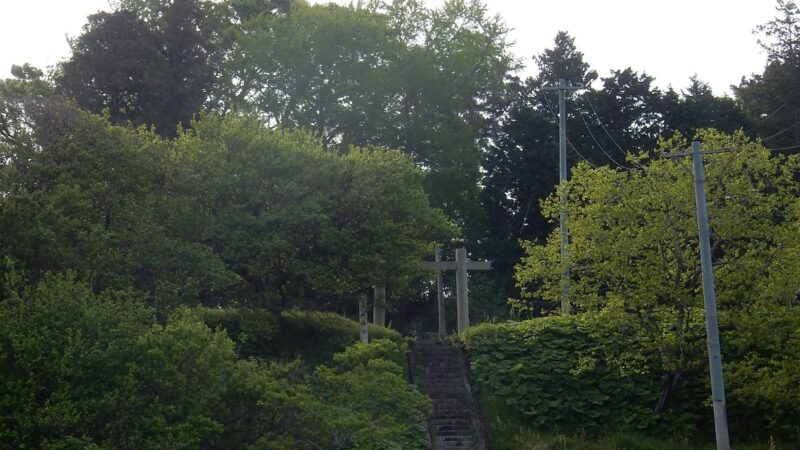
Gongendo Castle was a medieval flatland castle located in Nishidaidate, Namie Town, Futaba District, Fukushima Prefecture (Shioya District, Mutsu Province). Situated on the north bank of the Ukedo River, it was built on a hill approximately 20 meters high at the tip of a tongue-shaped plateau extending from west to east.
The castle was built by the Shioya clan, who ruled Shioya District (present-day northern Futaba District), and later became an important base for defending the south as a branch castle of the Soma clan. Two baileys and two trenches remain well-preserved today, making them valuable remains for understanding the structure of medieval castles.
Geographical Characteristics
Gongendo Castle’s location was a strategic point, with the Ukedo River, a natural defensive line, to its south. By utilizing the tip of the plateau, a robust defensive system was constructed, protected on three sides by natural cliffs. This topographical advantage is believed to be the primary reason the Shioya clan chose this location for their castle.
As a typical example of medieval castles in the Hamadori region of Fukushima Prefecture, it features a layout that skillfully utilizes the terrain. Although the relative elevation is not particularly high, the combination of steep slopes, dry moats, and earthworks ensured sufficient defensive capabilities.
The History of the Shioya Clan and the Construction of Gongendo Castle
The Establishment and Expansion of the Shioya Clan
The Shioya clan was a medieval samurai group based in Shioya County, Mutsu Province. While said to be a branch of the Soma clan, they controlled the entire Shioya County area as an independent force. The Shioya clan’s retainers were known as the “Shioya Six Knights and Seven Men,” forming a strong organization that supported their lord.
The Shioya clan initially had a residence in Ukedo, but as conflicts with surrounding forces intensified during the Sengoku period, they felt the need for a more defensible castle.
Construction during the Bun’an Era
The construction of Gongendo Castle is believed to have been carried out by Shioya Kiyotaka during the Bun’an era (1444-1449). This period corresponds to the mid-Muromachi period, a time when the Sengoku period-like atmosphere was intensifying in the Tohoku region.
Shioya Kiyotaka moved his base from his residence in Ukedo to the more defensible Gongendo Castle to prepare for conflicts with surrounding forces such as the Soma and Iwaki clans. The fact that Kiyotaka’s name is recorded as the builder suggests that this castle was a symbol of the strengthening of the Shioya clan’s power base.
The Soma Clan’s Invasion and the Fall of Gongendo Castle
Conflict Between the Shioya and Soma Clans
As the Sengoku period began, the Shioya clan engaged in fierce conflict with the Soma clan to the south and the Iwaki clan to the southwest. The conflict with the Soma clan was particularly serious, with ongoing struggles over control of Shioya County.
The Soma clan gradually expanded its power and began invading Shioya territory. The Shioya clan fought bravely with the support of a powerful group of retainers known as the “Shioya Six Knights and Seven Generals,” but the Soma clan’s military pressure intensified year by year.
Fall Due to Internal Betrayal
The fall of Gongendo Castle was not only due to external attacks, but also decisively due to internal betrayal. Members of the Shioya clan and their retainers defected to the Soma clan, causing the castle’s defenses to collapse from within.
Due to this betrayal, even the formidable Gongendo Castle could not escape its fall. With the fall of the Shioya clan, Gongendo Castle fell into the hands of the Soma clan and came under their control.
Gongendo Castle as a Soma Clan Branch Castle
Positioning within the Soma Clan’s Castle System
After the fall of the Shioya clan, Gongendo Castle was reorganized as a branch castle of the Soma clan. To control its vast territory, the Soma clan built a castle network with branch castles located throughout the region, and Gongendo Castle became an important base for defending its southern territory.
From the perspective of Nakamura Castle (Soma City), the Soma clan’s main base, Gongendo Castle functioned as a frontline castle against the Iwaki and Date clans to the south. It is possible that the castle’s structure was also modified during this period.
The Battle of Sekigahara and the Abandonment
It is believed that Gongendo Castle was abandoned around the time of the Battle of Sekigahara (1600). During this period, castle consolidation and abolition progressed nationwide, and many medieval castles were abandoned.
It is presumed that the Soma clan also adopted a policy of consolidating the castles within their territory into major strongholds. Gongendo Castle was likely abandoned because its strategic importance declined, or because it was difficult to convert it into a modern castle. While the year of its abandonment is generally believed to be during the Keicho era, historical records are limited regarding the exact date.
Structure and Remains of Gongendo Castle
Characteristics of the Castle Structure
Gongendo Castle is classified as a flatland castle and is a typical example of a medieval castle lacking a keep. The tip of a tongue-shaped plateau is divided north-south by two dry moats, creating two main enclosures.
The castle’s structural features are as follows:
- Main Enclosure: Located at the very tip of the plateau, it was the most important defensive stronghold.
- Second Enclosure: Located behind (to the west of) the main enclosure, it supported the main enclosure.
- Dry Moat: Two dry moats clearly demarcated the enclosures, preventing enemy intrusion.
- Earthwork: Earthworks surrounded the enclosures, enhancing their defensive capabilities.
Existing Remains
Currently, the following remains are well-preserved at the Gongendo Castle site:
Dry Moat (Dry Moat)
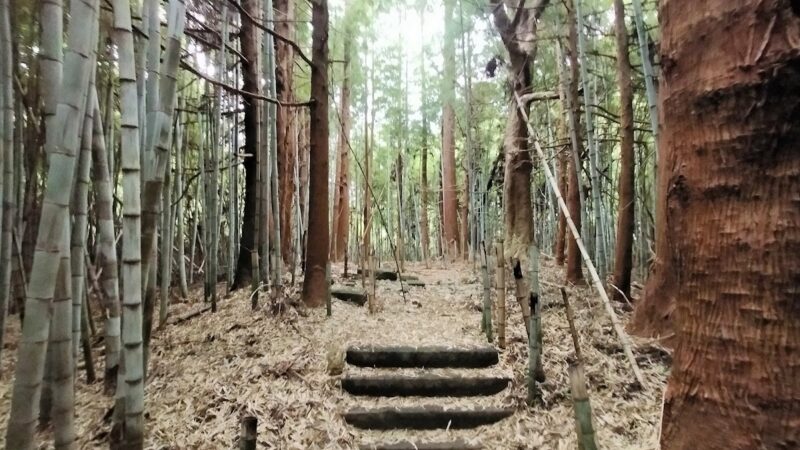
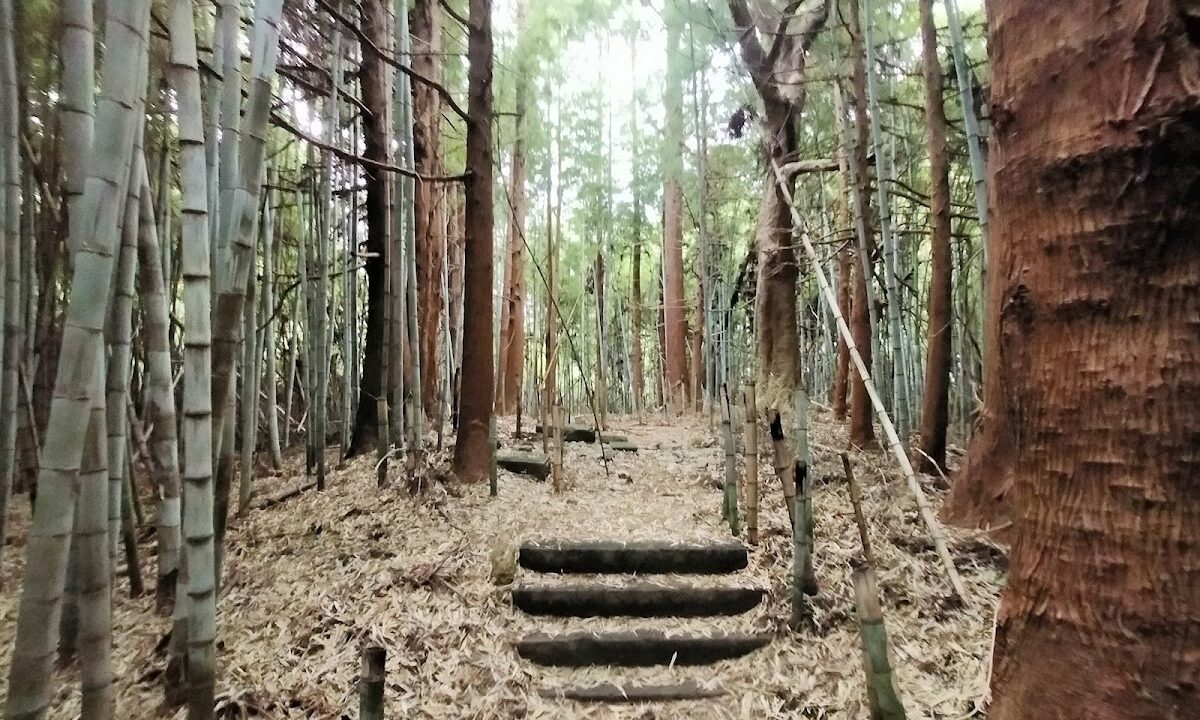
Two dry moats, the castle’s most important defensive structure, are still clearly visible. They are dug to cut across the plateau from north to south, and their depth and width demonstrate the high level of defensive technology at the time. The scale and shape of the dry moats provide a concrete understanding of medieval castle layout techniques.
Earthwork
Earthworks surrounded the enclosures, some of which still retain their height. The earthworks are thought to have been constructed by piling up the soil excavated from the dry moats, demonstrating the use of efficient castle-building techniques. Traces of earthworks have also been found in the outer enclosure, suggesting the existence of multiple defensive lines.
Enclosure Layout
The two enclosures are positioned to maximize the use of the plateau’s topography. Each enclosure has a relatively large flat area, providing ample space for buildings and troop encampments. Earthworks surround the edges of the enclosures, serving both defensive and surveillance functions.
Characteristics of the Castle Layout
The layout of Gongendo Castle exhibits typical characteristics of medieval castles. Within the topographical constraints of its location on the tip of a plateau, the design maximizes the use of limited space.
The division by the two trenches is based on the concept of “depth defense,” which progressively prevents enemy incursions. Even if the first trench is breached, the second trench provides further defense.
Traces of earthworks and small moats have been confirmed in the outer fortifications, suggesting that the castle grounds may have extended beyond the main and secondary enclosures. These outer fortifications are thought to have served to protect the castle town and supply facilities.
Shioya Clan Graves and Related Historical Sites
Shioya Clan Burial Grounds
Surrounding Gongendo Castle are historical sites related to the Shioya clan. In particular, the Shioya clan’s gravestones are valuable cultural assets that convey the family’s history. These gravestones indicate that the Shioya clan was a powerful force deeply rooted in the region.
The style and arrangement of the gravestones suggest that the Shioya clan valued Buddhist faith and protected temples that commemorated their family members. They are important historical materials for understanding the faith and funeral culture of medieval samurai groups.
Ukedo Manor Site
Ukedo Manor, which served as the Shioya clan’s base before the construction of Gongendo Castle, is also a historically important site. While the exact location and size of the castle site remain largely unknown, research is progressing on it as an early base of operations for the Shioya clan.
The relocation of the base from Ukedo to Gongendo reflects the Shioya clan’s expansion of power and the need to strengthen its defenses. It is expected that clarifying the relationship between the two bases will provide a clearer picture of the Shioya clan’s development.
Archaeological Survey and Cultural Property Designation
Results of Excavation Surveys
Archaeological surveys have been conducted at the Gongendo Castle site, and the results are published in databases such as the “National Archaeological Site Report Directory.” The surveys are accumulating scientific data regarding the castle’s structure and period of use.
Excavated artifacts include ceramics and fragments of weapons dating from the Muromachi to Sengoku periods, providing important information that complements documentary sources.
Value as a Cultural Property
The Gongendo Castle site is recognized as an important cultural property of Namie Town, Fukushima Prefecture. Classified as a “castle/fortified residence,” its main historical period is considered to be the “Muromachi period” and “Medieval period (details unclear).”
In addition to being designated as a cultural property at the municipal level, this site should be considered for broader regional designation in the future. As a historical heritage site in a region affected by the Great East Japan Earthquake and the nuclear accident, its importance is increasing from both preservation and utilization perspectives.
Access and Visiting Information for Gongendo Castle
Location and Transportation Access
Location: Nishidaidate, Namie-machi, Futaba-gun, Fukushima Prefecture
Access by Train:
The nearest station is Namie Station on the JR Joban Line. It’s about a 10-minute drive from the station. Public transportation is limited, so using a rental car or taxi is recommended.
Access by Car:
It’s about a 15-minute drive from the Namie Interchange on the Joban Expressway. The castle ruins can be accessed from the road along the Ukedo River.
Points to Note When Visiting the Gongendo Castle Ruins
Please note the following points when visiting the Gongendo Castle Ruins:
Estimated Visit Time: The average visit time is about 30 minutes. If you wish to carefully observe the remains, it is recommended to allow about an hour.
Difficulty of Visit: Although it is a hill with a relative elevation of about 20 meters, some walking is necessary to see the remains. We recommend visiting in comfortable shoes and clothing.
Highlights: The two dry moats and earthworks are the main highlights. You can experience the defensive structure of a medieval castle firsthand, including the scale and shape of the moats and the height of the earthworks. The relationship between the layout of the enclosures and the terrain is also a point of interest.
Related Historical Sites in the Surrounding Area
Visiting the following related historical sites in conjunction with a visit to Gongendo Castle will provide a deeper understanding of the history of the Shioya and Soma clans:
- Shioya Clan-related tombstones
- Historical sites in the Ukedo area
- Other castles of the Soma clan (e.g., Nakamura Castle)
There are many other medieval historical sites scattered throughout Namie Town, which can be visited as part of a regional history exploration route.
Situation and Preservation Challenges After the Great East Japan Earthquake
Impact of the Earthquake and Nuclear Accident
The Great East Japan Earthquake and the Fukushima Daiichi Nuclear Power Plant accident in March 2011 had a devastating impact on the entire town of Namie. Gongendo Castle ruins were included in the evacuation zone for a period, making research and preservation activities difficult for a long time.
Even after the lifting of the evacuation order, efforts to protect cultural properties remain limited due to population decline and the priority given to reconstruction projects. However, the importance of Gongendo Castle ruins as a regional historical heritage site remains unchanged, and efforts for preservation and utilization continue.
Future Preservation and Utilization
The following are challenges and possibilities for the preservation of the Gongendo Castle ruins:
Preservation Challenges:
- Weathering of remains and erosion by vegetation
- Securing research and maintenance budgets
- Difficulty in maintenance due to declining local population
Possibilities for Utilization:
- Utilization as a historical heritage site as a symbol of reconstruction
- Development as an educational resource
- Strengthening information dissemination as a tourist resource
As a valuable historical site for understanding the medieval history of the Hamadori region of Fukushima Prefecture, the preservation and utilization of the Gongendo Castle ruins are also of great importance for maintaining the region’s cultural identity.
Historical Significance and Current Research Status
Position in Medieval Tohoku History
Gongendo Castle is an important historical site for understanding the political and military history of the Tohoku region in the medieval period. It serves as a concrete example illustrating the rise and fall of the Shioya clan, a local samurai group, the process of the Soma clan’s expansion, and the realities of power struggles in the Tohoku region during the Sengoku period.
In particular, the transfer of power from the Shioya clan to the Soma clan symbolizes the reorganization of regional powers during the Sengoku period. The fact that the castle fell due to internal defection reflects the complex interpersonal relationships and power structures within the samurai groups of the time.
Value in Castle Research
From the perspective of castle history, Gongendo Castle has research value as a typical example of a medieval hilltop castle. It is featured in fundamental texts such as “The Complete Guide to Japanese Castles,” and is one of the key sites for understanding medieval castles in the Tohoku region.
Basic castle construction techniques of the medieval period, such as the division by two moats, the arrangement of earthworks, and the utilization of the terrain, are well preserved. These remains provide valuable physical evidence for understanding the reality of medieval castles, for which written historical sources are limited.
Future Research Issues
Regarding Gongendo Castle, the following research issues remain:
- Refinement of the Construction Date: While the general period of the Bun’an era is known, a more precise determination of the construction date is needed.
- Complete Clarification of the Castle Structure: Detailed investigation of the outer fortifications other than the main and second baileys.
- Clarification of the Shioya Clan’s Reality: Research on the Shioya clan’s genealogy, retainer structure, and economic base.
- Renovations under the Soma Clan: Whether and what renovations were made to the castle under Soma rule.
- Clarification of the Abandonment Process: The precise date of abandonment and subsequent land use.
By addressing these issues, it is expected that the history of Gongendo Castle and the Shioya clan will become clearer, and our understanding of medieval Tohoku history will deepen.
Summary
Gongendo Castle is a medieval flatland castle located in Namie Town, Fukushima Prefecture, built by the Shioya clan during the Bun’an era (1444-1449). Located on a tongue-shaped plateau on the north bank of the Ukedo River, Gongendo Castle was a formidable fortress with two dry moats and earthen ramparts as its main defensive features.
The Shioya clan ruled Shioya County, supported by a group of retainers known as the “Shioya Six Knights and Seven Generals.” However, due to the invasion of the Soma clan and internal defection within the clan, Gongendo Castle fell. Afterward, it served as a branch castle of the Soma clan, responsible for defending the south, but was abandoned around the time of the Battle of Sekigahara.
Even today, the remains of the castle, including two baileys, two moats, and earthen ramparts, are well-preserved, making it a valuable historical site for understanding the structure of medieval castles. Despite being located in an area affected by the Great East Japan Earthquake and the nuclear accident, efforts to preserve and utilize it as a regional historical heritage continue.
The Gongendo Castle ruins are an important site for studying the political and military history, castle history, and regional history of the Tohoku region during the medieval period, and further investigation and research are expected.