Complete Guide to Iwaseyama Castle (Fukushima Prefecture): From the Nikaido Clan’s Base to its Fortified Residence
Iwaseyama Castle, built on Atagoyama Mountain in Sukagawa City, Fukushima Prefecture, was an important base for the Nikaido clan, who ruled the Sukagawa region from the medieval period to the Sengoku period. Currently, it is maintained as Midorigaoka Park, a place of relaxation for citizens, but remnants of the Sengoku period still remain scattered throughout the site. This article provides a detailed explanation of Iwaseyama Castle’s history, structure, highlights, and access methods.
Basic Information on Iwaseyama Castle
Iwaseyama Castle is a flatland castle located on Atagoyama Mountain in Sukagawa City, Fukushima Prefecture. Built on a hill 278 meters above sea level with a relative height of approximately 30 meters, it occupies a strategic location overlooking the city of Sukagawa.
Other names include Atagoyama Castle, Biwakubi-kan, Moriya-kan, and Sukagawa Old Castle. These names originate from the castle’s location and historical background.
Castle Classification: Hilltop Castle
Construction Period: Late Kamakura Period (Late 13th to Early 14th Century)
Builder: Nikaido Yukitomo
Main Lord: Nikaido Clan
Year of Abandonment: Tensho Era (Around 1590)
Remains: Earthworks, baileys, moats, enclosures
Current Status: Midorigaoka Park
History of Iwaseyama Castle
Entry of the Nikaido Clan and Construction
The history of Iwaseyama Castle dates back to the late Kamakura period. It is said that Nikaido Yukitomo entered Iwase District in Mutsu Province as a local administrator and built a castle in this area. The Nikaido clan was a powerful retainer of the Kamakura Shogunate, and their family settled in Oshu after acquiring territory there.
The Nikaido clan originally served in the central government of the Kamakura shogunate, holding important positions such as chief administrator of the Mandokoro (administrative office). A branch of this family moved to Mutsu Province and expanded their power, establishing their base in Iwase District.
As the Nikaido Clan’s Base
From its construction through the Muromachi period, Iwaseyama Castle functioned as the Nikaido clan’s base. Located on a hill overlooking the Sukagawa plain, the castle played a crucial role as the center of their territorial management.
The Nikaido clan used this base to strengthen their control over the surrounding areas. The Iwase District area boasted fertile plains and high agricultural productivity. With this economic foundation as a backdrop, the Nikaido clan gradually expanded their power.
Relocation of the Base to Sukagawa Castle
In the mid-Muromachi period, the Nikaido clan moved their base from Iwaseyama Castle to Sukagawa Castle. Sukagawa Castle was located near a plain, allowing for a larger fortress. It’s likely that Sukagawa Castle, being closer to the plains, was more convenient as a political and economic center.
However, Iwaseyama Castle was not abandoned; it continued to function as a fortified outpost for Sukagawa Castle. A fortified outpost is a final defensive stronghold, used when the main castle is under attack. As a mountain castle, Iwaseyama Castle was better suited for defense than the flatland castle of Sukagawa Castle, and was therefore maintained as a place of refuge in emergencies.
Iwaseyama Castle in the Sengoku Period
With the arrival of the Sengoku period, the Nikaido clan became embroiled in conflicts with surrounding daimyo. Their relationship with the Date clan, who were expanding their power from the north, was particularly important.
Initially, the Nikaido clan maintained friendly relations with the Date clan, including marriage alliances. However, the situation changed dramatically during the time of Date Masamune. Masamune rapidly expanded his power, aiming for hegemony in Oshu, and successively conquered surrounding forces.
Conquest by Date Masamune
In 1589 (Tensho 17), Date Masamune attacked Sukagawa Castle, the stronghold of the Nikaido clan. This battle is known as the “Battle of Sukagawa” or the “Battle of Kubota.”
Nikaido Moriyoshi, the head of the Nikaido clan, resisted the Date clan’s invasion, but was defeated by the overwhelming difference in military strength. With the fall of Sukagawa Castle, it is believed that Iwaseyama Castle also fell into the hands of the Date clan. This battle marked the end of the Nikaido clan, who had ruled this region since the Kamakura period.
Oshu Settlement and the Rule of Gamo Ujisato
In 1590 (Tensho 18), Toyotomi Hideyoshi carried out the “Oshu Settlement.” This was a policy to reorganize the various daimyo of Oshu after the Siege of Odawara, and Date Masamune also suffered a significant reduction in his territory. As a result of this pacification of Oshu, Iwase District, including Sukagawa, became part of the territory of Gamo Ujisato. Gamo Ujisato was a powerful daimyo based in Aizu-Wakamatsu, and the Sukagawa region came under his control.
It is believed that around this time, Iwaseyama Castle ceased to function as a military base and was abandoned. In the Edo period, Sukagawa became part of the Nihonmatsu Domain, but Iwaseyama Castle was never reused.
Layout and Structure of Iwaseyama Castle
Location and Utilization of Topography
Iwaseyama Castle is built on Atagoyama, located in the southeastern part of Sukagawa city. Its location, at an elevation of 278 meters and a relative height of approximately 30 meters, provides ideal conditions for a flatland castle.
The north and west sides of the castle have steep slopes, forming a natural stronghold. On the other hand, the south and east sides have relatively gentle slopes, and artificial defensive structures were built to prepare for invasions from these sides.
From the mountaintop, one could see the city of Sukagawa and the surrounding plains, making it an ideal location for monitoring enemy movements. The Abukuma River system was also visible, making it suitable for monitoring transportation routes.
Main Enclosure and Enclosure Layout
The central part of Iwaseyama Castle is the main enclosure located on the mountaintop. The main enclosure is a relatively large, flat area, and it is believed that a residence and important facilities were located there.
Surrounding the main enclosure are several enclosures (kuruwa) arranged in a stepped pattern. These enclosures were military facilities designed to defend the main enclosure, functioning as garrisons for soldiers and storage areas for supplies.
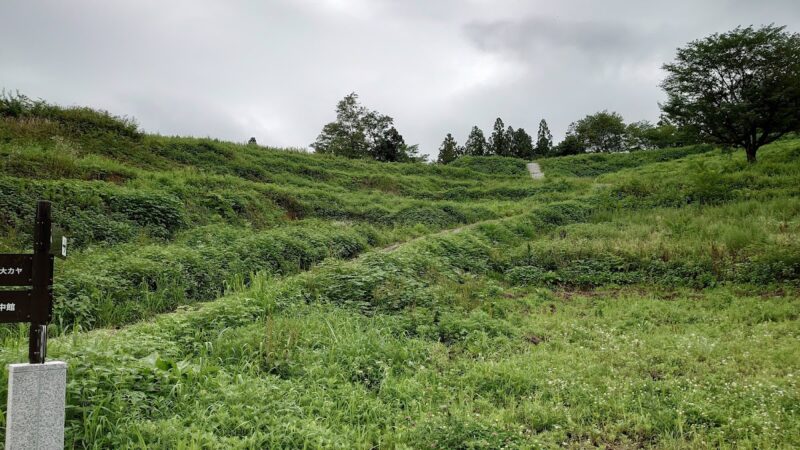
The layout of the enclosures cleverly utilizes the terrain, taking advantage of natural elevation differences to enhance defensive capabilities. In particular, the south and east sides feature multiple terraces, demonstrating a design intended to make enemy intrusion difficult.
Earthworks and Moats
Earthworks and moats played a crucial role as defensive structures at Iwaseyama Castle.
Earthen ramparts are defensive structures built by constructing mounds of earth along the edges of enclosures. They served to prevent enemy intrusion and also provided protection from arrows and gunfire. Some earthen ramparts still remain today, offering insights into the defensive structures of the time.
Dry moats are dry moats dug to cut across ridges. They effectively blocked enemy access routes, making it difficult to approach the castle. At Iwaseyama Castle, it is believed that dry moats were particularly constructed along the southern ridge.
Entrance and Ascent Route
The entrance (koguchi) to the castle was one of the most important defensive structures. The entrance was not merely an entrance; it incorporated various ingenious features to deter enemy intrusion.
While the exact structure of Iwaseyama Castle’s entrance is unclear, based on examples of typical medieval mountain castles, it is possible that techniques such as staggered entrances or square-shaped entrances were used.
The path leading to the castle, from the foot of the mountain to the main enclosure, was intentionally designed with curves and steep slopes for defensive purposes.
Existing Remains and Highlights
Current Status as Midorigaoka Park
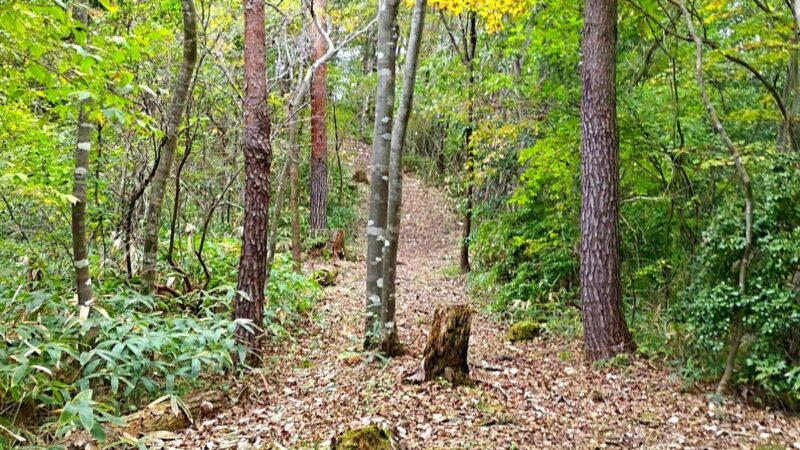
Currently, the Iwaseyama Castle ruins have been developed into Midorigaoka Park, a place of relaxation for the citizens of Sukagawa. Walking paths are maintained within the park, allowing visitors to easily explore the castle ruins.
While some remains have been altered due to the park’s development, the basic structure of the castle remains remains. Those interested in history can enjoy exploring while imagining the castle’s appearance in its heyday.
Status of Earthworks
The earthworks are the best-preserved remains of Iwaseyama Castle. Clear earthworks can be seen, especially around the main enclosure.
The height of the earthworks varies depending on the location, but in some places they are about 1-2 meters high. Although they have been lowered by weathering and collapse over many years, they still allow one to appreciate the scale of the defensive facilities at the time.
Walking along the top of the earthworks and looking down into the inner baileys from there makes the castle’s structure easier to understand.
Topography of the Baileys
The arrangement of multiple baileys in a stepped pattern is still clearly visible in the topography today. The flat areas of each bailey are used as park plazas and walking paths.
The differences in elevation between the baileys indicate the defensive lines of the time. By observing these differences in elevation, you can understand how the castle was defended.
Traces of Moats
The remains of moats are not as clear as those of the earthworks, but some can be identified with careful observation. In particular, there are unnatural depressions and steps along the ridge, which may be traces of moats.
Moats are structures that tend to become unclear over time due to filling in or collapse, but their existence can be estimated by paying attention to subtle changes in the topography.
Excellent Views
The view from Iwaseyama Castle Ruins (Midorioka Park) is magnificent, offering a panoramic view of Sukagawa city. On a clear day, you can see as far as Mount Adatara and the Nasu mountain range.
This magnificent view speaks to the castle’s value as a military surveillance base. Imagining the castle lord and soldiers watching the surrounding movements from this spot during the Sengoku period evokes a sense of historical romance.
Atago Shrine
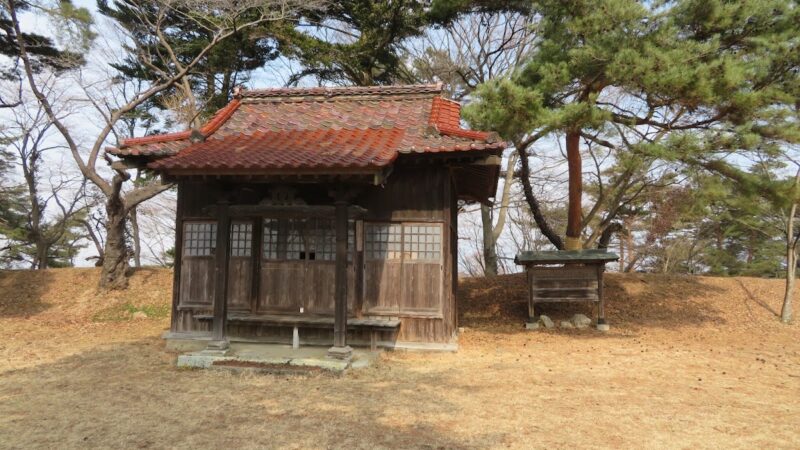
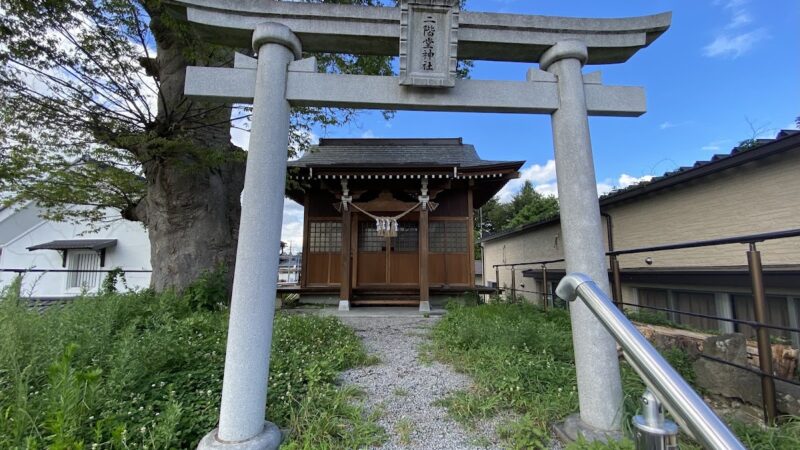
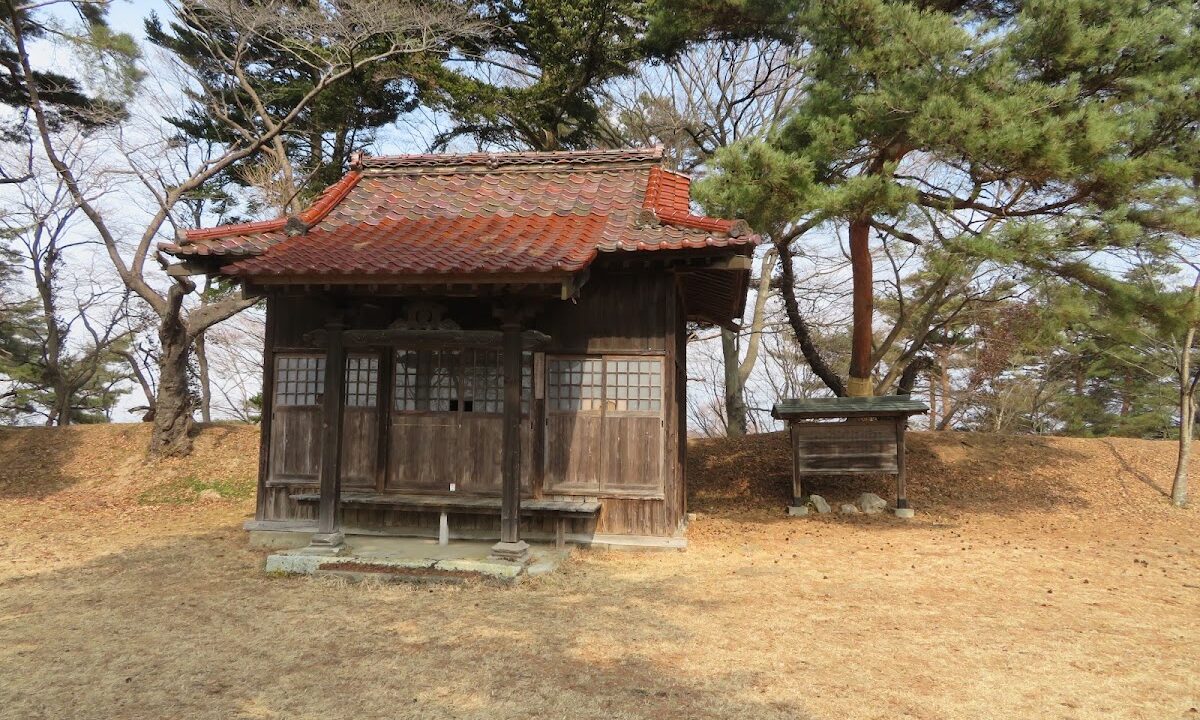
Atago Shrine is located on the castle ruins. Atago worship is widely practiced as a god of fire prevention, and it was often enshrined as the guardian deity of castles.
The exact date of the current Atago Shrine’s founding is unknown, but it’s possible that some kind of religious facility existed there during the time the castle was still in use. The area around the shrine is also part of the castle ruins, allowing visitors to enjoy observing the remains while paying their respects.
Related Historical Sites in the Surrounding Area
Sukagawa Castle Ruins
Sukagawa Castle was closely related to Iwaseyama Castle. It was located in the center of Sukagawa City, around the current Sukagawa City Hall.
Sukagawa Castle was the castle where the Nikaido clan moved their base from Iwaseyama Castle, and it developed as a flatland castle. Currently, due to urbanization, very few remains are left, but traces of earthworks and moats can be seen in some areas.
An explanatory sign is installed at the Sukagawa Castle site, where you can learn about the history of the Nikaido clan and the castle’s structure. Visiting both Sukagawa Castle and Iwaseyama Castle will give you a deeper understanding of the Nikaido clan’s castle system.
Temples and Shrines Related to the Nikaido Clan
Several temples and shrines associated with the Nikaido clan remain in Sukagawa City.
Choroku-ji Temple is known as the Nikaido clan’s family temple. Within the temple grounds are gravestones and memorial towers related to the Nikaido clan, allowing you to reflect on the family’s history.
Furthermore, Kamitakikan Shrine was a shrine revered by the Nikaido clan and was considered important as a protector against evil influences from the castle’s northeast direction. Visiting these temples and shrines will allow you to experience the cultural aspects of the Nikaido clan that cannot be seen from the castle alone. ### Other Medieval Castles in Fukushima Prefecture
Besides Iwaseyama Castle, many other medieval castles remain in Fukushima Prefecture.
Aizu-Wakamatsu Castle (Tsuruga Castle) is a famous castle extensively renovated by Gamo Ujisato, and its keep has now been restored. It was the base of Gamo Ujisato, who brought Iwaseyama Castle under his control after the pacification of Oshu, and is a castle with deep historical ties.
Shirakawa Komine Castle is a flatland castle located south of Sukagawa and was the residence of the Shirakawa Yuki clan. It had close ties with the Nikaido clan, and at one point was an alliance during the Sengoku period.
Miharu Castle was the residence of the Tamura clan and is known as the birthplace of Ai-hime, the principal wife of Date Masamune. It was a neighboring force to the Nikaido clan, and had a complex relationship of sometimes allies and sometimes conflicts.
Mukaihaguroyama Castle is a large mountain castle built by the Ashina clan of Aizu, boasting one of the largest scales in the Tohoku region. Comparing this castle to Iwaseyama Castle, which showcases the pinnacle of castle construction technology in the Tohoku region during the Sengoku period, offers some fascinating discoveries.
Visiting these castles will deepen your understanding of the Sengoku period history and castle history of Fukushima Prefecture.
Access Information
Access by Public Transportation
JR Tohoku Main Line, Sukagawa Station is the nearest station. The distance from the station to the Iwaseyama Castle ruins (Midori-ga-oka Park) is approximately 2 kilometers.
Walking from the station takes about 25-30 minutes. The route through the city to the park is relatively flat and easy to walk.
If using a taxi, take one from the station and arrive in about 5 minutes. The fare is approximately 1,000 yen.
There are buses circulating within Sukagawa city, but the number of services is limited, so it is recommended to check the timetable in advance.
Access by Car
Access by car is the most convenient.
If using the Tohoku Expressway, exit at the Sukagawa Interchange. It’s about a 10-minute drive from the interchange to the Iwaseyama Castle Ruins.
The park is also accessible via National Route 4, passing through Sukagawa city center.
Midori-ga-oka Park has a free parking lot. It can accommodate several dozen cars and is usually not crowded, but it may get busy during peak tourist seasons such as cherry blossom season.
Estimated Visiting Time
A quick stroll through the Iwaseyama Castle Ruins (Midori-ga-oka Park) takes about 30 minutes, while a more thorough visit, including observing the remains, will take approximately 1 to 1.5 hours.
Including time for photography and enjoying the views, allow about 2 hours for a comfortable visit.
Notes for Visitors
Midori-ga-oka Park is always open, and admission is free. However, due to limited lighting at night, daytime visits are recommended.
The walking paths are well-maintained, but there are some steep slopes and stairs. Wearing comfortable shoes is recommended.
Caution is advised during and after rain, as the dirt paths can become slippery.
While there are toilets and rest facilities within the park, shops and vending machines are limited, so it’s a good idea to bring your own drinks.
Tips for Enjoying Iwaseyama Castle
Learn about the historical background before visiting
Before visiting Iwaseyama Castle, gaining some basic knowledge about the Nikaido clan and the history of the Sukagawa region during the Sengoku period will make your visit more fulfilling.
The Sukagawa City Museum has exhibits on the Nikaido clan and the history of Sukagawa; a visit before visiting the castle ruins is recommended. Learning about the historical background at the museum before visiting the castle ruins will allow you to more deeply understand the meaning and importance of the remains.
Bring a castle layout map
A castle layout map (a blueprint of the castle) is useful for understanding the structure of the castle. Printing out a map of the castle grounds available online or saving it on your smartphone will allow you to understand the overall layout of the castle while examining the remains on-site.
Seasonal Attractions
Iwaseyama Castle Ruins have different charms depending on the season.
Spring is known as a famous cherry blossom viewing spot, attracting many visitors. The combination of cherry blossoms in full bloom and the castle ruins is perfect for photography.
Summer is lush with greenery, and the earthworks and baileys are covered in vegetation, but the shade of the trees makes it cool and suitable for strolling.
Autumn is beautiful with its autumn foliage, further enhancing the atmosphere of the castle ruins. Additionally, the withered vegetation makes it easier to observe the remains.
Winter may make visits difficult due to snow, but the castle ruins in a snowscape also have their own charm.
Combining with Nearby Sightseeing
Sukagawa City has many other tourist attractions besides Iwaseyama Castle Ruins.
The Sukagawa City Museum features exhibits on the city’s history and culture, including information about the Nikaido clan and Sukagawa Castle.
Sukagawa Peony Garden is one of the leading peony viewing spots in the Tohoku region, offering beautiful peony blossoms in spring.
Taimatsu Akashi is a traditional event in Sukagawa City, held every November. This event has a historical background, with legends related to the downfall of the Nikaido clan.
Combining these tourist spots allows for a deeper experience of Sukagawa’s history and culture.
Historical Significance of Iwaseyama Castle
Importance in Nikaido Clan Research
Iwaseyama Castle is an important historical site for studying the history of the Nikaido clan, as it was one of their early bases. The Nikaido clan played a central role in the Kamakura Shogunate, and Iwaseyama Castle provides valuable clues to understanding their development in eastern Japan.
The Nikaido clan ruled this region for approximately 300 years, from the Kamakura period to the Sengoku period. Iwaseyama Castle marked the beginning of their long-term rule and can be considered the origin of the family’s history.
Position in the History of Castles in the Medieval Tohoku Region
Iwaseyama Castle is important in the study of castle history as a typical example of a flatland castle in the medieval Tohoku region.
Many medieval castles in the Tohoku region are mountain castles that skillfully utilize the terrain, and Iwaseyama Castle is a prime example. While equipped with basic defensive structures such as earthworks and moats, its relatively small size clearly demonstrates the characteristics of castles built by local powerful families.
Its function as an auxiliary castle to Sukagawa Castle in the late Sengoku period is also an interesting example for understanding the actual state of castle management at that time. The relationship between the main castle and its auxiliary castle is an important element in understanding the defensive strategies of the Sengoku period, and Iwaseyama Castle provides a concrete example of this.
Importance in Local History
Iwaseyama Castle played a central role in the history of the Sukagawa region. The rule of the Nikaido clan, based at this castle, had a significant impact on the region’s politics, economy, and culture.
The urban structure and cultural foundation of Sukagawa, formed during the Nikaido era, are still inherited by present-day Sukagawa City. Iwaseyama Castle can be considered one of the sources of this region’s historical identity.
Materials and Research on Iwaseyama Castle
Major Literary Sources
While historical materials on Iwaseyama Castle are limited, the following materials form the basis of research:
Military chronicles such as the *Oshu Eikei Gunki* and *Date Jike Kiroku* contain descriptions of the Nikaido clan and the Battle of Sukagawa, and also mention Iwaseyama Castle in fragments.
Geographical texts such as the *Shinpen Aizu Fudoki* and *Mutsu no Kuni Fudoki* contain descriptions of castles in the Sukagawa region.
Archaeological Investigation
While full-scale excavation has not been conducted at the Iwaseyama Castle site, the castle’s structure is gradually being revealed through surface observation and surveying.
Recent advances in castle research have led to the creation of layout maps and detailed analysis of remains. These research findings have been published in specialized castle research journals and local history research papers.
Related Books
The following books are recommended for learning about Iwaseyama Castle and the Nikaido clan:
- “Comprehensive Guide to Japanese Castles, Volume 3: Yamagata, Miyagi, and Fukushima” (Shin Jinbutsu Oraisha) comprehensively introduces castles in Fukushima Prefecture and includes information on Iwaseyama Castle.
- “Castles of Fukushima” (Rekishi Shunju Publishing) is a book that clearly explains castles in Fukushima Prefecture and includes numerous photographs and illustrations.
- “Medieval Castle Sites in Fukushima Prefecture” is a research report published by the Fukushima Prefectural Board of Education, containing detailed information on medieval castles in the prefecture.
These books are available at libraries and specialty bookstores.
Summary
Iwaseyama Castle is an important historical site indispensable to understanding the history of Sukagawa City, Fukushima Prefecture. This castle, which served as the stage for approximately 300 years of history, from the arrival of the Nikaido clan in the Kamakura period to its conquest by Date Masamune in the Sengoku period, is still a popular spot for citizens today as Midorigaoka Park.
The remains, such as earthworks and baileys, are well-preserved, making it a valuable place to experience the structure of a medieval castle firsthand. The panoramic view of Sukagawa city is also magnificent, allowing visitors to enjoy both historical and nature walks.
When visiting Sukagawa, be sure to visit the Iwaseyama Castle ruins and feel the glory of the Nikaido clan and the spirit of the Sengoku period. Visiting the nearby Sukagawa Castle ruins and the municipal museum in conjunction will allow you to understand Sukagawa’s history more deeply.
Fukushima Prefecture has many other fascinating castles. By visiting castles such as Aizu-Wakamatsu Castle, Shirakawa-Komine Castle, and Miharu Castle, each with its own unique characteristics, you can experience the rich history and culture of Fukushima Prefecture. Why not reflect on the history of the Tohoku region during the Sengoku period through a tour of these castles?