Komatsu Castle (Yamagata Prefecture) Complete Guide | A Thorough Explanation of History, Remains, Access, and Surrounding Sightseeing
Located in Kawanishi Town, Higashiokitama District, Yamagata Prefecture, Komatsu Castle is a historic castle site that functioned as an important branch castle of Yonezawa Castle from the Kamakura period to the Sengoku period. Built at a strategic point where the Echigo Road and Nagai Road intersected, this castle became the stage for numerous historical events under the rule of the Date clan. This article provides a detailed introduction to Komatsu Castle, including its history, existing remains, highlights, access methods, and surrounding sightseeing information.
History of Komatsu Castle
Founding and Initial Role in the Kamakura Period
Komatsu Castle was founded in the Kamakura period by Funayama Inaba-no-kami, a vassal of the Nagai clan. The Nagai clan was a powerful samurai group that ruled the Okitama region, and Komatsu Castle was built as an important base supporting their system of rule. Located at the intersection of two major highways, the Echigo Highway and the Nagai Highway, Komatsu Castle served as a strategic transportation hub and meeting place.
From its inception, Komatsu Castle is believed to have functioned not merely as a military facility, but also as a regional administrative and economic center. This strategic location laid the foundation for Komatsu Castle’s later role as an important branch castle of Yonezawa Castle during the Sengoku period (Warring States period).
The Sengoku Period and the Date Clan’s Rule
With the arrival of the Sengoku period, Komatsu Castle came under the control of the Date clan and became an important branch castle of Yonezawa Castle. In the process of controlling the Okitama region, the Date clan valued Komatsu as a transportation hub and appointed high-ranking retainers as castle lords.
The only recorded castle lord during the Date clan’s rule is Omachi Shuri-no-suke Sadatsugu. The Omachi clan was known as a senior retainer of the Date family, and serving as lord of Komatsu Castle demonstrated their high social standing. Subsequently, Komatsu Castle was also ruled by Kuwori Harima-no-kami Kagenaga and Makino Danjo Hisanaka, maintaining its status as an important base for the Date family.
The Tenbun Rebellion and the Genki Incident
Komatsu Castle became the stage for two major internal conflicts within the Date family. One was the “Tenbun Rebellion” (1542-1548), a succession dispute between Date Tanemune and his eldest son, Harumune. This rebellion escalated into a large-scale conflict involving the entire Tohoku region, and Komatsu Castle played a crucial role as a strategically important location.
Even more important was the “Genki Incident” (1570). The “Battle of Komatsu Castle,” which occurred in the first year of the Genki era, arose as part of an internal power struggle within the Date family. In this battle, Komatsu Castle became the focal point of the attack and defense, reaffirming its strategic importance. The Genki Incident had a significant impact on the power structure of the Date clan and subsequently influenced the political situation in the Tohoku region.
After the Edo Period
During the Edo period, Komatsu Castle gradually lost its military function. Even after the Uesugi clan became the lords of the Yonezawa Domain, Komatsu remained an important transportation hub, but its maintenance as a castle declined. After the Meiji Restoration, the castle site was repurposed as a local public facility and residential area, and remains so to this day.
Layout and Structure of Komatsu Castle
Scale and Layout of the Castle
Komatsu Castle was built as a flatland castle and consisted of the main keep, the northern keep, and the second keep. Taking advantage of its location as a transportation hub, it was built in a position to monitor and manage the roads. While the castle’s scale was standard for a medieval local lord’s castle, its strategic location made it extremely important.
The main keep was the central part of the castle, housing the lord’s residence and major defensive facilities. The current location of Shinzan Shrine is considered the site of the main keep, and a park has been developed around it. The northern keep is located north of the main keep and is now a town-owned housing complex. ### Entrances and Defensive Structures
Komatsu Castle had multiple entrances (gateways), including the East Entrance. These entrances were the most important defensive structures for the castle, employing complex designs to prevent enemy intrusion. The location of the East Entrance can still be confirmed today, and its site is believed to be near the former school gate.
The castle’s defensive structures included earthworks and moats. As it was a flatland castle, earthworks functioned more as the primary defensive structure than stone walls. These civil engineering techniques are valuable as they demonstrate the level of castle construction technology at the time.
Current Highlights of Komatsu Castle Ruins
Main Enclosure Site and Shinzan Shrine
Shinzan Shrine currently stands on the site of the main enclosure, the central part of Komatsu Castle. The shrine grounds roughly coincide with the area of the main enclosure, allowing visitors to experience the scale of the castle in its heyday. The shrine grounds have been developed into a park, serving as a place of relaxation for local residents.
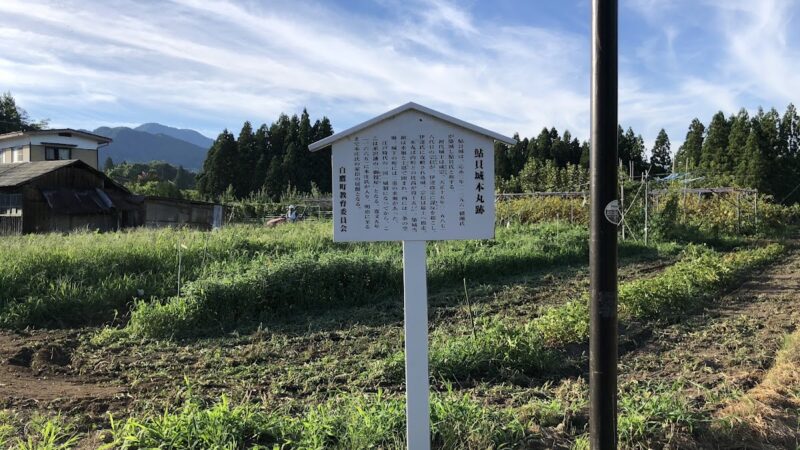
A stone monument inscribed with “Honmaru Ato” (Main Enclosure Site) stands at the site of the main enclosure, indicating that this was the central part of the castle. Walking around the area, slight undulations of the terrain remain, giving a sense of the castle’s former appearance.
Stone Monuments and Stone Walls
Several stone monuments are erected at the Komatsu Castle ruins. In addition to the “Honmaru Ato” monument, there is also a monument inscribed with “Tenshudai” (Castle Tower Base). However, historical records are scarce regarding whether a castle tower actually existed at Komatsu Castle, and whether the area called Tenshudai was truly the foundation of a castle tower is debatable.
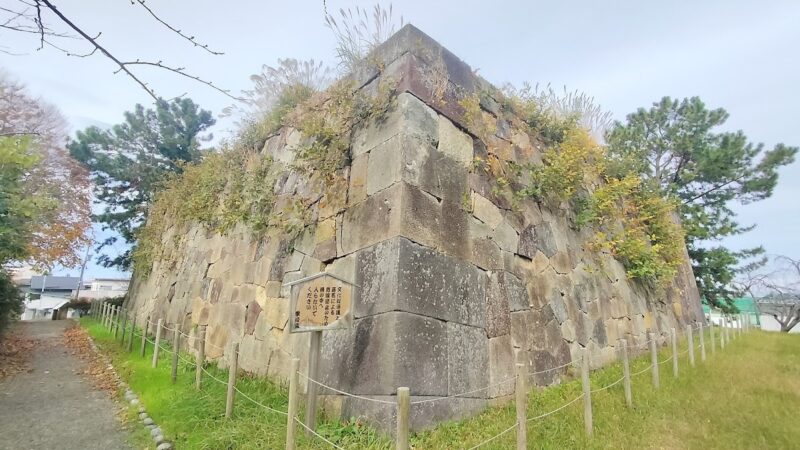
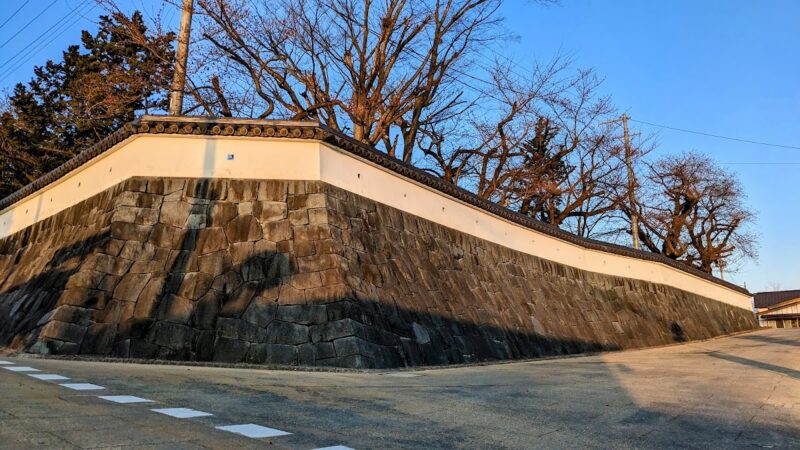
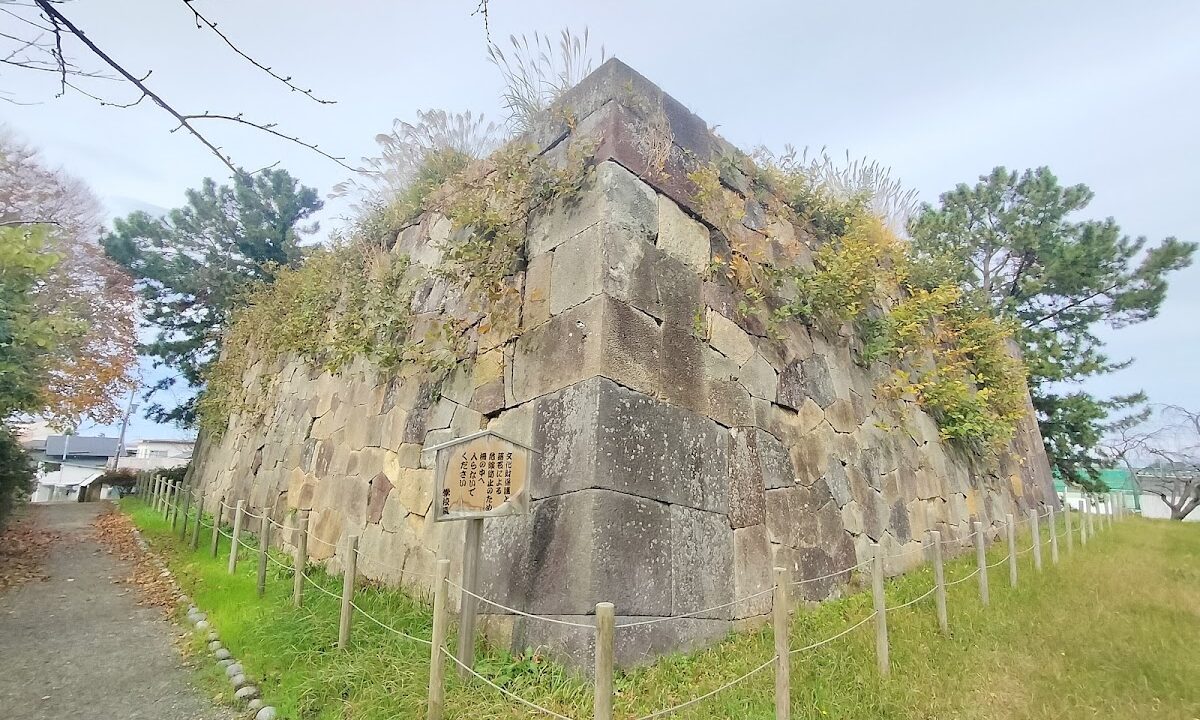
Regarding the stone walls, some parts still exist. While these stone walls may have been rebuilt in later periods, they are important remains that convey the atmosphere of the castle ruins. Although the stone walls are small in scale, they are valuable resources for understanding the castle construction techniques of the time.
Former Komatsu Elementary School Gate
Near the eastern entrance of the Komatsu Castle ruins, the gate of the former Komatsu Elementary School remains. This school gate serves as an access point to the Komatsu Castle ruins, and many visitors enter the castle grounds from here. While the gate itself is a modern structure, it is cherished as part of the historical landscape of the castle ruins.
There is parking space near the school gate, so visitors arriving by car can park here. However, space is limited, so caution is advised if visiting with multiple vehicles.
Preservation of the Ruins
Many of the remains of Komatsu Castle have been lost over the long years. The main keep site has been converted into a shrine and park, and the northern bailey into a town-owned housing complex, leaving only limited, clearly defined castle remains. However, the topography, some of the stone walls, and the atmosphere of a historical site still remain, making it a worthwhile place to visit for history enthusiasts.
Currently, Komatsu Castle ruins are positioned not as a large-scale tourist attraction, but rather as a historical site quietly conveying the history of the region. While not flashy, it is a valuable place where you can feel the history of the Tohoku region during the Sengoku period firsthand.
Access to Komatsu Castle
Location
Komatsu Castle Ruins are located at 3114 Nakakomatsu, Kawanishi-cho, Higashiokitama-gun, Yamagata Prefecture. It is close to the center of Kawanishi-cho, and surrounded by residential areas.
Access by Car
By car, it is approximately 15 minutes from the Yonezawa Chuo Interchange on the Tohoku Chuo Expressway, or approximately 20 minutes from the Nanyo Takahata Interchange. Using a car navigation system, searching for “Komatsu Castle Ruins” or “Shinzan Shrine” will accurately guide you to the vicinity of the East Gate.
There is parking space near the gate of the former Komatsu Elementary School, but the number of spaces is limited. It may be crowded on holidays and during tourist seasons, so it is recommended to visit with plenty of time to spare.
Access by Public Transportation
If using public transportation, the nearest station is Uzen-Komatsu Station on the JR Yonesaka Line. It is approximately a 15-minute walk from the station to Komatsu Castle Ruins. Uzen-Komatsu Station is a small station, but it’s located on the line connecting Yonezawa and Oguni, and is accessible from Yonezawa Station.
From Yonezawa Station, you can take the Yamagata Railway Flower Nagai Line to Nishi-Otsuka Station and then take a taxi. However, since the number of trains is limited, it’s important to check the timetable in advance.
Points to Note When Visiting
Komatsu Castle Ruins are open to the public as a park, but they are also part of the grounds of Shinzan Shrine, so consideration for worshippers is necessary. Especially when festivals or other events are taking place, please refrain from visiting or be mindful of quiet observation.
While there are information boards within the castle ruins, detailed explanations are limited. Researching the historical background beforehand will allow you to enjoy the castle ruins more deeply. Also, since many of the remains are preserved as part of the terrain, caution is needed when walking, especially in rainy weather or winter.
Tourist Spots Around Komatsu Castle
Historical and Cultural Facilities in Kawanishi Town
When visiting Komatsu Castle Ruins, we recommend also visiting other historical and cultural facilities in Kawanishi Town. Kawanishi Town is dotted with valuable historical sites that tell the history of the Okitama region, and Komatsu Castle is positioned as one of the “48 Castles of Date in Okitama.”
The Kawanishi Town Exchange Center (Friendly Plaza) features exhibits on local history and culture, allowing visitors to learn more about the history of Komatsu Castle. Furthermore, the town has many other medieval castle ruins, shrines, and temples, making it ideal for historical walks.
Tourist Spots in Yonezawa City
Yonezawa City, located about 20 minutes by car from Komatsu Castle, boasts numerous tourist attractions. Yonezawa Castle Ruins (Uesugi Shrine) is a historical site that was the main castle of Komatsu Castle and attracts many tourists as a historical site associated with the Uesugi family.
The Uesugi Museum (Denkoku no Mori) exhibits the history and cultural artifacts of the Uesugi family, allowing visitors to learn deeply about the history of the Tohoku region during the Sengoku period. Additionally, Yonezawa City has many historical sites associated with the Uesugi family, such as the Uesugi Family Mausoleum and Rinsenji Temple, making it an area unmissable for history enthusiasts.
Hot Springs in the Okitama Region
Around Komatsu Castle, there are several hot spring resorts that represent the Okitama region. Onogawa Onsen is known as the inner sanctuary of Yonezawa City and is about a 30-minute drive from Komatsu Castle. It is a historic hot spring town with many facilities where you can enjoy a day trip to the baths.
Shirabu Onsen is a famous hot spring, counted as one of the three most famous hot springs in Oshu, and is about a 40-minute drive from Komatsu Castle. Located in a mountainous area at a high altitude, you can enjoy soaking in the hot springs while enjoying the changing seasons. Akayu Onsen is also nearby and is a popular hot spring resort where you can enjoy wine and hot springs.
Gourmet Spots
Kawanishi Town and the surrounding area have many restaurants where you can enjoy Yamagata Prefecture’s unique cuisine. Yonezawa beef is known as one of Japan’s three major wagyu beef brands, and there are many restaurants and yakiniku restaurants in Yonezawa City that serve Yonezawa beef.
Kawanishi Town is also known as a rice-producing area, and there are many restaurants that serve dishes using locally produced rice. The Okitama region is also a sake-producing area, and izakayas (Japanese pubs) where you can enjoy local sake and sake brewery tours are popular.
There are also many soba (buckwheat noodle) restaurants, with many serving Itasoba, a local dish of Yamagata Prefecture. Enjoying local cuisine before or after visiting Komatsu Castle is highly recommended.
Recommended Plans for Visiting Komatsu Castle
Half-Day Course
Even if you take your time, about an hour is sufficient to visit the Komatsu Castle ruins. A recommended half-day plan is to visit the Komatsu Castle ruins in the morning, then move to Yonezawa city to visit Uesugi Shrine and the Uesugi Museum. Lunch would include enjoying Yonezawa beef in Yonezawa city, followed by a fulfilling afternoon exploring historical sites in the city.
Full-Day Course
A full-day plan exploring the history of the Okitama region is also recommended. After visiting the Komatsu Castle ruins in the morning, you can visit other historical sites in Kawanishi town. After lunch, we will travel to Yonezawa City and visit historical sites associated with the Uesugi family, such as Uesugi Shrine, Uesugi Family Mausoleum, and Rinsenji Temple. In the evening, we will enjoy hot springs at Onogawa Onsen and Akayu Onsen, and savor a dinner featuring local seasonal ingredients – a plan that allows you to fully enjoy history and hot springs.
Weekend Accommodation Plan
For a weekend accommodation plan, the first day involves visiting historical sites in Kawanishi Town, including the Komatsu Castle ruins, and staying overnight in Yonezawa City. On the second day, we recommend a plan where you can thoroughly explore tourist spots in Yonezawa City, learn about history at the Uesugi Museum, and enjoy shopping in Yonezawa City. If time permits, you can also extend your trip to nearby tourist spots such as Kumano Taisha Shrine in Nanyo City or wineries in Takahata Town.
Komatsu Castle Reviews and Visitor Feedback
Visitors to the Komatsu Castle ruins often praise the “quiet and peaceful atmosphere that allows you to feel the history.” Because it’s not a large-scale tourist destination, the ability to leisurely explore the castle ruins is highly appreciated.
On the other hand, some argue that “there are few remaining structures, and the castle ruins offer limited points of interest.” Indeed, no structures such as keeps or turrets remain, and only a few stone walls and earthworks remain. However, those who visit with an understanding of the historical background appreciate it as a valuable place to experience the history of the Tohoku region during the Sengoku period.
For photography, the stone monuments, stone walls, and the Shinzan Shrine are good subjects. While not flashy, it allows you to capture a historical atmosphere. In particular, the castle ruins, harmoniously integrated with the surrounding nature, possess beauty that changes with the seasons.
Komatsu Castle and the Forty-Eight Castles of Okitama, Inspired by the Date Clan
Komatsu Castle is positioned as one of the “Forty-Eight Castles of Okitama, Inspired by the Date Clan.” This is a collective term for castle ruins from the medieval to Sengoku periods scattered throughout the Okitama region, representing a group of strongholds that supported the rule of the Date clan.
The number “forty-eight castles” is not an actual number, but rather an expression meaning “many,” although there are indeed numerous castle ruins remaining in the Okitama region. These castles were part of a network built by the Date clan to control the Okitama region, each strategically located.
Komatsu Castle held a particularly important position among the 48 castles, playing a crucial role as a base for managing key transportation points and as the stage for political events within the Date family. Visiting Komatsu Castle along with other castle ruins allows for a deeper understanding of the Date clan’s system of rule and the history of the Tohoku region during the Sengoku period.
Summary
Komatsu Castle (Yamagata Prefecture) functioned as an important fortress protecting key transportation points from the Kamakura period to the Sengoku period. Under the rule of the Date clan, it was positioned as an important branch castle of Yonezawa Castle and was the stage for historical events such as the Tenbun Rebellion and the Genki Incident.
The current Komatsu Castle site is a park with the Shinzan Shrine located on the site of the main keep. While the remains are limited, some stone monuments and parts of the stone walls remain, allowing visitors to feel the history of the Sengoku period in a quiet atmosphere.
Access is convenient by car, as it is about 20 minutes from Yonezawa city. The surrounding area boasts numerous attractive tourist spots, including the ruins of Yonezawa Castle, the Uesugi Museum, and hot spring resorts, making it ideal for historical tours starting from Komatsu Castle.
While not a large-scale tourist destination, Komatsu Castle is worth visiting for those interested in the history of the Tohoku region during the Sengoku period, those who want to learn more about the history of the Date clan, and those who simply want to enjoy a quiet historical site visit. Why not take a leisurely stroll through the castle ruins while experiencing the rich history and nature of the Okitama region?