Ayukai Castle (Yamagata Prefecture) Complete Guide: A Thorough Explanation of History, Remains, and Access
Located in Shirataka-cho, Nishiokitama-gun, Yamagata Prefecture, Ayukai Castle is an important castle that played a significant role in the history of the Okitama region from the medieval to the early modern period. Built in 1396, it functioned as the residence of the Ayukai clan for approximately 250 years, playing a strategically important role as a border castle between the Date and Mogami clans. This article comprehensively explains the detailed history of Ayukai Castle, existing remains, points of interest, and access methods, providing useful information for castle enthusiasts and history buffs.
Basic Information on Ayukai Castle
Ayukai Castle is a flatland castle built in Ayukai, Okitama-gun, Dewa Province (present-day Ayukai, Shirataka-cho, Nishiokitama-gun, Yamagata Prefecture). Also known as “Yaotome Castle,” the current main keep site is a designated historical site of Shirataka-cho.
Location and Topographical Features
Ayugai Castle is built on the right bank of the Mogami River, utilizing an isolated hill connected to the river terrace and the end of the Shiratakayama Hills. Located at an elevation of approximately 190-210 meters, with a relative height of about 30 meters, it faces Arato Castle across the Mogami River. This geographical location was extremely important for controlling a key transportation hub in the Okitama region.
The castle features a layout that skillfully utilizes the natural terrain, with baileys arranged from the summit to the slopes of the castle hill. A defensive system was constructed that leveraged the natural fortifications of the Mogami River while taking advantage of the isolated hill’s topography.
Castle Scale and Structure
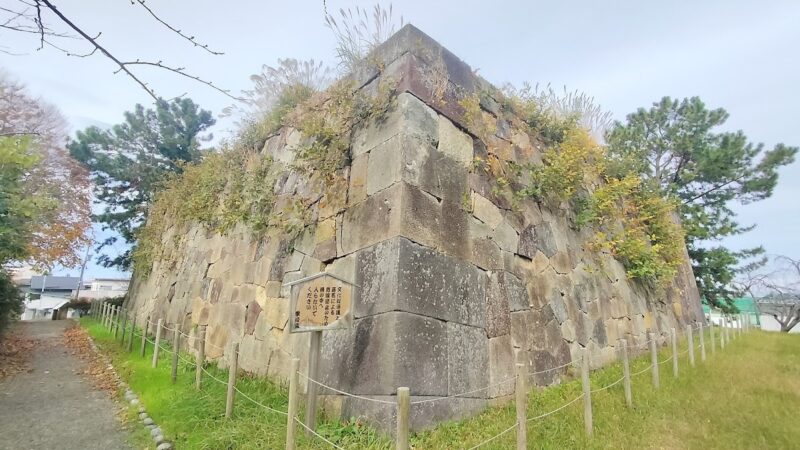
Ayugai Castle exhibits the typical form of a medieval mountain castle, consisting of multiple baileys. The main bailey is at the center, surrounded by other baileys such as the second and third baileys, each separated by earthworks and moats. The current location of Ayugai Hachimangu Shrine is believed to be the site of the main keep, and the most important remains are concentrated in this area.
Due to the establishment of government offices during the Edo period and the fact that part of the area is now residential, it is difficult to fully understand the original structure. However, the remaining remains allow us to infer its appearance at that time.
History of Ayugai Castle
Construction of the Castle and the Establishment of the Ayugai Clan
Ayugai Castle is said to have been built in 1396 by Ayugai Narimune. The Ayugai clan claimed descent from Fujiwara no Kamatari and established their power as local lords in the Okitama region. From the time of its construction by Ayugai Narimune, this castle functioned as the residence of successive generations of the Ayugai clan and became the family’s base.
The Ayugai clan maintained their power as a powerful local lord in the Okitama region, building complex relationships with various surrounding forces. By controlling the Mogami River basin, a crucial transportation and economic hub, the Ayugai clan established their own sphere of influence, backed by considerable economic power.
The Tenbun Rebellion and Subjugation to the Date Clan
The Tenbun Rebellion, which occurred during the Tenbun era (1532-1555), dramatically altered the fate of the Ayugai clan. This civil war originated from a succession dispute within the Date family and affected a wide area, including the Okitama region.
In the Tenbun Rebellion, the Ayugai clan was defeated by Date Harumune. However, their military prowess and governing abilities were recognized, and the Ayugai clan was welcomed as influential vassals of the Date clan. From this period onward, Ayugai Castle became a branch castle of the Date clan, playing a crucial role in maintaining the Date clan’s power in the Okitama region.
A Castle on the Border Between the Date and Mogami Clans
In the latter half of the 16th century, Ayugai Castle occupied an extremely important strategic position as a border castle between the Date clan, based in Yonezawa, and the Mogami clan, based in Yamagata. Military tensions frequently escalated in this region where the spheres of influence of both forces met, and Ayugai Castle functioned as a frontline defensive stronghold.
Along with Arato Castle, located on the opposite bank of the Mogami River, Ayugai Castle formed a defensive line for the Okitama region. During this period, the castle’s lords constantly had to monitor the movements of both forces while strengthening the castle’s defenses.
Turmoil in the Tensho Era
The Tensho era (1573-1592) was a turbulent time for Ayugai Castle. During this period, various political events occurred, including changes in castle lords and rebellions.
Of particular note is the internal conflict within the Ayugai clan over succession. During the Tensho era, Ayugai Munenobu served as the castle lord, but as the conflict between the Date and Mogami clans intensified, the Ayugai clan also found themselves in a difficult position. Issues concerning the succession of the family headship and the control of the territory were not merely internal family matters, but important matters that affected the Date clan’s overall rule over Okitama.
The Uesugi Clan’s Entry into Aizu and Ayugai Castle
In 1589, Date Masamune defeated the Ashina clan at the Battle of Suriagehara and brought Aizu under his control. However, due to Toyotomi Hideyoshi’s pacification of Oshu, the Date clan had many territories, including the Okitama region, confiscated. In 1591, Gamo Ujisato entered Aizu, and the Okitama region came under his control.
Later, in 1598, when Uesugi Kagekatsu entered Aizu as the lord of a 1.2 million koku domain, the Okitama region came under the direct control of the Uesugi clan. While many details about how Ayugai Castle was used during this period remain unclear, it is believed to have played a certain role in the Uesugi clan’s domain management.
After the Battle of Sekigahara and the Castle’s Demise
The Uesugi clan, who sided with the Western Army in the Battle of Sekigahara in 1600, had their territory drastically reduced to 300,000 koku in Yonezawa after the war. This relocation significantly altered the castle layout in the Okitama region.
In the Edo period, Ayugai Castle lost its function as a military base and transformed into an administrative facility, with government offices being established. Following the “One Castle Per Province” decree of 1615, many branch castles were abandoned, and it is believed that Ayugai Castle gradually ceased to function as a castle.
While the exact date of its abandonment is unclear, it largely lost its function as a castle in the first half of the 17th century, and has since been the grounds of the Ayugai Hachimangu Shrine, which remains to this day.
Remains and Highlights of Ayugai Castle
Main Enclosure Site and Ayugai Hachimangu Shrine
Currently, Ayugai Hachimangu Shrine is enshrined on the site of the main enclosure of Ayugai Castle. This Hachimangu Shrine has long been revered as the tutelary deity of the Ayugai clan and also functioned as the guardian deity of the castle. The shrine grounds are located on the eastern edge of the plateau, offering panoramic views of the surrounding area.
Around the Hachimangu Shrine building, the remains of the castle from that time are well preserved, conveying the atmosphere of a medieval castle to visitors. In particular, behind the shrine building (to the west), important earthworks and moat remains can be seen.
Remains of Earthworks
A thick earthwork remains exist within the grounds of Ayugai Hachimangu Shrine, especially behind the western side. This earthwork was an important structure for defending the main enclosure, and parts of it reach several meters in height. The structure and scale of the earthworks indicate that Ayugai Castle was a fortress with considerable defensive capabilities.
A raised area, possibly a watchtower base, can be seen on part of the earthworks, suggesting the possibility of watchtowers or defensive towers being built there. A moat was positioned outside the earthworks, indicating the existence of a defensive system combining earthworks and a moat.
Remains of the Moat
A distinctive feature of Ayugai Castle is the L-shaped remains of a moat. This moat was positioned around the outside of the earthworks, serving to prevent enemy intrusion. Even today, the shape and scale of the moat can be observed, allowing us to imagine the defensive system of the time.
Furthermore, traces of a water moat remain around the castle. Taking advantage of its location near the Mogami River, it is thought that a water-filled moat was constructed to create a stronger defensive system. Compared to Arato Castle, the remains of the water moat at Ayugai Castle are a noteworthy feature.
Layout of Enclosures
The topography reveals traces of multiple enclosures (kuruma) arranged around the main enclosure (honmaru). While much of the area is now residential or farmland, observing the micro-topography allows for inferring the boundaries and layout of the former enclosures.
In particular, the terrain around the main enclosure shows traces of artificial leveling and cut slopes, suggesting a systematically designed castle. The use of the entire castle hill is a prime example of the development of castle construction technology from the medieval to the Sengoku period.
Stone Monuments and Information Boards
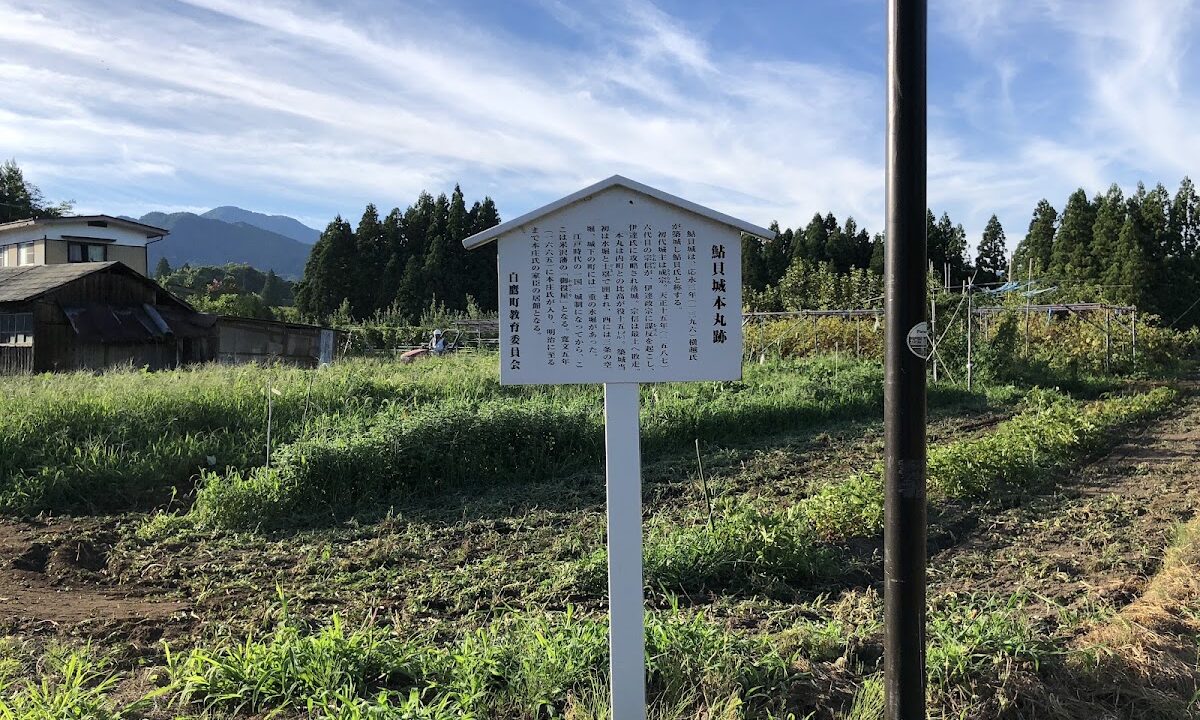
At the Ayugai Castle ruins, the Shirataka Town Board of Education has installed information boards, providing detailed explanations of the castle’s history and structure. Stone monuments marking the castle site also indicate its historical importance.
These information boards and monuments are valuable resources for visitors to understand the castle’s history. First-time visitors, in particular, should begin by reviewing the information boards to gain a deeper understanding of the remains.
Related Historical Sites in the Surrounding Area
Relationship with Arato Castle
When visiting Ayugai Castle, we recommend also visiting Arato Castle, located on the opposite bank of the Mogami River. Arato Castle’s buildings have been restored, allowing for a visual understanding of its medieval castle appearance.
The two castles are located opposite each other across the Mogami River and cooperated to defend the Okitama region. Visiting both Ayugai Castle and Arato Castle will provide a deeper understanding of the strategic placement of castles in this region.
Historical and Cultural Facilities in Shirataka Town
In addition to Ayugai Castle, Shirataka Town has many other historical and cultural facilities and sites. The town’s museum features exhibits on the history of the Ayugai clan and the Okitama region, and visiting before or after your castle visit will provide a deeper understanding.
Access Information
Access by Public Transportation
The nearest station to Ayugai Castle is Shiki-no-Sato Station on the Yamagata Railway Flower Nagai Line. The castle ruins are accessible on foot from the station, taking approximately 15-20 minutes. The route from the station towards Ayugai Hachimangu Shrine is relatively easy to follow, and you can ask locals for directions.
If traveling by car, it’s about a 5-minute drive from Shiki-no-Sato Station. Since the Flower Nagai Line has limited service, it’s recommended to check the timetable in advance and plan your visit accordingly.
Access by Car
If traveling by car, it’s approximately a 40-minute drive from the Nanyo-Takahata Interchange on the Tohoku Chuo Expressway. Take National Route 113 or a prefectural road towards Shirataka Town and head towards the Ayugai area.
If using a car navigation system, you can set your destination by searching for “Ayugai Hachimangu Shrine” or “Shirataka Town Ayugai.” There is some parking space around Ayugai Hachimangu Shrine, but please remember that this is reserved for worshippers and use it respectfully.
Address and Location Information
- Address: 992-0771 Ayugai, Shirataka-cho, Nishiokitama-gun, Yamagata Prefecture
- Nearest Station: Yamagata Railway Flower Nagai Line “Shiki-no-Sato Station”
- Nearest Interchange: Tohoku Chuo Expressway “Nanyo-Takahata IC”
Notes and Manners for Visitors
Visiting Hours and Seasons
Ayugai Castle Ruins are located within the grounds of Ayugai Hachimangu Shrine and are generally open for viewing during the daytime. However, please remember that it is shrine grounds and observe proper visiting etiquette.
The best seasons for visiting are from spring to autumn. Especially during the seasons of fresh greenery and autumn leaves, the surrounding scenery is beautiful, making it more enjoyable to observe the ruins. During winter, there is snow, so caution is necessary when walking.
Clothing and Equipment
For visiting the castle ruins, comfortable walking shoes and clothing are essential. When observing the earthworks and moat remains, you will be walking on slightly undulating terrain, so sneakers or trekking shoes are suitable.
In summer, it is recommended to bring insect repellent, a hat, and drinking water. A camera or binoculars will also be helpful for detailed observation of the remains and confirmation of the surrounding landscape.
Visitor Etiquette
Ayugai Castle ruins are located within the grounds of a shrine, and part of the site is adjacent to a residential area. Please observe the following points when visiting:
- Behave quietly within the shrine grounds and avoid disturbing worshippers.
- Do not trespass on private property.
- Always take your trash with you.
- Do not damage the remains or climb the earthworks.
- When taking photographs, be considerate of the privacy of those around you.
Historical Value and Future Preservation of Ayugai Castle
Academic Value
Ayugai Castle has significant academic value as a castle from the transitional period from the medieval to the early modern period in the Okitama region. The history of Ayugai Castle, which transformed from the residence of a local lord, the Ayugai clan, to a branch castle of daimyo such as the Date and Uesugi clans, is a valuable case study for understanding the realities of regional control during the Sengoku period.
The existing remains are also important resources for understanding the structure of medieval castles. In particular, the arrangement of earthworks and moats is attracting attention from castle researchers as concrete examples of the castle-building techniques and defensive philosophies of the time.
Utilization as a Regional Resource
Ayugai Castle ruins are an important historical and cultural resource of Shirataka Town. In recent years, with the growing interest in historical tourism, there is a growing expectation for tourism promotion efforts utilizing local castle historical sites like Ayugai Castle.
Broader utilization strategies, such as collaboration with Arato Castle and the establishment of sightseeing routes connecting with other castles in the Okitama region, are also being considered. Further utilization as an educational resource for learning about local history is also desired.
Challenges in Preservation and Development
There are several challenges in preserving Ayugai Castle ruins. Due to the fact that part of the site is now residential and alterations during the Edo period have obscured its original appearance, careful consideration is needed for the preservation and utilization of the remains.
Future archaeological excavations and documentary research are expected to shed more light on the castle’s overall structure. Furthermore, the proper preservation and management of existing remains, along with improved information provision for visitors, are also crucial issues.
Summary: The Charm of Ayugai Castle
Ayugai Castle, built in 1396, is a fortress that watched over the history of the Okitama region for approximately 250 years. Its history, beginning as the residence of the Ayugai clan, its strategic importance as a border castle between the Date and Mogami clans, and ultimately coming under the control of the Uesugi clan, can be seen as a microcosm of regional history during the Sengoku period.
The remaining earthworks and moats are valuable historical relics that convey the castle’s appearance in its heyday. Located across the Mogami River from Arato Castle, and with its main keep ruins still standing as the Ayugai Hachimangu Shrine, Ayugai Castle is a historical site well worth visiting, a place where history and culture are layered upon one another.
For castle enthusiasts, those interested in the history of the Sengoku period, and anyone wanting to experience the history and culture of Yamagata Prefecture, Ayugai Castle is a must-see. Be sure to visit and experience the weight of its history and the allure of its remains.