
Complete Guide to the Tendo Jinya Ruins (Yamagata Prefecture) | The History and Present of the Tendo Oda Domain Ruled by Descendants of Oda Nobunaga
Located in the heart of Tendo City, Yamagata Prefecture, the Tendo Jinya Ruins were the site of the administrative center of the Tendo Oda Domain, ruled by descendants of Oda Nobuo, the second son of Oda Nobunaga. While currently occupied by the Kitaro Inari Shrine and residential areas, a magnificent fortified residence surrounded by a moat once stood here. This article provides a detailed explanation of the Tendo Jinya Ruins, from its history to its current state, access methods, and nearby tourist attractions.
What are the Tendo Jinya Ruins?
The Tendo Jinya Ruins were the site of the domain’s administrative center, established in 1830 during the late Edo period (Tenpo 1). Located in the present-day Tazuru-cho area of Tendo City, Yamagata Prefecture, the area centered around the Kitaro Inari Shrine was the former center of the fortified residence.
Basic Information
- Location: 1-7-13 Tazuru-cho, Tendo City, Yamagata Prefecture (around Kitaro Inari Shrine)
- Year of Construction: Tenpo 1 (1830)
- Builder: Oda Nobuyoshi
- Year of Abandonment: After the Meiji Restoration
- Remains: Almost completely gone (only stone monument and information board remain)
- Designation: None in particular
The Establishment and History of the Tendo Oda Domain
A Daimyo Family Descended from Oda Nobunaga
The Tendo Oda Domain was ruled by descendants of Oda Nobuo, the second son of Oda Nobunaga, a hero of the Sengoku period. Nobuo’s lineage continued as daimyo throughout the Edo period, eventually obtaining a territory of 20,000 koku in Tendo, Dewa Province.
After the Honnō-ji Incident, Oda Nobuo survived amidst complex relationships with Toyotomi Hideyoshi and Tokugawa Ieyasu, and his descendants continued as hatamoto (direct retainers) of the Edo shogunate. In 1830, Oda Nobuyoshi was transferred from the Takahata Domain to Tendo, thus establishing the Tendo Oda Domain.
Construction of the Tendo Jinya (Fortified Residence)
Oda Nobuyoshi immediately began construction of the Jinya after his transfer to Tendo. The Jinya was built in the area of present-day Tazuru-machi and surrounded by a moat. Its scale was comparable to a castle of the late Edo period, and it contained a palace, residences for retainers, and samurai residences.
According to the Tendo Jinya map, the Jinya had a long, north-south structure, with the lord’s residence (Goten) in the center, and the residences of chief retainers and senior officials arranged around it. Furthermore, a domain school, “Chōbukan,” and training halls were established for the education of samurai, providing education in both literary and martial arts.
Domain Finances and Industry
Although the Tendo Domain was a small domain with a 20,000 koku (unit of rice production) yield, in addition to rice cultivation, safflower cultivation and silk weaving were also carried out within its territory. Tendo, in particular, became known as a production center for shogi (Japanese chess) pieces, and shogi piece making was encouraged as a side job for samurai. This led to the current tradition of “Tendo Shogi Pieces.”
Financially, due to its small size, the domain was always in a difficult situation, and the lives of the samurai were not particularly affluent. Therefore, records show that many samurai engaged in agriculture or handicrafts as a side job.
The Boshin War and the Burning of the Tendo Jinya (fortified residence)
Joining the Ōuetsu Reppan Alliance
In 1868 (Keiō 4), when the Boshin War broke out, the Tendo Domain joined the Ōuetsu Reppan Alliance. For the small Tendo Domain, this choice was made under pressure from powerful neighboring domains (especially the Shonai Domain).
The Tendo Domain was forced to fight against the new government forces, but there were also factions within the domain that sided with the new government, resulting in a division of opinion. In this situation, the town of Tendo Castle was destined to become a battlefield.
Battle in Tendo Castle Town and the Burning of the Jinya (Fortified Residence)
On April 4th, 1868 (Keio 4), a battle broke out in the town of Tendo Castle between the allied forces, centered around the Shonai Domain, and the new government forces. This battle resulted in the burning of most of the town (233 houses), including the Tendo Jinya.
The burning of the Jinya was a major blow to the Tendo Oda family. Not only was the central function of the domain lost, but many samurai lost their homes, making it difficult to continue the domain’s administration.
Tendo After the Meiji Restoration
After the Meiji Restoration, the Tendo Domain ceased to exist due to the abolition of the feudal domains and the establishment of prefectures, and was incorporated into Yamagata Prefecture via Tendo Prefecture. Many former samurai lost their jobs and fell into poverty. Therefore, the Meiji government implemented relief measures such as land reclamation projects, but these were not entirely successful.
After the Meiji era, the site of the former jinya (fortified residence) was developed into residential land. Furthermore, in 1901 (Meiji 34), the Ou Main Line opened, and part of the former palace site became part of the railway line. As a result, the remains of the jinya almost completely disappeared.
Current State of the Tendo Jinya Site
Kitaro Inari Shrine
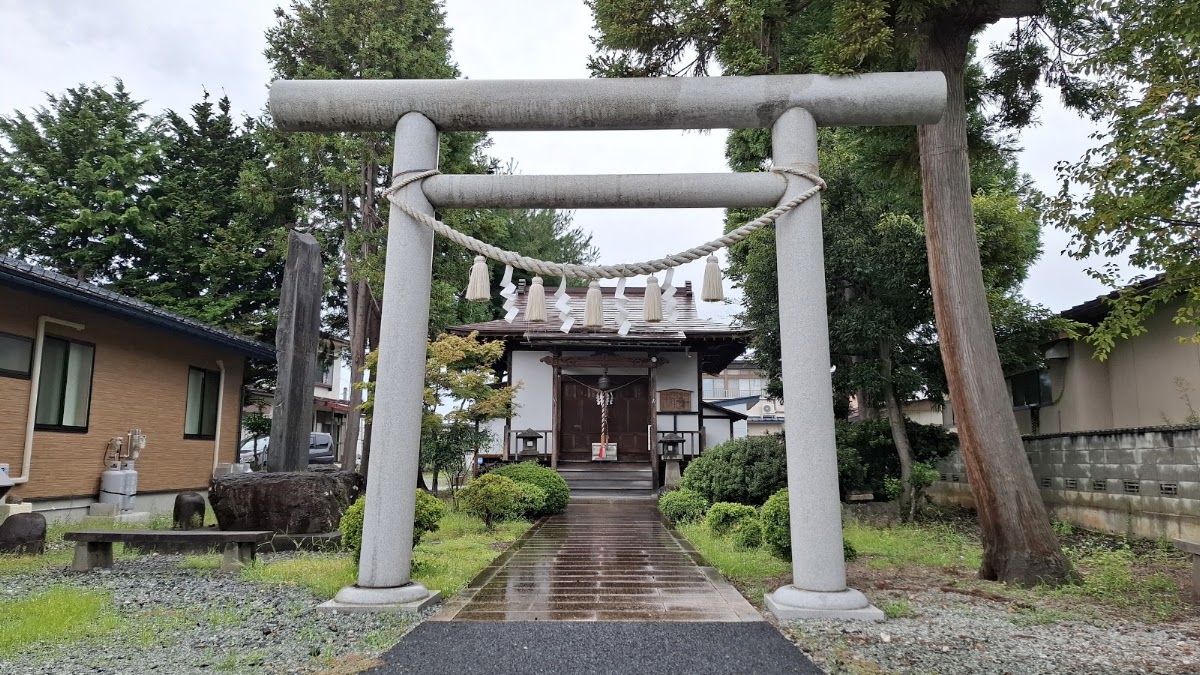
Currently, the Kitaro Inari Shrine stands in the center of the Tendo Jinya site. This shrine has been within the jinya since the Edo period and is one of the few remaining structures of the Tendo Jinya.
A stone monument marking the “Tendo Jinya Site” stands beside the shrine’s torii gate, indicating that this was once the center of the Tendo Oda Domain. The shrine grounds are well-maintained and attract the faith of local people.
Information Boards and Markers
At the entrance to Kitaro Inari Shrine, there is an information board explaining the history of the Tendo Jinya (fortified residence). The board includes a photograph of a map of the Tendo Jinya, allowing visitors to understand the layout of the residence at the time.
Furthermore, information boards for the “Chobukan Training Ground Site” and a marker for the “Otemon Gate Site” are also located nearby, allowing visitors to explore and confirm the boundaries of the residence.
Status of Remains
Unfortunately, the buildings and moats of the Tendo Jinya have completely disappeared. The area around present-day Tazuru-cho is a residential and commercial area, making it difficult to directly perceive any traces of the past.
However, by comparing the Tendo Jinya map with current maps, it is possible to estimate the approximate extent and layout of the residence. This research continues among local historians and history enthusiasts.
Tendō Oda no Sato Historical Museum (Former Higashimurayama County Office)
Western-Style Architecture from the Meiji Era
Located within walking distance of the Tendō Jinya Ruins, the Tendō Oda no Sato Historical Museum (former Higashimurayama County Office) is an important facility for learning about the history of the Tendō Oda Domain.
This building is a Western-style structure built in 1879 (Meiji 12) as the Higashimurayama County Office, and is one of the oldest existing Western-style buildings from the Meiji era in Yamagata Prefecture. It was designated a Yamagata Prefecture Tangible Cultural Property in 1972 (Showa 47), and underwent restoration work in 1985 (Showa 60), resulting in its current appearance.
Exhibits
The museum displays over 240 items, mainly focusing on materials related to the Tendō Oda Domain and materials from around the Meiji Restoration. The main exhibits include the following:
- Oda Family Related Materials: Documents showing the lineage from Oda Nobunaga, portraits of successive feudal lords, etc.
- Tendo Jinya Related Materials: Maps of the Tendo Jinya, domain administration documents, weapons, etc.
- Boshin War Related Materials: Records of battles, memoirs of samurai, etc.
- Meiji Era Materials: Documents showing the lives of former samurai, documents from the county office era, etc.
The map of the Tendo Jinya, in particular, is a valuable resource for understanding the appearance of the now-lost Jinya.
Imperial Residence of Emperor Meiji
In September 1881 (Meiji 14), during Emperor Meiji’s tour of the Tohoku region, this building was used as an imperial residence (temporary lodging for the emperor). This indicates that the Higashimurayama County Office at the time was a central facility in the region.
The building harmonizes with the landscape of Tendo Park (Maizuru Mountain) behind it, forming a beautiful landscape integrated with the surrounding nature.
Relationship with Takatama Jinya
Takatama Jinya of the Akimoto Domain
Within Tendo City, separate from the Tendo Jinya (fortified residence), there was another fortified residence called “Takatama Jinya.” This was the residence of the Akimoto family of the Tatebayashi Domain (later the Yamagata Domain), and was established in 1846 (Koka 3) west of the site of the second bailey of Takatama Castle.
The Akimoto Domain was a large domain with a 60,000 koku (unit of rice production) yield, but the number of samurai was so large that the domain office in Yamagata alone could not accommodate them all, so a branch office was established in Takatama.
Short History of Takatama Jinya
The Takatama Jinya was abolished in 1849 (Kaei 2) after only four years. However, the residences of the Akimoto domain’s retainers remained, and approximately 300 unemployed samurai resided there until the Meiji Restoration.
Although the remains of the Takatsuma Jinya (fortified residence) have almost completely disappeared, the memory of the residence remains in the local area. The fact that two Jinya existed within Tendo City reflects the complex political situation in this region during the late Edo period.
Access Information
Access by Public Transportation
Walking from JR Tendo Station
- Approximately 10 minutes on foot from the east exit of JR Ou Main Line “Tendo Station”
- Head south along the railway tracks towards Tazuru-machi
- Look for the torii gate of Kitaro Inari Shrine
Renting a Bicycle from JR Tendo Station
- Bicycle rentals are available at Tendo Station (check with the tourist information center)
- Approximately 5 minutes by bicycle
- Efficiently visit other tourist spots in Tendo City
Access by Car
From the Yamagata Expressway
- Approximately 15 minutes from Yamagata Kita IC via National Route 13
- Approximately 10 minutes from Tendo IC via National Route 13
Parking
- There is no dedicated parking lot around Kitaro Inari Shrine
- Use the Tendo City Hall parking lot (5 minutes on foot) or nearby coin parking lots
- Parking is available at the Tendo Oda no Sato History Museum
Points to Note When Visiting
- Kitaro Inari Shrine is located in a residential area, a living space for surrounding residents. Please be considerate and avoid causing any disturbance, such as noise.
- Most of the former Jinya site is private property. Please do not enter the premises without permission.
- Some of the signposts and markers are small and inconspicuous. We recommend checking their locations in advance.
Nearby Tourist Attractions
Tendo Park (Maizuru Mountain)
Tendo Park, located about a 15-minute walk from the Tendo Jinya site, is a popular recreational spot for citizens, affectionately known as Maizuru Mountain. From the summit, you can enjoy a panoramic view of Tendo city, Mount Gassan, and the Asahi mountain range. In spring, approximately 2,000 cherry trees bloom, making it one of Yamagata Prefecture’s leading cherry blossom viewing spots.
The park also has a plaza that serves as the venue for “Human Shogi,” a traditional event held every April where actual people act as shogi pieces.
Tendo Onsen
Tendo City is also known as a hot spring resort, and there are several hot spring inns within walking distance of the Tendo Jinya Ruins. The spring water is a sodium-calcium sulfate spring, said to be effective for neuralgia and muscle pain.
Many facilities offer day-trip bathing, allowing you to relax in the hot springs after exploring the historical sites.
Tendo, the Village of Shogi Pieces
Tendo City is the “Village of Shogi Pieces,” accounting for approximately 95% of the nation’s shogi piece production. Within the city, there are workshops where you can observe the shogi piece manufacturing process, and facilities where you can experience painting shogi pieces.
The origins of shogi piece making in Tendo are said to date back to the Edo period, when samurai of the Tendo Oda Domain started it as a side job, and it has deep ties to the history of the Tendo Jinya.
Wakamatsu-ji Temple (Wakamatsu Kannon)
Located approximately 10km southwest of Tendo City, Wakamatsu-ji Temple is an ancient Tendai sect temple known for its Kannon statue that grants blessings for matchmaking, earning it the reputation of “Izumo in the west, Wakamatsu in the east.” From the temple grounds, visitors can enjoy panoramic views of Tendo city and the Mogami River, appreciating the beautiful scenery throughout the seasons.
Model Course for Visiting the Tendo Jinya Ruins
Half-Day Course (Mainly Walking)
- JR Tendo Station (Start)
- Tendo Jinya Ruins (Kitaro Inari Shrine) (30 mins)
- Check the stone monument and information board
- Explore the markers for the Chobukan/Keikojo ruins and the Otemon Gate ruins
- Tendo Oda no Sato History Museum (60 mins)
- Learn about the history of the Tendo Oda clan
- View materials such as the Tendo Jinya map
- Tendo Park (Maizuru Mountain) (60 mins)
- Stroll to the summit
- Enjoy a panoramic view of Tendo city from the observation deck
- Day Trip Bathing at Tendo Onsen (60 mins)
- JR Tendo Station (Goal)
Full-Day Course (Using a Rental Car)
- JR Tendo Station (Rent a car)
- Tendo Jinya Ruins (Kitaro Inari Shrine) (30 mins)
- Tendo Oda no Sato Historical Museum (60 mins)
- Shogi Piece Workshop Visit & Painting Experience (90 mins)
- Lunch (Local Cuisine such as Tendo Soba) (60 mins)
- Wakamatsu-ji Temple (60 mins)
- Tendo Park (Maizuru-yama) (45 mins)
- Day Trip Bathing at Tendo Onsen (60 mins)
- JR Tendo Station (Return rental car, finish line)
Historical Value of Tendo Jinya Ruins
Inheritance of Oda Nobunaga’s Bloodline
The greatest historical value of Tendo Jinya Ruins lies in the fact that it is a place that demonstrates the inheritance of the bloodline of Oda Nobunaga, a hero of the Sengoku period, throughout the Edo period, and that the family continued to exist as a daimyo family until the Meiji Restoration.
The Tendo Domain was the only domain ruled by a direct descendant of Oda Nobunaga, and in that sense, the Tendo Jinya (fortified residence) site is an important historical site for understanding the history of the Oda family.
A Valuable Example Showing the Reality of a Small Domain
The Tendo Domain was a small domain with a stipend of 20,000 koku (a unit of rice production). Most daimyo families in the Edo period were large domains with tens or hundreds of thousands of koku, and historical materials showing the reality of small domains are relatively scarce.
The Tendo Jinya site and related materials provide a valuable example for understanding the administration, the lives of the samurai, and the financial situation of a small domain.
A Fierce Battle Site of the Boshin War
The Tendo Jinya site also shows the reality of the fighting in the Tohoku region during the Boshin War. The situation in which the small Tendo Domain was forced to join the Ouetsu Reppan Alliance due to pressure from surrounding large domains, and the tragedy of the burning of the fortified residence and castle town during the fighting, illustrates the complex political situation during the late Edo and Meiji Restoration periods.
Preservation and Utilization of the Tendo Jinya Site
Current Challenges
The biggest challenge at the Tendo Jinya site is that the remains have almost completely disappeared, making it difficult to visually experience the history. While there are stone monuments and information boards, they give tourists a somewhat unremarkable impression.
Furthermore, since most of the Jinya site is privately owned, there are limitations on excavation and preservation activities.
Future Possibilities
Tendo City is working to utilize the history of the Tendo Oda clan as a tourist resource. Improvements are being made to the Tendo Oda no Sato History Museum, information boards are being installed, and guided tours are being conducted. Further development is expected in the future.
In addition, the recreation of the Jinya using digital technology such as VR (virtual reality) and AR (augmented reality) is being considered. If realized, visitors may be able to experience the Jinya as it was at the time.
Collaboration with the Local Community
Tendo City is promoting tourism by combining multiple tourist resources, such as shogi pieces, hot springs, and fruits (cherries). The Tendo Jinya Ruins are positioned as part of these tourist routes, and efforts are needed to make them accessible not only to history enthusiasts but also to general tourists.
Summary
The Tendo Jinya Ruins were the center of the Tendo Oda Domain, ruled by descendants of Oda Nobunaga, and played a significant role in history from the late Edo period to the Meiji Restoration. Although most of the remains have disappeared, the Kitaro Inari Shrine, stone monuments, and information boards convey the atmosphere of the time.
At the Tendo Oda Village History Museum, you can see detailed materials about the Tendo Jinya and the Tendo Oda Domain, allowing you to learn more about history. Furthermore, there are many attractive tourist spots in the surrounding area, such as Tendo Park, Tendo Onsen (hot springs), and a shogi piece workshop, allowing you to combine historical walks with sightseeing.
When visiting the Tendo Jinya Ruins, it would be beneficial to review the history of the Tendo Oda Domain and a map of the Tendo Jinya beforehand for a deeper understanding. If you have the opportunity to visit Tendo City, Yamagata Prefecture, be sure to visit the Tendo Jinya Ruins. You’ll be able to experience the history of a daimyo family descended from Oda Nobunaga, as well as the turbulent times of the late Edo period and the Meiji Restoration.


