Yamabe Castle (Yamagata Prefecture) Complete Guide | The History and Highlights of the Mountain Castle that Supported Mogami Yoshiaki
Located in Takahara-cho, Yamagata City, Yamagata Prefecture, Yamabe Castle is an important mountain castle that fortified the eastern defenses of Yamagata Castle during the time of Mogami Yoshiaki. Also known as Takahara Castle, this castle, built on a mountaintop 234 meters above sea level, still retains well-preserved remains such as stone walls and moats, conveying the appearance of a mountain castle from the Sengoku period.
This article provides detailed information useful for castle enthusiasts and history buffs, from the history of Yamabe Castle to its highlights and access methods.
Basic Information on Yanbe Castle
Castle Name: Yanbe Castle
Alternate Name: Takahara Castle
Classification: Mountain Castle
Location: Takahara-cho, Yamagata City, Yamagata Prefecture
Elevation: 234 meters (relative height approximately 80-100 meters)
Builder: Yanbe Nobuhiko
Year of Construction: Shohei era (1346-1370)
Main Lords: Yanbe clan (Yanbe Nobuhiko, Yanbe Kuniyori, Yanbe Kiyoyori, Yanbe Seibei, etc.)
Year of Abandonment: Genna 8 (1622)
Remains: Enclosures, earthworks, moats, dry moats, gates, stone walls, second bailey stone walls
Cultural Property Designation: City-designated historical site
History of Yanbe Castle
Construction during the Nanboku-cho period
Yamaga Castle is said to have been built by Yamaga Nobuhiko during the Shohei era (1346-1370). During the turbulent Nanboku-cho period, it played a crucial role as a base for controlling this region. The Yamaga clan is believed to have served Shiba Kaneyori, the ancestor of the Mogami clan, and ruled this area for generations.
Relationship with the Mogami Clan
The Yamaga clan, as powerful vassals of the Mogami clan, played a vital role in the defense of Yamagata Castle. Especially during the Sengoku period, under the rule of Mogami Yoshiaki, Yamaga Castle functioned as a strategic point protecting the eastern side of Yamagata Castle. Located at an altitude of 234 meters, almost the same as Hasedo Castle, its location overlooking the Yamagata Basin made it an ideal position for monitoring enemy movements.
The heads of the Yamaga clan, including Yamaga Kawachi-no-kami, played an active role in Mogami Yoshiaki’s territorial expansion and defense, and held important positions as senior retainers of the Mogami clan. During the Keicho Dewa Campaign (1600), Yamaga Castle served as a crucial base for defending against eastern invasions against the Uesugi army led by Naoe Kanetsugu.
Dispossession of the Mogami Clan and Abandonment of the Castle
In 1622 (Genna 8), when the Mogami clan was dispossessed of their territory, Yamaga Castle ceased to serve its purpose. The Mogami clan’s dispossession is attributed to an internal dispute that occurred during the time of Mogami Yoshitoshi. As a result, the Yamaga clan lost their territory, and Yamaga Castle was abandoned. Since then, the castle has been left unmanaged and has returned to nature, but remnants such as sturdy stone walls and earthworks remain to this day.
Layout and Structure of Yamaga Castle
Characteristics as a Mountain Castle
Yamaga Castle is a typical Sengoku period mountain castle, possessing a defensive structure that skillfully utilizes the natural terrain. It features a unique layout with the main keep located on the mountaintop at an altitude of 234 meters, and the second keep behind it.
The location, with a relative elevation of approximately 80-100 meters, offered a steep and difficult ascent for attackers, while simultaneously providing an excellent vantage point for defenders, offering a panoramic view of the entire Yamagata Basin.
Main Enclosure Layout
Honmaru: The main enclosure located at the mountaintop, believed to have housed the lord’s residence and command post. It was surrounded by earthen ramparts, with a heavily fortified entrance.
Ninokuruwa: An enclosure located behind (north of) the Honmaru, where the castle’s most notable feature, the stone walls, remain. This layout differs from typical mountain castles, providing a unique structure to protect the rear of the Honmaru.
Koshikuruwa: Multiple Koshikuruwa (lower enclosures) surround the Honmaru and Ninokuruwa, forming a multi-layered defensive structure.
Defensive Facilities
Horikiri: A dry moat dug across the ridge, an important defensive structure to prevent enemy intrusion. Yamaga Castle features multiple dry moats, with particularly deep moats along the main approach routes.
Horizontal Moats (Dry Moats): The horizontal moats surrounding the baileys are well-preserved, clearly indicating the castle’s defensive lines.
Earthworks: Earthworks were built around each bailey, enhancing defense and obscuring the view of the interior from the outside.
Gate Entrances: The gate entrances to the baileys show ingenious design elements, such as curves and narrow sections, to prevent enemy intrusion.
Highlights of Yamaga Castle
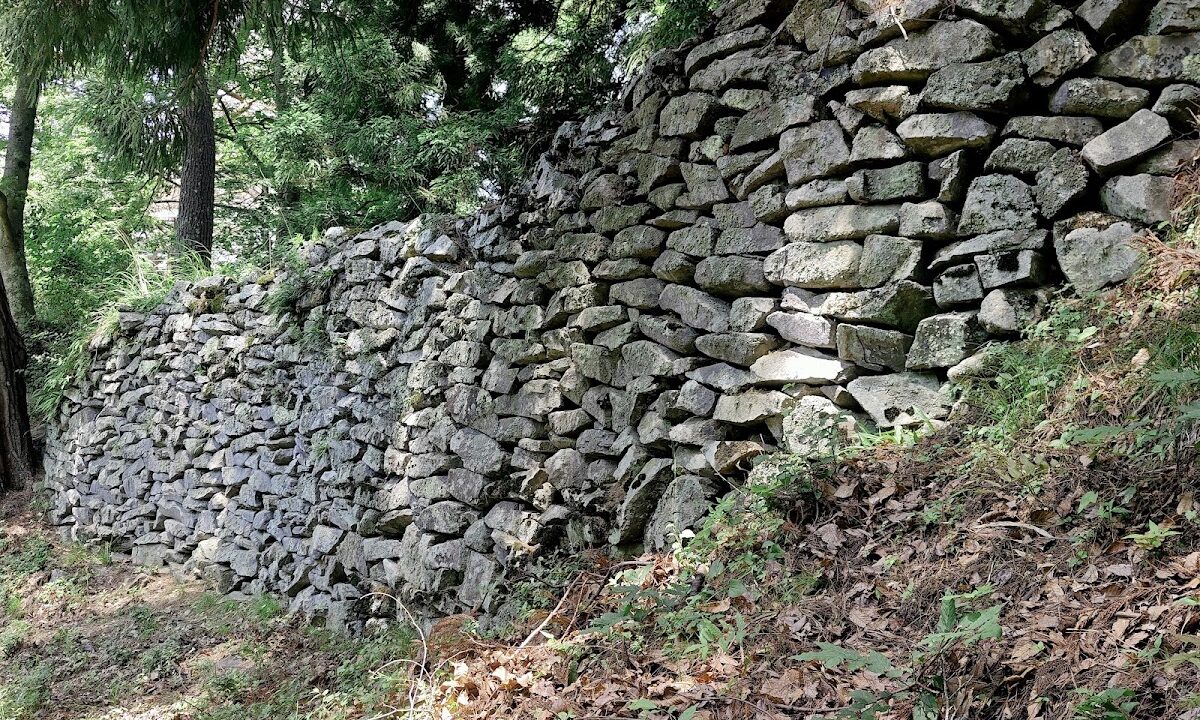
Stone Walls of the Second Bailey (The Main Highlight)
The stone walls remaining in the second bailey are an absolute must-see when visiting Yamaga Castle. Located behind the main bailey, these walls are highly valued by castle enthusiasts as a precious example of the castle-building techniques of the time.
The stone walls, constructed using the nozura-zumi technique, maintain a solid structure while utilizing natural stones. The stone walls, still standing after more than 400 years, are a testament to the formidable defenses of Yamaga Castle.
The stone walls reach several meters in height and are thought to have also functioned as a watchtower base. Combined with the surrounding earthworks and moats, they formed a strong defensive line.
Moats and Horizontal Moats
Yamaga Castle retains several moats, their scale and depth being truly impressive. The moats along the main approach to the castle, in particular, reach several meters in depth, completely cutting off the ridge.
Horizontal moats also surround each enclosure, functioning as effective defensive structures to restrict the movement of attackers. These dry moats are still clearly visible today, allowing us to experience the defensive system of a mountain castle from the Sengoku period.
Enclosures and Earthworks
Several enclosures are arranged in a stepped pattern, centered around the main enclosure and the second enclosure. Earthworks were built around each enclosure, enhancing its defensive capabilities. These earthen ramparts still remain today, reaching a height of about 1-2 meters, allowing us to imagine their original scale.
The interior of the enclosure is relatively flat and leveled, suggesting it was used for troop garrisons and storage of supplies.
View
From the mountaintop at an altitude of 234 meters, a magnificent panoramic view of the Yamagata Basin unfolds. On a clear day, you can see not only Yamagata Castle but also the Zao mountain range and Mount Gassan.
This view is precisely why Yamaga Castle was considered so important as a surveillance base; its location was ideal for detecting enemy movements early. Even today, this view continues to captivate visitors.
Access Methods and Castle Ascent Route
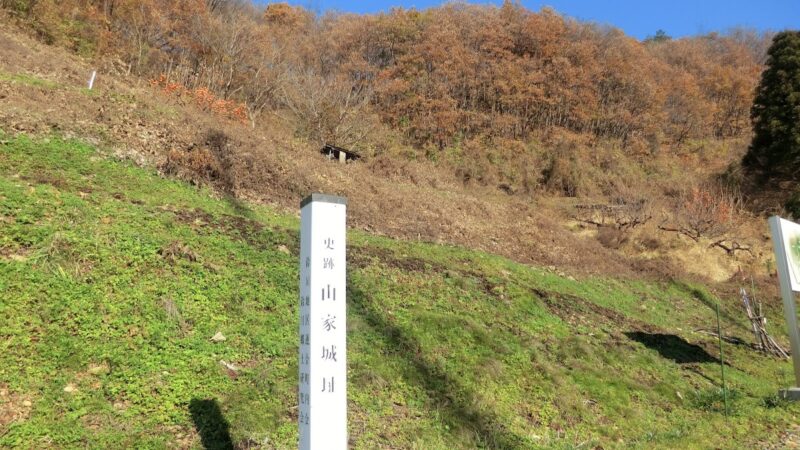
Access to the Castle Entrance
Access by Car:
- Approximately 15 minutes from the Yamagata Zao Interchange on the Yamagata Expressway
- The landmark for the castle entrance is a golf driving range (near the Kogen Golf Center)
- There is a signpost and the castle entrance on the north side of the golf driving range
- Parking space is limited, so please be careful not to park on the street.
Public Transportation:
- Take a bus from JR Yamagata Station towards “Kogen”
- Approximately 15-20 minutes on foot from the nearest bus stop
Castle Ascent Route
At the castle entrance, there is an information board explaining the history and highlights of Yamaga Castle. In May 2013, a long-awaited walking trail was completed, making it easier to climb the castle than before.
Climbing Time: Approximately 20-30 minutes from the entrance to the main keep
Difficulty: Intermediate (Suitable for those familiar with mountain trails)
Notes:
- Hiking boots or non-slip shoes are recommended
- Insect repellent is necessary in summer
- Be careful as the ground can be slippery during or after rain
- Climbing is difficult in winter due to snow
While the walking paths are well-maintained, there are steep slopes and uneven terrain characteristic of mountain castles, so please climb carefully. As you proceed, observing the remains such as moats and earthworks will help you understand the defensive structure of the mountain castle.
Nearby Attractions
Yamagata Castle (Kasumi Castle)
If you visit Yamaga Castle, be sure to also visit Yamagata Castle (Kasumi Castle Park). Expanded by Mogami Yoshiaki, Yamagata Castle is a flatland castle, in contrast to Yamaga Castle, and its vast layout and the reconstructed Ninomaru Otemon Yagura (main gate tower) are its highlights.
Visiting Yamaga Castle with an understanding of its historical background—that it fortified the eastern defenses of Yamaga Castle—will allow you to more deeply appreciate the relationship between the two castles.
Hasedo Castle
Located at roughly the same elevation as Yamaga Castle, Hasedo Castle was also an important branch castle during the time of Mogami Yoshiaki. Known as the site of a fierce battle during the Keicho Dewa Campaign, it was the historical stage where the Uesugi army led by Naoe Kanetsugu was repelled.
By visiting Yamaga Castle, Hasedo Castle, and Yamagata Castle, you can experience the Mogami clan’s defensive network.
Points to Note When Visiting Yamaga Castle
Clothing and Equipment
- Shoes: Hiking boots or trekking shoes are recommended. Sneakers are acceptable, but please choose non-slip shoes.
- Clothing: Long sleeves and long pants are recommended (to prevent insect bites and injuries from branches).
- Items to bring: Drinking water, towel, insect repellent (in summer), camera, binoculars (to enjoy the view).
Best time to visit
- Spring (April-May): Beautiful fresh greenery and mild weather. Ideal time to visit the castle.
- Summer (June-August): Many insects, so insect repellent is essential. Early morning visits are recommended.
- Autumn (September-November): Beautiful autumn foliage and excellent views. Ideal time to visit the castle.
- Winter (December-March): Difficult to visit the castle due to snow. Visits should be avoided.
Safety Precautions
- Avoid climbing the castle alone; it is recommended to visit in groups whenever possible.
- Check cell phone signal strength in advance.
- Be aware of sudden weather changes and avoid climbing the castle if necessary.
- Do not climb on stone walls or earthworks to protect the remains.
- Always take your trash with you.
Historical Value of Yamaga Castle
Yamaga Castle is a valuable historical site that preserves the typical structure of a mountain castle from the Sengoku period in excellent condition. It is particularly valued for the following reasons:
- Part of the Mogami Clan’s Branch Castle Network: Historically significant as a key strategic point in the eastern part of the defense system centered around Yamagata Castle.
- Remains of Stone Walls: Few mountain castles in Yamagata Prefecture have such well-preserved stone walls, making it valuable for understanding castle construction techniques.
- Preservation of the Layout: Clear remains of moats, lateral moats, earthworks, and baileys are preserved, conveying the appearance of a Sengoku period mountain castle to the present day.
- Local History: An important historical site that tells the history of the Yamaga clan, a powerful samurai group in the region.
Map
To access Yamaga Castle, it is recommended to search for “Yamagata Prefecture, Yamagata City, Takahara-cho” or “Takahara Golf Center” in advance using a map app or car navigation system. The entrance to the castle is located north of the golf driving range, and an information board is installed.
To explore the castle grounds, obtaining a layout map in advance will make it easier to understand the relative locations of the various remains. Castle layout maps are sometimes available on castle information websites such as Shirobito.
Points for Enjoying Yamaga Castle
Pre-visit Study
Before visiting Yamaga Castle, learning about the history of Mogami Yoshiaki and the Keicho Dewa Campaign will give you a deeper understanding of the castle’s historical background. Pre-visit study at the Yamagata City Local History Museum or the Mogami Yoshiaki Historical Museum is also recommended.
Photography
Photographing the stone walls of the second bailey from various angles will give you a good sense of its scale and structure. The morning light, in particular, beautifully illuminates the stone walls. The view from the mountaintop is also a popular photo spot.
Combining with Other Mogami Clan Historical Sites
Planning a “Mogami Clan Castle Tour,” visiting castles related to the Mogami clan such as Yamagata Castle, Hasedo Castle, and Kaminoyama Castle, will make for a more fulfilling historical exploration.
Summary
Yamaga Castle was an important mountain castle that served as the residence of the Yamaga clan, who supported Mogami Yoshiaki, and fortified the eastern defenses of Yamagata Castle. Built on a mountaintop at an altitude of 234 meters, the castle retains well-preserved remnants of the Sengoku period, such as stone walls, moats, lateral moats, and earthworks, conveying the appearance of a mountain castle from that era.
The stone walls of the second bailey are particularly noteworthy, maintaining their sturdy form even after more than 400 years. Thanks to a walking trail developed in 2013, it is now more accessible than before, and the castle ruins offer a panoramic view of the Yamagata Basin, allowing visitors to feel the romance of history.
When visiting Yamagata Prefecture, why not visit Yamaga Castle along with Yamagata Castle and reflect on the era of the Mogami clan? As a hidden gem where you can fully appreciate the charm of a Sengoku period mountain castle, it is a historical site that I highly recommend to castle enthusiasts.