Complete Guide to Otate Castle (Miyagi Prefecture) | Thorough Explanation of History, Remains, and Access Information
What is Otate Castle?
Otate Castle is a mountain castle located in Tateyama Yamada, Marumori-cho, Igu-gun, Miyagi Prefecture. It is a historical castle that was used for a long period from the late Heian period to the Sengoku period, and is an important historical site for understanding the medieval history of southern Miyagi Prefecture.
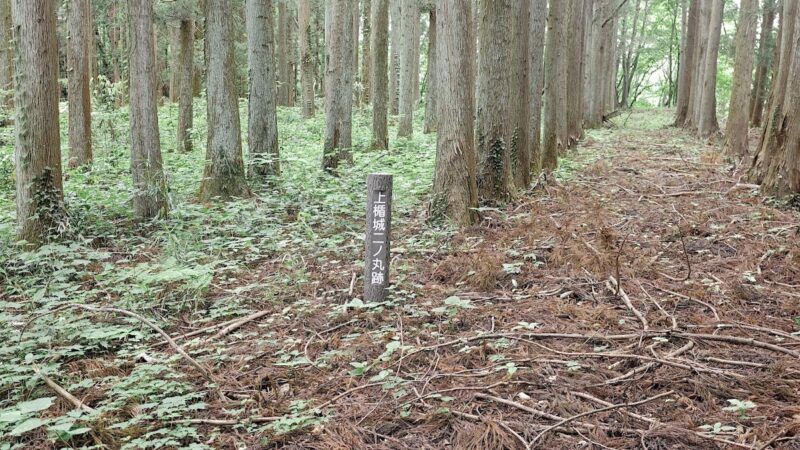
The current castle site is located on a hill called Tateyama, with the entrance to the castle near Shinryuin Temple. Although many parts are covered with vegetation, traces of defensive structures such as steep slopes can be seen, making it a worthwhile place for castle enthusiasts to explore.
History of Otate Castle
Construction in the Late Heian Period
Otate Castle is believed to have been built in the late Heian period by Igu Juro Nagahira. This period coincided with the height of the Oshu Fujiwara clan’s power expansion in the Tohoku region, and it is believed that Otate Castle functioned as a key base within the Fujiwara clan’s system of control.
The Igu clan was a local powerful family based in Igu County, and under the umbrella of the Oshu Fujiwara clan, they were entrusted with regional governance. Otate Castle served as their base of operations, playing a role in governing and defending the surrounding area.
Kamakura to Muromachi Periods
Even after the Oshu Fujiwara clan was destroyed by Minamoto no Yoritomo, Otate Castle continued to exist as an important regional stronghold. It is presumed that the Igu clan continued to rule this area from the Kamakura to the Muromachi period, although detailed records are limited.
During this period, while the Kamakura and Muromachi Shogunates exerted influence over the Tohoku region, local powerful families maintained their own independent power. Otate Castle, as a castle of such regional powers, witnessed the changing times.
Odate Castle in the Sengoku Period
During the Sengoku period (Warring States period), Odate Castle was incorporated into the sphere of influence of the Date clan. The castle’s lords recorded during this period are Tate Munemoto and Hosome Shurinosuke, both members of the Date clan.
The Date clan was a powerful daimyo in the Tohoku region, expanding their influence primarily in Miyagi Prefecture. They governed their territory by establishing numerous branch castles. Odate Castle was positioned as an important strategic point on the Date clan’s southern defense line, likely serving as a defense against hostile forces to the south, such as the Soma clan.
The Tate clan was a branch of the Date clan, ruling the area around Marumori. The Hosome clan is also known as a samurai who served the Date clan, suggesting that the two clans may have managed Odate Castle alternately or jointly.
Changes After the Early Modern Period
With the establishment of the Sendai Domain during the Edo period, Odate Castle is believed to have been abandoned. After losing its function as a modern castle, the area was used for farmland and forestry, and the remains gradually became buried by nature.
Although it is now recognized as a local historical heritage site, no full-scale archaeological excavations or restoration work has been carried out, so visitors must imagine its former appearance.
Structure and Remains of Odate Castle
Location and Layout
Odate Castle is a mountain castle built on a hill called Tateyama. While the elevation is not particularly high, there is a clear difference in elevation from the surrounding plains, utilizing terrain suitable for defense.
The castle’s layout (design) is presumed to be a series of interconnected enclosures centered on the mountaintop. It is thought that multiple enclosures (kuruwa: flat areas) were arranged around the main enclosure, each separated by defensive structures.
Cut Slopes
One of the main remains that can be confirmed today is the cut slope. A cut slope is a defensive structure created by artificially cutting a steep slope around an enclosure, serving to make enemy intrusion difficult.
While the overall structure of the cliffs at Otate Castle is difficult to grasp due to being covered in vegetation, clear traces of artificial construction can be seen in some areas. In particular, relatively clear cliffs are said to remain around the main enclosure.
Enclosures (Kuruwa)
Several flat areas exist within the castle grounds, and it is presumed that these functioned as enclosures (kuruma). The main enclosure is located at the mountaintop, and it is possible that the second and third enclosures were arranged along the ridge from there.
Currently, it is difficult to determine the exact extent and number of enclosures due to being covered with trees and vegetation, but it is possible to infer the original structure from the topography.
Possibility of Moats and Earthworks
While it is highly probable that Otate Castle also possessed moats (dry moats cutting across ridges) and earthworks (earthen defensive walls), which are common defensive structures for mountain castles, clear confirmation is difficult at present.
Further detailed surveys and investigations may lead to the discovery of these remains.
Highlights of Odate Castle
Shinryuin Temple and the Castle Entrance
Shinryuin Temple is an important landmark when visiting Odate Castle. This temple has an information board about Odate Castle, where you can learn about its history and overview.
From Shinryuin Temple, you will need to find the entrance to the castle grounds. However, there is no clearly maintained hiking trail, so this is a destination best suited for those with experience exploring castles. Appropriate equipment and prior research are necessary for your visit.
Experiencing a Historical Atmosphere
The greatest charm of Odate Castle lies in the opportunity to experience an “unspoiled mountain castle” that hasn’t been overly developed. As you search for the remains while pushing through the bushes, you can truly grasp the environment in which a medieval mountain castle was built.
By exploring while reflecting on the history of the castle, which was used for hundreds of years from the Heian period to the Sengoku period, you can feel closer to the medieval history of Miyagi Prefecture.
Surrounding Historical Landscape
Besides Odate Castle, numerous other medieval castle ruins are scattered around Marumori Town. Igu District has long been a strategically important transportation hub, and many warlords ruled this area. Visiting Odate Castle and the surrounding castle ruins allows for a deeper understanding of the region’s overall historical context.
Access to Otate Castle
Location
Address: Yamada, Tateyama, Marumori-cho, Igu-gun, Miyagi Prefecture
Access by Public Transportation
- Get off at Marumori Station on the JR Tohoku Main Line
- Approximately 10-15 minutes by car from the station
- Access by public transportation alone is difficult, so we recommend taking a taxi.
Access by Car
- Approximately 30 minutes from Shiroishi Interchange on the Tohoku Expressway
- Setting your navigation system to Shinryuin Temple will make it easier to find.
- Regarding parking, we recommend checking in advance whether there is parking space around Shinryuin Temple.
Precautions for Visiting
- Since there is no clearly maintained hiking trail, mountain hiking equipment is necessary.
- There are areas with dense undergrowth, so wear long sleeves, long pants, and work gloves.
- In the summer, we recommend bringing insect repellent spray.
- Avoid visiting alone; it is safer to go in a group.
- Please be considerate of local residents and refrain from trespassing on private property.
Odate Castle and Surrounding Castles
Medieval Castles of Miyagi Prefecture
Miyagi Prefecture has many medieval mountain castles, such as Odate Castle. While the famous Sendai Castle (Aoba Castle) is a modern castle, mountain castles were built throughout the region in earlier times, serving as centers of regional control.
- Shiraishi Castle: A modern castle known as the residence of the Katakura clan, a senior retainer of the Date clan.
- Taga Castle: An ancient fortified settlement, a base for controlling Oshu (northern Japan).
- Wakutani Castle: The residence of the Wakutani Date clan.
- Kanayama Castle: Another medieval castle within Igu District.
Visiting these castles together will provide a deeper understanding of Miyagi Prefecture’s castle history.
Castles Related to the Date Clan
Odate Castle came under the control of the Date clan during the Sengoku period, but the Date clan had numerous branch castles within Miyagi Prefecture.
- Iwakiri Castle: An important base of the Date clan located in Sendai City
- Tateyama Castle (Akiu): The residence of the Akiu clan, subordinate to the Date clan
- Nagadate Castle: A castle in the Natori River basin
By visiting these castles related to the Date clan, one can understand the structure of the Date clan’s territorial control.
Research and Study of Odate Castle
Current Research Status
Regarding Odate Castle, a full-scale academic investigation has not yet been sufficiently conducted. Historical documents are limited, and many aspects of the castle’s detailed structure and history remain unclear.
On the other hand, visit records and photographs by castle enthusiasts are gradually accumulating, and information is being shared among visitors on websites such as Kojodan. These citizen-level records are also valuable resources for understanding the actual state of the castle.
Future Challenges and Possibilities
To re-evaluate the value of Odate Castle and pass it on to future generations, the following initiatives are expected:
- Academic Research: Reveal the precise structure of the castle through archaeological excavations and surveys.
- Documentary Research: Clarify the castle lord and historical events through careful examination of ancient documents and local historical materials.
- Preservation and Development: Implement preservation measures for important remains and develop viewing paths.
- Information Dissemination: Strengthen information provision to visitors by improving signboards and creating explanatory materials.
If these initiatives progress, Odate Castle will be recognized as an even more important historical site for learning about the medieval history of Miyagi Prefecture.
Significance of Visiting Odate Castle
As a Place for Historical Learning
Odate Castle offers an excellent opportunity to learn about local history that is not found in textbooks. Standing at the actual castle ruins allows you to truly experience the historical transformations this region underwent, from the Heian period to the Sengoku period.
In particular, Otate Castle holds significant importance as a historical site symbolizing the political upheavals in the Tohoku region, from the era of the Oshu Fujiwara clan to the era of the Date clan.
The Joy of Castle Exploration
Unlike well-maintained tourist destinations, Otate Castle is a castle ruin with a strong element of “exploration.” The joy of discovering remains hidden in the bushes and the pleasure of imagining its former appearance from the topography are unique pleasures for castle enthusiasts.
While not suitable for beginners, it is a rewarding destination for those with some experience in castle exploration.
Deepening Regional Understanding
Otate Castle also provides important clues for understanding the region of Marumori Town and Igu District. By considering why the castle was built in this location and what geographical and political conditions were present, the origins of the region become clearer.
Learning about local history deepens our understanding of and affection for the land.
Summary
Ōdate Castle is a mountain castle located in Marumori Town, Igu District, Miyagi Prefecture, dating from the Heian period to the Sengoku period. Built by Igu Jūrō Nagahira, it was used for a long period, from the time of the Ōshū Fujiwara clan to the time of the Date clan.
Currently, many parts are covered with vegetation, and equipment and preparation are necessary for a visit, but it is possible to see remains such as cliffs. With Shinryūin Temple as the entrance, it is a valuable historical site where you can experience the atmosphere of a medieval mountain castle.
For those interested in the medieval history of Miyagi Prefecture, or those who enjoy exploring castles, Ōdate Castle is a place worth visiting. Visiting it along with other surrounding castles will provide a deeper understanding of history.
The charm of Ōdate Castle lies in the opportunity to experience a “mountain castle in its original state,” without over-maintaining it. Please experience the joy of exploring while confirming the traces of history with your own eyes and using your imagination.