Complete Guide to Iji Castle (Miyagi Prefecture) | A Thorough Explanation of the History and Remains of Ancient Tohoku Castle Ruins
What is Iji Castle?
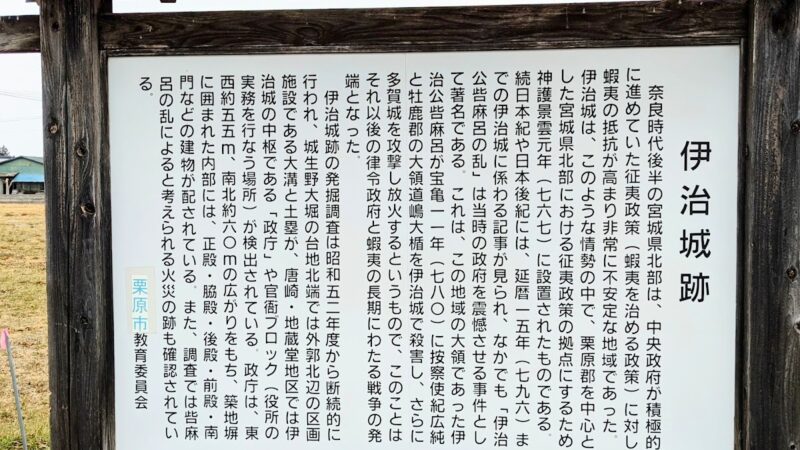
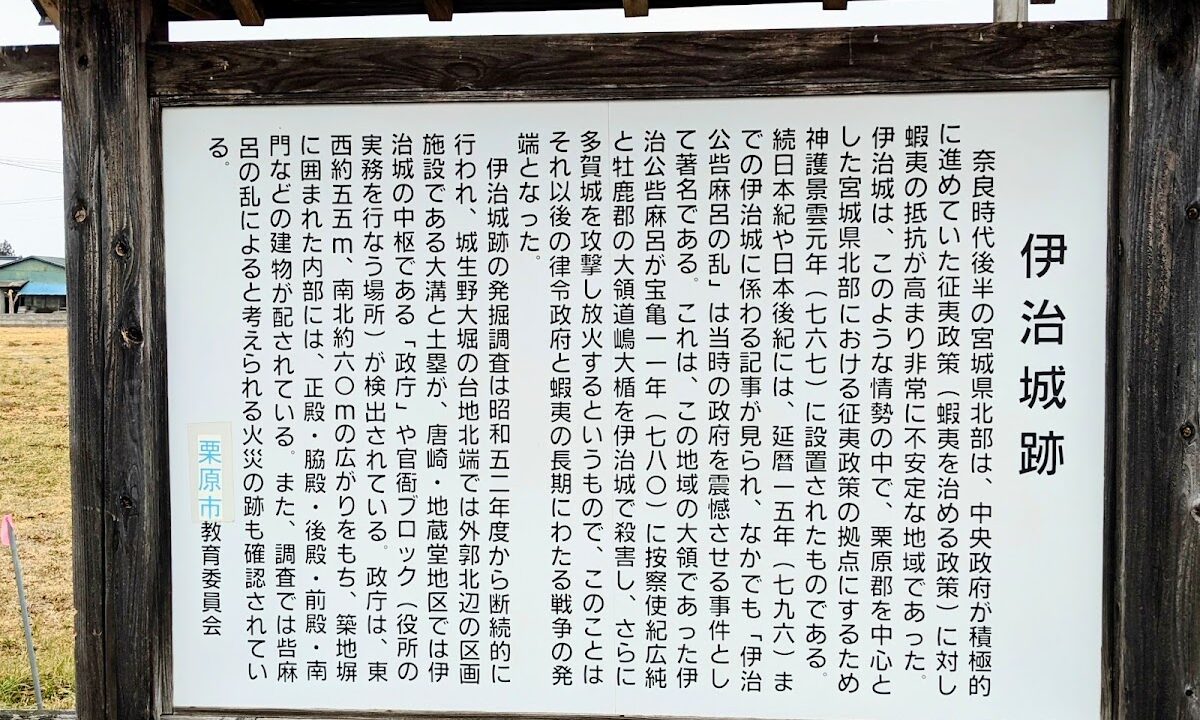
Iji Castle (also known as Korehari Castle or Koreharu Castle) is a castle ruin from the Nara period located in Tsukidate, Kurihara City, Miyagi Prefecture. It was an important military and administrative base constructed in 767 AD (Jingo-Keiun 1) by the Ritsuryo state for the management of the inland (mountain roads) area of ancient Mutsu Province. It is now designated a National Historic Site.
The castle ruins were designated a National Historic Site on August 27, 2003 (Heisei 15), and additional designations were made on July 14, 2005 (Heisei 17). As a base of control for the Ritsuryo government in the ancient Tohoku region, it played a leading role in the expansion of power northward from Taga Castle.
Pronunciation and Name of Iji Castle
There are several theories regarding the pronunciation of Iji Castle, including “Ijijō,” “Koreharijō,” and “Koreharujō.” Some historical documents also refer to it as “此治城.” While modern research generally uses “Ijijō” or “Koreharijō,” the pronunciation “Koreharujō” is also popular locally.
Historical Background of Iji Castle
Construction History and Purpose
Iji Castle was built in 767 (Jingo-Keiun 1) by the Ritsuryo state to serve as a base for managing the inland (mountainous) areas of Mutsu Province, particularly the region centered around Kurihara County. According to the *Shoku Nihongi*, the construction was spearheaded by the Chinju Shogun Tanaka no Tadamaro and others, with Michishima no Miyama of Oshika County playing a key role as the local manager. It is recorded that the castle was completed in a remarkably short period of about one month.
The Ritsuryo government at the time sought to strengthen its control over the inhabitants of the Tohoku region, known as the Emishi, and was expanding its influence northward from its base in Tagajo. Iji Castle was located approximately 50 km north of the provincial capital, Tagajo, and was a strategically important point midway between Iji Castle and Izawa Castle (Oshu City, Iwate Prefecture), where a garrison was later established.
The Iji Azamaro Rebellion (Hoki Rebellion)
The most important event in the history of Iji Castle is the “Iji Azamaro Rebellion,” which occurred in 780 (Hoki 11). Iji Azamaro was an Emishi chieftain who cooperated with the Ritsuryo government and was employed as the Azechi (inspector) of Iji Castle.
In March of the 11th year of the Hōki era (879 AD), Iji Azamaro suddenly launched a rebellion, killing his superior, Mutsu no Azechishi (Inspector of Mutsu Province), Ki no Hirozumi. This escalated into a large-scale uprising, burning down Iji Castle and attacking Taga Castle. This rebellion, also known as the “Hōki Rebellion,” dealt a major blow to the Ritsuryo government’s administration of the Tohoku region.
The rebellion is believed to have stemmed from the harsh rule of the Ritsuryo government and discriminatory treatment of the Emishi people. It has been suggested that Iji Azamaro, despite receiving an official rank from the imperial court, may have been treated unfairly due to his Emishi origins.
Iji Castle After the Rebellion
Iji Castle was destroyed by fire during Iji Azamaro’s rebellion, but historical records regarding its subsequent history are limited, leaving many details unclear. Archaeological excavations suggest that some form of facility may have been maintained after the rebellion, but it is believed that it lost its function as a large-scale fortified settlement. The Ritsuryo government, using this rebellion as a catalyst, revised its policy for governing the Tohoku region, shifting its focus to the construction of castles further north, such as Izawa Castle (built in 802) and Shiwa Castle (built in 803). The exact date of Iji Castle’s abandonment is unclear, but it is presumed to have gradually lost its functionality from the early to mid-9th century.
Location and Geographical Conditions of Iji Castle
Geographical Location
The Iji Castle ruins are spread across the Ohori moat and Karasaki fort in Tsukidate, Kurihara City, Miyagi Prefecture. It sits on a river terrace at the foot of the Tsukidate Hills, which branch eastward from the Ou Mountains, and is situated between two rivers, the Hazama River (Ichihazama River) and the Nihazama River. The Nihazama River flows eastward to the north, and the two rivers merge to the northeast.
It is located approximately 50 km north of the provincial capital, Tagajo, and was an important relay point on the ancient mountain road (inland route). This location is a crucial transportation hub connecting the Pacific coastal road and the inland mountain roads, making it an extremely important location militarily and administratively.
Topographical Features and Defensiveness
The river terrace on which Iji Castle was built is higher than the surrounding area, giving it a topographical advantage as a natural stronghold. The terrain, sandwiched between two rivers, functioned as a natural defensive line, making it difficult for enemies to approach.
The flat area on the terrace was suitable for arranging buildings such as government offices and barracks, and also provided excellent visibility of the surrounding area. Such locational conditions are typical of the selection criteria for ancient castles and fortifications, and are also common features of castles such as Taga Castle and Izawa Castle.
Structure and Scale of Iji Castle
Overall Structure of the Fortification
Excavation results have revealed that Iji Castle was a large-scale fortification, measuring approximately 900m from north to south and 700m from east to west. The basic structure of the fortified enclosure was a triple-layered structure, similar to that of Taga Castle, with the central “administrative office” surrounded by an “inner enclosure,” and further surrounded by an “outer enclosure.”
The fortified enclosure was demarcated by earthen ramparts and wooden walls (muiding walls), which functioned as defensive structures. It is believed that particularly important sections were equipped with more robust mud walls.
Structure of the Administrative Office
The administrative office was located in the center of the fortified enclosure and served as the central administrative and ceremonial facility of Iji Castle. Archaeological excavations have confirmed the presence of multiple large post-and-beam buildings within the administrative office area. These buildings are presumed to have consisted of a main hall for conducting ceremonies and government affairs, and side halls where officials carried out their duties.
The layout of the administrative office buildings was symmetrical, centered around the main hall, and followed the architectural style of government offices in the Ritsuryo state. The scale and layout of the buildings indicate that Iji Castle was not merely a military facility, but rather a strong administrative center for the region centered around Kurihara County.
Inner and Outer Enclosures
The inner enclosure was the area surrounding the government office, functioning as a defensive space for the office and for the placement of important facilities. It is believed that barracks, warehouses, and residences for officials were located within the inner enclosure.
The outer enclosure was a vast area further outside the inner enclosure, containing residential areas for ordinary soldiers and laborers, workshops, and stables. While the exact boundaries of the outer enclosure are not fully determined, archaeological excavations have confirmed a portion of its outline.
Earthen Walls and Embankments
Earthen walls and embankments played an important role as facilities that demarcated the perimeter of the castle. Earthen walls are structures made of compacted earth with a roof, a typical defensive facility of the Ritsuryo period, also used at Taga Castle and other sites.
Archaeological excavations have confirmed the foundations of earthen walls and traces of embankments in various locations. These remains reveal that Iji Castle was a large-scale, systematically designed fortified settlement. The scale and structure of the earthworks are thought to have varied according to the importance of the fortified settlement and the need for defense.
History and Results of Archaeological Excavations
Controversy Surrounding the Location of the Site
There has been much debate regarding the location of the Iji Castle ruins since the Edo period. While the name Iji Castle appears in historical documents, there is no clear description of its specific location, and various theories have been proposed by researchers.
Several locations within Kurihara City have been suggested as candidate sites, and the debate continued for many years. The suggestion that the place name Jōno originates from “Jōno no ni” (castle field), and local legends have been used as clues to determining the location.
Determination of Location Through Archaeological Excavations
From 1977 (Showa 52) to 1979 (Showa 54), archaeological excavations were conducted by the Miyagi Prefecture Tagajo Ruins Research Institute. This investigation uncovered the remains of an ancient castle and fortification in the Shiroino district of Tsukidate Town (present-day Shiroino, Tsukidate, Kurihara City).
Based on the dating of the excavated pottery and the characteristics of the remains, it was determined that this site is highly likely to be Iji Castle, as recorded in the *Shoku Nihongi* (Continued Chronicles of Japan). This brought a tentative resolution to a long-standing debate.
Continued Investigation by the Tsukidate Town Board of Education
Since 1987 (Showa 62), the Tsukidate Town Board of Education (present-day Kurihara City) has been continuously conducting excavation surveys. These surveys have gradually revealed the specific details of Iji Castle.
A wide range of information has been accumulated, including the layout of buildings in the administrative area, the extent of the inner and outer enclosures, the structure of the earthen walls and ramparts, and the contents of the excavated artifacts. Investigations are still ongoing, and new discoveries are expected.
Excavated Artifacts and Archaeological Findings
Haji Ware and Sue Ware
A large quantity of Haji ware and Sue ware has been excavated from the Iji Castle site. These pottery vessels were used in daily life and rituals within the castle grounds and date from the late 8th to early 9th centuries.
Haji ware is unglazed pottery used as cooking jars and tableware. Sue ware is hard pottery fired at high temperatures and used as more luxurious tableware and storage containers. The forms and manufacturing techniques of these vessels provide insights into the lifestyle and technological level of the time.
Rod-shaped Stone Artifacts and Tools
A distinctive artifact is the discovery of rod-shaped stone artifacts. These are tools made from processed stone and are thought to have been used for various purposes. Iron tools have also been found, indicating their use in construction and daily repair work within the castle grounds.
Discovery of Medieval Pottery
In addition to ancient artifacts, medieval pottery has also been unearthed at the Iji Castle ruins. This indicates that the site continued to be used in some form even after Iji Castle was abandoned. It is possible that a settlement or small residence existed here during the medieval period.
Ink-Inscribed Pottery and Written Documents
Several pieces of ink-inscribed pottery have also been unearthed, indicating the existence of documentary administration and a literate class within the castle grounds. These written documents provide evidence that Iji Castle was not merely a military facility, but an administrative office with government functions.
Iji Castle and the Ancient Tohoku Castle Network
Relationship with Taga Castle
Iji Castle played a role in the castle network centered around Taga Castle, where the Mutsu Provincial Government was located. Taga Castle, founded in 724, was the most important base for the administration of Mutsu Province, and Iji Castle functioned as a front-line base located approximately 50 km north of it.
From Tagajo, advances to the north were attempted via two routes: a coastal route and an inland mountain route. Iji Castle was strategically located on the mountain route and played a crucial role as a base for controlling the inland area, primarily Kurihara County.
Relationship with Izawa Castle and Shiwa Castle
After the Iji Azamaro Rebellion, the Ritsuryo government shifted its base of operations for the Tohoku region further north. Izawa Castle (Oshu City, Iwate Prefecture) was constructed in 802, and Shiwa Castle (Morioka City, Iwate Prefecture) in 803.
Iji Castle was located almost midway between Tagajo and Izawa Castle, and served as an important relay point on the transportation routes connecting these fortresses. The geographical location of Iji Castle held strategic importance for communication and the transport of goods between the fortresses.
Comparison with Other Fortresses
Many other ancient fortresses were built in the Tohoku region besides Iji Castle. Well-known examples include Akita Castle (Akita City, Akita Prefecture), Haruta-saku (Daisen City, Akita Prefecture), and Tokutan Castle (Yahaba Town, Iwate Prefecture).
Compared to these castles and fortifications, Iji Castle is classified as medium-sized, but its location and structure exhibit typical characteristics of castles and fortifications from the Ritsuryo period. Many common elements can be seen, such as the triple-tiered structure centered around the government office, the division by earthen walls, and the planned arrangement of buildings.
National Historic Site Designation and Cultural Property Value
History of Historic Site Designation
Iji Castle ruins were designated a national historic site on August 27, 2003 (Heisei 15). This was in response to the revelation of the site’s importance through archaeological excavations. Furthermore, on July 14, 2005 (Heisei 17), an additional designation was made, expanding the scope of the historic site.
National historic site designation means that the site has been recognized as having “high historical or academic value for Japan.” The Iji Castle ruins are a crucial historical site for understanding the history of ancient Tohoku, and are protected by the government.
Importance as a Cultural Property
The cultural value of the Iji Castle ruins lies in the following points:
Firstly, it is a valuable site that reveals the actual state of administration in Tohoku by the Ritsuryo state. Archaeological evidence reveals the specific structure, scale, and operation of the fortifications, which cannot be learned from written historical sources alone.
Secondly, it is the site of the Iji Azamaro Rebellion, a significant historical event. This rebellion is extremely important for understanding the relationship between the Ritsuryo government and the Emishi people, and the realities of ancient Tohoku society. Preserving the site is of great historical significance.
Thirdly, it serves as a standard source for studying the structure and changes of ancient fortifications. The results of the Iji Castle excavation have been utilized in the study of other fortification sites, and it occupies an important position as fundamental material for the study of ancient Tohoku history.
Site Visit and Access Information
Development as a Historical Park
Kurihara City has developed the Iji Castle ruins into a historical park and opened it to the public. Some of the remains revealed by archaeological excavations are displayed on the ground surface, allowing visitors to experience the scale and structure of the ancient castle.
Information boards are installed on-site, allowing visitors to learn about the history and remains of Iji Castle. However, prioritizing the preservation of the ruins, no building reconstructions have been carried out. Many of the remains have been backfilled and protected.
Access Methods
Using Public Transportation
- Approximately 15 minutes by taxi from JR Tohoku Shinkansen “Kurikoma-Kogen Station”
- Approximately 20 minutes by bus or taxi from JR Tohoku Main Line “Semine Station”
Using a Car
- Approximately 10 minutes from Tohoku Expressway “Tsukidate IC”
- Accessible via Prefectural Road from National Route 4
Parking is available, but it is not large. Admission is free, and the site is open year-round. However, visits may be difficult during winter due to snow.
Related Facilities in the Surrounding Area
To deepen your understanding of the Iji Castle Ruins, we recommend visiting the following facilities:
Kurihara City Kurihara Cultural Center
Exhibits artifacts and research findings from the Iji Castle Ruins. Models and video materials are also available, helping to grasp the overall picture of the ruins.
Taga Castle Ruins (Tagajo City, Miyagi Prefecture)
The ancient center of Tohoku where the Mutsu Provincial Government was located. Visiting this site in conjunction with Iji Castle is recommended to understand its relationship to Iji Castle.
Izawa Castle Ruins (Oshu City, Iwate Prefecture)
An important fortified site built after Iji Castle. It is useful for understanding the development of ancient fortified sites.
Current Status and Challenges of Iji Castle Research
Unresolved Issues
While much has been revealed about Iji Castle through archaeological excavations, several issues remain unresolved.
The biggest issue is the exact date of Iji Castle’s abandonment. After its destruction during the Iji Azamaro Rebellion, the extent of reconstruction and the exact date of its complete loss of function remain unclear.
Furthermore, the exact boundaries of the outer fortifications are not fully determined. Further investigation is needed to accurately understand the overall scale of the fortifications.
Future Research Directions
Future research is expected to address the following issues:
Firstly, to advance archaeological excavations in unexplored areas to clarify the overall picture of the fortifications. Determining the boundaries of the outer fortifications is a particularly important task.
Secondly, to clarify the realities of life and production activities within the fortifications through detailed analysis of excavated artifacts. Analysis of pottery origins and research on plant and animal remains are effective methods.
Thirdly, to comprehensively examine historical documents and archaeological findings to gain a deeper understanding of Iji Castle’s historical position. Further research is needed, particularly regarding the background and impact of the Iji Azamaro Rebellion.
Efforts for Preservation and Utilization
Kurihara City is continuously working on the preservation and utilization of the Iji Castle ruins. While ensuring the proper preservation and management of the site, efforts are also being made to utilize it for education and tourism.
Local schools use the Iji Castle ruins as teaching material for local history lessons, providing children with an opportunity to learn about the region’s history. Regular on-site explanation sessions and symposiums are also held, disseminating research findings to the public.
Future challenges include strengthening information dissemination and improving the guide system to make the value of Iji Castle known to more people. Visualization of the ruins using digital technology is also being considered.
Summary: The History of Ancient Tohoku as Told by Iji Castle
Iji Castle is a valuable historical site that conveys the history of the Ritsuryo state’s administration of Tohoku. Although its history spans only a little over a decade, from its construction in 767 AD to its abandonment after the Iji Azamaro Rebellion in 780 AD, significant historical turning points in ancient Tohoku occurred during that time.
The structure of the castle and the artifacts unearthed through archaeological excavations reveal aspects of society at the time that cannot be learned from written historical records alone. The planned layout centered around the government office, the traces of large-scale civil engineering works, and the diverse artifacts suggest the organizational strength of the Ritsuryo government and the magnitude of the resources invested in this region.
At the same time, the Iji Azamaro Rebellion demonstrates that the rule of the Ritsuryo state was not one-sided, but unfolded within a tense relationship with local society. Iji Azamaro’s actions, as a chieftain of the Emishi people who served the imperial court while simultaneously rebelling, illustrate the complexity of ancient Tohoku society and the difficulties of the relationship between rulers and the ruled.
The Iji Castle ruins, as an important cultural asset that conveys the history of ancient Tohoku to the present day, will continue to be preserved, researched, and utilized. When visiting Kurihara City in Miyagi Prefecture, we highly recommend visiting this historical site and reflecting on the lives of people from over 1200 years ago.