
Complete Guide to Watari Castle (Miyagi Prefecture): A Thorough Explanation of Gagyūjō, Associated with Date Shigezane and Katakura Kagetuna
What is Watari Castle?
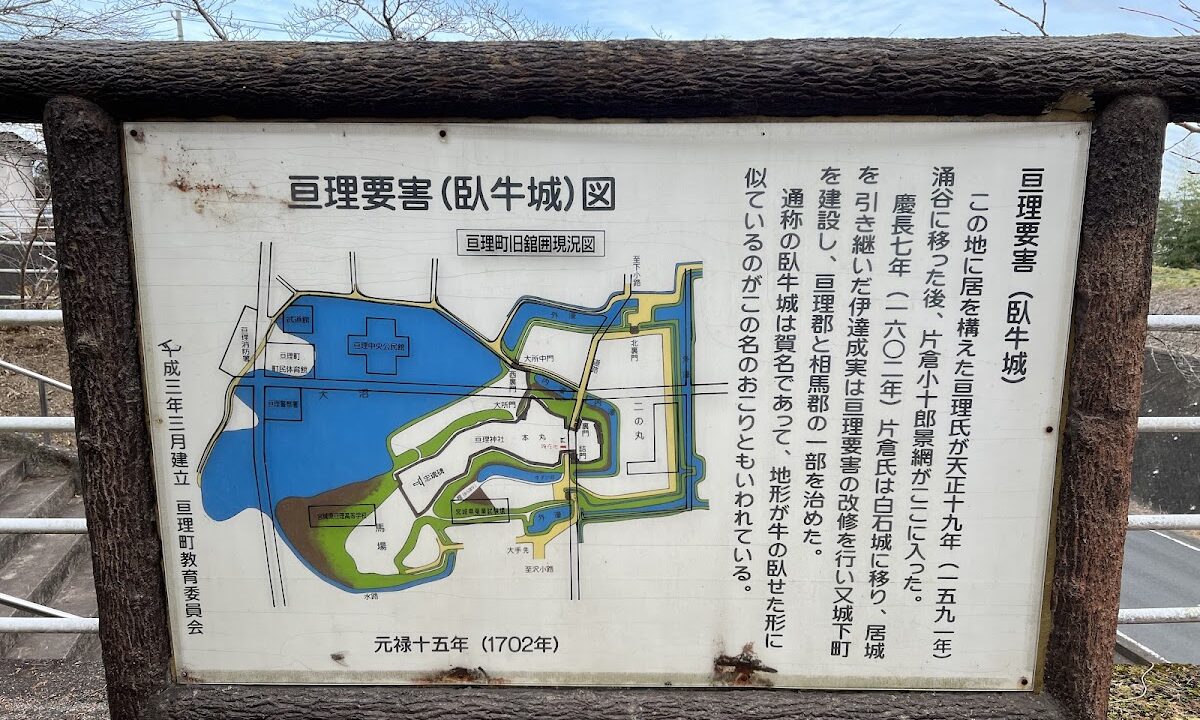
Watari Castle (Watari-jō) was a flatland castle located in Watari-cho, Watari-gun, Miyagi Prefecture. It was also known as Gagyūjō or Watari Yōgai. Its name comes from the fact that the castle’s terrain resembled the shape of a reclining ox.
It is known for being the castle lord of two renowned generals, Katakura Kagetuna (Katakura Kojūrō) and Date Shigezane, who were considered the right-hand men of Date Masamune. It played an important role as a key southern stronghold of the Sendai Domain. Currently, Watari Shrine stands on the site of the main keep, enshrining Date Shigezane.
History and Background of Watari Castle
From Construction to the Watari Clan Era
Watari Castle is believed to have been built during the Tensho era (1573-1592), by Watari Motomune. The Watari clan was a family descended from the Kanmu Taira clan and ruled this region for a long time.
Initially, the Watari clan was subordinate to the Date clan, but maintained its own power amidst the complex political situation of the Sengoku period. However, with the expansion of Date Masamune’s power, they were eventually incorporated under the Date clan’s control.
The Era of Katakura Kagetuna (1591-1602)
In 1591 (Tensho 19), the Watari clan was transferred due to Toyotomi Hideyoshi’s pacification of Oshu. Subsequently, Katakura Kagetuna (Katakura Kojuro), a close confidant of Date Masamune, became the lord of Watari Castle.
Katakura Kagetuna was known as a brilliant general possessing both wisdom and courage, and was one of the foremost retainers who supported Date Masamune. Kagetuna ruled Watari Castle for approximately 11 years, stabilizing the administration of the region.
In 1602 (Keicho 7), following the distribution of rewards after the Battle of Sekigahara, Katakura Kagetuna was transferred to Shiroishi Castle. Shiroishi was a strategic point in the southern part of the Date territory, indicating that Kagetuna’s abilities were highly valued.
The Era of Date Shigezane (1602-1660)
When Katakura Kagetuna moved to Shiroishi Castle, Date Shigezane became the lord of Watari Castle. Date Shigezane was a cousin of Date Masamune and, along with Katakura Kagetuna, was a highly regarded retainer of the Date family.
Shigezane was a fierce warrior feared as “Oni no Kojuro” (Demon Kojuro), and achieved military success in numerous battles. Although he was at odds with Masamune for a time and even fled, he later reconciled with him and ended his life as the lord of Watari Castle.
Shigezane ruled this area for approximately 58 years until his death at Watari Castle in 1660 (Manji 3). During that time, he dedicated himself to the development of the castle town and the territory, making a significant contribution to the development of Watari.
The Era of the Watari Date Clan
After the death of Date Shigezane, his descendants, the Watari Date clan, served as lords of the castle for generations. Throughout the Edo period, the Watari Date clan continued to govern this area as an important branch of the Sendai Domain.
During the turbulent period at the end of the Edo period, Date Kuninari played an active role as the head of the clan. After the Meiji Restoration, the Watari Date clan is also known for participating in the development of Hokkaido and laying the foundation for present-day Date City, Hokkaido.
The Abandoned Castle and the Present
In 1870 (Meiji 3), prior to the abolition of the feudal domains and establishment of prefectures, Watari Castle was abandoned. Since then, the castle grounds have gradually been developed. Watari Shrine was built on the site of the main keep, the former horse training ground became the site of Watari High School, and the second bailey became the site of a supermarket, indicating increasing urbanization.
The Structure and Layout of Watari Castle
Basic Structure of the Castle
Watari Castle is classified as a hilltop castle, built on a hilly area on the south bank of the Abukuma River. Although its elevation is low, it occupies a strategic location overlooking the surrounding plains.
The castle grounds consisted of the main keep, the second bailey, the third bailey, and the horse training ground. Defensive features included a horizontal moat (water moat), and the layout skillfully utilized the natural terrain.
Main Enclosures
The Honmaru (main enclosure) was the core of the castle, and is now home to Watari Shrine. Located at the highest point, it is believed to have housed the lord’s residence and other important buildings.
The Ninomaru (second enclosure) was an important area protecting the Honmaru, and is believed to have contained the residences of retainers and administrative facilities. Currently, the area has been urbanized, with supermarkets and other commercial facilities.
The Baba (horse riding ground) was used for military training and equestrian practice, and is now the site of Watari High School.
Defensive Structures
A notable defensive feature of Watari Castle is the Yokobori (water moat). The remains of the inner moat still exist in the former Tate Park, offering a glimpse into the castle’s defensive system.
The water moat was a crucial defensive line protecting the castle and played a vital role in preventing enemy incursions. In the case of Watari Castle, it is believed that the surrounding water system was utilized to create an effective water moat.
Highlights and Existing Remains of Watari Castle
Watari Shrine (Main Enclosure Site)
Watari Shrine stands on the site of the current main enclosure, enshrining Date Shigezane, the castle’s lord. The shrine grounds evoke the atmosphere of the former main enclosure, making it a must-see spot for castle enthusiasts.
Watari Shrine remains a center of local faith, attracting many worshippers. It is particularly lively during New Year’s and the annual festival, serving as a core of the local community.
Remains of the Inner Moat at Former Tate Park
Located south of Watari Shrine, Former Tate Park preserves the valuable remains of the inner moat. This is one of the few remaining structures of Watari Castle and an important historical site that allows visitors to experience the castle’s defensive system.
The inner moat is preserved with water, evoking the appearance of the castle in its heyday. Because it is maintained as a park, visitors can stroll through the area and reflect on history.
Relocated Gates
Some of the gates of Watari Castle have been relocated to other locations within the town and still exist today. These relocated gates are protected as valuable cultural assets that convey the architectural techniques of the Edo period.
Traces of the Fortifications
Even in today’s urbanized area, traces of the fortifications can be found with careful observation. The differences in elevation and the layout of the roads allow us to sense the remnants of the original castle layout.
Figures Associated with Watari Castle
Date Shigezane (1568-1660)
Date Shigezane was a prominent lord of Watari Castle. Born as a cousin of Date Masamune, he grew up alongside Masamune from a young age. A fierce warrior known as “Oni no Kojuro” (Demon Kojuro), he achieved military success in numerous battles.
Shigezane’s work, “Shigezane-ki,” is an important historical document for understanding the achievements of Date Masamune. In his later years, he dedicated himself to governing his domain in Watari and lived to the ripe old age of 92.
Katakura Kagetuna (1557-1615)
Katakura Kagetuna (Katakura Kojuro) was a renowned general known as a strategist for Date Masamune. He possessed exceptional intelligence and supported Masamune’s ambition to conquer Japan.
During his time as lord of Watari Castle, Kagetuna stabilized the administration of his territory and played an important political role as a close confidant of Masamune. Even after moving to Shiroishi Castle, the Katakura family continued to support the Sendai Domain as lords of Shiroishi Castle for generations.
Watari Motomune
Watari Motomune, the builder of Watari Castle, was the head of the Watari clan, who ruled this region. While maintaining their own power amidst the turmoil of the Sengoku period, they ultimately became subordinate to the Date clan.
The Watari Castle, built by Motomune, was later improved and expanded by Katakura Kagetuna and Date Shigezane, developing into an important base for the Sendai Domain.
Date Kuninari (1841-1904)
He was the head of the Watari Date clan, who was active from the end of the Edo period to the Meiji era. He fought as a member of the Sendai Domain during the Boshin War, but after the Meiji Restoration, he dedicated himself to the development of Hokkaido.
Kuninari migrated to Hokkaido with the people of Watari, laying the foundation for what is now Date City, Hokkaido. This migration is known as the “Watari-Date Migration” and is an important chapter in the history of Hokkaido’s development.
Access and Visiting Information
Location
Kyukan, Watari-cho, Watari-gun, Miyagi Prefecture (Watari Shrine)
Transportation Access
Access by Train:
- Approximately 15 minutes on foot (approx. 1.1 km) from JR Joban Line “Watari Station”
- Approximately 40 minutes by rapid train from Sendai Station to Watari Station
Access by Car:
- Approximately 5 minutes from Joban Expressway “Watari IC”
- Approximately 40 minutes from central Sendai via National Route 6
Parking
Watari Shrine has parking spaces for visitors. There are also parking spaces available at Kyukan Park.
Visiting Hours
The grounds of Watari Shrine are generally open for free visits. Kyukan Park is also open as a park and can be visited anytime during the day.
Points to Note During Your Visit
- Experience the atmosphere of the main castle grounds at Watari Shrine
- Confirm the remains of the inner moat at Former Tate Park
- Observe the surrounding topography and imagine the layout of the castle in its heyday
- If possible, visit the relocated gate as well
Nearby Tourist Attractions
Daioji Temple (Graves of the Successive Lords of Watari, the Date Clan)
This temple houses the graves of successive lords of the Watari Date clan, including Date Shigezane. It is an important historical site that should be visited in conjunction with Watari Castle.
Watari Town Local History Museum
This facility allows you to learn about the history and culture of Watari, and features exhibits related to Watari Castle and the Watari Date clan. Visiting before visiting the castle ruins will deepen your understanding.
Arahama Coast
A beautiful coastline facing the Pacific Ocean, this spot allows you to enjoy the nature of Watari Town. Although it suffered tsunami damage from the Great East Japan Earthquake, reconstruction is progressing.
Ozutsumi Castle Ruins
The ruins of Ozutsumi Castle, which functioned as a subsidiary castle of Watari Castle, are also an interesting spot for castle enthusiasts. Visiting it together with Watari Castle will help you understand the castle network in this region.
Cultural Value of Watari Castle
Southern Key to the Sendai Domain
Watari Castle was an important southern defense base for the Sendai Domain. Throughout the Edo period, it played a role in preparing for threats from the south.
The fact that first-class samurai such as Katakura Kagetsuna and Date Shigezane served as castle lords speaks to the strategic importance of this castle.
Connection to Hokkaido Development
After the Meiji Restoration, the participation of the Watari Date clan in the development of Hokkaido is a significant event in modern Japanese history. People who migrated from Watari to Hokkaido pioneered a new land in a harsh environment, laying the foundation for present-day Date City.
Due to this historical connection, Watari Town in Miyagi Prefecture and Date City in Hokkaido continue to exchange relations to this day.
Regional Identity
The history of Watari Castle and the Watari Date clan is a vital source of identity for the current residents of Watari Town. Watari Shrine, dedicated to Date Shigezane, is a center of faith and a place for preserving the region’s history and culture.
Points to Note When Visiting Watari Castle
Limited Remains
Watari Castle has been largely urbanized, and only a limited number of remains remain. Having some prior knowledge before your visit will enhance your experience.
Use Your Imagination
With fewer remains, there’s a greater enjoyment in imagining its former appearance. Try to deduce the former layout from the elevation differences of the terrain and the arrangement of roads.
Learning Local History
Visiting related facilities such as the Watari Town Local History Museum and Daiyuji Temple will deepen your understanding of Watari Castle’s history.
Summary
Watari Castle (also known as Gagyū Castle or Watari Fortress) is a historically significant castle where Katakura Kagetuna and Date Shigezane, senior retainers of Date Masamune, served as its lords. Built during the Tenshō era by Watari Motomune, it functioned as the residence of the Watari Date clan throughout the Edo period.
Although urbanization has progressed and only limited remains exist today, historical sites that evoke its former glory remain, such as the Watari Shrine on the site of the main keep and the remains of the inner moat in the former Tate Park. As a key southern stronghold of the Sendai Domain and a starting point for the development of Hokkaido, Watari Castle played a crucial role in Japanese history.
When visiting southern Miyagi Prefecture, be sure to visit the Watari Castle ruins and trace the footsteps of famous generals like Date Shigezane and Katakura Kagetuna. While few remains exist, it is a valuable place where you can experience the region’s history and culture firsthand.


