Warabi Castle (Saitama Prefecture) Complete Guide | Thorough Explanation of History, Remains, and Access Information
What is Warabi Castle?
Warabi Castle (Warabi-jo) is a Japanese castle located in the central part of Warabi City, Saitama Prefecture. From the Nanboku-cho period to the Sengoku period, it flourished as the residence of the Shibukawa clan, a branch of the Ashikaga clan of the Muromachi Shogunate. It was also known as “Warabi Gosho” or “Warabi no Gosho,” reflecting its high status. Currently, it is designated as a Saitama Prefecture historical site, and the site of the main keep has been developed into Warabi Castle Ruins Park.
Although Warabi City is known as the smallest city in Japan, Warabi Castle is a historically valuable spot as a precious example of a medieval castle in the Kanto region. Built in the style of a Renkuruwa-shiki Hirajiro (a type of flatland castle), it utilized its location on a slightly elevated area formed by the natural levee of the former Iruma River (present-day Arakawa River).
History of Warabi Castle
Construction History and Period
The construction period of Warabi Castle has been a subject of debate among researchers for many years. Traditionally, the prevailing theory was that it was built in the mid-14th century during the Nanboku-cho period by Shibukawa Yoshiyuki. However, research by the Warabi City History has presented a new theory suggesting that it was built in the mid-15th century by Shibukawa Yoshikane.
The most widely accepted theory states that around 1457 (Choroku 1), Shibukawa Saemon-no-suke Yoshikane received an order from Shogun Ashikaga Yoshimasa to become the Kanto Kanrei (governor of the Kanto region), and built or extensively renovated Warabi Castle as a base to oppose the Koga Kubo (governor of Koga). The Shibukawa clan was a prestigious branch of the Ashikaga clan, and their castle possessed a status befitting its name, “Gosho” (imperial residence).
The Shibukawa Clan and Warabi Castle
The Shibukawa clan, a branch of the Ashikaga clan, played a crucial role throughout the Muromachi period. Warabi Castle served as the residence of successive Shibukawa clan members and became their political and military base in the Kanto region. Located south of Warabi Shrine, the castle developed as a central hub controlling the surrounding area.
Shibukawa Yoshikage opposed the Koga Shogunate, and Warabi Castle served as his frontline base. The Kanto region during this period was under complex political circumstances, and it is believed that Warabi Castle functioned not merely as a military facility but also as a center for diplomacy and politics.
Battles in the Sengoku Period
With the arrival of the Sengoku period, Warabi Castle became embroiled in the conflict between the Hojo and Uesugi clans. Around 1524, Warabi Castle fell to an attack by Hojo Ujitsuna of the Later Hojo clan. This battle was a crucial one in the Hojo clan’s expansion into the Kanto region.
Subsequently, control of Warabi Castle changed hands several times, including when the Uesugi clan defeated the Hojo clan and seized the castle. However, during the time of Hojo Ujimasa, the Hojo clan recaptured the castle, and from then on, it was incorporated into the sphere of influence of the Later Hojo clan.
In 1567, during the Battle of Mifuneyama in Kazusa Province, the head of the Shibukawa clan was killed, marking the end of the Shibukawa clan’s rule over Warabi Castle. It is said that Warabi Castle was abandoned following the death of the Shibukawa clan in this battle.
Changes after the Edo Period
In the Edo period, the site of Warabi Castle was repurposed. A “palace” was built as a resting place for the Tokugawa shogunate’s falconry expeditions, and the castle ruins were reused. This is thought to be due to the favorable location and historical significance of Warabi Castle.
Falconry was an important event for the Tokugawa family, and the selection of Warabi as the shogun’s falconry ground demonstrated the region’s value. Throughout the Edo period, the Warabi Castle ruins maintained their connection with the Tokugawa family and continued to exist as a historical symbol of the region.
After the Meiji era, it became privately owned and was neglected for a long period. However, in the Showa era, its historical value was re-evaluated, and it was designated a Saitama Prefecture Historic Site. Currently, it is maintained as Warabi Castle Ruins Park and is a popular recreational area for citizens.
Structure and Characteristics of Warabi Castle
Form of a Concentric Flatland Castle
Warabi Castle was built as a concentric flatland castle. A concentric castle is a layout in which multiple baileys (enclosures) are arranged in a straight line, and a flatland castle refers to a castle built on flat land. In the Sengoku period, when mountain castles were common, flatland castles had the advantage of being easily able to function as political and economic centers.
The castle’s location utilized a slightly elevated area formed by the natural levee of the former Iruma River (present-day Arakawa River), creating a slight difference in elevation from the surrounding lowlands. It is believed that this terrain was utilized to construct a moat, enhancing its defensive capabilities.
Castle Scale and Layout
The area of the current Warabi Castle Ruins Park is considered the site of the main keep, with the Warabi Civic Hall standing to its south. The Civic Hall’s grounds are also estimated to have been part of the castle grounds, indicating the former scale of the castle. Furthermore, the Warabi Shrine is adjacent to the north side of the castle grounds, suggesting that the area around the shrine may also have been part of the castle.
Archaeological excavations and research of ancient documents have revealed that Warabi Castle had multiple enclosures, surrounded by moats and earthworks. While it was a standard size for a medieval flatland castle, it is presumed to have been a magnificent structure befitting the status of the Shibukawa clan.
Existing Remains
Currently, no buildings from Warabi Castle remain, but a few remnants from that time can still be seen. Within the castle ruins park, remnants of earthworks remain, offering glimpses of the former defensive structures. Partial traces of the moat can also be seen, allowing for a slight recollection of the castle’s outline.
However, it is believed that very few remains from the Shibukawa clan era survive, and many of the existing structures may have been altered in later periods. Nevertheless, the topography and the park’s layout still evoke the atmosphere of the former castle.
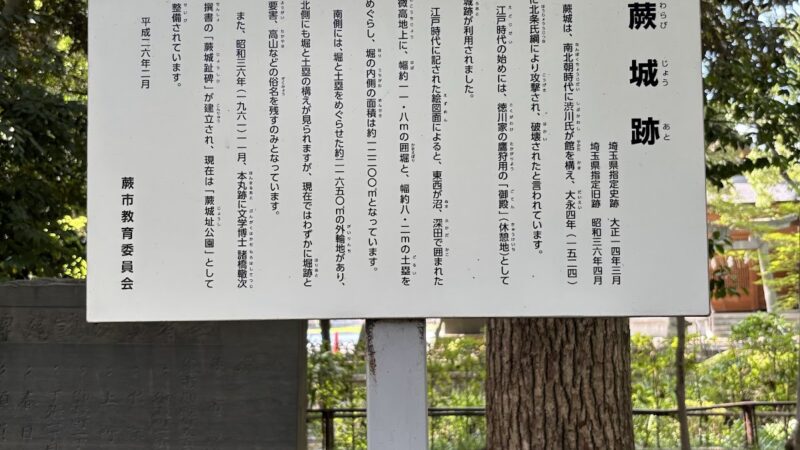
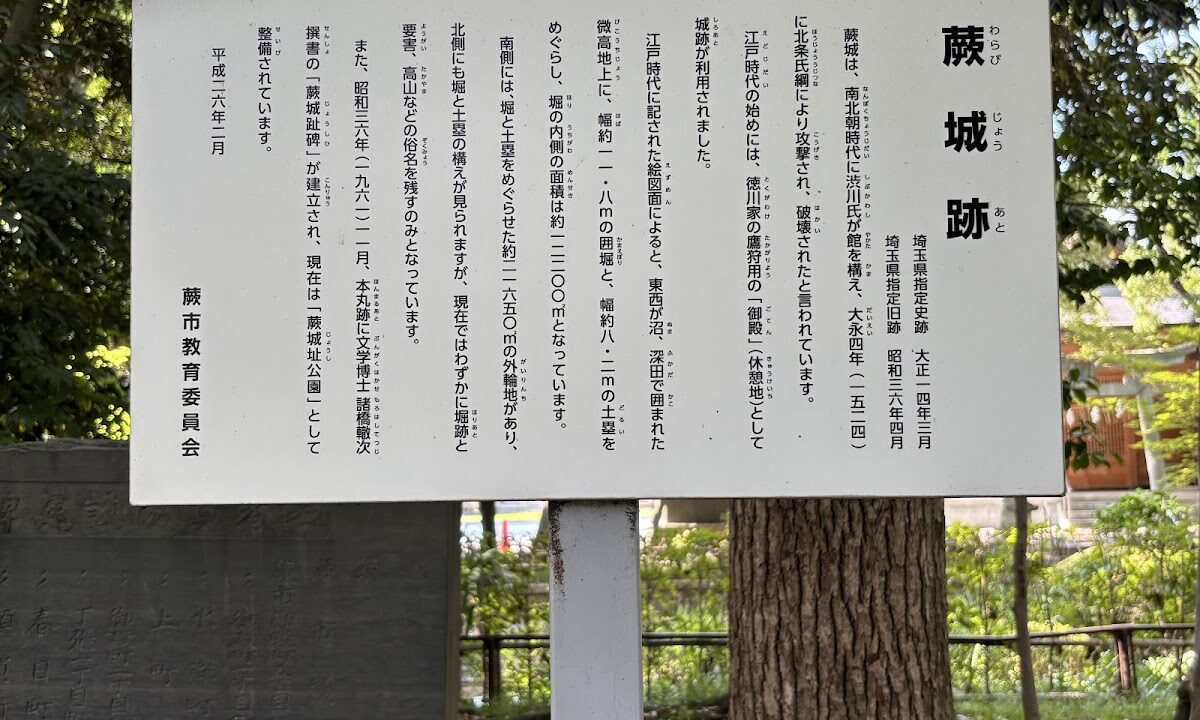
A stone monument marking the site of Warabi Castle stands in one corner of the park, and information boards are installed at the park entrance and other locations. These boards provide detailed explanations of the castle’s history and structure, aiding visitors in their understanding.
Present State of Warabi Castle Ruins Park
Park Development Status
Warabi Castle Ruins Park is a public park developed around the site of the main keep. Numerous trees are planted, creating a tranquil and lush green environment. Despite being in an urban area, it is a quiet and valuable space for local residents to stroll and experience history.
The park features well-maintained walking paths and benches, making it ideal for resting and strolling. Cherry trees are also planted, making it a popular spot for cherry blossom viewing in spring. The park is well-maintained, balancing its historical value with its function as a place of relaxation for citizens.
Relationship with Surrounding Facilities
Adjacent to the south of Warabi Castle Ruins Park is the Warabi Civic Hall, a hub for cultural activities. The Civic Hall hosts various events and activities, forming a community space integrated with the castle ruins park.
To the north lies the Warabi Shrine, and the shrine grounds and castle ruins park share a historical continuity. The Warabi Shrine is an ancient shrine related to the origin of the name Warabi, and, along with Warabi Castle, is an indispensable part of Warabi’s history. During the shrine’s festivals, the area around the castle ruins park becomes lively.
Points to Note When visiting Warabi Castle Ruins
When visiting Warabi Castle Ruins, we recommend carefully reading the information board at the park entrance. It contains detailed information about the castle’s history and structure, and gaining this background knowledge will make your visit much more fulfilling.
When walking through the park, pay attention to the faint traces of the earthworks and the undulations of the terrain. Even in the seemingly flat park, careful observation reveals subtle differences in elevation, allowing you to imagine the structure of the former castle.
In front of the stone monument, reflect on the history of the Shibukawa clan and the changes in Warabi Castle. Considering the role this place played in its long history, from the Muromachi period to the Sengoku period and then to the Edo period, will lead to a deeper understanding.
The average visit time is about 20 minutes, but if you take your time to stroll and feel the history, a stay of 30 minutes to an hour is perfectly enjoyable. Visiting the nearby Warabi Shrine in conjunction with the castle ruins will give you a more comprehensive understanding of Warabi’s history.
Access Information
Access by Train
The nearest station to Warabi Castle Ruins Park is Warabi Station on the JR Keihin-Tohoku Line. The park is approximately a 12-minute walk from Warabi Station. Exit the station, head towards the west exit, and you will arrive at the park after passing through a residential area.
Warabi Station is easily accessible from central Tokyo, approximately 30 minutes from Tokyo Station, 20 minutes from Ueno Station, and 15 minutes from Omiya Station. Its convenient location makes it ideal for day trips from various parts of the Kanto region.
The path from the station to the park is relatively flat, and there are signs guiding you, so even first-time visitors should be able to arrive without getting lost. You can enjoy the scenery of Warabi town along the way.
Access by Car
If visiting by car, access via the Metropolitan Expressway or the Tokyo Outer Ring Expressway is convenient. However, Warabi Castle Ruins Park does not have its own parking lot, so you will need to use nearby paid parking lots.
There are several coin-operated parking lots around Warabi Station, and it’s common to park there and walk to the park. Parking fees are charged by the hour, so be mindful of this if you plan to stay for an extended period.
Warabi City has many narrow roads, so drive carefully. Pay particular attention to pedestrians and cyclists when passing through residential areas.
Address and Basic Information
Address: 4-21-2 Chuo, Warabi City, Saitama Prefecture (Warabi Castle Ruins Park)
Opening Hours: Always open (There are no specific opening hours as it is a park)
Admission Fee: Free
Estimated Visiting Time: Approximately 20-30 minutes
Inquiries: Warabi City Board of Education, Cultural Properties Protection Division
The park is open year-round and can be visited freely at any time. However, it is recommended to avoid visiting at night for safety reasons.
Warabi Castle Reviews and User Feedback
Reviews from Castle Enthusiasts
On castle information websites such as Kojodan, Warabi Castle has an average rating of 2.42 based on 244 reviews. This is mainly due to the scarcity of remaining structures, but its historical value and favorable location are highly praised.
Among castle enthusiasts, it is generally considered a valuable spot for learning about the history of the Shibukawa clan, despite the limited remaining structures. Over 120 photos have been posted, documenting the stone monuments, information boards, and park scenery.
General Visitor Feedback
General visitors often offer positive feedback, such as “easily accessible on foot from Warabi Station,” “well-maintained as a park, perfect for walks,” and “a calm atmosphere with many trees.”
On the other hand, some comments include “few points of interest as a castle ruin” and “unsatisfying without historical knowledge, as no buildings remain.” This is a common characteristic of flatland castles; learning about its history beforehand will lead to a more fulfilling visit.
The park is cherished by local residents as a place of relaxation used daily, and is utilized for morning walks, jogging, and as a playground for children. A key characteristic of Warabi Castle Ruins Park is that, despite being a historical site, it blends seamlessly into modern life.
Nearby Tourist Attractions
Warabi Shrine
Warabi Shrine, located adjacent to the north side of Warabi Castle Ruins Park, is a historical shrine related to the origin of the name Warabi. While its founding date is unknown, it has long been a center of local faith. It also has a deep connection to Warabi Castle, and it has been suggested that it may have been part of the castle grounds.
The shrine grounds feature a magnificent main hall, exuding a tranquil atmosphere. When visiting Warabi Castle Ruins, be sure to also visit Warabi Shrine. Visiting both will allow you to gain a deeper understanding of Warabi’s history.
Warabi City Historical and Folk Museum
This facility allows you to learn about the history and culture of Warabi City. There are also materials and exhibits related to Warabi Castle, and visiting before or after your visit to the castle ruins will give you a deeper understanding. You can learn about the diverse history of Warabi, including the history of Warabi-juku and its relationship with the Nakasendo Road.
Nakasendo Warabi-juku
During the Edo period, Warabi flourished as a post town on the Nakasendo Road. Even today, traces of the old townscape remain, allowing you to enjoy a historical walk. By learning about Warabi in the Edo period, which differs from the era of Warabi Castle, you can feel the layered history of this region.
Points to Note When Visiting Warabi Castle
Guidelines for Visiting
Warabi Castle Ruins Park is maintained as a place of relaxation for citizens, so please be considerate of other visitors when visiting. Avoid speaking loudly or running around, and take your time to quietly appreciate the history.
Since only a few remains are left, please be careful not to trample on traces such as earthworks. Carefully reading the information boards and monuments to deepen your understanding of history is arguably the greatest reward of visiting Warabi Castle.
Photography
Photography is permitted within the park, but please be considerate and avoid including other visitors in your photos. Pay particular attention to the privacy of children playing.
Main subjects for photography include monuments, information boards, and the remaining earthworks. The park’s appearance changes with the seasons, allowing you to enjoy the scenery of each season, such as cherry blossoms in spring, lush greenery in summer, and vibrant autumn foliage.
Time Required and Combination
A visit to Warabi Castle Ruins Park alone takes about 20-30 minutes, but combining it with visits to Warabi Shrine and other nearby historical sites allows for a fulfilling half-day historical stroll.
There are many restaurants around Warabi Station, so you can enjoy a meal after your visit. Since Warabi is close to central Tokyo, it’s easy to plan a schedule where you visit Warabi Castle in the morning and move on to another tourist spot in the afternoon.
Summary
Warabi Castle, located in Warabi City, Saitama Prefecture, was the residence of the Shibukawa clan and played a significant role in the history of the Kanto region from the Nanboku-cho period to the Sengoku period. Although no buildings remain today, the site has been developed into Warabi Castle Ruins Park, where a few remnants and a stone monument evoke the past.
Warabi Castle, with its multi-layered history encompassing the Shibukawa clan (a prestigious branch of the Ashikaga clan), conflicts with the Koga Kubo, battles with the Hojo clan, and its reuse by the Tokugawa family during the Edo period, is a castle site of high historical value despite the scarcity of remaining structures.
With its convenient access (a 12-minute walk from Warabi Station) and protected as a Saitama Prefecture designated historical site, Warabi Castle Ruins is a worthwhile spot to visit for those interested in medieval Kanto history, castle enthusiasts, and those who want to learn about local history.
The current park, developed as a park, is a space where history and modernity harmonize, and it also functions as a place of relaxation for citizens. Please visit Warabi, Japan’s smallest city, and experience firsthand the traces of history etched into its walls.