Ryugai Castle (Chichibu City, Saitama Prefecture) Complete Guide | Exploring the History and Remains of a Sengoku Period Mountain Castle
Located in Yoshida Hisanaga, Chichibu City, Saitama Prefecture, Ryugai Castle is a valuable mountain castle site that conveys the tense situation of the Sengoku period. As a branch castle of Hachigata Castle, it was a strategic point built to prepare for invasions by Takeda Shingen, and even today, features such as dry moats and baileys strongly resemble its former glory. This article provides a detailed explanation of Ryugai Castle, from its history to the highlights of its remains and how to access it.
What is Ryugai Castle? | Basic Information and Overview
Ryugai Castle is a mountain castle built on the tip of a 333-meter-high hill extending southeast towards the Akahira River in Yoshida Hisanaga, Chichibu City. Also known as “Ryugai Castle,” it possesses the typical characteristics of a Sengoku period mountain castle.
Location and Topographical Features
The castle ruins are located on a hill overlooking the Akahira River, and feature a defensive structure that skillfully utilizes the natural terrain. A dry moat can be reached by descending approximately 100 meters from the gentle ridge on the north side, and a deep trench utilizing the rocky terrain remains on the south side of the ridge. This topographical advantage speaks to its importance as a military base during the Sengoku period.
Castle Size and Classification
Ryūgatani Castle is classified as a medium-sized mountain castle and played a part in the Hōjō clan’s castle network centered around Hachigata Castle. The structure, with multiple baileys arranged around the main enclosure and fortified with dry moats and trenches, is a valuable example of castle construction technology from the late Sengoku period.
The History of Ryugaya Castle | From Construction to Abandonment
Construction History and Lords
The exact construction date of Ryugaya Castle is uncertain, but it is believed to have been built during the Sengoku period by Hisanaga Tajima-no-kami. Hisanaga Tajima-no-kami was a samurai who served the Hojo clan and was responsible for the defense of the Chichibu region as a retainer of Hojo Ujikuni, the lord of Hachigata Castle.
Hachigata Castle was the most important base for the Later Hojo clan in northern Kanto, and Ryugaya Castle served as its branch castle, protecting the border region between Musashi and Kozuke Provinces.
Takeda Shingen’s Invasion and “Yoshida no Tate”
The most important event in the history of Ryugaya Castle was the invasion by Takeda Shingen in 1567. At this time, “Yoshida no Tate,” mentioned in historical records by Asami Ise-no-kami reporting on the Takeda army’s invasion, is identified as Ryugaya Castle.
Takeda Shingen was attempting to expand his territory from Kai Province through Shinano Province into the Kanto region, and the Chichibu region was the front line where the forces of the Takeda and Hojo clans clashed. Ryugaya Castle functioned as a crucial military base in this tense situation.
Developments after the fall of the Hojo clan
In 1590, when the Hojo clan was destroyed in Toyotomi Hideyoshi’s siege of Odawara, Ryugaya Castle also ceased to serve its purpose. It is believed that the castle’s lord, Hisanaga Tajima-no-kami, subsequently served Uesugi Kagekatsu. Uesugi Kagekatsu was based in Aizu, and it is known that he employed some of the former Hojo retainers during the reorganization of power in the Kanto region after the fall of the Hojo clan.
After its abandonment, Ryugaya Castle was left neglected throughout the Edo period and returned to nature, which meant that its Sengoku period remains were preserved almost entirely intact.
The Structure and Remains of Ryugaya Castle | Detailed Explanation of Highlights
The greatest attraction of Ryugaya Castle is its well-preserved group of Sengoku period (Warring States period) remains. Here, we will provide a detailed explanation of the main remains that visitors can actually see.
Dry Moats
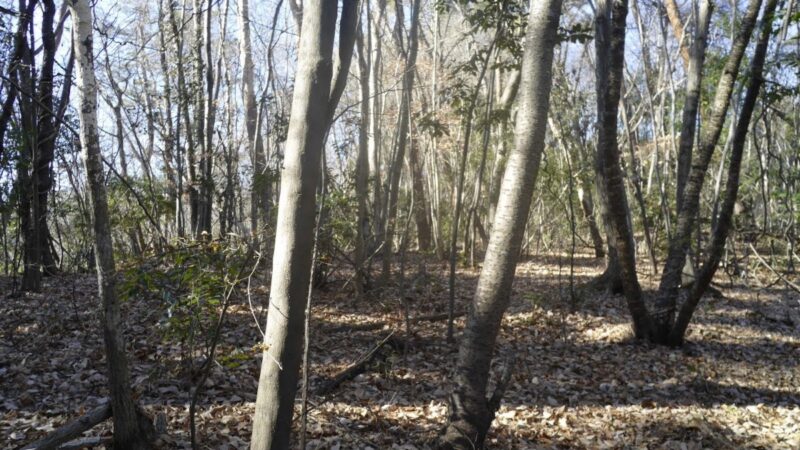
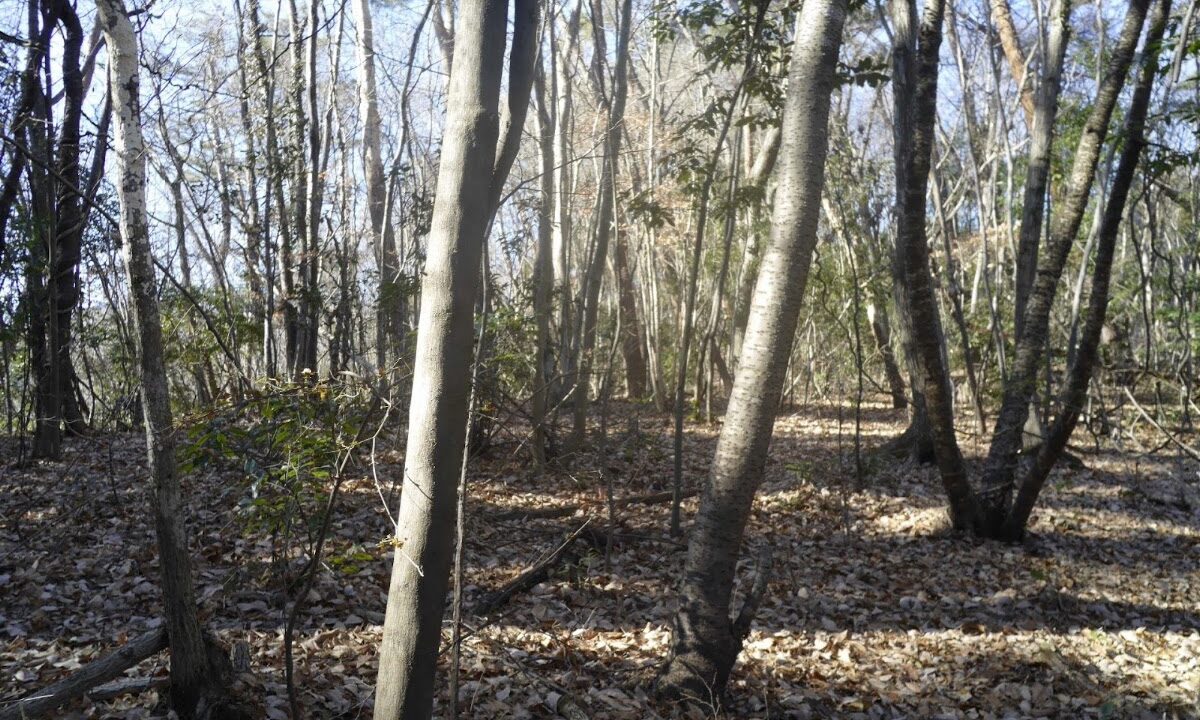
Descending the northern ridge, two dry moats remain. A dry moat is a moat that does not hold water, and it was a defensive structure excavated to prevent enemy intrusion. While many fallen trees have fallen and the dry moats of Ryugaya Castle are returning to nature, their shape can still be clearly seen.
The depth and width of the dry moats allow us to infer the construction techniques and the scale of the labor force at the time, making them important resources in the study of Sengoku period castles.
Moats
On the southern ridge, a deep moat utilizing the rocky terrain remains well-preserved. A moat dug to divide the ridge served to block enemy intrusion routes. The moats at Ryugatani Castle were carved out of bedrock, demonstrating the advanced civil engineering techniques of the time.
The scale and arrangement of the moats offer insights into the castle’s defensive strategy, making them a valuable subject of observation for researchers of mountain castles.
Kuruwa (Enclosures)
The castle contains multiple kuruwa (flat areas). These kuruwa were used for soldier encampments, supply storage, and battlefield positions. The tiered arrangement of kuruwa, centered around the main enclosure, reveals ingenuity in constructing an efficient defensive system.
Even today, the flat surfaces and elevation changes of the kuruwa can be observed, making it a valuable place to experience the castle’s structure from that era.
Dorui (Earthworks)
Traces of earthworks remain in some of the kuruwa. Earthworks are defensive walls built by piling up earth, intended to protect against arrows and firearms. While the earthworks at Ryugatani Castle are weathered, careful observation allows us to imagine their former appearance.
Koguchi (Tiger’s Mouth Entrance)
The structure of the koguchi, the entrance to the castle, can be partially observed. The koguchi was the most important part of a castle’s defense, and various ingenious measures were taken to prevent enemy intrusion.
Caution Regarding Confuses with “Ryūgaya Castle” in Saitama Prefecture
There are several castles in Saitama Prefecture called “Ryūgaya Castle” or “Ryūgaya Castle,” which can be confused. Let’s clarify each castle.
Ryūgaya Castle in Chichibu City (The Subject of This Article)
The Ryūgaya Castle introduced in this article is located in Yoshida Hisanaga, Chichibu City, and is a branch castle of Hachigata Castle, built by Hisanaga Tajima-no-kami. Situated on a hill 333 meters above sea level, it is identified as “Yoshida no Tate,” related to Takeda Shingen’s invasion.
Ryugaya Castle (Senbayama Castle) in Minano Town
There is also a “Ryugaya Castle” in Misawa, Minano Town, Chichibu District, Saitama Prefecture, also known as “Senbayama Castle” or “Senba Castle.” This is also considered a branch castle of Hachigata Castle, and it is said that the Yōdo clan were its lords. Located near the Minano-Nagatoro Interchange, it retains remnants such as double moats and vertical trenches.
Ryugaya Castle in Moroyama Town
There is also a “Ryugaya Castle” (Ryugayayama Castle, Ryugayayama Castle, Moroyama Fortress, Moroyama Castle) in Moroyama Town, Iruma District, Saitama Prefecture. This is designated as a Saitama Prefecture Important Historical Site, and its remains are preserved as the Raiden Shrine within a golf course.
When visiting castle ruins, it is recommended to carefully check the location before heading there.
How to Access Ryugaya Castle
Access by Public Transportation
The nearest stations to Ryugaya Castle by public transportation are Minano Station or Chinaba Station on the Chichibu Railway. However, the castle ruins are several kilometers from the stations, making walking difficult. We recommend using a taxi or rental car.
Access by Car
Access by car is the most convenient. From the Hanazono Interchange on the Kan-Etsu Expressway, take National Route 140 towards Chichibu, heading towards the Yoshida area of Chichibu City. The journey takes approximately 40 minutes.
There is no designated parking lot near the castle ruins, but there are parking spaces on the roadside near the entrance to the castle. However, please be considerate of local residents.
Ascent Route and Estimated Time
The most common route from the entrance to the main enclosure is along the ridge on the north side. It takes approximately 15 minutes from the start of the climb to the dry moat, and another 10-15 minutes to reach the main enclosure. Since the mountain trails are not well-maintained, it is important to wear appropriate clothing and footwear for hiking. Also, be aware of fallen trees and steep slopes.
Notes and Etiquette for Visitors
Equipment and Clothing
Ryūgatani Castle is a full-fledged mountain castle, and the following equipment is recommended for climbing:
- Trekking shoes or hiking boots
- Long-sleeved shirt and long pants (for bushwhacking and insect bite protection)
- Hat and gloves
- Drinking water
- Map or GPS device
- Bear bell (for protection against wild animals)
Best Season for Visiting
The best season for visiting is from late autumn to early spring (November to March), when the vegetation has withered and the remains are easy to observe. In summer, the vegetation is overgrown, making it difficult to see the remains, and caution is also needed regarding insects and snakes.
Safety Precautions
- Avoid visiting alone; it is recommended to travel in groups.
- Be aware of sudden changes in weather; avoid visiting during rainy weather or immediately after rain.
- Cell phone reception may be poor in some areas; inform family or friends of your destination in advance.
- There is a possibility of encountering wild animals (wild boars, deer, bears, etc.); it is recommended to carry a bear bell or walk while making noise.
Manners and Protection
Ryugatani Castle Ruins are a valuable cultural asset. Please observe the following manners:
- Do not damage or dig up the ruins.
- Always take your trash with you.
- Collecting plants or capturing animals is prohibited.
- The use of fire is strictly prohibited.
- Obtain permission from the landowner if the land is private.
Nearby Tourist Attractions and Related Historical Sites
Hachigata Castle Ruins (Yorii Town)
Hachigata Castle, the main castle of Ryugatani Castle, is a large flatland castle located in Yorii Town, Saitama Prefecture. Hachigata Castle is a nationally designated historical site and also houses the Hachigata Castle History Museum. When visiting Ryugaya Castle, we highly recommend also visiting Hachigata Castle.
Hachigata Castle was one of the strongest castles in the Kanto region, built by Hojo Ujikuni. During the Siege of Odawara in 1590, it withstood a siege against a large army led by Maeda Toshiie and Uesugi Kagekatsu for over a month.
Chichibu Shrine
Located in the city of Chichibu, Chichibu Shrine is one of the oldest shrines in the Kanto region and an important spot for understanding the history of the Chichibu area. The shrine building, donated by Tokugawa Ieyasu, is designated as a tangible cultural property of Saitama Prefecture.
Mitsumine Shrine
Mitsumine Shrine, located in Mitsumine, Chichibu City, is one of the leading power spots in the Kanto region, situated on a mountain 1,100 meters above sea level. It’s about an hour’s drive from Ryugaya Castle and is a classic stop on Chichibu sightseeing routes.
Chichibu Pilgrimage
The Chichibu region boasts 34 Kannon pilgrimage sites, attracting many visitors on the “Chichibu Pilgrimage.” Combined with a historical exploration of Ryugaya Castle, this pilgrimage offers a chance to experience Chichibu’s culture and faith.
Research and Preservation Activities of Ryugaya Castle
Academic Evaluation
Ryugaya Castle is attracting attention as an important case study in the study of mountain castles from the Sengoku period. In particular, it has been investigated by castle researchers as a relic that reveals a part of the Hojo clan’s branch castle network.
The arrangement of dry moats and trenches, and the structure of the baileys, reveal the castle construction techniques and defensive philosophies of the late 16th century, and comparative research with other mountain castles of the same period is also underway.
Preservation Status and Challenges
Currently, Ryugaya Castle ruins do not have any special preservation designation. However, because it is located in a remote mountainous area, the threat of development is relatively low. Nevertheless, natural weathering and damage to the remains due to fallen trees are progressing, making long-term preservation measures a challenge.
Regular observations are conducted by local history enthusiasts and castle researchers, and efforts to document and preserve the remains are underway.
Visit Records by Castle Enthusiasts
In recent years, there has been a boom in mountain castles among castle enthusiasts, and visit records for Ryugatani Castle are being shared on websites such as “Kojodan” (Castle Attack Group). Visitor photos and impressions are a valuable source of information about the current state of the castle ruins.
Points for Enjoying Ryugatani Castle
Recommendation for Prior Study
Before visiting Ryugatani Castle, learning about the history of the Hojo and Takeda clans during the Sengoku period, and basic knowledge of mountain castles, will deepen your understanding at the site. In particular, researching its relationship with Hachigata Castle and Takeda Shingen’s invasion of the Kanto region during the Eiroku era would be beneficial.
Photography Tips
When photographing historical ruins, keep the following points in mind to take better pictures:
- Photograph dry moats and trenches so that the angle of the slope is visible.
- Use a wide-angle lens to capture the entire flat surface of the enclosure.
- Late autumn to early spring, when there are fewer trees, is the best time for photography.
- Utilize the morning’s oblique light to highlight the topography.
Combining with Other Castle Ruins in the Chichibu Region
Besides Ryugaya Castle, there are many other mountain castles in the Chichibu region. If you have time, consider visiting the following castle ruins:
- Ryugaya Castle (Senbayama Castle) in Minano Town
- Ogano Castle (Ogano Town)
- Tenjinyama Castle (Chichibu City)
Visiting these castle ruins will give you a deeper understanding of the power dynamics and defense systems in the Chichibu region during the Sengoku period.
Summary | The Historical Value and Charm of Ryugaya Castle
Ryugaya Castle in Chichibu City, Saitama Prefecture, is a valuable mountain castle ruin that conveys the tense situation of the Sengoku period, built as a branch castle of Hachigata Castle by Hisanaga Tajima-no-kami. It functioned as “Yoshida no Tate” (Yoshida Shield) to prepare for invasions by Takeda Shingen and was an important military base supporting the Hojo clan’s rule.
The well-preserved remains, such as dry moats, trenches, and baileys, are valuable historical materials that demonstrate the castle-building techniques and defensive philosophies of the time, making it an attractive destination for castle researchers and history enthusiasts.
While a visit requires proper mountain hiking equipment, it offers a rare opportunity to experience a Sengoku period mountain castle. Why not immerse yourself in the romance of history amidst the rich nature of Chichibu and follow in the footsteps of our ancestors?
Ryugaya Castle may not be flashy, but it quietly continues to tell its history as a living testament to the local samurai of the Sengoku period. This historical site is a hidden gem in Saitama Prefecture, and we hope many people will visit it.