Nakajo Castle (Ogawa Town, Saitama Prefecture) Complete Guide | History, Remains, Access, and Castle Stamp Information
What is Nakajo Castle?
Nakajo Castle is a medieval mountain castle located in Otsuka, Ogawa Town, Hiki District, Saitama Prefecture. Built on the tip of a plateau approximately 20 meters high overlooking the Ogawa Basin, this castle is a typical example of a medieval castle in Musashi Province and attracts attention from historians and castle enthusiasts.
Currently designated as a historical site of Ogawa Town as the “Sengaku Risshi Ruins,” the remains such as earthworks and dry moats are well preserved. It is a valuable resource for understanding medieval castles in the Kanto region and occupies an important position in castle research within Saitama Prefecture.
History of Nakajo Castle
Kamakura Period: The Residence of the Saruo Clan and a Site for Manyoshu Research
The exact construction period of Nakajo Castle is unclear, but according to tradition, it is believed to have functioned as the residence of the Saruo clan, a local powerful family, during the Kamakura period. The Saruo clan were medieval samurai based in Hiki District, Musashi Province, and were a powerful local force in the region.
A notable aspect of Nakagusuku during this period is its connection to the Tendai Buddhist scholar, Sengaku Risshi. Sengaku was a scholar of the Manyoshu (Collection of Ten Thousand Leaves) during the mid-Kamakura period, and from around 1252 to 1266, he devoted himself to the study of the Manyoshu in Nakagusuku.
The “Manyoshu Chushaku” (Commentary on the Manyoshu), completed by Sengaku in this area, is known as a groundbreaking achievement that laid the foundation for Manyoshu research. It is the oldest existing commentary on the Manyoshu and an extremely important document in the history of Japanese literature. It is believed that Sengaku conducted his research activities in this area under the patronage of Saruo Tanenao, suggesting that Nakagusuku functioned not merely as a military facility but also as a cultural center.
Sengoku Period: As a Sub-castle of Koshigoe Castle
During the Sengoku period (Warring States period), Nakajo Castle became an integral part of the regional military network. During this time, Nakajo Castle was positioned as a sub-castle of Koshigoe Castle, playing a crucial role in the defense system of the Ogawa Basin.
Koshigoe Castle, built near the center of Ogawa Town, was one of the key castles in the Hiki region during the Sengoku period. Nakajo Castle, as its sub-castle, is thought to have served as a forward base to prepare for invasions from the south. It is believed that the defensive structures such as earthworks and moats seen today were constructed during this period.
The Kanto region during the Sengoku period was a turbulent era of power struggles between powerful clans such as the Later Hojo, Uesugi, and Takeda. The Hiki region, caught between these major powers, was frequently embroiled in conflict. Nakajo Castle, as a regional defense base, is thought to have experienced these turbulent times.
Edo Period: Kaneko Iyo-no-kami’s Jinya (Fortified Residence)
In the Edo period, Nakajo Castle ceased to function as a military facility and was repurposed as a Jinya (fortified residence) for a hatamoto (direct retainer of the shogun). Kaneko Iyo-no-kami established his Jinya there and governed the area.
A Jinya was a residence or administrative center established by hatamoto or daimyo with a stipend of less than 10,000 koku during the Edo period. While not a large-scale defensive structure like a castle, it functioned as a base for administrative functions. In the case of Nakajo Castle, it is believed that the Jinya was built utilizing the existing castle remains.
During this period, Nakajo Castle played a different role than it did during the Sengoku period, serving as a base for regional governance in a peaceful era.
Structure and Remains of Nakajo Castle
Location and Layout
Nakajo Castle is built on the tip of a plateau at an elevation of approximately 110 meters, with a relative height of approximately 15-20 meters. Located on a hill overlooking the Ogawa Basin, its layout skillfully utilizes the surrounding terrain.
The castle grounds measure approximately 100 meters east-west and 150 meters north-south, a standard size for a castle of a local lord during the medieval period. It utilizes the plateau terrain and employs a typical flatland castle structure, employing natural elevation differences for defense.
Remains of Earthworks and Moats
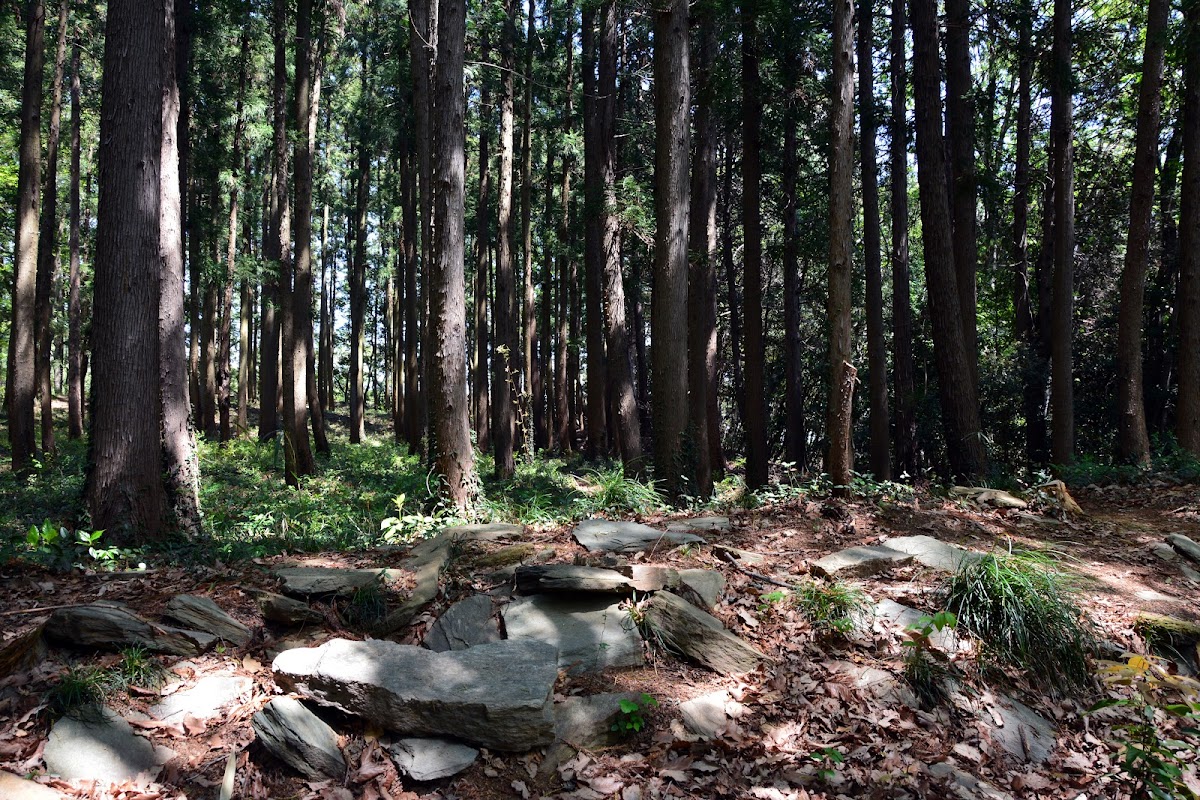
The greatest highlight of Nakajo Castle is the well-preserved remains of earthworks and dry moats. Particularly noteworthy is the double earthwork structure, a design intended to enhance defensive capabilities.
The earthworks surrounding the main enclosure are approximately 2-3 meters high and are clearly visible in some sections. A dry moat surrounds the outside of the earthworks, preventing enemy intrusion. These remains, though partially buried in the grove of trees, are valuable traces that evoke the castle’s former appearance.
The southern defenses are particularly strong, with multiple trenches and earthworks. This defensive design anticipates attacks from the south, conveying the tension of the Sengoku period.
Structure of the Entrance (Koguchi)
Several entrances (koguchi) to the castle have been identified. Koguchi are not merely entrances; they are crucial defensive structures that prevent enemy intrusion while allowing friendly forces to enter and exit.
Many of the koguchi at Nakajo Castle are of the form created by cutting into earthen ramparts, and some exhibit ingenious features such as staggered koguchi. This is a defensive technique designed to prevent enemies from advancing directly, a common characteristic of castles from the Sengoku period.
Arrangement of the Enclosures (Kuruwa)
Nakajo Castle has multiple enclosures (kuruwa) arranged around the main enclosure (shukuruwa). An enclosure (kuruwa) is a flat area within the castle, used for building structures and deploying troops.
The main enclosure is located in the center of the castle and is thought to be where the most important facilities were located. The second and third enclosures (ni-no-kuruwa) are arranged around it, forming a hierarchical defensive structure. Even today, the arrangement of the enclosures can be deciphered from the elevation differences of the terrain.
Highlights of Nakajo Castle
Value as the Sengaku Risshi Site
Nakajo Castle is designated as a historical site by Ogawa Town as the “Sengaku Risshi Site,” and is an important sacred site in the history of Manyoshu research. The historical fact that Sengaku completed his “Manyoshu Commentary” here gives Nakajo Castle a cultural value separate from the castle ruins themselves.
For those interested in the Manyoshu or studying the history of Japanese literature, Nakajo Castle is a must-see historical site. Its duality as both a samurai castle and a place of learning is a major attraction.
Well-Preserved Medieval Castle Ruins
Many medieval castles exist in Saitama Prefecture, but many have been lost due to residential development and other construction. In this respect, Nakajo Castle is in a relatively good state of preservation, making it a valuable historical site where you can actually see and walk through the earthworks and dry moats.
Especially for castle enthusiasts and history researchers, the opportunity to actually observe the ruins is of great value. The charm of Nakajo Castle lies in the opportunity to experience the local topography and atmosphere, something that cannot be conveyed through photographs or collections alone.
Educational Material for Learning About Medieval Castles in the Kanto Region
Nakajo Castle, as a typical example of a medieval castle in the Kanto region, particularly in Musashi Province, also holds educational value for castle research. Its scale, structure, and location are all standard, making it an ideal castle for learning the basics of medieval castles.
By visiting Nakajo Castle while comparing it with other castles in Saitama Prefecture, such as Sugiyama Castle, Hachigata Castle, Kawagoe Castle, and Oshi Castle, you can gain a deeper understanding of the characteristics of each castle and how they changed over time.
Castle Stamp Information
Nakajo Castle offers a castle stamp, which is attracting attention among castle enthusiasts. A castle stamp is a seal that can be purchased as a memento of visiting a castle, and with the recent castle boom, they have become available throughout Japan.
Nakajo Castle’s castle stamp features a design that evokes the historical romance of this Saitama mountain castle, which is only known through legend, and is popular as a souvenir of a visit and a trophy of historical exploration. For information on where to purchase the castle stamp and other details, we recommend checking the Ogawa Town tourism information website or related facilities.
For collectors, this will be an important item when touring castles in Saitama Prefecture.
Access Information
Location
Address: Nakajo, Otsuka, Ogawa-machi, Hiki-gun, Saitama Prefecture
Access by Public Transportation
Train:
- Get off at Ogawa-machi Station on the JR Hachiko Line or Tobu Tojo Line
- Approximately 30-40 minutes on foot from the station, or approximately 10 minutes by taxi
Bus:
While there are bus routes from Ogawa-machi Station, there is no bus stop that provides direct access to the castle ruins. Access is by walking from the nearest bus stop.
Access by Car
Kan-Etsu Expressway:
- Approximately 15 minutes from Ranzan-Ogawa IC
Parking:
There is no dedicated parking lot, so we recommend avoiding street parking and using the parking lots of nearby public facilities or tourist facilities. It’s a good idea to contact the Ogawa Town Hall or the Tourist Association before your visit.
Points to Note When Visiting
Nakajo Castle is not a developed tourist destination, but a mountain castle preserved as a historical site. Please keep the following points in mind when visiting:
- Attire: Comfortable walking shoes and clothing are essential. Since you will be walking through a wooded area, long sleeves and long pants are recommended.
- Season: From spring to autumn, the vegetation is dense, so winter may be a better time to observe the ruins.
- Insect repellent: Insect repellent spray is especially necessary in summer.
- Information boards: There may be few detailed information boards at the site, so it is recommended to gather information beforehand.
- Safety: The remains such as earthworks and moats may be slippery, so please watch your step while viewing.
Nearby Tourist Spots
Other Castles in Ogawa Town
When visiting Nakajo Castle, it is recommended to also visit other castles in Ogawa Town:
Koshigoe Castle: This castle is considered to be the main castle of Nakajo Castle and is located near the center of Ogawa Town. Visiting it together with Nakajo Castle will give you a deeper understanding of the relationship between the branch castles and the main castle.
Takami Castle: Another medieval castle in Ogawa Town, each with its own distinct characteristics.
Aoyama Castle: Located in the northern part of Ogawa Town, this castle has a different location than Nakajo Castle.
Major Castles in Saitama Prefecture
Saitama Prefecture has many historical castles remaining, and visiting them together with Nakajo Castle will give you a broader understanding of Musashi Province’s castle culture:
Sugiyama Castle: A nationally designated historical site located in Ranzan Town, Hiki District, known for its highly refined layout, often called a “textbook of castle construction.” It’s about a 20-minute drive from Nakajo Castle.
Hachigata Castle: Located in Yorii Town, Chichibu District, this is one of Japan’s 100 Famous Castles and was an important base for the Later Hojo clan. It is a large castle built on a cliff between the Arakawa and Fukasawa Rivers.
Kawagoe Castle: Located in Kawagoe City, this is one of the seven famous castles of the Kanto region, and is a valuable castle with its main keep still standing. You can see Edo period castle architecture.
Oshi Castle: Located in Gyoda City, this castle is known as the “Floating Castle” and is a famous fortress that withstood Ishida Mitsunari’s water siege.
Cultural Facilities in Ogawa Town
Saitama Traditional Crafts Center: Ogawa Town is known as a production area for washi (Japanese paper), and the Traditional Crafts Center offers demonstrations and hands-on experiences of washi making.
Ogawa Town Library: This library collects local historical materials, and it may be possible to view materials related to Nakajo Castle and Senkaku.
Significance of Visiting Nakajo Castle
Nakajo Castle may be relatively less well-known among medieval castles in Saitama Prefecture. However, that is precisely why it has the charm of quietly confronting history.
Throughout its long history, spanning from the Kamakura period to the Sengoku period and then the Edo period, this castle played various roles. It served as the residence of the Saruo clan, a site for the study of the Manyoshu (an ancient collection of Japanese poetry), a branch castle of Koshigoe Castle, and the encampment of the Kaneko clan. Traces of each era remain today in the form of earthworks and moats.
The cultural and historical value of Nakajo Castle, particularly as the place where the monk Sengaku Risshi immersed himself in the study of the Manyoshu (Collection of Ten Thousand Leaves), is a unique charm not found in other castles. Its duality as both a samurai castle and a place of learning enriches its history.
For those interested in medieval castles in the Kanto region, especially Saitama Prefecture, those interested in the Manyoshu or the history of Japanese literature, or those who simply want to enjoy a quiet historical exploration, Nakajo Castle is a historical site worth visiting.
Summary
Nakajo Castle, located in Ogawa Town, Hiki District, Saitama Prefecture, is a medieval mountain castle with a long history spanning from the Kamakura period to the Edo period. It began as the residence of the Saruo clan, became a research site for the Manyoshu scholar Sengaku Risshi, functioned as a branch castle of Koshigoe Castle during the Sengoku period, and housed a fortified residence during the Edo period.
Currently designated as a town historical site, the “Sengaku Risshi Ruins,” its remains, including earthworks, dry moats, and gatehouses, are well-preserved. This is a valuable historical site where you can actually observe typical defensive structures of medieval castles, such as double earthen ramparts and moats.
Castle stamps are also sold, making it a popular souvenir for castle enthusiasts. It’s accessible from Ogawamachi Station, and nearby are other related castles such as Koshigoe Castle and Takami Castle, as well as other representative castles of Saitama Prefecture, such as Sugiyama Castle and Hachigata Castle.
Nakajo Castle, where multiple historical contexts—the medieval history of Musashi Province, the history of castles, and the history of Manyoshu research—intersect, is an indispensable historical site for understanding the history of Saitama Prefecture. If you want to experience the romance of history in a quiet mountain castle, be sure to visit.