Musashioka Castle (Asaka City, Saitama Prefecture) Complete Guide | History, Highlights, and Access Information
What is Musashioka Castle?
Musashioka Castle (Musashioka-jo) is a medieval hilltop castle located in Oka, Asaka City, Saitama Prefecture. Also known as “Oka Castle” or “Oka no Shiroyama,” it is a typical hill castle built on a tongue-shaped plateau on the west bank of the Kurome River. Currently, it is maintained as “Shiroyama Park,” and the remains such as earthworks and dry moats are well-preserved, making it a valuable historical site for learning about medieval castles in the Kanto region.
The most distinctive feature of Musashioka Castle lies in its layout (castle design), which skillfully utilizes the long, narrow, eastward-extending hilly terrain. The main keep is located at the tip, with the second, third, and next baileys arranged in a line on the plateau, each bailey separated by a dry moat, creating a linear structure. This structure is typical of castles in the Kanto region during the Sengoku period and is an important historical site that tells the history of castle architecture in Musashi Province. ## History of Musashioka Castle
Mysteries and Theories about its Construction
The construction date and builder of Musashioka Castle are largely unknown due to a lack of historical records. However, several plausible theories exist, each with its own historical background.
The Theory of Ota Dokan’s Construction
The most famous theory is that the castle was built by Ota Dokan (1432-1486), a renowned general of the late Muromachi period. Ota Dokan is known for building Edo Castle and Kawagoe Castle, and served as a senior retainer of the Ogigayatsu Uesugi clan in Musashi Province. It is believed that Dokan built numerous branch castles within Musashi Province, and Musashioka Castle may have been one of them.
The latter half of the 15th century, when Dokan was active, saw a complex political situation in the Kanto region, including conflicts between the Koga Shogunate and the Yamanouchi Uesugi and Ogigayatsu Uesugi clans, as well as the Nagao Kageharu Rebellion. Given this historical context, it’s possible that Musashioka Castle was built due to the need to control a strategic point in southern Musashi Province.
The Ota Yasusuke Residence Theory
Another strong theory suggests that it was the residence of Ota Yasusuke (dates of birth and death unknown), a samurai of the Sengoku period. Ota Yasusuke served Hojo Ujiyasu and is said to be a descendant of Ota Dokan. In the mid-16th century, as the Later Hojo clan expanded its power into southern Musashi Province, it’s possible that Musashioka Castle functioned as a base for controlling this region.
Yasusuke’s era coincided with the period when the Later Hojo clan established its hegemony in the Kanto region. Musashioka Castle’s location, a crucial transportation hub connecting Edo and Kawagoe, suggests it played a vital role in the Later Hojo clan’s system of rule.
Musashioka Castle in the Sengoku Period
Musashi Province during the Sengoku period was the center of fierce battles for control of the Kanto region. Musashioka Castle was one of the castles that survived the turbulent times, serving as a battleground for famous daimyo such as the Ashikaga, Uesugi, Hojo, and Takeda clans.
In the 16th century, the Later Hojo clan controlled most of Musashi Province, but with the fall of the Later Hojo clan in 1590 (Tensho 18) following Toyotomi Hideyoshi’s siege of Odawara, Musashioka Castle is believed to have ended its role. Afterward, Tokugawa Ieyasu entered the Kanto region, and during the Edo period, Musashioka Castle was abandoned and the land was used for farmland and forests.
Structure and Layout of Musashioka Castle
Layout Utilizing the Topography
Musashioka Castle was built by skillfully utilizing a natural stronghold: a tongue-shaped plateau on the west bank of the Kurome River. The hill’s elevation is approximately 12 meters, with a relative height difference of about 10 meters from the surrounding plains. This topographical advantage makes the castle structure well-suited to defending against enemy attacks. The castle is built on a long, narrow hill stretching east to west, with a total length of approximately 300 meters. Taking advantage of this elongated terrain, a “renkaku-shiki” (connected enclosure) layout was adopted, arranging multiple enclosures in a straight line.
Arrangement of Enclosures
The arrangement of enclosures at Musashioka Castle is as follows:
Honmaru (Main Enclosure)
This is the main enclosure located at the easternmost tip of the hill. With an area of approximately 1,500 square meters, it served as the central function of the castle. The Honmaru is surrounded on three sides by steep slopes, giving it an extremely advantageous defensive position. Traces of the earthworks remain clearly visible today, allowing us to imagine the former grandeur of the castle.
Ninokuruwa (Second Enclosure)
This enclosure is adjacent to the west of the Honmaru, separated by a deep dry moat. This dry moat is approximately 8 meters wide and 3 meters deep, and was an important defensive structure to prevent enemy intrusion. The Ninomaru (second enclosure) is the second most important enclosure after the Honmaru (main enclosure), and it is presumed to have contained living quarters and warehouses.
Sannomaru (third enclosure)
This enclosure is located west of the Ninomaru and is also demarcated by a dry moat. The Sannomaru has a relatively large area and is thought to have functioned as a garrison for soldiers and a storage area for supplies.
The next enclosure
This is the westernmost enclosure and marks the entrance to the castle. It is presumed that a route leading into the castle was established from here, and the possibility of a koguchi (castle gate) being located here has been suggested.
Defensive Structures
Dry Moats
The most distinctive feature of Musashioka Castle is the dry moats (karabori) that separate each enclosure. These are moats that do not hold water and are a common defensive structure found in medieval castles in the Kanto region. The dry moats of Musashioka Castle are still clearly visible today, and some sections maintain a depth of over 3 meters.
Dry moats not only separated the baileys but also hindered enemy advances and limited the range of arrows and firearms. They also served to facilitate movement within the castle by utilizing the bottom of the moat as a pathway.
Earthworks
Earthworks were built around the baileys. These earthen walls, constructed by piling up earth, prevented enemy intrusion and also functioned as shields against arrows and firearms. At Musashioka Castle, the earthworks around the main keep are particularly well-preserved, with some reaching a height of 1-2 meters.
It is believed that fences or walls were built on top of these earthworks, further enhancing their defensive capabilities. At the current Shiroyama Park, visitors can walk along these earthworks, experiencing the scale of the castle at that time.
Highlights of Musashioka Castle
Remains Developed as Shiroyama Park
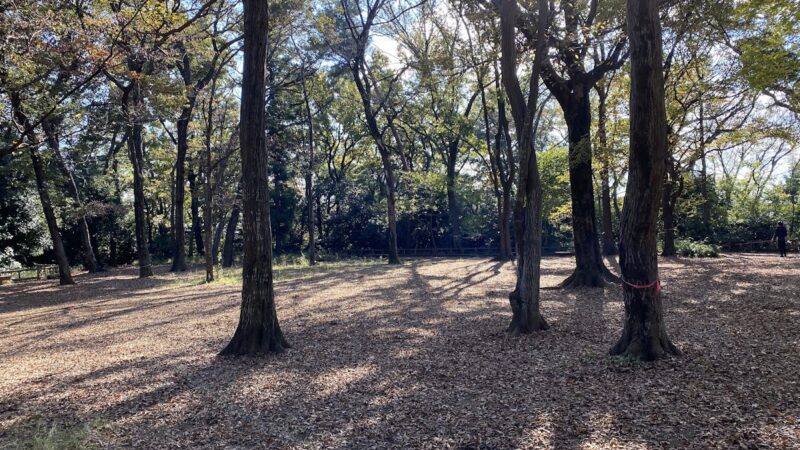
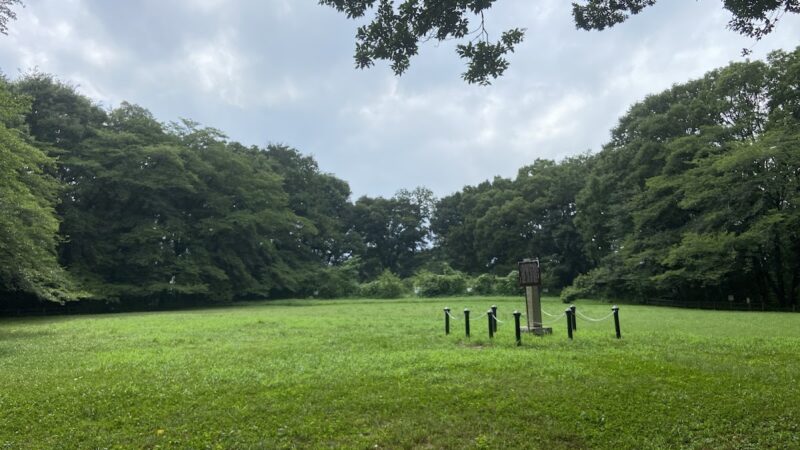
The Musashioka Castle ruins are currently developed as “Shiroyama Park” by Asaka City. Walking paths are provided within the park, allowing anyone to easily view the remains of the medieval castle. During development, the preservation of the remains was the top priority, and the natural state has been maintained, avoiding excessive alterations.
Information boards and explanatory signs are installed within the park, allowing visitors to learn about the history and structure of Musashioka Castle. It is also known as a cherry blossom viewing spot, and in spring, it is bustling with many flower viewers. It is a valuable spot where you can enjoy both historical exploration and nature appreciation.
Earthworks of the Main Enclosure
The earthworks remaining at the main enclosure are one of the most impressive remains of Musashioka Castle. Approximately 1.5 meters high and 3 meters wide, the earthworks surround the main enclosure. Climbing these earthworks allows you to survey the surrounding terrain and understand why the castle was built in this location.
The earthworks are well-preserved, conveying their appearance from over 500 years ago. Observing the cross-section of the earthworks reveals that they were carefully constructed using a technique called rammed earth (hanchiku), where soil was meticulously compacted. This technique was widely used in medieval castles, demonstrating the high level of construction technology at Musashioka Castle.
Remains of the Dry Moats
The dry moats between each enclosure were the cornerstone of Musashioka Castle’s defensive system. The dry moat between the main enclosure and the second enclosure is particularly large, measuring approximately 3 meters deep and 8 meters wide. Looking up from the bottom of the moat, one is struck by its depth and steepness.
The dry moats were not merely ditches; earthworks were built on both sides, further enhancing their defensive capabilities. It is still possible to walk along the bottom of the moats, allowing for close observation of the ingenuity of medieval castle architecture. Especially in winter, when the leaves have fallen from the trees, the entire structure of the dry moats is clearly visible, making it ideal for photography.
Topography of the Tongue-Shaped Plateau
The tongue-shaped plateau on which Musashioka Castle was built is itself an important point of interest. Standing on the tip of the plateau, one can truly appreciate the strategic location surrounded on three sides by lowlands. The elevation difference between the plateau and the lowlands where the Kurome River flows is approximately 10 meters, demonstrating that the natural terrain acts as a natural defensive wall.
This terrain was not only suitable for defending against enemy attacks but also for monitoring the surrounding area. From the main keep, one can overlook the roads leading to Kawagoe and Edo, highlighting its strategic location controlling a vital transportation hub.
The Arrangement of the Enclosures
The arrangement of the enclosures in a line running east-west is another major feature of Musashioka Castle. Visitors can walk along the promenade from the main keep to the next enclosure, viewing each enclosure in sequence. Each enclosure is clearly separated by a dry moat, allowing visitors to experience the structure of a multi-enclosure castle.
Comparing the size and shape of each enclosure, it can be inferred that the main keep was the most heavily guarded, the second and third enclosures were used for residence and storage, and the next enclosure functioned as the castle entrance. Thus, the appeal of Musashioka Castle lies in the opportunity to learn about the functional layout of castle fortifications firsthand.
Access Information
Location
3-chome, Oka, Asaka City, Saitama Prefecture 351-0014 (within Shiroyama Park)
Access by Public Transportation
By Train
- Approximately 15 minutes on foot from the South Exit of Asaka Station on the Tobu Tojo Line
- Approximately 20 minutes on foot from Asakadai Station on the Tobu Tojo Line or Kita-Asaka Station on the JR Musashino Line
Access from Asaka Station is the most convenient. Exit the station, head towards Oka from the South Exit, and you will arrive at Shiroyama Park after passing through the residential area. There are also signs along the way.
By Bus
Take the Kokusai Kogyo bus bound for Asakadai Station from the South Exit of Asaka Station, get off at the “Oka” bus stop, and it’s about a 5-minute walk. However, since the number of buses is limited, it is recommended to check the timetable in advance.
Access by Car
If using the expressway:
- Approximately 15 minutes from the Wako IC on the Kan-Etsu Expressway
- Approximately 10 minutes from the Wako-Kita IC on the Tokyo Gaikan Expressway
Parking Information:
There is no dedicated parking lot at Shiroyama Park. We recommend using nearby coin-operated parking lots or public transportation. There are several paid parking lots around Asaka Station.
Visiting Information
Opening Hours:
Shiroyama Park is open 24 hours, but visiting during daylight hours is recommended. The best time for observing the ruins is from morning until around 3 PM.
Admission Fee:
Free. As it is a park, anyone can freely visit.
Estimated Visiting Time:
A leisurely tour of the ruins takes approximately 30 minutes to 1 hour. If you plan to take photographs or conduct detailed observations, allow about 1.5 hours.
Points to Note When Visiting
- Please be careful not to damage the earthworks or dry moats to protect the remains.
- The ground can be slippery after rain, so we recommend wearing comfortable shoes.
- In the summer, there are many insects such as mosquitoes, so we recommend taking precautions against insects.
- Referring to the information boards and explanatory signs to confirm the location of the remains will deepen your understanding.
Nearby Tourist Attractions
Asaka City Museum
Located about a 20-minute walk from Musashioka Castle, the Asaka City Museum offers a chance to learn about the history and culture of Asaka City. There are also exhibits related to Musashioka Castle, which will help you understand the castle’s history more deeply.
Walking Path Along the Kurome River
A beautiful walking path is maintained along the Kurome River, which flows east of Musashioka Castle. In spring, the cherry blossom trees are magnificent, and you can enjoy a stroll along the path in conjunction with visiting the castle ruins.
Other Castles in Saitama Prefecture
Besides Musashioka Castle, many other castle remains remain in Saitama Prefecture. If you’re interested in medieval castles in the Kanto region, we recommend visiting the following castles:
Kawagoe Castle
One of Japan’s 100 Famous Castles, this is a valuable castle with its main keep still standing. It is believed that Ota Dokan was involved in its construction, and it has historical ties to Musashioka Castle. It’s about a 30-minute drive from Musashioka Castle.
Hachigata Castle
A mountain castle from the Sengoku period, selected as one of Japan’s Continued 100 Famous Castles. It functioned as an important base for the Later Hojo clan, and large earthworks and dry moats remain.
Sugiyama Castle
One of Japan’s Continued 100 Famous Castles, this castle is renowned for its layout, sometimes referred to as a “textbook of castle construction.” Like Musashioka Castle, it’s an ideal castle site for learning about the structure of medieval castles.
Oshi Castle
Oshi Castle, famous from the novel “Nobou no Shiro,” is a renowned castle that withstood Ishida Mitsunari’s water siege during Toyotomi Hideyoshi’s Odawara campaign. Currently, the reconstructed three-story turret is open to visitors.
Historical Significance of Musashioka Castle
Importance in the Study of Medieval Castles in the Kanto Region
Musashioka Castle is an important historical site for the study of medieval castles in the Kanto region. It exhibits typical castle structures of the Sengoku period in the Kanto region, such as its multi-bailey layout, dry moat divisions, and utilization of a tongue-shaped plateau.
In particular, the suggested connection to Ota Dokan and the Ota clan provides valuable clues for understanding the political situation in Musashi Province from the 15th to the 16th centuries. Ota Dokan is known for building many castles in Musashi Province, including Edo Castle and Kawagoe Castle, and Musashioka Castle may have been part of that castle network.
Role in Local History
Musashioka Castle is an important legacy that tells the story of medieval history in the area of present-day Asaka City. It indicates that this area was not merely a rural area, but a strategically important location. Located in a strategic position controlling the transportation routes along the Kurokawa River basin, it is believed to have functioned as a monitoring base for the highway connecting Kawagoe and Edo (present-day Tokyo).
Musashioka Castle is also an important teaching material in local history education. Local elementary and junior high schools provide opportunities for students to visit the castle ruins and learn about local history as part of their local history studies.
Efforts for Preservation and Utilization
Asaka City continues its efforts to preserve the Musashioka Castle ruins as a valuable cultural asset. The development of Shiroyama Park is an attempt to balance the protection of the remains with providing a place of relaxation for citizens.
In recent years, interest in Musashioka Castle has been growing among castle enthusiasts and history lovers, and many visit records and photographs have been posted on castle information websites such as Kojodan. This accumulation of information contributes to the historical research of the castle.
Points to Note When Visiting Musashioka Castle
Seasonal Highlights
Spring (March-May)
Shiroyama Park is known as a famous cherry blossom viewing spot, and is bustling with many visitors during the spring. The contrast between the cherry blossoms and the castle ruins is beautiful and makes for excellent photography. However, it gets crowded during cherry blossom season, so if you want to carefully observe the ruins, a weekday visit is recommended.
Summer (June-August)
The greenery becomes lush, and the earthworks and dry moats are covered with trees. Observing the ruins becomes slightly more difficult, but you can enjoy a stroll in the cool shade of the trees. Don’t forget insect repellent and hydration.
Autumn (September-November)
The autumn foliage is beautiful, making it the perfect season for exploring the castle ruins. The weather is mild, allowing for careful observation of the ruins. November, in particular, has clear air and is ideal for photography.
Winter (December-February)
The leaves have fallen from the trees, making this the season when the overall structure of the ruins is most clearly visible. Winter is ideal for detailed observation of the shape of the dry moats and earthworks. However, be sure to dress warmly.
Photography Tips
When photographing the remains of Musashioka Castle, keep the following points in mind:
- When photographing the dry moat, take a shot looking up from the bottom of the moat to convey its depth and presence.
- When photographing the earthworks, take a shot from an angle to express their height and length.
- When photographing the view from the main keep, convey the strategic importance of the location.
- To express the sequence of baileys, take a shot from a slightly elevated position.
Learning Points
When visiting Musashioka Castle, paying attention to the following points will deepen your understanding:
- Observation of Topography: Consider why the castle was built in this location and the topographical advantages.
- Defense System: Observe how the dry moat and earthworks are combined to enhance the defensive capabilities.
- Arrangement of Baileys: Infer the function of each bailey from its size and location.
- Comparison with Other Castles: Comparing Musashioka Castle to other castles in Saitama Prefecture, such as Kawagoe Castle and Sugiyama Castle, reveals both similarities and differences.
Summary
Musashioka Castle is a valuable medieval castle ruin remaining in Asaka City, Saitama Prefecture. It boasts many points of interest, including its historical background linked to Ota Dokan and Ota Yasusuke, its skillful layout utilizing a tongue-shaped plateau, and its well-preserved earthworks and dry moats.
Currently, it is maintained as Shiroyama Park, making it easily accessible to everyone. Its convenient location, approximately a 15-minute walk from Asaka Station on the Tobu Tojo Line, is also a major draw. This historical site is highly recommended for anyone interested in medieval castles in the Kanto region or those wanting to learn about Saitama Prefecture’s history.
Musashioka Castle displays different expressions with each season: cherry blossoms in spring, lush greenery in summer, vibrant autumn leaves, and clearly visible ruins in winter. It’s a charming spot where you can enjoy both historical exploration and nature appreciation. Visiting Musashioka Castle along with other castles in Saitama Prefecture, such as Kawagoe Castle and Hachigata Castle, will allow you to gain a deeper understanding of the Sengoku period history of the Kanto region.
Why not reflect on the Sengoku period of over 500 years ago at Musashioka Castle, where the history of Musashi Province still lives on?