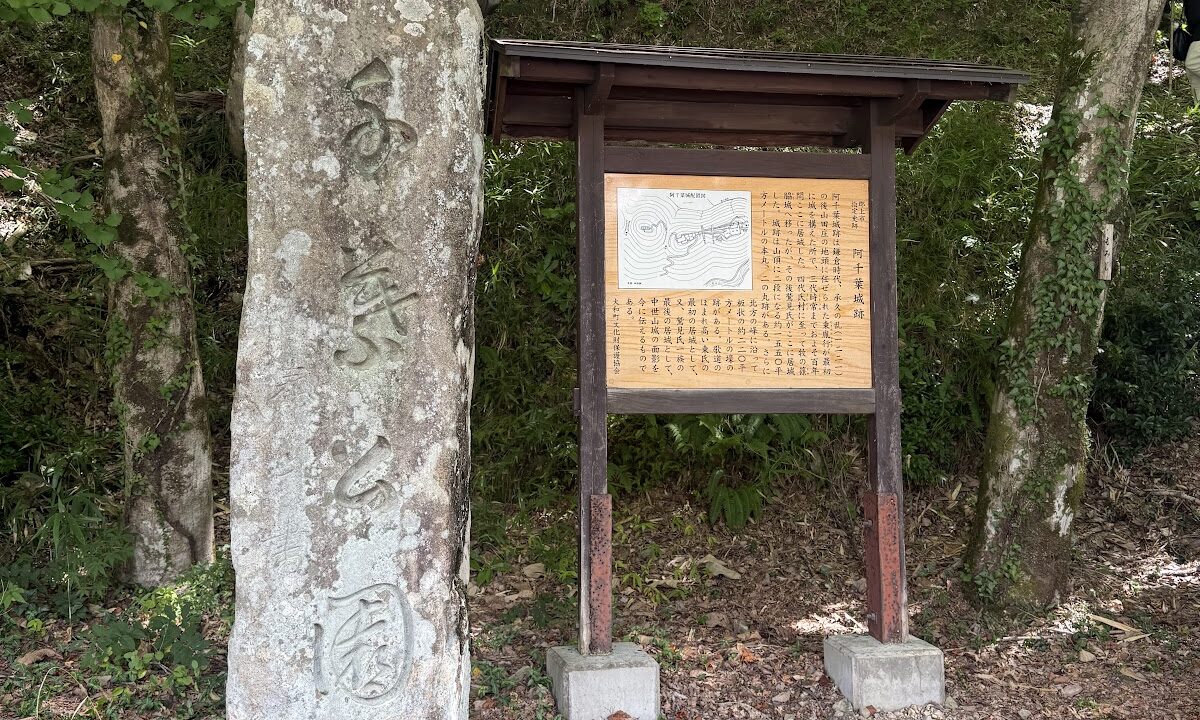
Achiba Castle (Gujō City, Gifu Prefecture): A Complete Guide to its History and Highlights | Mountain Castle Remains and the Residence of the Endō Clan
Achiba Castle, located in Tsurugi, Yamato-chō, Gujō City, Gifu Prefecture, is a medieval mountain castle built on a mountaintop at an altitude of 385 meters. Known as the residence of the Endō clan, a powerful local lord of Mino Province, its remains, including stone walls, earthworks, baileys, and moats, are remarkably well-preserved. Currently designated as a historical site by Gujō City, it is a valuable historical heritage site that conveys the appearance of a Sengoku period mountain castle.
This article thoroughly explains the charm of this little-known but magnificent castle, from its historical background to the details of its remains and access methods.
The History of Achiba Castle and the Endō Clan
The Endō Clan and the Origins of Achiba Castle
Achiba Castle was built as the residence of the Endō clan, who ruled Gujō District in Mino Province. The Endo clan were local lords who held power in the Gujo region from the late Heian period, and they reigned as rulers of Gujo County from the Kamakura period to the Sengoku period.
While there are no clear records of the exact construction date of Achiba Castle, it is believed to have been built between the 14th and 15th centuries, when the Endo clan expanded their power. It is a typical medieval mountain castle built on a steep mountaintop, showcasing the pinnacle of defensive technology of the time.
Achiba Castle in the Sengoku Period
During the Sengoku period, Mino Province became the stage for conflict between Oda Nobunaga and the Saito clan. The Gujo region was no exception, and the Endo clan sought to survive amidst the complex political situation.
Achiba Castle served as the Endo clan’s base and played a crucial role as a center of control over the surrounding area. Located at an altitude of 385 meters, it functioned as an impregnable fortress, utilizing the steep terrain with a relative height difference of approximately 80 meters.
It is believed that the Endo clan later relocated to Gujo Hachiman Castle as their new base, and Achiba Castle took on the role of a subsidiary or fortified castle.
Abandonment and Aftermath
During the Edo period, many mountain castles were abandoned due to the “One Castle Per Province” decree. Achiba Castle was no exception, and it is presumed to have been abandoned during this period.
However, even after its abandonment, the remains of the mountain castle remained intact, preserving its original appearance to this day. This is largely due to the fact that Achiba Castle was located on a remote mountaintop, thus untouched by development.
Layout and Structure of Achiba Castle
Location and Topographical Utilization as a Mountain Castle
Achiba Castle is a typical mountain castle built on a mountaintop at an altitude of 385 meters. It maximized the use of the steep terrain with a relative height difference of approximately 80 meters, designed to make enemy intrusion difficult.
From the mountaintop, one can see a panoramic view of the Gujo basin, making it a militarily advantageous location. This excellent visibility was essential for detecting enemy movements early and preparing defensive positions.
Structure of the Main Enclosure (Honmaru)
The main enclosure of Achiba Castle is located at the mountaintop. The main enclosure is the central part of the castle, where the lord’s residence and important facilities were located.
Earthworks surround the main enclosure, enhancing its defensive capabilities. These earthworks protected the castle from enemy arrows and bullets, and also served as cover for soldiers when counterattacking.
While the size of the main enclosure is standard for a mountain castle, its design prioritizes defense over habitability, indicating a structure intended for siege during wartime.
Arrangement of Enclosures (Kuruwa)
Achiba Castle has multiple enclosures arranged around the main enclosure. These enclosures are arranged in a stepped pattern, forming a multi-layered defensive structure.
Each enclosure is separated by steep slopes called “kirigishi,” designed to make it difficult for the enemy to advance to the next enclosure even after capturing one. This multi-layered defensive structure is a typical feature of medieval mountain castles and is effectively employed at Achiba Castle.
The number and arrangement of the baileys indicate that Achiba Castle was not merely a watchtower, but a full-fledged mountain castle capable of withstanding a siege for a certain period.
Characteristics of the Stone Walls
Remains of stone walls can be found at Achiba Castle. While stone walls were not always common in medieval mountain castles, they were used in important locations at Achiba Castle.
The stone walls are mainly found on the edges of the baileys and around the entrances (koguchi). These stone walls were built using a technique called “nozurazumi,” where natural stones were stacked as they were, demonstrating the stone wall technology of the Sengoku period.
Although smaller in scale compared to other famous mountain castles in Gifu Prefecture, such as Iwamura Castle and Naegi Castle, these remains are valuable for understanding the development of regional stone wall technology.
Moat and Earthwork Defensive System
The core of Achiba Castle’s defensive system consists of moats and earthworks. The moats were positioned as trenches cutting across the ridgeline, serving to block enemy incursions.
Multiple trenches were constructed, with particularly deep trenches dug towards the main entrance (Ote-michi). These trenches are several meters wide and several meters deep, and their scale can still be appreciated today.
Earthworks were built around the enclosures and along the edges of the moats, functioning as defensive walls. The height of the earthworks varies depending on the location, but in important areas, some are over 2 meters high.
Design of the Entrance (Koguchi)
The entrances to the castle, known as koguchi, incorporated various features to prevent enemy incursions. The entrance to Achiba Castle is not straight but curved, making a direct charge difficult for the enemy.
Furthermore, earthworks and stone walls were positioned on both sides of the entrance, allowing for flanking attacks on invading enemies. This type of entrance design is called “yokoya-gakari” (flanking fire) and is a defensive technique of medieval castles.
Highlights of the Achiba Castle Ruins
Well-Preserved Earthworks
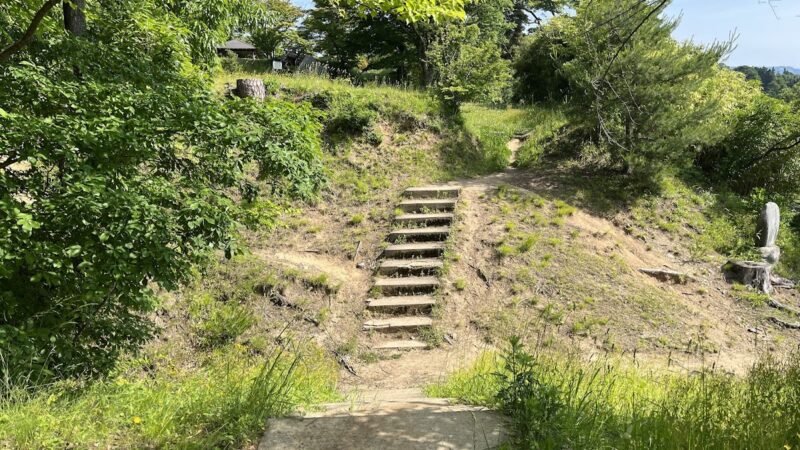
One of the greatest highlights of Achiba Castle is its well-preserved earthworks. The earthworks around the main enclosure remain at a height of approximately 1.5 to 2 meters, allowing visitors to experience the defensive structure of the time.
Observing the cross-section of the earthworks reveals that they were carefully constructed using the rammed earth technique. This technique, which involves compacting layers of soil to increase strength, demonstrates the advanced civil engineering technology of the medieval period.
Walking along the top of the earthworks allows visitors to experience how the castle’s defenders protected the castle, offering a glimpse into historical romance.
Clear Moats
The moats cutting across the ridgeline are a key element of Achiba Castle’s defensive system. The moats on the north and south sides of the main enclosure are particularly large, with depths exceeding 3 meters and widths exceeding 5 meters, all remarkably well-preserved.
Standing at the bottom of the moats, one is struck by the steepness of the cliffs on both sides. This gives a real sense of how difficult it would have been to attack beyond this moat.
The moats are not isolated but are arranged in a series, forming a “continuous moat” configuration in some places, demonstrating the thoroughness of the defenses.
Remaining Stone Walls
The stone walls of Achiba Castle remain partially around the entrance and on the edges of the enclosures. While not large in scale, the skillful use of natural stones in the Nozurazumi technique can be observed.
The stone walls are approximately 1 to 1.5 meters high and do not remain in their complete form, but the scattered fallen stones allow us to estimate their original size.
While different from the large-scale stone walls of Iwamura Castle and Naegi Castle in Gifu Prefecture, these are important remains for understanding the introduction of stone wall technology in the history of castles in this region.
Enclosure Layout and Views
From each enclosure of Achiba Castle, one can see the mountains and basin of Gujo. The view from the main enclosure is particularly magnificent; on a clear day, you can see as far as the Hakusan mountain range.
This excellent view likely served not only a military surveillance function but also served to demonstrate the lord’s prestige. Overlooking the territory from a mountaintop castle was a symbol of dominance.
By observing the layout of each enclosure, one can understand the skillful design of the entire castle.
Achiba Castle and the Surrounding Castle Network
Relationship with Gujo Hachiman Castle
An essential aspect of discussing Achiba Castle is its relationship with Gujo Hachiman Castle. Gujo Hachiman Castle was later the base of the Endo clan, and its reconstructed keep is now a tourist attraction.
The Endo clan moved their base from Achiba Castle to Gujo Hachiman Castle, but it is believed that Achiba Castle continued to function as a subsidiary or fortified castle. The two castles are approximately 10 kilometers apart, and a system of coordinated defense for the Gujo region was established.
While Gujo Hachiman Castle served as a government office during peacetime, it is presumed that Achiba Castle functioned as a strong fortress during times of conflict.
Positioning within the Mino Province Castle Network
Numerous castles were built in Mino Province (present-day southern Gifu Prefecture). Famous castles such as Gifu Castle (Inabayama Castle), Iwamura Castle, and Naegi Castle are well-known, but Achiba Castle also played a part in the Mino Province castle network.
The Gujo region, in particular, is located in the northern part of Mino Province and was a border area with Hida Province. Achiba Castle functioned as an important base protecting this strategic point in the region.
Compared to other mountain castles in Gifu Prefecture, Achiba Castle is classified as a medium-sized castle, but it is an important historical site for understanding the realities of regional governance.
Endo Clan’s Branch Castles
The Endo clan established several branch castles in the Gujo region to govern their territory. Achiba Castle is one such example; other well-known castles include Shinowaki Castle and Oshima Castle.
These subsidiary castles cooperated with each other, communicating information through signal fires and other means to establish a comprehensive defense system for the entire territory. Achiba Castle is believed to have been one of the main strongholds within this system.
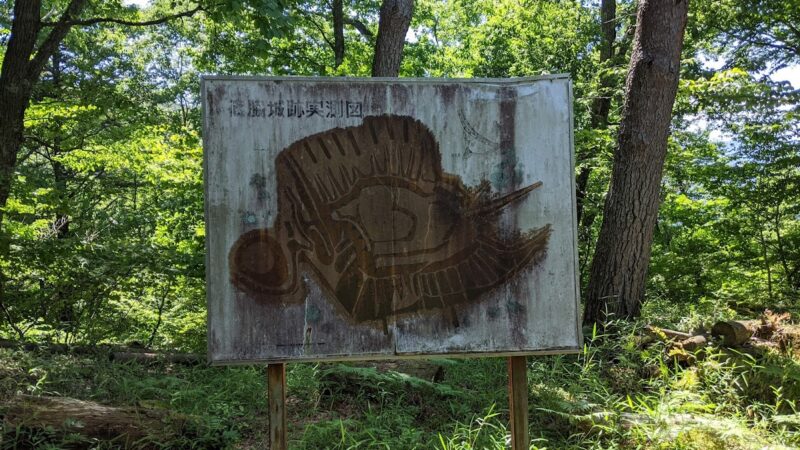
A map of the subsidiary castles reveals a strategic layout designed to monitor and defend major roads and rivers.
Cultural Value of Achiba Castle
Designated as a Gujo City Historic Site
Achiba Castle is designated as a Gujo City Historic Site and is protected as an important cultural property of the region. The designation ensures the preservation and utilization of the remains.
The historic site designation indicates that Achiba Castle is not merely a ruin, but an important witness to the history of the Gujo region. It is expected to be utilized for local history education and as a tourist resource.
Importance in Medieval Mountain Castle Research
Achiba Castle retains a well-preserved, typical structure of a medieval mountain castle, making it an important resource for castle research. With various remains such as stone walls, earthworks, baileys, and moats, it is a valuable example for comprehensively understanding the defensive systems of medieval castles.
In particular, research on Achiba Castle is essential for understanding the actual state of castles of local lords in Mino Province. While archaeological excavations have been limited, further detailed investigations are expected to reveal more historical facts.
Preservation of the Remains
Despite being abandoned more than 400 years ago, the remains of Achiba Castle are remarkably well-preserved. This is due to its mountaintop location, which protected it from development and agricultural conversion.
The height of the earthworks, the depth of the moats, and the shape of the baileys remain almost exactly as they were at the time of construction, making it like a time capsule. This excellent state of preservation enhances Achiba Castle’s value as a cultural property.
Access and Climbing Guide to Achiba Castle
Access Methods
To access Achiba Castle, head towards the Ken district of Yamato-cho, Gujo City.
Access by Car
- Approximately 15 minutes by car from the Gifu Yamato IC on the Tokai-Hokuriku Expressway
- Accessible via National Route 156 and a prefectural road
- There are several parking spaces near the castle entrance.
Access by Public Transportation
- Approximately 10 minutes by taxi from Gujo Yamato Station on the Nagaragawa Railway
- Bus services are limited, so access by car is recommended.
Climbing Route and Estimated Time
Climbing Achiba Castle from the entrance at the foot of the mountain to the main enclosure at the summit takes approximately 30 to 40 minutes on foot.
The climbing path is well-maintained, but there are steep slopes typical of mountain castles, so appropriate clothing and shoes for hiking are necessary. Particular caution is needed during rainy weather and winter, as the path can become slippery.
The climb involves an elevation difference of approximately 80 meters, but even those without much physical stamina can reach the top without difficulty by taking their time. Along the way, you can observe the remains of the castle, such as moats and baileys, giving you a real sense of its defensive structure.
Important Points for Visitors
Clothing and Equipment
- Wear hiking boots or trekking shoes.
- Wear long sleeves and long pants to prevent insect bites and abrasions.
- In summer, bring a hat and water.
- In winter, take precautions against the cold and wear non-slip clothing.
Safety Precautions
- Avoid visiting alone; visiting in groups is recommended.
- Check cell phone signal strength in advance.
- Avoid visiting in bad weather.
- Be careful of falls on steep slopes such as moats and cliffs.
Manners and Rules
- Damaging or removing any remains is strictly prohibited.
- Always take your trash with you.
- No open flames are allowed.
- Avoid trespassing on private property.
Estimated Visit Time
For a visit to Achiba Castle, you should allow approximately 2 to 3 hours, including the time spent ascending and descending.
- Ascent to the castle: 30-40 minutes
- Castle interior tour: 60-90 minutes
- Descending the castle: 20-30 minutes
If you take your time to carefully observe the ruins and enjoy taking photographs, it may take longer. We recommend planning with ample time.
Tourist attractions around Achiba Castle
Gujo Hachiman Castle
If you visit Achiba Castle, you should definitely also visit Gujo Hachiman Castle. Gujo Hachiman Castle boasts a beautifully reconstructed wooden keep and is known as the “Castle in the Sky.”
It was the residence of the Endo clan after they moved from Achiba Castle, and visiting both castles will give you a deeper understanding of the Endo clan’s history. From Gujo Hachiman Castle, you can enjoy a panoramic view of the castle town, and in autumn, you can see its fantastical appearance floating in a sea of clouds.
Gujo Hachiman Townscape
Gujo Hachiman is known as the “Town of Water,” with beautiful waterways flowing through the town. The old townscape is well-preserved, making it a pleasant place to stroll.
At the Gujo Hachiman Museum, you can see a performance of the Gujo Odori dance and experience local culture. It’s also known as the birthplace of food samples, and sample-making workshops are popular.
Kokin Denju no Sato (Village of the Transmission of Ancient and Modern Japanese Poetry)
In Yamato-cho, Gujo City, there is the “Kokin Denju no Sato” (Village of the Transmission of Ancient and Modern Japanese Poetry), where you can learn about the traditions of classical Japanese literature. The Higashi-shi Kanjo Ruins Garden is designated as a national scenic spot, and you can admire a beautiful Japanese garden.
By exploring the cultural aspects of the Gujo region in conjunction with the history of Achiba Castle, your historical exploration will be even more fulfilling.
Things to Know Before Visiting Achiba Castle
Best Time to Visit
Achiba Castle is visitable throughout the year, but each season has its own unique charm.
Spring (April-May)
The fresh greenery is beautiful, and climbing to the castle is pleasant. However, this is also the time when insects begin to increase.
Summer (June-August)
The greenery is lush, and the contrast between the ruins and nature is beautiful. However, precautions against the heat and insects are essential.
Autumn (September-November)
The autumn foliage is beautiful, making this the best time to visit. The temperature is comfortable, and the views are excellent.
Winter (December-March)
Snow can accumulate, making it difficult to climb the castle. However, the castle ruins amidst the snowscape are magical.
Photography Tips
Taking photographs at Achiba Castle is important as a record of the ruins and as a memento of your trip.
Recommended Photo Spots
- View from the main enclosure: With the Gujo mountains in the background
- Panoramic view of the moat: An angle that allows you to appreciate its depth and scale
- Cross-section of the earthwork: An angle that shows its height and structure
- Close-up of the stone wall: A record of the nozura-zumi (rough stone masonry) technique
Photography Tips
- The morning light beautifully illuminates the ruins
- You can take colorful photos during the autumn foliage season
- A wide-angle lens makes it easier to capture the entire ruins
About Castle Stamps
Castle stamps for Achiba Castle may be available at tourist facilities in Gujo City and at Gujo Hachiman Castle. Castle tours using castle stamps are popular in Gifu Prefecture, and Achiba Castle may be included in such tours.
We recommend checking the latest information on the Gujo City Tourism Association or the Gujo Hachiman Castle official website before visiting.
Summary: The Charm and Historical Significance of Achiba Castle
Achiba Castle is a valuable medieval mountain castle remaining in Gujo City, Gifu Prefecture. Built as the residence of the Endo clan, Achiba Castle boasts remarkably well-preserved remains, including stone walls, earthworks, baileys, and moats.
While less well-known than famous Gifu castles such as Gifu Castle, Iwamura Castle, and Naegi Castle, it is an important historical site where one can learn about the typical structure of a medieval mountain castle. The view from the 385-meter-high summit is magnificent, allowing one to appreciate the strategic location and defensive ingenuity of a Sengoku period mountain castle.
Visiting Achiba Castle in conjunction with Gujo Hachiman Castle and the townscape of Gujo Hachiman will provide a deeper understanding of the history and culture of the Gujo region. This castle site is especially recommended for those interested in the history of castles in Mino Province, the history of the Endo clan, and mountain castle enthusiasts.
While proper preparation is necessary for the climb, a worthwhile historical experience awaits. Be sure to visit Achiba Castle, a hidden gem of Gifu Prefecture.
Reference Information/Related Links
For more detailed information about Achiba Castle, please refer to the following sources.
- Gujo City Official Tourism Website
- Gujo Hachiman Castle Official Website
- Gifu Prefecture Official Tourism Website “Gifu Travel Guide”
- Castle-related books: “Medieval Castles of Gifu Prefecture,” “Mountain Castles of Mino,” etc.
When visiting the area, please check the latest information and enjoy your castle tour safely.