Kariyasu Castle (Mizunami City, Gifu Prefecture) Complete Guide | History, Remains, and Access Explained in Detail
Located in Mizunami City, Gifu Prefecture, Kariyasu Castle is a mountain castle that played an important role from the Sengoku period to the Battle of Sekigahara. Built on the summit of Gongen-yama along the old Nakasendo road, this castle still retains well-preserved remains such as earthworks and moats, attracting attention from castle enthusiasts and history buffs. This article provides a thorough introduction to Kariyasu Castle, a unique and fascinating mountain castle in Gifu Prefecture, covering its detailed history, changes in castle lords, notable remains, and useful access information for visitors.
Overview and Basic Information of Kariyasu Castle
Kariyasu Castle is a mountain castle located in Toki-cho, Mizunami City, Gifu Prefecture, built on the summit of Gongen-yama at an altitude of approximately 320 meters. The castle’s style is typical of a mountain castle, characterized by its layout that skillfully utilizes the natural terrain.
Basic Data
- Location: Toki-cho, Mizunami City, Gifu Prefecture
- Alternate Name: Gongen-yama Castle
- Castle Structure: Mountain Castle
- Construction Period: Estimated to be around the Genki era (1570-1573)
- Main Lords: Nishio Michinaga, subordinates of the Tamaru clan
- Year of Abandonment: After the Battle of Sekigahara in Keicho 5 (1600)
- Remains: Earthworks, moats, baileys, vertical moats
- Designated Cultural Property: None (Not designated as a city historical site)
Kariyasu Castle was located along the important Nakasendo highway, and therefore functioned as a strategic base controlling a key transportation hub. While Gifu Prefecture has many famous castles such as Gifu Castle, Iwamura Castle, Naegi Castle, and Ogaki Castle, Kariyasu Castle, though smaller in scale compared to them, was by no means insignificant in terms of regional control.
The History of Kariyasu Castle and the Changes in its Lords
Construction during the Genki Era and Nishio Doei
While the detailed circumstances of Kariyasu Castle’s construction remain unclear due to limited historical records, it has been confirmed that Nishio Doei served as its lord during the Genki era (1570-1573). This period marked the time when Oda Nobunaga had pacified Mino Province and begun his quest for national unification from his base in Gifu, leading to fierce power struggles in the surrounding areas.
Nishio Doei is believed to have governed this region as a local lord. His choice of Gongen-yama, a geographically advantageous location for the castle, demonstrates his military knowledge and the need for regional control. Given its location overlooking the old Nakasendo road, it is presumed that monitoring and defending the road was one of its primary purposes.
Its Role as a Branch Castle of Iwamura Castle
The most important turning point in the history of Kariyasu Castle is the time of the Battle of Sekigahara. In 1600 (Keicho 5), Kariyasu Castle was positioned as a branch castle of the Tamaru clan, lords of Iwamura Castle. Iwamura Castle was a crucial stronghold in eastern Mino Province, considered one of Japan’s three greatest mountain castles, and Kariyasu Castle functioned as part of its network of branch castles.
Initially, the Tamaru clan sided with the Toyotomi clan, but as the Battle of Sekigahara approached, the eastern Mino region became a complex mix of Tokugawa and Toyotomi forces. Iwamura Castle and its branch castles held the key to the military balance in this region.
The Battle of Sekigahara and the Fall of Castles
Prior to the main Battle of Sekigahara on September 15, 1600 (Keicho 5), preliminary battles unfolded in eastern Mino. Tokugawa Ieyasu’s Eastern Army attempted to gain an advantage in the decisive battle at Sekigahara by capturing various castles within Mino Province, thereby cutting off the Western Army’s rear lines of communication.
It is said that Kariyasu Castle was also attacked by the Tokugawa forces and fell after a fierce battle. While detailed records of the siege are not available, Kariyasu Castle was abandoned after the Battle of Sekigahara, ending its role. This fall also led to the collapse of the Tamaru clan’s network of branch castles, centered around Iwamura Castle, effectively eliminating Toyotomi forces in eastern Mino Province.
Kariyasu Castle After its Abandonment
After the Battle of Sekigahara and the establishment of the Tokugawa shogunate, many mountain castles were abandoned. Kariyasu Castle was no exception, and its function as a castle was completely lost during the Edo period. However, the place name Gongen-yama and the surrounding topography retain the memory of the castle, and it has been affectionately known locally as “Shiroyama” (Castle Mountain).
To this day, the Kariyasu Castle ruins have escaped large-scale development, resulting in the relatively well-preserved remains of the Sengoku period. This makes it a valuable resource for the study of mountain castles in Gifu Prefecture.
Layout and Structure of Kariyasu Castle
Design Utilizing the Topography of Gongen-yama Mountain
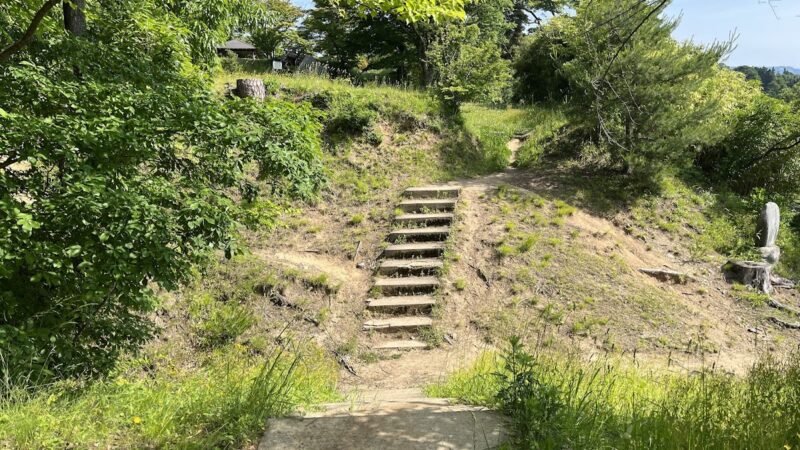
Kariyasu Castle is a mountain castle built around the summit of Gongen-yama Mountain, characterized by its defensive layout that utilizes the difference in elevation. Multiple baileys are arranged around the main enclosure at the summit, and trenches and vertical moats are provided along the ridges and valleys.
A fundamental defensive principle of mountain castles is the use of terrain to make enemy approach difficult, and Kariyasu Castle is designed faithfully to this principle. The combination of steep slopes and artificial cliffs creates a structure that forces considerable effort on the attacking side.
Arrangement of the Main Enclosure and Baileys
The main enclosure is located at the summit, and it is believed to have functioned as the lord’s residence and command post. While the main enclosure is not particularly large, it is surrounded by earthen ramparts, enhancing its defensive capabilities.
Around the main enclosure, multiple baileys are arranged in a stepped pattern, each designed to function as an independent defensive unit. These enclosures are presumed to have been used as garrisons for soldiers and storage areas for supplies.
Structure and Function of Earthworks
Among the remains of Kariyasu Castle, the well-preserved earthworks are particularly noteworthy. The earthworks around the main enclosure are about 1-2 meters high and built along the edges of the enclosures. These earthworks were not merely mounds of earth, but important military structures designed to defend against enemy arrows and firearms.
A flat surface is secured inside the earthworks, designed to facilitate movement for defending soldiers. Furthermore, the outside of the earthworks features steep cliffs, making it difficult for enemies to climb.
Defensive Lines Created by Moats and Vertical Ditches
Several moats blocking the ridgeline can be identified at Kariyasu Castle. These moats were structures designed to prevent enemies from invading along the ridgeline, and are dry moats approximately 3-5 meters deep.
In addition, vertical ditches were constructed on the slopes, serving to hinder lateral movement of enemies. These trenches and vertical moats are ingenious designs for efficient defense with limited forces, and are a typical example of mountain castle construction techniques from the Sengoku period.
Highlights and Ruins of Kariyasu Castle
Observation Points of the Earthworks
The most noteworthy ruins when visiting Kariyasu Castle are the earthworks remaining around the main enclosure. Even after more than 400 years, the shape of the earthworks remains relatively clear, allowing you to experience the castle’s structure at the time.
Walking along the earthworks allows you to survey the surrounding terrain from the perspective of the defending soldiers, helping you understand why this location was chosen for the castle. The view from the position overlooking the old Nakasendo road, in particular, speaks to the castle’s function of monitoring the road.
Experiencing the Power of the Trenches
The trenches built along the ridge are the ruins that best represent the defensive philosophy of Kariyasu Castle. Standing at the bottom of the trench, you will be overwhelmed by its depth and steep walls. The sheer technical skill and labor mobilization capabilities of the Sengoku period, who carried out such extensive civil engineering work using only human power, are astonishing.
The moats were not merely ditches, but powerful obstacles designed to completely block enemy advances, making it clear that considerable sacrifices were necessary to break through them.
Observing the Castle’s Scale and the Remains of the Enclosures
By visiting the remains of multiple enclosures, one can grasp the overall structure of Kariyasu Castle. Observing the flat area and arrangement of each enclosure allows one to infer the size of the forces the castle could accommodate and the division of functions.
Descending from the main enclosure to the lower enclosures allows one to experience the castle’s hierarchical structure and learn about the spatial configuration of medieval mountain castles.
Relationship to the Old Nakasendo Road
A major characteristic of Kariyasu Castle is its proximity to the old Nakasendo road. By examining the route of the old Nakasendo road from the castle ruins, it becomes clear that the castle was built for road surveillance and defense.
The Nakasendo, one of the Five Highways of Japan during the Edo period, was also a crucial transportation route connecting Kyoto and eastern Japan during the Sengoku period (Warring States period). Kariyasu Castle was a strategic base controlling this vital route.
Kariyasu Castle and the Surrounding Castle Network
Relationship with Iwamura Castle
Understanding Kariyasu Castle is essential to understanding its relationship with Iwamura Castle. Iwamura Castle is a central castle in eastern Mino Province, considered one of Japan’s three greatest mountain castles, built on a magnificent mountaintop at an altitude of 717 meters.
Kariyasu Castle is located approximately 15 kilometers west of Iwamura Castle and played a role in the network of subsidiary castles centered around Iwamura Castle. It is thought to have served as an outpost to maintain the sphere of influence of the Iwamura Castle lord and to prepare for invasions from the Nakasendo direction.
Iwamura Castle, located in Ena City, Gifu Prefecture, currently boasts well-preserved remains such as stone walls, making it a popular tourist destination. Visiting both Kariyasu Castle and Iwamura Castle provides a deeper understanding of the Sengoku period castle network.
Castles in and around Mizunami City
Besides Kariyasu Castle, several other castle ruins exist in and around Mizunami City. These castles, built by various forces that ruled the region, such as the Toki and Toyama clans, reflect the complex political situation of eastern Mino Province.
Plotting these castles on a map reveals their connections to geographical elements such as roads and rivers. Kariyasu Castle also functioned as part of this regional castle network.
Comparison with Mountain Castles in Gifu Prefecture
Gifu Prefecture boasts numerous nationally renowned castles, including Gifu Castle, Naegi Castle, and Ogaki Castle. Gifu Castle, as the base from which Oda Nobunaga declared his ambition of “unifying the country by military force,” and Naegi Castle, known as the “castle in the sky,” each attract many tourists with their unique charms.
While Kariyasu Castle is smaller in scale compared to these famous castles, it is valuable as a precious historical site that reveals the realities of regional control. While large-scale castles symbolize power, smaller mountain castles like Kariyasu Castle more directly convey the realities of actual military operations and regional governance.
Access and Visiting Guide to Kariyasu Castle
Access by Public Transportation
When visiting Kariyasu Castle using public transportation, the following route is the basic one.
Access by Train
- Get off at Mizunami Station on the JR Chuo Main Line
- Approximately 5 kilometers from Mizunami Station to the castle ruins
- Approximately 10 minutes by taxi from the station
- Approximately 1 to 1.5 hours on foot
Mizunami Station is a major station on the Chuo Main Line and is accessible from both Nagoya and Nakatsugawa. However, since public bus routes from the station to the castle ruins are limited, taking a taxi is the most practical option.
Access by Car
Access by car is the most convenient.
Using Expressways
- Approximately 10 minutes from Mizunami IC on the Chuo Expressway
- Approximately 15 minutes from Toki-Minami-Tajimi IC on the Tokai-Kanjo Expressway
Using General Roads
- Via Prefectural Road from National Route 19
- Accessible along the Old Nakasendo Road
Parking Information
There is no dedicated parking lot around the castle ruins, but there are a few parking spaces near the trailhead. However, since it is not a properly maintained parking lot, please be careful not to park on the road.
Climbing Route and Estimated Time
To climb Kariyasu Castle, use the hiking trail on Gongen-yama Mountain.
Climbing Route
- Approximately 20-30 minutes from the trailhead to the main enclosure at the summit
- The path is relatively clear, but appropriate clothing and shoes for mountain climbing are necessary as it is a mountain trail
- Trekking poles are useful as there are steep slopes
Time Required for Visiting the Ruins
- Visiting the ruins around the main enclosure: 30 minutes to 1 hour
- For thorough observation: 1 hour to 1 hour 30 minutes
- Total time including round-trip travel time: 2-3 hours
Precautions for Visiting
Clothing and Equipment
- Comfortable clothing (long sleeves and long pants recommended)
- Trekking shoes or athletic shoes
- Insect repellent spray is essential in summer
- Bring drinking water
- It is recommended to refrain from visiting in rainy weather as it can be slippery
Safety Precautions
- Avoid visiting alone; visit with others if possible
- Check cell phone signal strength in advance
- Manage your time to descend before sunset
- During winter, be extremely careful as there is a possibility of snow and ice.
Manners and Consideration
- Protect the historical remains (do not damage earthworks or moats)
- Always take your trash with you
- When passing through private land, be considerate of the landowner
- No open fires allowed
Best Time to Visit
Spring (March-May)
- Beautiful fresh greenery and mild weather
- Enjoy observing wildflowers
- However, the ground may be muddy in early spring
Autumn (October-November)
- Beautiful autumn foliage, the most suitable time to visit
- Comfortable temperature and easy to climb
- Fewer insects, making it pleasant
Summer (June-August)
- The greenery is lush, but be careful of the heat and insects
- Early morning visits are recommended
- Drink plenty of water
Winter (December-February)
- Possibility of snow and ice; suitable for experienced hikers
- The fallen leaves make it easier to observe the shape of the ruins.
- Cold weather gear is essential.
Tourist Spots Around Kariyasu Castle
Highlights of Mizunami City
This section introduces tourist spots in Mizunami City that can be enjoyed in conjunction with a visit to Kariyasu Castle.
Mizunami City Fossil Museum
Mizunami City is known as a fossil producing area, with numerous fossils discovered in geological strata from the Miocene epoch of the Cenozoic era, approximately 17 to 15 million years ago. The museum exhibits valuable fossil specimens, allowing visitors to learn about the history of the Earth.
Nakasendo Okuwa-juku
Okuwa-juku, which flourished as a post town on the old Nakasendo road, preserves a townscape that retains the atmosphere of the Edo period. It is a valuable spot where you can experience the history of the Nakasendo road, which was monitored by Kariyasu Castle.
Ryuginkyo Gorge
This gorge in Mizunami City is a scenic spot where you can enjoy the beauty of nature. A walking path is maintained, allowing you to enjoy the scenery of each season.
Exploring Nearby Castles
Iwamura Castle (Ena City)
Iwamura Castle, the main castle of Kariyasu Castle, is about a 30-minute drive away. As one of Japan’s three greatest mountain castles, you can enjoy its magnificent stone walls and the atmosphere of its castle town. Castle stamps are also available.
Naegi Castle (Nakatsugawa City)
Naegi Castle, recently popular as the “Castle in the Sky,” is about a 40-minute drive from Kariyasu Castle. Its unique stone walls, utilizing massive rocks, and the spectacular view from the castle tower are its main attractions.
Gifu Castle (Gifu City)
Gifu Castle, associated with Oda Nobunaga, is about a 1-hour drive from Kariyasu Castle. From the castle tower on the summit of Mt. Kinka, you can enjoy a panoramic view of the Nobi Plain.
Local Food and Culture
Mizunami Bono Pork Dishes
Dishes using Mizunami Bono Pork, a brand of pork from Mizunami City, can be enjoyed at restaurants in the city.
Mino Ware Village
The area around Mizunami City is a production center for Mino ware pottery, where you can enjoy shopping for ceramics and visiting kilns.
Chestnut Kinton
Chestnut kinton, a specialty of the Higashi-Mino region, is an exquisite Japanese confectionary available only in autumn.
Research and Preservation Activities of Kariyasu Castle
Position in Castle Research
Kariyasu Castle is an important resource in academic castle research. It is valued for retaining the original form of a Sengoku period mountain castle because it has not undergone large-scale alterations.
Surveys and layout maps have been created by castle researchers and local historians in Gifu Prefecture, and its true nature is gradually becoming clearer. In particular, the arrangement of moats and earthworks provides valuable data for understanding the castle construction techniques of the time.
Regional Preservation Efforts
Regional history enthusiasts and local history research groups are primarily responsible for the preservation of the Kariyasu Castle ruins. Regular grass cutting and trail maintenance are carried out on a volunteer basis.
Although it has not received formal designation as a cultural property, it is cherished as a local historical heritage site, and the development of a future protection system is expected.
Future Challenges and Prospects
The following are future challenges for Kariyasu Castle:
- Clarification of historical facts through detailed archaeological excavations
- Establishment of legal protection through cultural property designation
- Enhancement of information provision through the installation of signboards and explanatory panels
- Development of safe viewing routes
- Examination of strategies for utilizing it as a tourist resource
While many castles exist in Gifu Prefecture, shedding light on small to medium-sized mountain castles like Kariyasu Castle allows for a more multifaceted understanding of the region’s history.
The Significance of Visiting Kariyasu Castle
Experiencing Regional Rule in the Sengoku Period
The greatest significance of visiting Kariyasu Castle is the opportunity to experience firsthand the realities of regional rule during the Sengoku period. While large-scale castles like Gifu Castle and Iwamura Castle represent centers of power, Kariyasu Castle conveys the appearance of a castle that actually functioned on the front lines of the region.
By actually seeing the remains such as earthworks and moats, one can understand the wisdom and ingenuity of the Sengoku period warlords who tried to create maximum defensive effectiveness with limited resources and manpower.
Connection to the History of the Old Nakasendo Road
Kariyasu Castle is also interesting from the perspective of transportation history due to its connection to the important old Nakasendo road. Looking down on the old Nakasendo road from the castle ruins allows one to understand why a castle was necessary in this location and how important the road was in terms of military and economic value.
Even before the development of the Five Highways in the Edo period, this road was a route for the movement of people and goods, and also a route for the transmission of information. Kariyasu Castle was a base that controlled such a crucial transportation hub.
Understanding the Preludes to the Battle of Sekigahara
While the Battle of Sekigahara is often associated with the main battle in Sekigahara-cho, Fuwa-gun, Gifu Prefecture, preliminary battles actually unfolded throughout Mino Province. The fall of Kariyasu Castle is one example of such regional-level fighting, demonstrating that the Battle of Sekigahara was not a single battle but part of a larger, regional military operation.
Visiting Kariyasu Castle allows you to reflect on regional battles not typically found in history textbooks, leading to a more comprehensive understanding of history.
Summary: The Charm of Kariyasu Castle and a Recommendation to Visit
Kariyasu Castle in Mizunami City, Gifu Prefecture, though not large in scale, holds great value as a typical example of a Sengoku period mountain castle and as a precious historical site that conveys the regional battles of the Battle of Sekigahara.
Built on Gongen-yama along the old Nakasendo road, this castle was ruled by Nishio Michinaga during the Genki era. During the Battle of Sekigahara, it was attacked and captured by the Tokugawa forces as a branch castle of the Tamaru clan, lords of Iwamura Castle. Even today, the remains of earthworks, moats, and baileys are well-preserved, allowing visitors to learn about the castle-building techniques and defensive philosophies of the Sengoku period.
Access is convenient by taxi or car from JR Mizunami Station, and the climb to the castle takes about 20-30 minutes. Appropriate clothing and equipment are necessary as it involves climbing a mountain path, but it is a historical site well worth visiting for history buffs and castle enthusiasts.
Gifu Prefecture boasts many famous castles such as Gifu Castle, Iwamura Castle, Naegi Castle, and Ogaki Castle, but visiting a regional mountain castle like Kariyasu Castle allows for a deeper understanding of Sengoku period history. Along with other nearby tourist spots, be sure to visit Kariyasu Castle as part of your exploration of the history of Eastern Mino.
Standing before the remains, you can feel the atmosphere of the Sengoku period and reflect on the warriors who fell in the Battle of Sekigahara—that is the true essence of a visit to Kariyasu Castle. As a hidden historical treasure of Gifu Prefecture, Kariyasu Castle quietly awaits your visit.