Complete Guide to Moriyama Castle (Gifu Prefecture): History and Highlights of the Remains of Ushigahana Fort
Moriyama Castle is a Sengoku period mountain castle located in Minokamo City, Gifu Prefecture. Also known as Ushigahana Fort, it was built in 1582, a turbulent time shortly after the death of Oda Nobunaga. Currently, a religious facility called “Kobi no Tenguyama” stands on the site, but it is known as a valuable historical site that still preserves the remains of the Sengoku period.
Overview of Moriyama Castle
Moriyama Castle was built by Saito Toshitaka, the lord of Kajita Castle, as a branch castle of Kajita Castle. Located on the hills of Atagoyama, facing the right bank of the Hida River, north of JR Furui Station, this was a strong fortress that utilized the natural defenses of the river’s cliffs.
Basic Information
- Location: Furui-cho, Minokamo City, Gifu Prefecture
- Alternate Name: Ushigahana Fort
- Builder: Saito Toshitaka
- Year of Construction: Tensho 10 (1582)
- Lord: Nishimura Jirobei (Castle Deputy)
- Year of Abandonment: Around Tensho 12 (1584)
- Remains: Enclosures, dry moats, stone walls, earthworks
- Current Status: Religious facility (Kobi no Tenguyama)
Located approximately 7 kilometers south of Kajita Castle, it functioned as a front-line base to counter Mori Nagayoshi, who was based at Kaneyama Castle.
Historical Background of the Construction of Moriyama Castle
The Situation in Mino Province After the Honnoji Incident
On June 2, 1582 (Tensho 10), when Oda Nobunaga committed suicide at Honnoji Temple in Kyoto due to the rebellion of Akechi Mitsuhide, the Oda clan was greatly shaken. Nobunaga’s third son, Oda Nobutaka, along with Hashiba Hideyoshi, defeated Akechi Mitsuhide at the Battle of Yamazaki, but the struggle for leadership within the Oda clan intensified thereafter.
Saito Toshitaka served as a chief retainer of Oda Nobutaka and resided at Kajita Castle. Meanwhile, Mori Nagayoshi had taken up residence at Kaneyama Castle, and the Mori clan was deepening their relationship with Hashiba Hideyoshi. The conflict between these two forces created tension in eastern Mino Province.
Purpose and Strategic Significance of the Castle Construction
Moriyama Castle was a subsidiary castle built by Saito Toshitaka to counter the Mori Nagayoshi forces at Kaneyama Castle. Its location on a cliff overlooking the Hida River provided an ideal position to monitor invasions from the direction of Kaneyama Castle and prevent approaches to Kajita Castle.
The castle was appointed as the castle lord by the senior retainer Nishimura Jirobei, and it functioned as an outpost for Kajita Castle. The castle’s construction in 1582 (Tensho 10) was immediately after the Honnoji Incident, suggesting it was an emergency construction amidst intensifying power struggles within the Oda family.
The Battle of Kajita and Kaneyama and Moriyama Castle
As a Stage for a Prelude
In 1584 (Tensho 12), when the Battle of Komaki and Nagakute broke out, fighting also unfolded in Mino Province between the combined forces of Oda Nobutaka and Tokugawa Ieyasu and the forces of Hashiba Hideyoshi. During this conflict, Saito Toshitaka of Kajita Castle and Mori Nagayoshi of Kaneyama Castle faced each other directly.
Moriyama Castle played a central role in the preliminary battles of the Kajita-Kaneyama conflict. Mori Nagayoshi sallied forth from Kaneyama Castle, initially targeting Moriyama Castle. It is said that the two armies, facing each other across the Hida River, engaged in a fierce battle for this fortress.
The Fall and Aftermath
Moriyama Castle is believed to have fallen to Mori Nagayoshi’s fierce assault. While detailed records of the fate of the castle’s lord, Nishimura Jirobei, are lacking, it is understood that he was unable to defend the castle.
After the fall of Moriyama Castle, Mori Nagayoshi advanced to Kajita Castle, which was also captured. However, Mori Nagayoshi himself was killed in the Battle of Komaki-Nagakute, and the tide of the war in this region shifted dramatically.
Moriyama Castle, though only used for a short period of a few years at the end of the Sengoku period, played a significant role in a crucial turning point in history: the succession struggle within the Oda family.
Structure and Layout of Moriyama Castle
Layout Utilizing the Topography
Moriyama Castle is a typical mountain castle built on the Atagoyama hill on the right bank of the Hida River. While its elevation is only about 150 meters, the side facing the river is a steep cliff, forming a natural defensive wall.
The castle’s layout featured a central main enclosure surrounded by multiple baileys, creating a linear structure. Despite the limited construction period, traces of late Sengoku period castle-building techniques can be seen.
Major Remains
The following remains can be observed at the current Moriyama Castle site:
Baileys
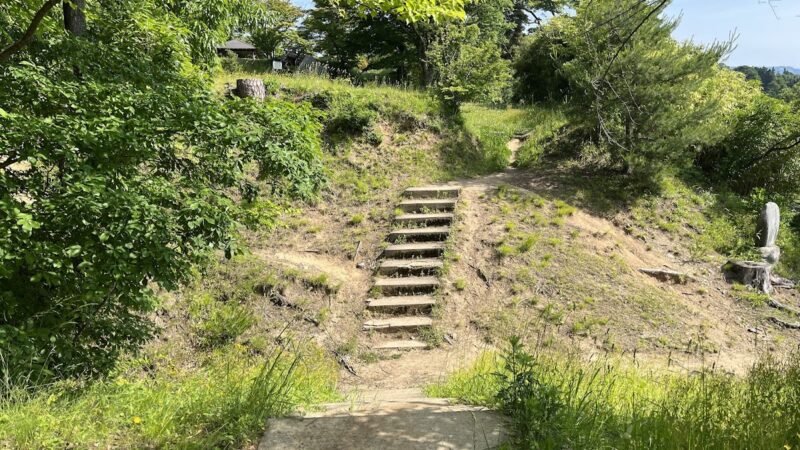
Multiple baileys remain, arranged in a stepped pattern around the main enclosure. Each enclosure has been leveled, indicating its use as a building or soldier encampment. The main enclosure has a relatively large, flat area, suggesting it was the central function of the castle.
Dry Moats
Dry moats were dug between the enclosures or along the boundaries of the castle grounds. These dry moats, which do not hold water, functioned as obstacles to prevent enemy intrusion. Some of the dry moats remain clearly visible today, providing clues to understanding the defensive system of the time.
Stone Walls
As the castle was built during the Tensho period, it is thought that some stone walls were used. However, due to its short period of use, full-scale stone wall construction was likely limited, and the stonework visible today may include later additions.
Earthworks
Earthworks were built along the edges of the enclosures, enhancing defensive capabilities and also serving as foundations for buildings. The height and placement of the earthworks allow us to understand the castle’s defensive lines.
Characteristics of the Defensive System
The defensive system of Moriyama Castle made maximum use of the natural terrain. The cliff side facing the Hida River was difficult to attack, and multiple layers of defense were employed against incursions from the mountain side behind, utilizing dry moats and the elevation changes of the baileys.
Because the castle was built in a short period of time, facilities such as large stone walls and complex entrances were limited, but it can be considered to have functioned sufficiently as a military base in emergencies.
Current Status of Moriyama Castle Ruins
Current Status as Kobino Tenguyama
Currently, the Moriyama Castle ruins are called “Kobino Tenguyama,” and a religious facility has been built there. This name is thought to originate from a local legend about tengu (mythical mountain spirits). A religious building stands near the summit, and it is a place visited by worshippers.
While some remains have been altered due to the construction of the religious facility, basic castle remains such as baileys and dry moats can still be seen. While the castle ruins are only partially maintained, this is a valuable historical site that offers a glimpse into the Sengoku period (Warring States period).
Preservation of the Remains
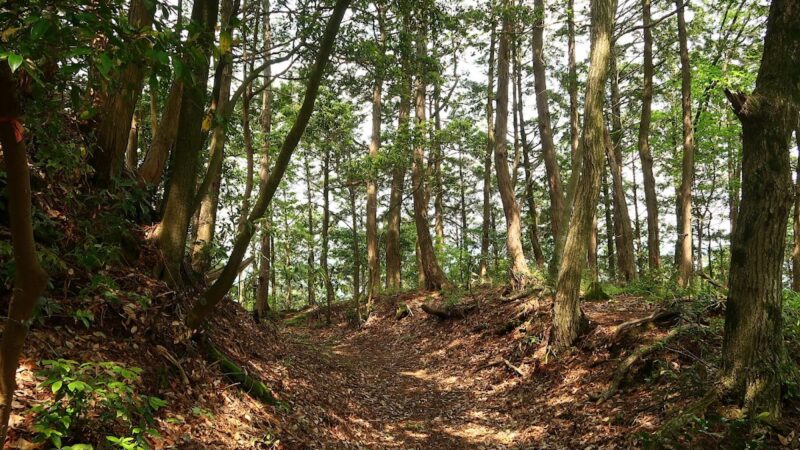
The state of preservation of the remains at Moriyama Castle varies depending on the location. While topographical alterations are visible around religious facilities, the baileys and dry moats are relatively well-preserved in the areas remaining as forest.
In particular, some dry moats remain clearly visible, making them valuable resources for learning about Sengoku period castle construction techniques. However, there are no information boards or explanatory signs, so it is recommended to understand the castle’s structure beforehand.
Surrounding Historical Environment
There are several related historical sites scattered around Moriyama Castle.
Kajita Castle Ruins
The Kajita Castle ruins, the main castle of Moriyama Castle, are located approximately 7 kilometers to the north. Also known as the residence of Saito Toshitaka, it is now maintained as a castle ruins park. When visiting Moriyama Castle, it is highly recommended to also visit the Kajita Castle ruins.
Kaneyama Castle Ruins
The ruins of Kaneyama Castle, the residence of Mori Nagayoshi who faced off against Moriyama Castle, are also an important mountain castle site in this region. Built on a strategic location along the Kiso River, Kaneyama Castle has a different scale and structure from Moriyama Castle, and comparing the two castles allows us to understand the power dynamics of the time.
View of the Hida River
The view of the Hida River from Moriyama Castle gives a real sense of its strategic importance at the time. It visually demonstrates how well-suited the location on the cliffs along the river was for defense.
Visitor Guide
Access Methods
Public Transportation
- Approximately 20-30 minutes on foot from JR Takayama Line “Furui Station”
- Head north from the station and follow the road along the Hida River to reach the foot of Mt. Atago.
By Car
- Approximately 10 minutes from Tokai-Kanjo Expressway “Minokamo IC”
- Parking may be available in the area reserved for visitors to the religious facility, but it is recommended to check in advance.
Points to Note During Your Visit
- Consideration for Religious Facilities: As the site is currently used as a religious facility, consideration for visitors and facility staff is necessary.
- Footwear: As it is a mountain castle, please wear comfortable shoes and clothing. It can be particularly slippery after rain.
- Lack of Signage: There are few signs indicating the castle ruins, so obtaining a map of the castle layout beforehand will enhance your understanding.
- Summer Visit: Since it becomes difficult to confirm the remains when vegetation is overgrown, visits from winter to early spring are recommended.
- Avoid Solo Visits: Because it is a mountainous area, visiting in groups is safer if possible.
Points to Note During Your Visit
When visiting Moriyama Castle, paying attention to the following points will help you understand the castle’s history more deeply.
- Observe the cliffs facing the Hida River and appreciate the natural fortifications of the terrain.
- Observe the layout of the baileys around the main enclosure and understand the efficient layout within a limited space.
- Check the depth and width of the dry moats and learn about the ingenuity of the defensive system.
- Understand the positional relationship between Kajita Castle and Kaneyama Castle and consider the strategic placement.
Nearby Sightseeing Spots
Nearby spots to visit in conjunction with a visit to Moriyama Castle:
- Kajita Castle Ruins: A castle park developed as the main castle site.
- Kaneyama Castle Ruins: The residence of Mori Nagayoshi; well-preserved remains such as stone walls.
- Mino Kanayama Castle Ruins: The base of the Mori clan; a famous castle designated as a national historical site.
- Minokamo City Museum: A facility where you can learn about the history of the region.
Historical Value of Moriyama Castle
A Historical Record of the Late Period of the Oda Regime
Moriyama Castle holds significant historical value as a castle built during the transitional period of the Sengoku era, following the death of Oda Nobunaga. It is a valuable archaeological site that reveals the movements of regional powers during the chaotic period after the Honnoji Incident, illustrating how the power struggles within the Oda family extended to the provinces.
A Typical Example of a Short-Term Used Castle
During the Sengoku period, many castles were used only for short periods due to strategic necessity. Moriyama Castle is a typical example of such a short-term used castle, making it a valuable resource for studying the castle construction techniques and tactics of the time.
It is also attracting attention from castle researchers as an example of how a defensive base was efficiently constructed with limited time and resources.
Importance in Regional History
Moriyama Castle is indispensable for understanding the Sengoku history of eastern Mino Province, particularly around Minokamo City. As a site that tells the story of a crucial phase in regional history—the conflict between the two major powers, Kajita Castle and Kaneyama Castle—it also serves as an element in shaping the region’s identity.
Related Castles and People
Kajita Castle
Kajita Castle, the main castle of Moriyama Castle, is known as the residence of Saito Toshitaka. Currently located in Tomika-cho, it is maintained as a castle ruins park. Understanding the history and structure of Kajita Castle is essential for understanding Moriyama Castle.
Kaneyama Castle
Kaneyama Castle, the residence of Mori Nagayoshi, is a mountain castle built on a strategic point along the Kiso River. Understanding the relationship between the two castles, which faced Moriyama Castle, reveals the military tensions of the time.
Saito Toshitaka
Saito Toshitaka, the builder of Moriyama Castle, was a samurai who served as a chief retainer of Oda Nobutaka. He was a member of the Mino Saito clan and maintained his power with Kajita Castle as his base. After the Honnoji Incident, he followed Oda Nobutaka and opposed Mori Nagayoshi, who was on Hashiba Hideyoshi’s side. ### Oda Nobutaka
The third son of Oda Nobunaga and lord of Saito Toshitaka. After the Honnoji Incident, he fought alongside Hashiba Hideyoshi to defeat Akechi Mitsuhide, but later clashed with Hideyoshi in a succession dispute and was ultimately driven to suicide.
Mori Nagayoshi
Lord of Kaneyama Castle and a warrior who sided with Hashiba Hideyoshi and opposed Saito Toshitaka. Known as a fierce warrior nicknamed “Oni Musashi” (Demon Musashi), he died in the Battle of Komaki-Nagakute.
Nishimura Jirobei
A senior retainer of Saito Toshitaka who served as the castellan of Moriyama Castle. While his detailed career is unknown, it is believed that he possessed considerable bravery and trustworthiness, as he was entrusted with Moriyama Castle, an important front-line base.
References and Related Materials
For those who wish to learn more about Moriyama Castle, the following resources may be helpful:
- *Comprehensive Survey of Japanese Castles*, Volume 9 (Shin Jinbutsu Oraisha)
- *Medieval Castles and Residences of Gifu Prefecture* (Gifu Prefectural Board of Education)
- *History of Minokamo City* (Minokamo City)
- Articles and reports in various castle research journals
More detailed local history materials may be available at local libraries and museums.
Summary
Moriyama Castle (Ushigahana Fort) was a subsidiary castle built by Saito Toshitaka in 1582, during the turbulent period following the death of Oda Nobunaga. Although it was only used for a short period of a few years, it played a significant role in the crucial historical turning point of the Oda family’s succession struggle.
The strategic location on the cliffs of the Hida River, the efficient layout of the baileys and defensive system using dry moats, and the historical significance as the site of a preliminary battle in the Kajita-Kaneyama Battle—these elements elevate Moriyama Castle beyond a mere small subsidiary castle to a historical site of considerable value.
Although a religious facility now stands on the site as “Kobi no Tenguyama,” the remains of the Sengoku period still exist, making it a worthwhile place to visit for history buffs and castle enthusiasts. Visiting it in conjunction with related historical sites such as Kajita Castle and Kaneyama Castle will provide a deeper understanding of the complex political and military situation in eastern Mino Province during the Tensho era.
While Gifu Prefecture boasts numerous famous castles, including Gifu Castle, smaller, locally-rooted mountain castles like Moriyama Castle also possess their own unique history and value. Why not visit the castle ruins on Mount Atago and experience the spirit of the Sengoku period?