Honjin-yama Castle (Mitake-cho, Gifu Prefecture) Complete Guide | History, Remains, Access, and Highlights
What is Honjin-yama Castle?
Honjin-yama Castle is a Sengoku period mountain castle located in Mitake-cho, Kani-gun, Gifu Prefecture. Built on the summit of Honjin-yama mountain (241 meters above sea level), its main enclosure is situated approximately 60 meters above ground level. Also known as Mitake-jo, it was an important base for protecting the Mitake area, along with Gongen-yama Castle (Kirigakure-jo).
Currently, it is maintained as Mitake Castle Ruins Park and is a relatively easily accessible castle site among Gifu Prefecture’s mountain castles, making it popular with history enthusiasts and castle fans. Although some parts have lost their original form due to large-scale construction work, it remains a valuable historical site where remains such as baileys and moats can still be seen.
History of Honjin-yama Castle
Construction History and Lord
The exact construction date of Honjin-yama Castle is uncertain, but it is believed to have been built during the Tenbun era (1532-1555) by Oguri Shinano-no-kami. The Oguri clan held considerable power in this region as local lords of Mino Province.
Originally, Gongen-yama Castle was built on Gongen-yama (approximately 260 meters above sea level) in the Mitake area; this was the first Mitake Castle. Gongen-yama Castle was also known as “Kirigakure-jo” (Castle Hidden in the Mist) and was feared as an impregnable fortress.
Relocation from Gongen-yama Castle to Honjin-yama Castle
To further strengthen the castle’s defenses, Oguri Shinano-no-kami relocated the castle from Gongen-yama to Honjin-yama, located to the west. Honjin-yama offered better views than Gongen-yama, making it a more advantageous location for monitoring and defending the surrounding area. The relocation was a result of pursuing military rationality, but this decision would later lead to tragedy.
The Legend and Fall of Kirigakure Castle
A mysterious legend remains about Gongen-yama Castle. It is said that Mori Nagayoshi, the lord of Kanayama Castle, repeatedly attacked Gongen-yama Castle with a large army, but a large white snake, a messenger of Gongen-sama, emitted mist to hinder the enemy, preventing their conquest. For this reason, it was called “Kirigakure Castle” (Mist-Hidden Castle) and was known as an impregnable fortress.
However, when Oguri Shinano-no-kami moved the castle to Honjin-yama, it lost the protection of Gongen-sama’s spiritual power. According to legend, because Honjin-yama Castle lost the protection of the Gongen-yama snake, it was attacked by the enemy and fell easily. This legend is a valuable story that conveys to the present day the spiritual world of the Sengoku period, where local beliefs and castle defense were closely intertwined.
Mino Province and Honjin-yama Castle in the Sengoku Period
Mino Province during the Sengoku period, where Honjin-yama Castle existed, was a fierce battleground where powerful daimyo such as Saito Dosan and Oda Nobunaga vied for supremacy. The Mitake area was a strategically important transportation hub connecting Mino and Owari provinces, and flourished as the Mitake post town on the Nakasendo road.
Honjin-yama Castle, though small in scale, occupied a strategically important location and is a typical example of a defensive stronghold built by local forces for survival. The fact that it was attacked by Mori Nagayoshi indicates that this castle was a military formidable presence.
Structure and Remains of Honjin-yama Castle
Layout and Main Enclosures
Honjin-yama Castle is a typical mountain castle built around the summit of a mountain 241 meters above sea level. It had a layout with multiple enclosures arranged around the main enclosure (shukaku).
The main enclosure is currently maintained as Mitake Castle Ruins Park, and a relatively flat terrain can be observed. This is thought to be the central area where the lord’s residence and command post were located. It is presumed that the second and third enclosures were arranged around the main enclosure, forming a tiered defensive line.
Moats and Earthworks
As defensive structures of Honjin-yama Castle, some remains of moats and earthworks can still be seen today. The moats, characteristic of mountain castles, were constructed to cut off the ridge, demonstrating an ingenious method to prevent enemy intrusion.
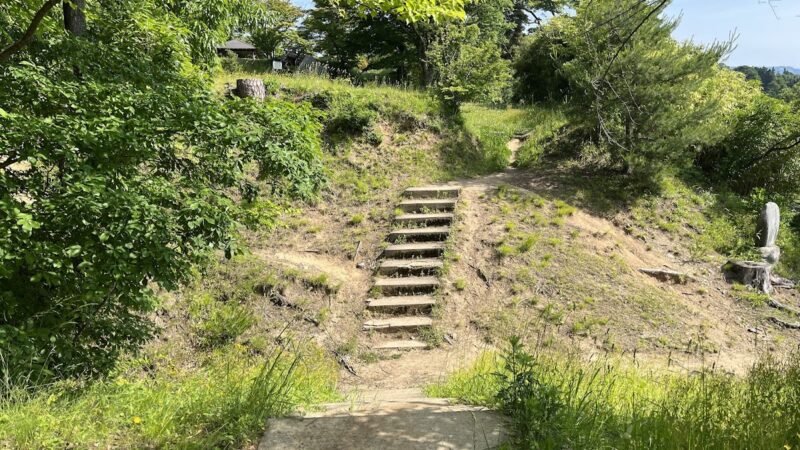
Although much has been lost due to large-scale construction work, careful observation allows one to imagine the defensive line of the time. While the earthworks are weathered, traces remain in some places along the edges of the enclosures.
Current Status and Preservation of the Remains
The Honjin-yama Castle Ruins have been significantly altered by post-war development and park construction. The area around the main enclosure, in particular, has undergone development as part of its park construction, and it cannot be said that the original topography from the Sengoku period (Warring States period) is preserved.
However, while many mountain castles in Gifu Prefecture have been completely lost, Honjin-yama Castle is a valuable historical site where castle remains such as the layout of the enclosures and parts of the moats can still be confirmed. Although the state of preservation of the remains is not good, there is sufficient information to learn about the basic structure of a mountain castle.
Excavation and Research
Regarding Honjin-yama Castle, it appears that no large-scale excavation surveys have been conducted, but investigations have been carried out by local historians and castle researchers. With the advancement of medieval castle research, a layout map of Honjin-yama Castle has been created, and its structure is gradually becoming clearer.
Further detailed surveys and partial excavations are expected to clarify the construction techniques, the period of use, and traces of daily life.
Highlights of Honjin-yama Castle
Mitake Castle Ruins Park
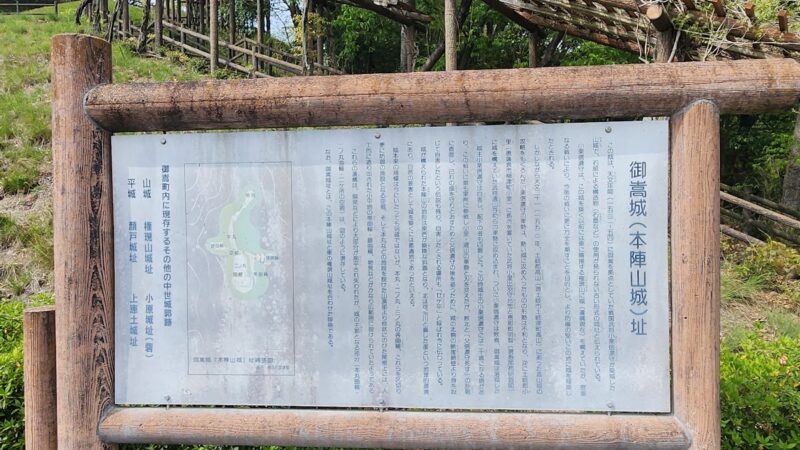
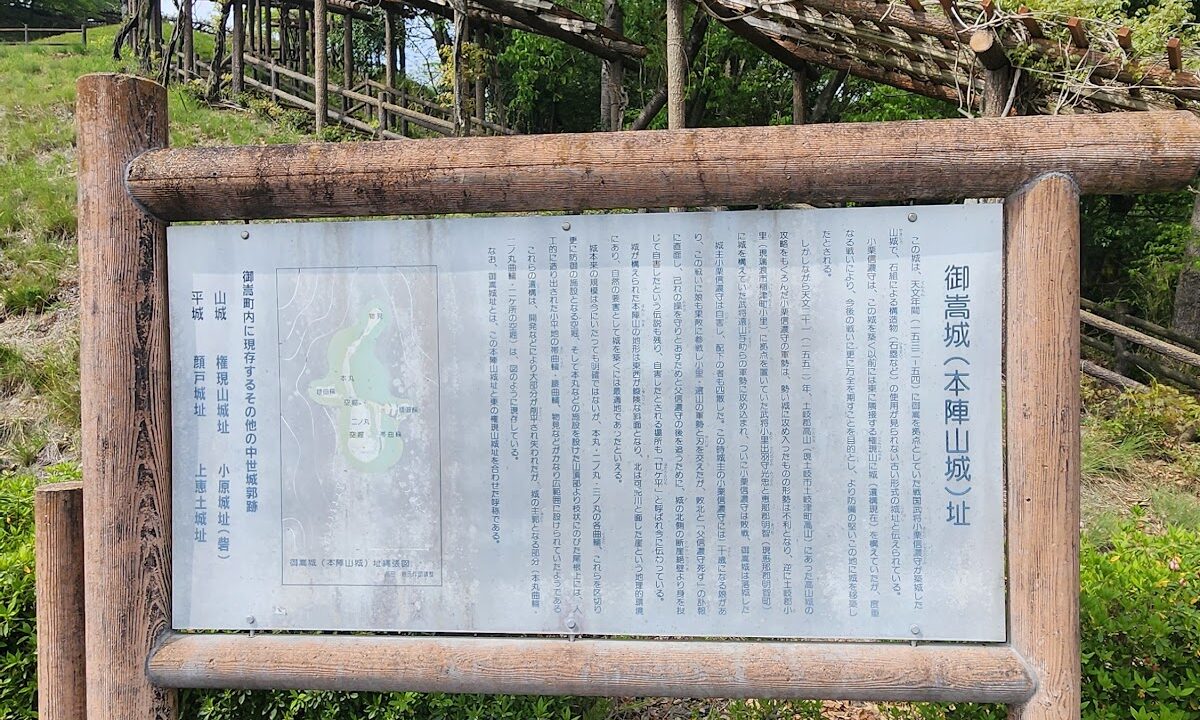
The main enclosure of Honjin-yama Castle has been developed as “Mitake Castle Ruins Park,” making it easily accessible to visitors. Information boards indicating the castle ruins are installed within the park, allowing visitors to learn about the history of Honjin-yama Castle and the legend of Kirigakure Castle.
The view from the park is also a highlight. From an altitude of 241 meters, you can enjoy a panoramic view of the town of Mitake, allowing you to imagine the former lord overlooking his territory from this spot. On a clear day, you can see the surrounding mountains and distant scenery, giving you a real sense of why this location was chosen for a castle.
Remains of Enclosures and Moats
For castle enthusiasts, the biggest highlight is the remaining remains of the enclosures and moats. While some parts have been altered due to the park’s development, careful observation will reveal traces of the Sengoku period topography and defensive structures.
In particular, the elevation changes around the main enclosure and the remains of moats cutting off the ridge provide valuable clues to understanding the structure of the mountain castle. Obtaining a map of the castle layout beforehand will allow for a deeper and more enjoyable exploration of the remains.
Relationship with Gongen-yama Castle
When visiting Honjin-yama Castle, it is recommended to also visit Gongen-yama Castle (Kirigakure Castle). The two castles are only about 1 kilometer apart in a straight line, allowing you to personally observe the history of the relocation from Gongen-yama Castle to Honjin-yama Castle.
Gongen-yama Castle is built at a higher elevation and on more rugged terrain than Honjin-yama Castle. Comparing the two castles offers an interesting opportunity to consider the military judgment behind Oguri Shinano-no-kami’s decision to relocate to Honjin-yama.
Relationship with Mitake-shuku
At the foot of Honjin-yama Castle lies Mitake-shuku, a post town on the Nakasendo road. While Mitake’s history as a post town dates back to the Edo period, it’s clear that this area has long been a vital transportation hub.
A stroll through the streets of Mitake-juku before or after visiting the castle ruins will provide insight into Mitake’s history from the medieval to the early modern period. Buildings that retain the atmosphere of a post town, as well as historical structures such as Gankoji Temple, are also worth seeing.
Castle Stamps and Castle Tours
Obtaining Castle Stamps
In recent years, castle tours collecting “castle stamps” (Gojoin) have become popular nationwide. A castle stamp is a commemorative stamp given upon visiting a castle, similar to a shrine’s Goshuin (temple/shrine stamp).
Many castles in Gifu Prefecture issue castle stamps, and Mitake Castle (Honjin-yama Castle) is one of them. Castle stamps are usually available at local tourist information centers and related facilities, so it’s a good idea to check distribution locations before your visit.
Castle Tour Course in Gifu Prefecture
Gifu Prefecture is known as the “Land of Castles,” boasting numerous famous castles such as Gifu Castle (Inabayama Castle), Inuyama Castle, and Gujo Hachiman Castle. Around Mitake Town, including Honjin-yama Castle, several Sengoku period mountain castles are scattered, including Kanayama Castle, Akechi Castle, and Naegi Castle.
Planning a castle tour course starting from Honjin-yama Castle and visiting these castles will allow you to gain a deep understanding of Mino’s Sengoku period history. Visiting castles selected as one of Japan’s Top 100 Castles or the Continued Top 100 Castles is also recommended.
Access and Visiting Information
Location
Address: Mitake, Mitake-cho, Kani-gun, Gifu Prefecture (Mitake Castle Ruins Park)
Honjin-yama Castle Ruins are located near the center of Mitake Town and are within walking distance of Mitake Station on the Meitetsu Hiromi Line.
Access by Train
- Get off at Mitake Station on the Meitetsu Hiromi Line: It’s about a 20-30 minute walk from the station to Honjinyama Castle Ruins Park.
- The path from the station to the castle ruins is a gentle uphill climb, so we recommend wearing comfortable shoes.
Access by Car
- Kani-Mitake IC on the Tokai-Kanjo Expressway: Approximately 10 minutes from the IC.
- Tajimi IC on the Chuo Expressway: Approximately 20 minutes from the IC.
There is parking available around Mitake Castle Ruins Park, but spaces are limited, so please consider using public transportation.
Notes for Visitors
- Opening Hours: The park is open at all times, but please avoid visiting at night.
- Admission Fee: Free
- Estimated Time Required: Allow 30 minutes to 1 hour for a stroll through the park. If you plan to carefully observe the ruins, you will need more time. – Attire: As this is a mountain castle, comfortable clothing and non-slip shoes are essential. Be especially careful after rain, as the ground can become slippery.
- Season: Spring to autumn is the best time to visit, but don’t forget insect repellent in the summer. Snow is possible in winter.
Nearby Tourist Attractions
When visiting Honjin-yama Castle, we recommend also visiting the following nearby spots:
- Gankoji Temple: An ancient temple housing numerous Buddhist statues designated as Important Cultural Properties.
- Mitake-juku Townscape: A historical townscape retaining the atmosphere of a post town on the Nakasendo road.
- Gongen-yama Castle (Kirigakure Castle): A mountain castle that complements Honjin-yama Castle.
- Mitake no Mori: A forest park where you can enjoy nature walks.
Contact Information
For detailed information and the latest status, please contact the following:
Mitake Town Tourism Association
- Phone: 0574-67-2111 (Mitake Town Hall Representative)
The Charm and Value of Honjin-yama Castle
Historical Value
Honjin-yama Castle possesses invaluable historical value as a castle of a local lord in Mino Province during the Sengoku period. While not a large-scale castle, it is an important historical site that conveys how local samurai protected their territory and survived the turbulent times.
The legend of Kirigakure Castle is not merely superstition, but demonstrates the faith of the people of that time and their wisdom in attempting to militarily utilize natural phenomena. The story, which combines the historical fact of the relocation from Gongen-yama Castle to Honjin-yama Castle with legend, enriches the region’s historical and cultural heritage.
Significance in Castle Research
Honjin-yama Castle is also important in castle research as a typical example of a small-scale mountain castle from the Sengoku period. Unlike the massive castles of daimyo-class lords, it allows us to understand the structure of a practical mountain castle built by a local lord.
You can learn about castle construction techniques that aimed to maximize defensive capabilities with limited resources, such as the arrangement of baileys, the construction of moats, and the utilization of terrain. This is an essential perspective for a comprehensive understanding of the history of Japanese castles.
As a Regional Cultural Heritage
For Mitake Town, Honjin-yama Castle is an important cultural heritage that forms the town’s identity. It has been developed as a castle ruins park, serving not only as a place of relaxation for residents but also as an educational site for learning local history.
The issuance of castle stamps and its use as a tourist resource can be seen as part of an effort to re-evaluate the region’s history and culture and pass it on to future generations.
The Significance of Visiting Honjin-yama Castle
Honjin-yama Castle is not a famous tourist destination, but that is precisely why it is a valuable place to quietly confront history. While there are no large-scale restored structures, the simple appearance of the earthen castle remains.
By actually walking through the mountain castle from the Sengoku period and looking around from the perspective of the people of that time, you can gain a real sense of history that cannot be learned from textbooks. Reflecting on the legend of Kirigakure Castle while gazing at Gongen-yama Mountain and contemplating the decisions and fate of Oguri Shinano-no-kami will be a valuable experience that evokes a sense of historical romance.
When visiting Gifu Prefecture, be sure to also visit Honjin-yama Castle. It will be a memorable castle tour that allows you to experience the region’s history and culture.
Summary
Honjin-yama Castle (Mitake Castle) is a Sengoku period mountain castle located in Mitake-cho, Kani-gun, Gifu Prefecture, built by Oguri Shinano-no-kami. A legend remains that the castle fell after it lost its spiritual protection following its relocation from Gongen-yama Castle (Kirigakure Castle) to Honjin-yama, making it a historically romantic site.
Currently, it is maintained as Mitake Castle Ruins Park, where you can see the remains of the baileys and moats. The view from the 241-meter-high mountaintop is also magnificent, allowing you to experience the atmosphere of a Sengoku period mountain castle. Easily accessible on foot from Meitetsu Mitake Station, and offering castle stamps, this is an ideal spot for a castle tour in Gifu Prefecture.
If you’re interested in the Sengoku period history of Mino Province or enjoy exploring mountain castles, be sure to visit Honjin-yama Castle and experience the local history and culture.