Complete Guide to the History and Highlights of Furukawa Castle (Gifu Prefecture) | Base of the Anegakoji and Kanamori Clans
The ruins of Furukawa Castle, located in Furukawa-cho, Hida City, Gifu Prefecture, are an important historical site indispensable for understanding the Hida region during the Sengoku period. This mountain castle, also known as “Hamaguri-jo” (Clam Castle), is known as the residence of the Furukawa clan, one of the three Anegakoji families, and later served as the base for the Kanamori clan’s rule of Hida.
This article will introduce the charm of Furukawa Castle in its entirety, from its construction to its abandonment, highlighting notable remains, and access methods.
What is Furukawa Castle? | A Mountain Castle Telling the Story of Hida’s Sengoku History
Furukawa Castle is a flatland castle located on a mountaintop across the Arakijo River from the Furukawa Kokufu Basin. It was built in the mountains of the present-day Takano district of Furukawa-cho, Hida City, and is situated opposite Masujima Castle across the Miyagawa River. Designated as one of the national historic sites “Anekōji Clan Castle Ruins,” it is an important historical site representing medieval castles in the Hida region. The layout, centered around the main enclosure, retains many characteristics of a Sengoku period mountain castle, and the remains such as stone walls and vertical moats are well-preserved.
Origin of the Alternate Name “Hamaguri Castle”
Furukawa Castle is also known by the alternative name “Hamaguri Castle.” Legend says this name originates from Kanamori Nagachika discovering a strange stone with a clam-shell pattern within the castle grounds. Kanamori Nagachika had previously resided in a castle called “Hamaguri Castle” in Ōmi Province, and it is said that upon seeing the stone, he reminisced about the past and gave it the same name.
This legend is not merely a story about the origin of a place name, but an interesting episode illustrating the relationship between the Kanamori clan and Furukawa Castle.
History of Furukawa Castle | From the Anegakoji Clan to the Kanamori Clan
Construction and the Era of the Furukawa Clan
There are various theories regarding the construction date of Furukawa Castle. One tradition states that it was built by Fujiwara no Moritomo at the end of the Oei era (early 15th century), while another suggests it was built by Furukawa Jiro during the Tenbun era (1532-1555). According to the *Hishu-shi* (History of Hishu Province), it was the residence of Furukawa Jiro from ancient times.
The Anegakoji clan, who were the governors of Hida Province, split into three branches—the Mukai, Furukawa, and Kojima clans—from the late Muromachi period to the Sengoku period. Furukawa Castle was the base of the Furukawa clan. As one of the three Anegakoji branches, the Furukawa clan maintained their power as a powerful local lord controlling the southern part of the Hida Kokufu Basin.
Conflict with the Miki Clan and the Era of the Shioya Clan
In 1530 (Kyoroku 3), Miki Naoyori (grandfather of Anegakoji Yoritsuna), who aimed to unify the Hida region, took advantage of an internal conflict within the Anegakoji family to attack the Furukawa clan along with the Mukai and Kojima clans. This conflict led to a decline in the Furukawa clan’s power, and the castle came under the influence of the Miki clan.
Subsequently, Shioya Chikuzen-no-kami Akisada became the lord of the castle. Shioya Chikuzen-no-kami fought with the lord of Shiroo Castle in Nei District, Etchu Province, initially serving Uesugi Kenshin, and later becoming a vassal of Oda Nobunaga. However, records indicate that he used this castle as his residence until his death in battle in 1583 (Tensho 11).
The Kanamori Clan’s Invasion of Hida and Furukawa Castle
In 1585 (Tensho 13), Kanamori Nagachika, having received orders from Toyotomi Hideyoshi to invade Hida, attacked and forced the surrender of Anegakoji Yoritsuna (Miki Jitsuna). Following this pacification of Hida, Kanamori Yoshishige, Nagachika’s adopted son, entered Furukawa Castle.
For the Kanamori clan, Furukawa Castle was a crucial castle, becoming their first base of operations in Hida. Kanamori Yoshishige began governing Hida Province from Furukawa Castle, aiming to stabilize the territory.
Relocation to Masujima Castle and Abandonment of Furukawa Castle
In 1586 (Tensho 14), Kanamori Yoshishige began construction of Masujima Castle, a new castle on the plains of the Furukawa Basin. Masujima Castle was built as a flatland castle in a location more suitable for governance, and upon its completion, Kanamori Yoshishige moved his residence there.
Consequently, Furukawa Castle was abandoned after only a little over a year. According to legend, when Masujima Castle was built, stones from Furukawa Castle’s stone walls were transported to Masujima Castle. There’s an interesting speculation that the large vertical moat extending from the lower bailey on the south side of the main enclosure might have been a passage for transporting the stones down.
Layout and Structure of Furukawa Castle
Composition of the Main Enclosure and Outer Baileys
The central part of Furukawa Castle is centered around the main enclosure. The main enclosure is located on the mountaintop, surrounded by outer baileys (enclosures surrounding the main enclosure), a typical structure for a mountain castle.
The steep cliff (artificially carved steep slope) between the main enclosure and the outer baileys is remarkably large in both slope and height, indicating its high defensive capabilities. This steep cliff functioned as an important defensive structure, making enemy intrusion difficult.
Stone Walls and Masugata Koguchi (Square Enclosure)
A distinctive feature of Furukawa Castle is the Masugata Koguchi (square enclosure) with stone walls remaining on the east side. A Masugata Koguchi is a castle construction technique that enhances defense by creating a winding path for enemy incursions.
Below the main enclosure’s watchtower base, traces of stone walls can be seen, providing valuable evidence of the developmental stage of stone wall technology during the Sengoku period. These stone walls may have existed before the Kanamori clan took control of the castle, offering important clues for considering the timing of the introduction of stone wall technology in the Hida region.
Vertical Moats and Defensive Structures
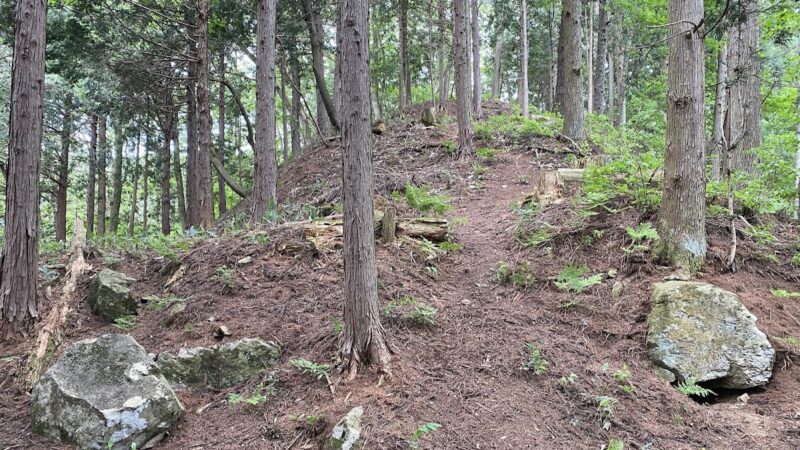
Multiple vertical moats have been identified within the castle grounds. These moats, dug vertically along the mountain slopes, prevented lateral movement by enemies and also functioned as rainwater drainage channels.
As mentioned earlier, the large vertical moat extending from the lower bailey below the south side of the main enclosure may have been used as a stone transport route during the construction of Masujima Castle, making it an interesting historical relic that tells the story of the castle.
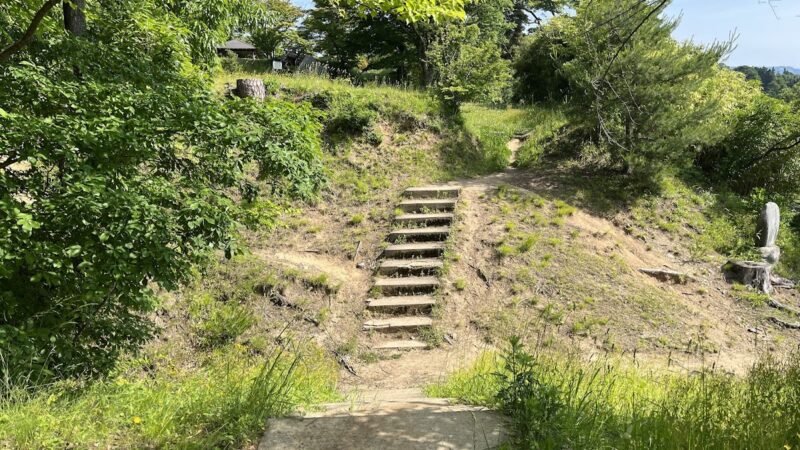
The earthworks and the layout of the baileys are also well-preserved, making it a valuable historical site where you can actually experience how a mountain castle was constructed during the Sengoku period.
Highlights of Furukawa Castle | Remains that can be seen on site
Remains around the main enclosure
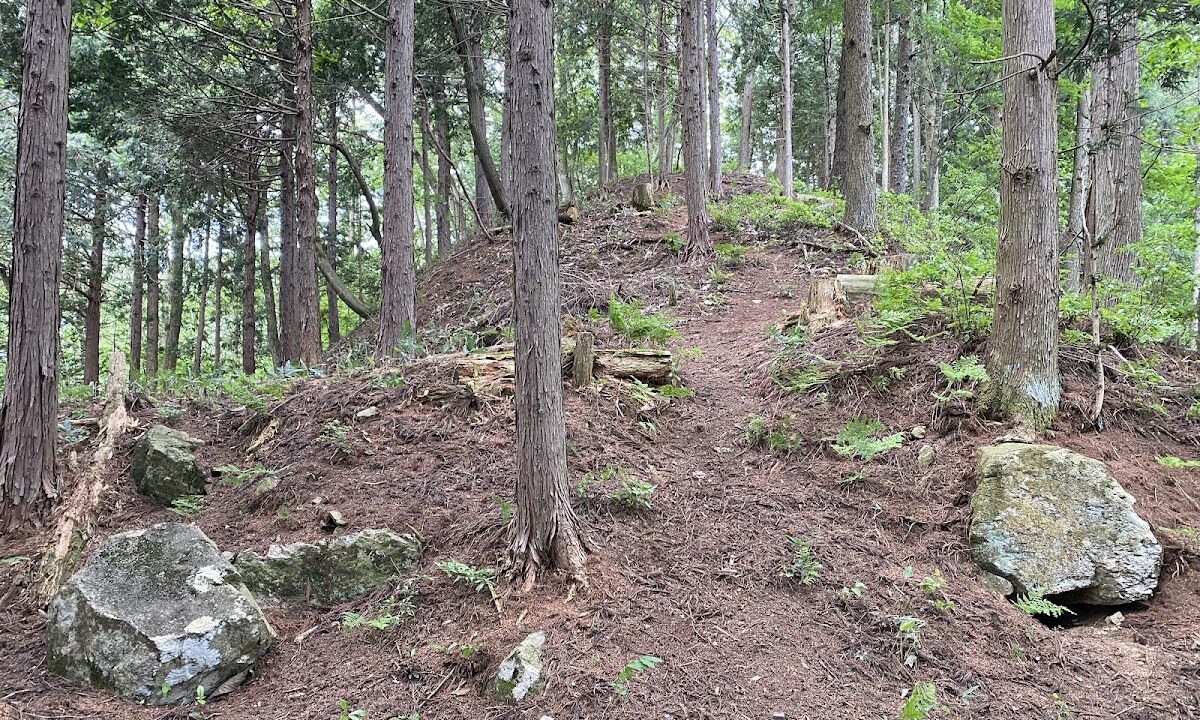
The biggest highlight when visiting Furukawa Castle is undoubtedly the group of remains around the main enclosure. The flat area of the main enclosure is relatively large, allowing you to imagine the traces of buildings.
The cliff between the main enclosure and the surrounding outer bailey is impressive, and its height and steep slope give a real sense of the advanced castle-building technology of the time. Even those unfamiliar with castles will understand the high defensive capabilities of a mountain castle by looking at this cliff.
Stone Walls and Turret Bases
The stone walls near the eastern masugata koguchi (square-shaped gate) are particularly noteworthy remains within Furukawa Castle. These walls, constructed using the nozurazumi (rough-stone masonry) technique, are valuable historical documents demonstrating Sengoku period stonework techniques.
The stone wall remains directly below the turret base of the main enclosure are also not to be missed. Turret bases were crucial for observation and defense, and it is believed that they offered panoramic views of the castle town and surrounding areas.
Vertical Moats and Enclosure Layout
Vertical moats carved into the mountain slopes can be observed in multiple locations. The large-scale vertical moats, in particular, demonstrate their importance as defensive structures due to their depth and size.
By walking and observing the layout of each enclosure, you can understand the ingenuity of the castle’s overall layout and the setting of its defensive lines. For those familiar with mountain castle exploration, bringing a layout map and comparing it to the actual terrain is recommended.
Related Historical Sites in the Surrounding Area
Masujima Castle Ruins
Across the Miyagawa River from Furukawa Castle lies the ruins of Masujima Castle. This flatland castle was built by Kanamori Yoshishige after he relocated from Furukawa Castle, and is now maintained as Masujima Castle Ruins Park.
Masujima Castle had a concentric layout with the main keep at its center, surrounded by the second and third baileys, and enclosed by a moat. Some of the stone walls and moats remain today, and visiting both Furukawa Castle and Masujima Castle allows for an understanding of the changes in the Kanamori clan’s rule over Hida Province.
Anegakoji Clan Castle Ruins
Furukawa Castle is designated as one of the national historic sites “Anegakoji Clan Castle Ruins,” but other castles such as Kojima Castle, Mukai-Kojima Castle, and Kotakari Castle are also included in the same group.
These castles were the bases of the three Anegakoji families, and are an important group of historical sites for understanding the Sengoku period history of the Hida region. If you have the time, visiting these castle ruins will give you a deeper understanding of the sphere of influence of the Anekōji clan and the Sengoku period in Hida.
The Townscape of Hida Furukawa
Furukawa-cho in Hida City, where Furukawa Castle is located, is a region with beautiful townscapes known as “Little Kyoto of Hida.” The white-walled storehouse district and the scenery along the Setogawa River have been designated as an Important Preservation District for Groups of Traditional Buildings.
When visiting Furukawa Castle, enjoying a stroll through the townscape of Furukawa in addition to exploring the castle ruins will allow you to experience history and culture comprehensively.
Access and Visit Information
Basic Information
Location: Takano, Furukawa-cho, Hida City, Gifu Prefecture
Historic Site Designation: One of the nationally designated historic sites “Anekoji Clan Castle Ruins”
Castle Classification: Hilltop Castle
Construction Period: Late Oei era or Tenbun era (various theories exist)
Year of Abandonment: Tensho 14 (1586)
Remains: Enclosures, stone walls, vertical moats, earthworks, cliffs
Transportation Access
Access by Train:
- Approximately 30 minutes on foot from JR Takayama Line “Hida-Furukawa Station”
- Approximately 5 minutes by taxi from Hida-Furukawa Station
Access by Car:
- Approximately 25 minutes via National Route 41 from Tokai-Hokuriku Expressway “Hida-Kiyomi IC”
- Approximately 20 minutes from the Takayama Interchange on the Chubu Trans-Japan Expressway via National Route 41.
Parking: There is no dedicated parking lot around the castle ruins, but you can use the parking lot at Masujima Castle Ruins Park and access the site on foot from there.
Notes for Visitors
Since Furukawa Castle Ruins is a mountain castle, please observe the following points when visiting.
Clothing and Equipment:
- Suitable hiking boots (trekking shoes recommended)
- Comfortable clothing
- Drinking water
- Insect repellent spray (in summer)
Safety:
- The cliff face is steep, so watch your step carefully
- Be especially careful during rainy weather or after rain, as it can be slippery
- Visiting in a group is recommended over visiting alone
- In winter, snow may make climbing difficult
Manners:
- As this is a nationally designated historical site, damaging or taking any remains is strictly prohibited
- Please take all your trash with you
- No open flames
Estimated Visit Time
For exploring the castle ruins, allow approximately 40 minutes to 1 hour for a round trip from the entrance to the main enclosure. If you want to observe the remains thoroughly, 1 hour and 30 minutes will allow for a more relaxed visit.
If combining this with a visit to Masujima Castle Ruins or exploring the townscape of Furukawa, it’s best to allocate about half a day.
Tips for Enjoying Furukawa Castle
Recommended Prior Study
Before visiting Furukawa Castle, acquiring basic knowledge about the history of the Anekōji and Kanamori clans, and the Sengoku period in Hida, will deepen your understanding at the site. Viewing related materials at the Hida City Library or Hida City Museum of Art is also recommended.
Obtaining a map of the castle grounds beforehand will allow you to explore while confirming the relative locations of the remains, resulting in a more fulfilling visit.
Best Season
The best time to visit Furukawa Castle ruins is spring (April-May) and autumn (October-November). The scenery is beautiful during the seasons of fresh greenery and autumn leaves, and the weather is mild, making it ideal for visiting the castle.
Summer (June-September) is characterized by many insects and intense heat, so early morning visits are recommended. In winter, snowfall can make access difficult, so it is recommended to check the conditions with the local tourism association beforehand.
Photography Tips
The following are recommended photography points at Furukawa Castle Ruins:
- View from the main enclosure (towards the Furukawa Basin and Masujima Castle)
- The cliff between the main enclosure and the outer bailey (its height and steepness)
- The masugata koguchi (square-shaped gate) with stone walls on the east side
- Remains of the stone walls directly below the turret base
- A panoramic view of the vertical moat
A wide-angle lens will make it easier to capture the scale of the cliffs and vertical moat.
Historical Significance of Furukawa Castle
Position in the History of the Sengoku Period in Hida
Furukawa Castle played an important role in understanding the Sengoku period history of the Hida region. As one of the three Anegakoji families, it was a base of control for the Hida Kokufu Basin, and as a historical site that tells the story of the conflict with the Miki clan and the process of the Kanamori clan’s unification of Hida, it has high historical value.
The fact that it was the first base of the Kanamori clan’s rule over Hida Province is particularly important. Although it was only for a short period before the Kanamori clan moved to Masujima Castle, the foundation of their Hida rule was laid at this castle.
Value in Castle History
The remains of Furukawa Castle retain many characteristics of a Sengoku period mountain castle, making it important for castle research. The structure of the main enclosure and outer baileys, the stage of development in stone wall technology, and the arrangement of vertical moats provide valuable information on Sengoku period castle construction techniques.
In particular, the stone walls may have existed before the Kanamori clan’s arrival, providing important clues for considering the timing of the introduction of stone wall technology in the Hida region.
Preservation and Utilization as a National Historic Site
Furukawa Castle is designated as a National Historic Site as one of the “Anekōji Clan Castle Sites,” and appropriate preservation and management are being carried out. Further research is expected to reveal more historical facts.
For Hida City, preserving the value of the Furukawa Castle ruins as a regional historical heritage site and a tourist resource is a crucial issue.
Summary | Experiencing the Sengoku Period of Hida at Furukawa Castle
Furukawa Castle is an important historical site indispensable to the history of the Sengoku period in the Hida region, as it was the residence of the Furukawa clan, one of the three Anegakoji families, and the first base of the Kanamori clan’s rule over Hida.
Many notable remains remain, including the impressive cliff between the main enclosure and the outer bailey, the masugata koguchi (square-shaped gate) with stone walls, the remains of stone walls directly below the turret base, and large-scale vertical moats. By actually seeing, walking, and touching these remains, you can experience how a mountain castle of the Sengoku period was built and how it functioned.
When you visit Hida Furukawa, be sure to visit the Furukawa Castle ruins in conjunction with strolling through the townscape, including the white-walled storehouse district. Visiting Furukawa Castle Ruins in conjunction with Masujima Castle Ruins will allow you to gain a deeper understanding of the changes in the Kanamori clan’s rule over Hida.
Equip yourself with the appropriate gear for mountain castle hiking, and while prioritizing safety, why not experience the romance of history at Furukawa Castle Ruins, where the Sengoku period of Hida still breathes?