History and Remains of Kanasugi Castle (Funabashi City, Chiba Prefecture) | The Complete Picture of a Small Castle from the Muromachi Period
Basic Information on Kanasugi Castle
Kanasugi Castle was a medieval castle located in Kanasugi-cho 2-chome, Funabashi City, Chiba Prefecture. It is located approximately 30-40 minutes on foot from the current Magomezawa Station on the Tobu Urban Park Line (formerly the Tobu Noda Line), and was built in an area where the place name “Horinouchi” remains.
Location and Former Province
- Location: Kanasugi-cho 2-chome, Funabashi City, Chiba Prefecture
- Former Province: Shimosa Province
- Topography: Hilltop Castle
- Elevation: Slightly elevated area of approximately 20-25m
Located at the southwestern edge of the Kanasugi settlement, near the former village entrance, this castle is thought to have played a strategic role as a key point for monitoring the highway.
Castle Size, Classification, and Structure
Kanasugi Castle is believed to be a single-enclosure flatland castle measuring approximately 50m x 50m. Based on this size, it is presumed to have been a small military facility functioning as a residence, fort, or guardhouse, rather than a full-fledged battle castle.
Classification and Structural Characteristics:
- Single-enclosure layout
- Earthen rampart defense
- Masugata (square-shaped) gate structures
- Presumed to have had a moat surrounding it
History of Kanasugi Castle and Builder
Construction Year and Builder
Regarding the construction year and builder of Kanasugi Castle, there are many unknowns due to a lack of clear historical records. However, several clues allow for inference.
Construction Year: Estimated to be from the Muromachi period to the Sengoku period (around the 15th-16th centuries). A Muromachi period stone monument has been unearthed at the site, confirming the existence of some kind of religious facility or residence during this period.
Builder: There are several theories regarding the builder of the castle, but the most plausible ones are as follows:
- Kanasugi Clan Theory: Records indicate that a family named Kanasugi existed in this area during the medieval period, and it is considered highly likely that this was their castle or residence.
- Takagi Clan Related Theory: Given that it was within the sphere of influence of the Takagi clan of Kogane Castle, it has been suggested that the Takagi clan may have stationed their samurai there to monitor the roads.
Castle Lords and Historical Changes
Details regarding the castle lords of Kanasugi Castle are unknown, but we can infer them from the historical changes in this region.
Early Medieval Period (Muromachi Period):
This is thought to be the period when the Kanasugi clan used it as their residence. During this time, samurai groups centered around the Chiba clan were vying for power in Shimosa Province, and the Kanasugi clan may have played a part in this.
Sengoku Period:
In 1566 (Eiroku 9), during Uesugi Kenshin’s invasion of the Kanto region, the Hara clan, who ruled this area, moved their base to Usui Castle. Records indicate that as a result, the territories of Kurihara and Funabashi were transferred to Takagi Tanetatsu, the lord of Kogane Castle. It is highly probable that Kanasugi Castle came under the control of the Takagi clan from this period onward.
The Takagi clan used Kogane Castle as their base and governed their territory by strategically placing several branch castles and forts around it. Kanasugi Castle is presumed to have played a role in monitoring roads and protecting the boundaries of their territory as part of this system.
Remains and Current State of Kanasugi Castle
Remaining Remains
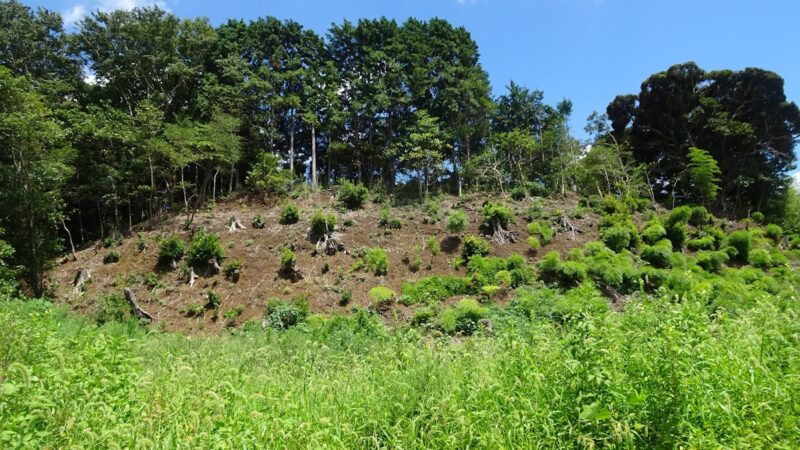
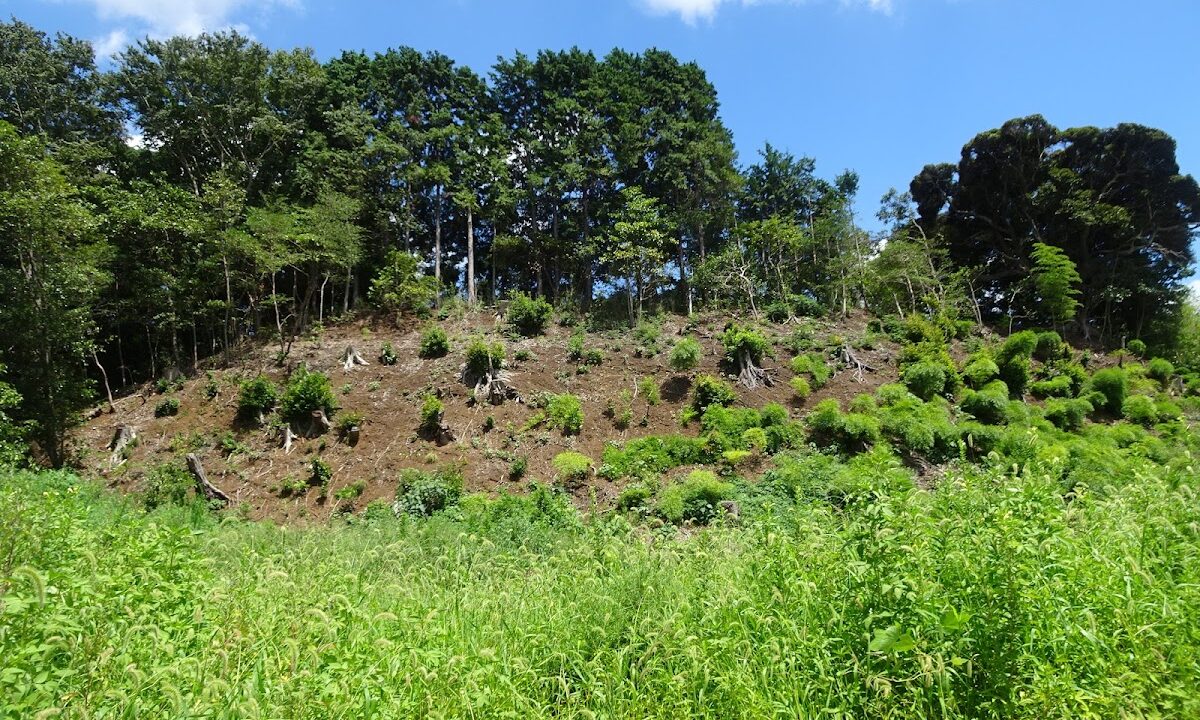
The most notable feature of Kanasugi Castle is that the remains of this medieval castle are still preserved in relatively good condition. This is due to the fact that the landowners have retained their land without relinquishing it.
Main Existing Remains:
- Earthworks: A portion of the earthworks surrounding the castle still exists. Approximately 1-2 meters high, it is clear that they served as a defensive structure.
- Masugata: Traces of a defensive structure called a masugata can be seen at the castle’s entrance (koguchi). This was a tactic to prevent enemy intrusion and is a typical structure of medieval castles.
- Topographical Undulations: The layout, utilizing slightly elevated terrain, can be inferred from the current topography.
- Traces of a Moat: While clear moat remains are difficult to confirm, the surrounding topography suggests the possibility of a moat.
Current Status as Private Land
The Kanasugi Castle site is currently largely private land and used as farmland. Therefore, public visits and access are restricted.
Current Characteristics:
- The majority of the castle site is privately owned farmland.
- Remains such as earthworks are preserved despite being used as farmland.
- No development as a park or historical site park has been carried out.
- Distant views from the road are possible, but detailed viewing is difficult.
This private ownership has paradoxically resulted in the preservation of the remains, escaping development. In Funabashi City, where residential development is progressing, the remaining medieval castle remains can be considered a valuable cultural asset.
Historical Significance and Role of Kanasugi Castle
A Strategic Point for Monitoring Highways
The most important role of Kanasugi Castle was its function as a strategic point for monitoring highways. This region was located where the main highways of Shimosa Province passed through, and understanding the movement of people and goods was an important task for the feudal lord.
Military Functions:
- Monitoring of roads and management of travelers
- Boundary defense of the territory
- Emergency communication base
- Garrison for a small garrison
Given its size of 50 meters square, it is likely that it was not a castle capable of housing a large army, but rather a guard post or fort where a small number of samurai were permanently stationed.
Relationship with Kogane Castle
Kanasugi Castle was located within the sphere of influence of the Takagi clan, who ruled Kogane Castle. Kogane Castle was a large medieval castle located in present-day Kogane, Matsudo City, and was the base of the Takagi clan.
The Takagi clan was a powerful warlord in this region during the Sengoku period, and managed their territory by establishing multiple branch castles. It is highly probable that Kanasugi Castle functioned as part of this branch castle network.
Relationship with Kogane Castle:
- Located within approximately 10km of Kogane Castle
- Monitored the road towards Funabashi
- Played a role in the Takagi clan’s territorial control
- Part of the emergency communication network
Position in Local History
The place name “Kanasugi” tells the story of this region’s history. There are several theories about the origin of the name “Kanasugi,” including theories related to metalworking and blacksmithing, or that it is a corruption of “Kamisugi” (神杉).
The discovery of a stone monument from the Muromachi period suggests that the Kanasugi settlement was an old settlement that existed since the Middle Ages, and that Kanasugi Castle also played a role in protecting this settlement.
Historical Spots Around Kanasugi Castle
Kanasugi Shinmei Shrine
The Kanasugi Shinmei Shrine is located on the east side of Kanasugi Castle. This shrine has long been revered as the guardian shrine of the Kanasugi settlement.
Characteristics of Kanasugi Shinmei Shrine:
- A few minutes’ walk from Kanasugi Castle
- The spiritual center of the settlement
- An ancient shrine possibly dating back to the Middle Ages
- A possible connection to the Kanasugi clan is also suspected.
Other Castles in Funabashi City
Besides Kanasugi Castle, several other medieval castles existed in Funabashi City. These are thought to have cooperated to form a regional defense network.
Major Castles in Funabashi City:
- Takane Castle: A castle located in Takane-cho, Funabashi City, believed to have been within the sphere of influence of the Takagi clan, similar to Kanasugi Castle.
- Natsumi Castle: A castle located in Natsumi, Funabashi City, with a possible connection to the Hara clan.
- Hazama Castle: A castle located in Hazama-cho, Funabashi City, a relatively large castle.
- Ogurihara Castle: A castle located in Ogurihara, Funabashi City.
- Tsuboi Castle: This castle was located in Tsuboi-cho, Funabashi City.
These castles are important historical sites for understanding the power dynamics in Shimosa Province during the Sengoku period.
Access and Transportation to Kanasugi Castle
Access by Public Transportation
Access by Train and Bus:
- Using the Tobu Urban Park Line (Tobu Noda Line)
- Get off at Magomezawa Station
- Approximately 30-40 minutes on foot from the station
- Head northwest along Chiba Prefectural Road No. 8 (Funatori Line)
- Using the Bus
- Use Shin-Keisei Bus or Funabashi Shin-Keisei Bus
- A few minutes’ walk from the nearest bus stop
- Please check the detailed bus routes in advance
Access by Car
Access by Car:
- Along Chiba Prefectural Road No. 8 (Funatori Line)
- There is no parking lot, so please use nearby public facilities, etc.
- Search for “Kanasugi-cho 2-chome, Funabashi City” on your car navigation system
Points to Note When Visiting
When visiting Kanasugi Castle Ruins, please note the following:
- Consideration for Private Property: The majority of the castle site is privately owned farmland; unauthorized entry is prohibited. Please limit your visit to viewing from the road.
- Protection of Remains: Remains such as earthworks are valuable cultural assets. Even when approaching them, care must be taken not to damage the remains.
- Consideration for Surrounding Residents: Since the site is close to a residential area, please avoid noise and disruptive behavior.
- Caution When Taking Photographs: Care must be taken to avoid including private property or houses in photographs.
References and Materials for Kanasugi Castle Research
This section introduces key references for investigating and researching Kanasugi Castle.
Main References
- “The System of Japanese Castles” (Shin Jinbutsu Oraisha)
- A fundamental reference covering castles throughout Japan
- Contains basic information about Kanasugi Castle
- “A Tour of Ancient Castle Sites in Boso”
- Provides detailed information on medieval castles in Chiba Prefecture
- Abundant information based on on-site surveys
- “Detailed Distribution Survey Report of Medieval and Early Modern Castle Sites in Chiba Prefecture” (Chiba Prefectural Board of Education)
- An official castle site survey report by Chiba Prefecture
- A highly reliable source of academic information
- “History of Funabashi City”
- The official history book of Funabashi City
- Allows understanding of Kanasugi Castle within the context of local history
Digital Resources
In modern times, information about Kanasugi Castle can also be obtained online:
- Nippon Castle Tour: A castle information site utilizing location information
- Kojodan: A community site for castle enthusiasts
- Shirobito: A comprehensive website for castle information
These sites allow you to view reviews and photos posted by people who have actually visited the castles, which is helpful for understanding the local conditions beforehand.
Preservation of Kanasugi Castle and Future Challenges
Value as a Cultural Property
Although small in scale, Kanasugi Castle has cultural value in the following respects:
- A typical example of a medieval castle: It exhibits the typical form of a small-scale castle, a single-enclosure structure measuring 50 meters square.
- Remaining structures: In Funabashi City, which is undergoing urbanization, the remaining structures such as earthworks and masugata (square enclosures) are invaluable.
- A witness to local history: It is an important historical site that conveys the history of the Kanasugi settlement, the sphere of influence of the Takagi clan, and the state of Shimosa Province during the Sengoku period.
- Materials for the history of highways: Its function as a key point for monitoring highways provides important information for studying the history of transportation in the medieval period.
Current Status and Challenges of Preservation
There are several challenges in preserving Kanasugi Castle:
Current Problems:
- Difficult to implement public protection measures due to private land ownership
- Lack of development as a historical site
- Low public awareness
- Insufficient detailed academic research
Future Prospects:
- Preservation activities with the cooperation of landowners
- Consideration of cultural property designation by Funabashi City
- Implementation of detailed surveys and archaeological excavations
- Enhancement of information dissemination, such as the installation of explanatory signs
- Providing opportunities for history education to local residents
Utilization as a Regional Resource
Kanasugi Castle has the potential to be utilized as a regional historical resource:
- History Education: Use as teaching material for local history education in local elementary and junior high schools
- Tourism Resource: Establishment of historical walking courses combining Kanasugi Castle with other castle ruins in Funabashi City
- Regional Identity: As a core element in forming the historical identity of the Kanasugi area
- Academic Research: Collaboration with universities and other research institutions as a field for medieval castle research
Summary: Historical Significance of Kanasugi Castle
Kanasugi Castle was a small castle located in Kanasugi-cho, Funabashi City, Chiba Prefecture, dating from the Muromachi period to the Sengoku period. Its size, approximately 50 meters square and single enclosure, suggests it was more of a guard post or small fort for monitoring roads than a full-fledged battle castle.
While many details about the builder and lord remain unknown, it is possible it was the residence of the Kanasugi clan, a local samurai family. Its location within the sphere of influence of the Takagi clan of Kogane Castle also suggests a possible connection to the Takagi clan. During the Sengoku period, it was caught in the turbulent historical currents of Uesugi Kenshin’s invasion of the Kanto region, and its role likely changed as the rulers of the area shifted.
Currently, the Kanasugi Castle site is privately owned and public access is restricted. However, remnants such as earthworks and masugata (square enclosures) are preserved in relatively good condition. This is an extremely valuable cultural asset in the increasingly urbanized city of Funabashi, and can be considered an important historical site that conveys the history of medieval Shimosa Province.
Learning about the history of Kanasugi Castle is not simply about understanding the history of a single castle; it provides clues to understanding medieval Japanese regional society, including the lives of local samurai during the Sengoku period, the realities of domain governance, and the relationship between roads and castles. It is hoped that further detailed academic research will be conducted in the future, revealing more about the true nature of Kanasugi Castle.