Nagao Jinya Ruins (Chiba Prefecture): The History of the Phantom Domain Office of the Late Edo and Meiji Restoration Periods and the Honda Clan’s Relocation to Awa Province
Located in Takiguchi, Shirahama-cho, Minamiboso City, Chiba Prefecture, the Nagao Jinya Ruins are the site of the domain office of the Nagao Domain, which existed for a short period during the Meiji Restoration. Built by the Honda clan, who were transferred to Awa Province following the relocation of the Tokugawa family to Suruga Province during the turbulent late Edo period, the jinya (fortified residence) is known as a tragic historical site, abandoned before completion due to typhoon damage. This article provides a detailed explanation of the historical background and current situation of this phantom jinya.
Historical Background of Nagao Jinya
The Meiji Restoration and the Relocation of the Tokugawa Family to Suruga Province
In 1868 (Meiji 1), when the Edo Shogunate collapsed and a new government was established, the Tokugawa family was granted a 700,000 koku domain in Suruga Province. This meant a return to the land where Tokugawa Ieyasu laid the foundation for unifying Japan, but it also meant expulsion from Edo, the political center. This transfer of the Tokugawa family to Suruga Province had a cascading effect on the surrounding domains.
Transfer of the Honda Clan to Awa Province
Honda Masatotsu, the lord of the Tanaka Domain (40,000 koku) in Suruga Province, was ordered by the new government to transfer to Awa Province following the Tokugawa family’s entry into Suruga. The Honda clan was a prestigious family known as a hereditary daimyo of the Tokugawa family, and Masatotsu was in the midst of reforming the administration of the Tanaka Domain.
Awa Province, located at the southernmost tip of the Boso Peninsula, was blessed with a mild climate and abundant marine resources, but transportation was far from convenient. However, the new government’s orders were absolute, and the Honda clan was forced to manage their domain in this new territory.
Construction and Site Selection of the Nagao Jinya
Site Selection from a Military Perspective by Onda Gyōgaku
Onda Gyōgaku, a samurai and military scholar, played a crucial role in selecting the site for the Jinya (fortified residence). From a military standpoint, Onda selected Takiguchi, near Shirahama at the southernmost tip of the Bōsō Peninsula. This location, situated on a plateau facing the Nagao River, was deemed ideal for defense as a natural stronghold.
Located west of Shirahama Castle, this site offered both proximity to the sea, making it easy to monitor enemy incursions, and the geographical advantage of being a plateau. At the time, the aftermath of the Boshin War was still ongoing, and with lingering tensions between the new government forces, primarily from the Satsuma and Chōshū domains, and the former shogunate forces, military preparedness was a critical issue.
Start of Jinya Construction
Construction of the Nagao Jinya began in 1868 (Meiji 1). The plateau was leveled, and plans were made for a palace, government offices, samurai residences, and warehouses to serve as the domain’s administrative center. Although called a “jinya” (fortified residence), it was essentially the central facility of the domain, expected to function in both administrative and military functions.
Local craftsmen and laborers were mobilized for construction, and materials such as timber were procured from the surrounding area. The Honda clan, having moved from Suruga to Awa, brought many samurai and retainers with them, making the securing of their living space a matter of urgency.
Catastrophic Damage from a Typhoon and Abandonment of the Jinya
Disaster Strikes the Jinya Under Construction
However, the fate of the Nagao Jinya took a dark turn just a few months after construction began. In the same year, the first year of the Meiji era, a large typhoon struck the Jinya while it was under construction. The southern part of the Boso Peninsula faces the Pacific Ocean and, being in the path of typhoons, had historically suffered from wind and flood damage.
This typhoon caused the houses under construction to collapse one after another, resulting in extensive damage. Many of the buildings constructed as palaces and government offices were damaged, making it clear that restoration would require enormous costs and time.
Internal Conflict and the Rise of Relocation Arguments
The typhoon damage brought to the surface latent conflicts within the domain. There were already opponents to the construction of the domain’s headquarters in Takiguchi. They pointed out the inconvenience of transportation, the limited land area, and the risk of natural disasters such as typhoons.
Following the typhoon damage, the opposition regained strength within the domain. The argument that convenience for domain administration and economic rationality should be prioritized over the value of the site as a military stronghold gained traction. As a result, the construction of the Nagao headquarters was abandoned, and the relocation of the domain’s headquarters was decided.
Relocation to the Hojo Headquarters (Tsurugaya Headquarters)
Selection of a New Domain Headquarters
In 1870 (Meiji 3), the Honda clan decided to relocate the domain headquarters to Hojo (present-day Hojo, Tateyama City). This area, also known as Tsurugaya, was a center of Awa Province and had developed since ancient times.
Hojo faced Tateyama Bay, making it a crucial point for maritime traffic, and also offered good land access to various parts of Awa Province. Furthermore, the presence of existing settlements and commercial facilities, along with the necessary infrastructure for domain administration, was one of the reasons for its selection.
From Temporary Office to Formal Domain Office
After the Nagao Jinya (fortified residence) was damaged, the domain’s administrative functions were temporarily operated in temporary offices such as Hokaiji Temple. After the relocation to Hojo, a new Jinya was constructed and functioned as the domain office of the Nagao Domain (later renamed the Hojo Domain) until the abolition of the feudal domains in 1871 (Meiji 4).
After the abolition of the feudal domains, it was incorporated into Tateyama Prefecture and eventually into Chiba Prefecture. Although the Honda clan’s rule over Awa was only a short period of three years, it had a certain impact on the modernization of the region.
Current Status of the Nagao Jinya Site
Disappearance of Remains and Changes in Land Use
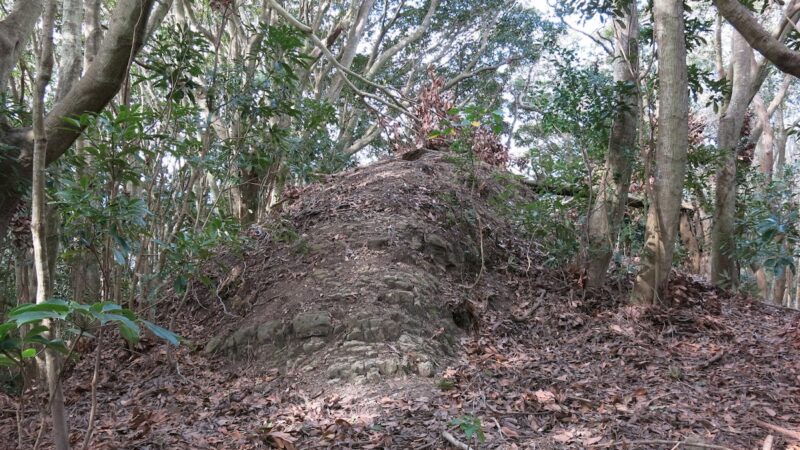
Currently, most of the Nagao Jinya site is farmland and residential land, and very few clear remains are left. The topography of the plateau itself is also thought to have changed significantly due to agricultural development and residential construction.
Even visiting the site in Takiguchi, Shirahama-cho, Minamiboso City, Chiba Prefecture, there are no signs or markers indicating the presence of the Jinya, making it difficult to find historical traces. Only the approximate location is estimated from the memories of local elders, old documents, and cadastral maps.
Possibility of Archaeological Investigation
No full-scale archaeological excavation has been conducted at the Nagao Jinya site. However, due to its unique history of being abandoned during construction, there is a possibility that foundations and artifacts remain underground.
If development plans arise in the future, preliminary trial excavations may provide important historical insights. This site could be a valuable historical resource for understanding the realities of Jinya construction during the Meiji Restoration period.
The Nagao Domain and Local Society
The Reality of Domain Administration and its Impact on the Region
Although the Nagao Domain was short-lived, the Honda clan’s rule had a certain impact on the local community. The samurai who moved from Suruga brought new culture and technology, contributing to regional development through interaction with local residents.
Furthermore, the establishment of the domain introduced a unified administrative organization to southern Awa Province, which had previously been a mix of hatamoto (direct retainer) territories and shogunate territories, marking a step towards modernization. The foundations of domain administration were developed, including the improvement of the tax system, maintenance of public order, and promotion of industry.
The Situation of Awa Province During the Meiji Restoration
Awa Province faced a complex political situation from the end of the Edo period to the early Meiji era. Due to its geographical location on the Boso Peninsula, it occupied an important position as a maritime transport route to Edo (Tokyo), making it a strategically valuable region for the new government.
It is believed that the establishment of the Nagao Domain also included the political intention of placing this region under the control of the new government. The Honda clan was a family that served the Tokugawa shogunate as hereditary daimyo, but by demonstrating their allegiance to the new government, they were allowed to continue their existence in the new territory of Awa.
Related Historical Sites and Cultural Properties
Relationship with Shirahama Castle
To the west of the Nagao Jinya (fortified residence) lies the site of Shirahama Castle. Shirahama Castle was built during the Sengoku period by a retainer of the Satomi clan and played a role in monitoring maritime traffic at the southern tip of the Boso Peninsula. It is thought that the existence of Shirahama Castle was also considered when selecting the location of the Nagao Jinya.
Some remains of Shirahama Castle still exist today, and traces of earthworks and dry moats can be seen. Visiting both the Nagao Jinya site and the Shirahama Castle site allows one to understand the military importance of this region.
Hojo Jinya Site and Historical Sites of Tateyama City
The Hojo Jinya site, which was relocated from the Nagao Jinya, was located in what is now Hojo, Tateyama City. While no clear remains of the castle itself exist, Tateyama City boasts numerous historical sites, including the Tateyama Castle ruins (now the Tateyama City Museum) and the Awa Kokubunji Temple ruins.
The Tateyama City Museum features exhibits on the history of the Awa region and houses materials related to the Nagao clan and the Honda family. When visiting the Nagao Jinya ruins, it is recommended to also visit related historical sites within Tateyama City.
Access and Visiting Information for Nagao Jinya Ruins
Transportation Access
Access to the Nagao Jinya ruins is inconvenient by public transport. The nearest stations are Chikura Station or Tateyama Station on the JR Uchibo Line, from which you will need to take a bus or taxi.
Access by Car:
- Approximately 30 minutes from Tomiura IC on the Tateyama Expressway
- Head south on National Route 410 towards Shirahama
- Near Takiguchi, Shirahama-cho, Minamiboso City (There is no designated parking area)
Public Transportation:
- Approximately 20 minutes by bus from Chikura Station on the JR Uchibo Line, then a short walk from the nearest bus stop
- Approximately 30 minutes by bus from Tateyama Station on the JR Uchibo Line
Notes for Visitors
The Nagao Jinya Ruins are not maintained as a historical site, and many areas are now private land or farmland. Therefore, caution is advised when visiting.
- There are no clear signs or markers.
- Please avoid trespassing on private property.
- Since very few remains are left, it is recommended to confirm the location beforehand before visiting.
- Please be considerate of local residents.
Significance of Nagao Jinya in Historical Research
Historical Materials for the Study of Domain Administration during the Meiji Restoration
The Nagao Jinya site is an important case study for studying domain administration during the Meiji Restoration and the treatment of Tokugawa retainers. After the collapse of the shogunate, many fudai daimyo were ordered to relocate by the new government, but there are limited historical sites that concretely demonstrate this reality.
The relocation of the Honda clan to Awa Province was part of the new government’s policy of reorganizing various domains, and the difficulties that arose during this process, as well as attempts to build relationships with local communities, provide valuable information for understanding the formation process of modern Japan.
Relationship between Natural Disasters and History
The fact that Nagao Jinya was abandoned due to typhoon damage is a good example of the impact of natural disasters on history. The decisions made by the domain administrators, balancing the conflicting elements of military strategic value and the risk of natural disasters, offer valuable insights for modern disaster prevention planning.
The southern part of the Boso Peninsula remains a typhoon path, making disaster prevention measures crucial. Learning from historical examples provides valuable knowledge for modern community development.
Honda Masanori and the Transfer from Tanaka Domain
The Honda Family Lineage and Tanaka Domain
Honda Masanori was a descendant of Honda Tadakatsu, known as one of the Four Heavenly Kings of Tokugawa. The Honda family of Tanaka Domain ruled Tanaka in Suruga Province (present-day Fujieda City, Shizuoka Prefecture). Masanori worked on domain reforms, striving for financial reconstruction and industrial development, but the turmoil of the Meiji Restoration forced him to relocate to Awa Province.
Movement of Samurai and Changes in Lifestyles
The relocation from Suruga to Awa was a major turning point not only for the lord but also for many samurai and their families. Leaving a familiar place and starting a new life in an unfamiliar land was a great burden, both physically and mentally.
The expenses associated with the relocation were enormous, straining the domain’s finances. Furthermore, unexpected expenses such as the reconstruction of the domain’s headquarters after typhoon damage added to the already precarious financial situation of the Nagao domain.
History and Regional Changes of Nagao Village
Establishment and Development of Nagao Village
Nagao Village was a village belonging to Awa District, located in the southern part of present-day Minamiboso City. It was officially established as Nagao Village with the implementation of the town and village system in the Meiji era, and through mergers in the Showa period, it became the present-day Minamiboso City.
The name Nagao is said to originate from the fact that the topography extends like a long tail. It was a region centered on agriculture and fishing, and the cultivation of agricultural products flourished, taking advantage of the warm climate.
Regional Development in the Modern Era
From the Meiji era onward, the Nagao region underwent modernization of agriculture, with flower cultivation becoming particularly popular. Local specialties such as Boshu loquats were produced and shipped to major cities like Tokyo.
During the Showa period, tourism development progressed, and beaches such as Shirahama Beach were developed. Currently, as part of Minamiboso City, it is a region with agriculture and tourism as its core industries.
Summary: The Phantom Jinya Tells the Story of the Turbulent Meiji Restoration
The Nagao Jinya site is a historical site symbolizing the turbulent era of the Meiji Restoration. This “phantom Jinya,” whose construction was abandoned after only a few months, was a place where multiple historical elements intersected: the new government’s policy of reorganizing various domains, the threat of natural disasters, and the establishment of relationships with the local community.
Although no clear remains exist today, standing on this site allows one to recall the history of the Honda clan and their retainers challenging themselves to govern their domain in a new land in the first year of the Meiji era. It also serves as a lesson in how fragile human plans can be in the face of the fury of nature, such as typhoons.
Although the Nagao Jinya Ruins are not designated as a Chiba Prefecture or national historical site, they hold significant importance for studying the history of the Meiji Restoration period. When visiting Minamiboso City, why not reflect on the history of this legendary fort? While enjoying the beautiful coastline of Shirahama and the mild climate, you can feel a glimpse of history from over 150 years ago.
Besides the Nagao Jinya Ruins, the southern part of the Boso Peninsula is dotted with many other historical sites, including the Shirahama Castle Ruins, Tateyama Castle Ruins, and Awa Kokubunji Temple Ruins. Visiting these sites allows you to experience the rich history of the Awa region from ancient times to the modern era. For history enthusiasts, Minamiboso City is sure to be a fascinating place to explore.