Nakazawa Castle (Tomisato City, Chiba Prefecture) Complete Guide | Ruins, History, and Access Information
Nakazawa Castle, located in Tomisato City, Chiba Prefecture, is an important medieval castle that tells the story of the Chiba clan’s sphere of influence in Shimosa Province during the Sengoku period. Built on a hill locally known as “Jōyama” (Castle Mountain), the castle’s remains, such as earthworks and dry moats, are well-preserved, and it is designated as Tomisato City’s first designated cultural property, making it a historical asset of the region. This article provides a detailed introduction to Nakazawa Castle, from its historical background to its highlights and access information for visitors.
Basic Information on Nakazawa Castle
Nakazawa Castle is a medieval mountain castle located in Nakazawa, Tomisato City, Chiba Prefecture. Let’s start by summarizing the basic information.
Common Names and Alternate Names
Nakazawa Castle is also known as Jōyama Castle. This name comes from the fact that the hill on which the castle ruins are located is locally called “Jōyama” (Castle Mountain). This name is still widely used among local residents, and when asking for directions to the castle ruins, saying “Shiroyama” (Castle Mountain) is usually understood.
Location
290 Nakazawa, Tomisato City, Chiba Prefecture, and other locations
Located in the Nakazawa district, southeast of the center of Tomisato City, west of Narita Airport. The surrounding area is a quiet environment with extensive farmland. While much of the former castle grounds are now used for agriculture, the main enclosure is preserved and open to visitors.
Former Provincial Name
Shimousa Province
In the Middle Ages, Shimousa Province referred to a vast area spanning from northern Chiba Prefecture to southwestern Ibaraki Prefecture. Nakazawa Castle was located in the central part of Shimousa Province and was one of the important strongholds within the Chiba clan’s sphere of influence.
Classification and Structure
Mountain Castle
Nakazawa Castle is a typical mountain castle utilizing hilly terrain. While the elevation difference is not particularly large, it clearly utilizes the elevated terrain compared to the surrounding plains. While based on a single-enclosure structure, it possesses a practical layout with reinforced defenses provided by earthworks and dry moats.
Keep Structure
None
Nakazawa Castle, a medieval castle, did not have a keep. Castles of the Sengoku period primarily consisted of defensive structures centered on earthworks and moats; stone walls and keeps like those found in early modern castles were not constructed.
Builder
Chiba Clan
Nakazawa Castle is believed to have been built by the Chiba clan. The Chiba clan was a prestigious family descended from the Kanmu Taira clan and was a powerful samurai group that ruled Shimosa Province from the late Heian period. They expanded their power by building numerous branch castles throughout Shimosa Province, centered around their base, Chiba Castle (present-day Chiba City).
Year of Construction
Late Muromachi Period (Late 15th to Early 16th Century)
While the exact year of construction is not recorded in historical documents, it is estimated to have been built in the late Muromachi period based on the castle’s structure and location. This period coincides with the time when the Chiba clan moved their base to Hon-Sakura Castle and strengthened their control over their territory.
Main Renovators
Details Unknown
No records of renovations have been found at present. Given the castle’s size and structure, it is highly likely that no major renovations were carried out.
Main Lords
Mitani Clan (Estimated)
While there are no definitive historical records regarding the lords of Nakazawa Castle, it has been suggested that the Mitani Clan, a branch of the Chiba clan, may have been the lords. The Mitani clan, as a branch of the Chiba clan, held power within Shimosa Province and is thought to have been responsible for managing the Chiba clan’s subsidiary castles. However, specific names and periods of residence remain unknown.
Year of Abandonment
Late Sengoku Period (Late 16th Century)
The exact year of abandonment is unknown, but it is presumed that Nakazawa Castle, a branch castle of the Chiba clan, was abandoned when the Chiba clan fell during Toyotomi Hideyoshi’s Odawara campaign in 1590.
Remains
Earthworks, Dry Moats, Earthen Bridges, Entrance Gates, Lower Enclosures
The remains of Nakazawa Castle are relatively well-preserved. In particular, the earthworks and dry moats surrounding the main enclosure are clearly visible and provide important clues to understanding the castle’s structure. Details will be explained later in “Highlights of Nakazawa Castle.”
Designated Cultural Property
Tomisato City Designated Cultural Property No. 1 (Historic Site)
Nakazawa Castle ruins are designated as Tomisato City’s first designated cultural property under the city’s cultural property protection ordinance. This indicates that it is recognized as one of Tomisato City’s most important historical heritage sites.
Historical Background of Nakazawa Castle
The Chiba Clan and Their Rule of Shimosa Province
To understand Nakazawa Castle, it is necessary to know the history of the Chiba clan, who built it. The Chiba clan, whose leader Chiba Tsunetane participated in Minamoto no Yoritomo’s uprising at the end of the Heian period, developed into a powerful vassal of the Kamakura Shogunate. Based in Shimosa Province, they were one of the most powerful families in the Kanto region.
In the Muromachi period, the Chiba clan established their regional rule as the governor of Shimosa Province. However, in the 15th century, internal conflicts and clashes with other forces continued, forcing them to move their base from Chiba Castle to Hon-Sakura Castle (present-day Shisui Town). During this process, the need arose to build branch castles in various locations to strengthen their control over their territory.
Strategic Location of Nakazawa Castle
The Nakazawa district of Tomisato City, where Nakazawa Castle was built, is located in the central part of Shimosa Province and was a strategically important transportation hub. Located strategically to control the road leading east from Hon-Sakura Castle, and also close to a communication route to Narita, Nakazawa Castle is believed to have functioned as an important relay point in the Chiba clan’s territorial control.
Nearby, several other castles and fortifications associated with the Chiba clan, such as Kuno Castle, Tatezawa Castle, and Hiyoshikura Castle, were scattered, forming a regional defense network in conjunction with these. It is presumed that its role was more as a subsidiary castle for information dissemination and the stationing of small units, rather than for independently confronting large armies.
Estimated Mitani Clan
The Mitani clan, presumed to be the castle lords, appears in historical documents as a branch of the Chiba clan. The Chiba clan managed their territories by stationing family members in various branch castles, and the Mitani clan is thought to have played a part in this. However, no historical documents directly linking the Mitani clan to Nakazawa Castle have been found to date; this is merely an estimation based on geographical and genealogical circumstances.
Trends in the Sengoku Period
In the 16th century, the situation in the Kanto region changed dramatically with the rise of the Hojo clan. The Chiba clan initially opposed the Hojo, but eventually became their subordinate, playing a key role in the Hojo’s control of Kanto. While the exact role of Nakazawa Castle during this period is unclear, it is believed to have continued to function as a branch castle of the Chiba clan.
In 1590, when the Hojo clan was destroyed by Toyotomi Hideyoshi’s siege of Odawara, the Chiba clan, who had been under their control, also lost their territory. It is presumed that Nakazawa Castle was abandoned at this time and subsequently used as farmland.
Layout and Structure of Nakazawa Castle
Single-Enclosure Layout
Nakazawa Castle is a relatively small castle with a single-enclosure layout. It has a simple structure centered around a single main enclosure, surrounded by earthworks and a dry moat, but it is a practical design that effectively utilizes the limited terrain.
The main enclosure measures approximately 50 meters east-west and 40 meters north-south, and is currently a flat space. This size is sufficient for the lord’s residence and troop garrisons.
Earthworks
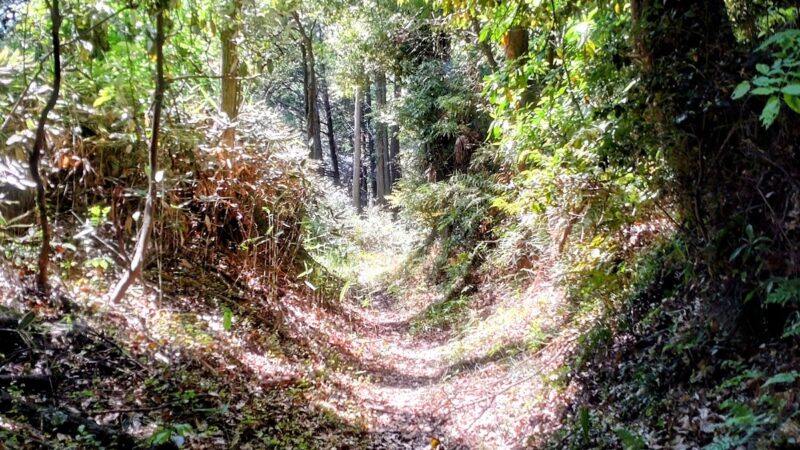
Earthworks surround the main enclosure. The earthworks on the west and north sides are particularly well-preserved, reaching a maximum height of approximately 2 meters. There are sections where it is possible to walk on top of the earthworks, allowing visitors to appreciate the scale of the defensive structures at the time.
The earthworks were not simply piled up; they were constructed using the rammed earth technique (a technique for compacting soil) to ensure their strength. Their continued existence, having withstood hundreds of years of wind and rain, is a testament to this robust construction technique.
Dry Moat Shape
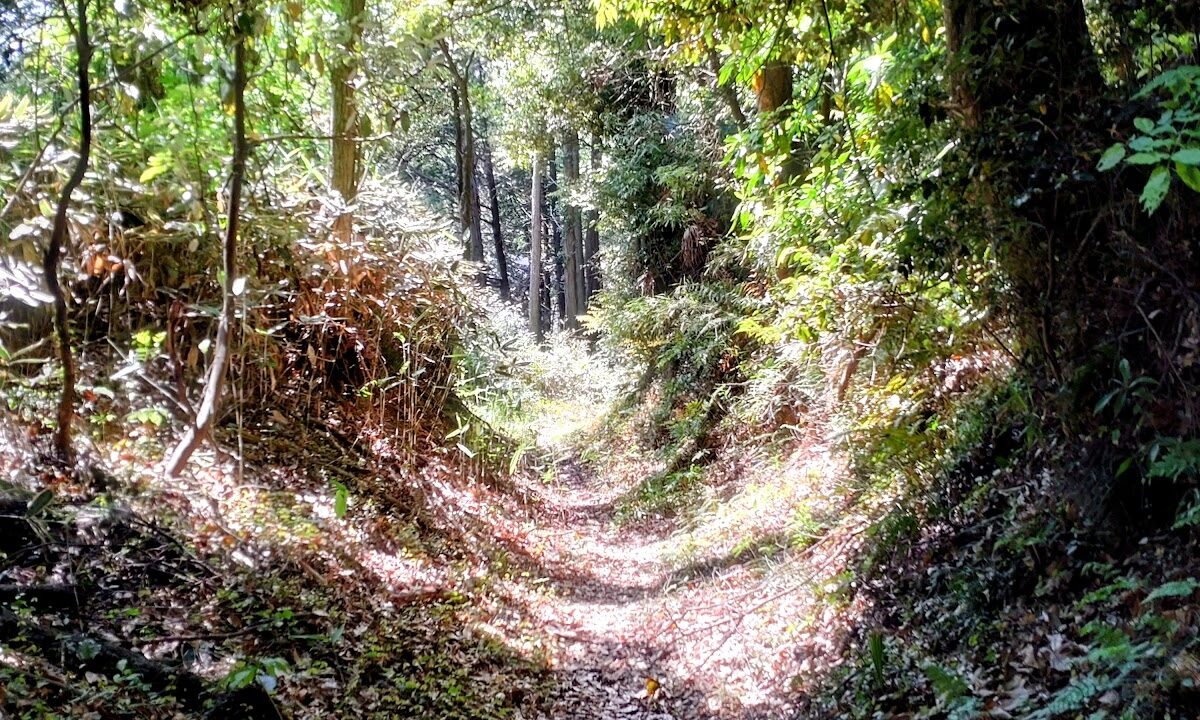
The dry moat surrounding the main enclosure is particularly clearly visible on the east side. It is approximately 3-4 meters deep and 5-6 meters wide. The bottom of the moat is still clearly visible and has a cross-section close to a V-shape.
The dry moat was positioned to wrap around the main enclosure from the east to the south, serving as a crucial defensive line to prevent enemy intrusion. An earthen bridge spanned the end of the moat, providing an entrance to the main enclosure.
Entrance and Earthen Bridge
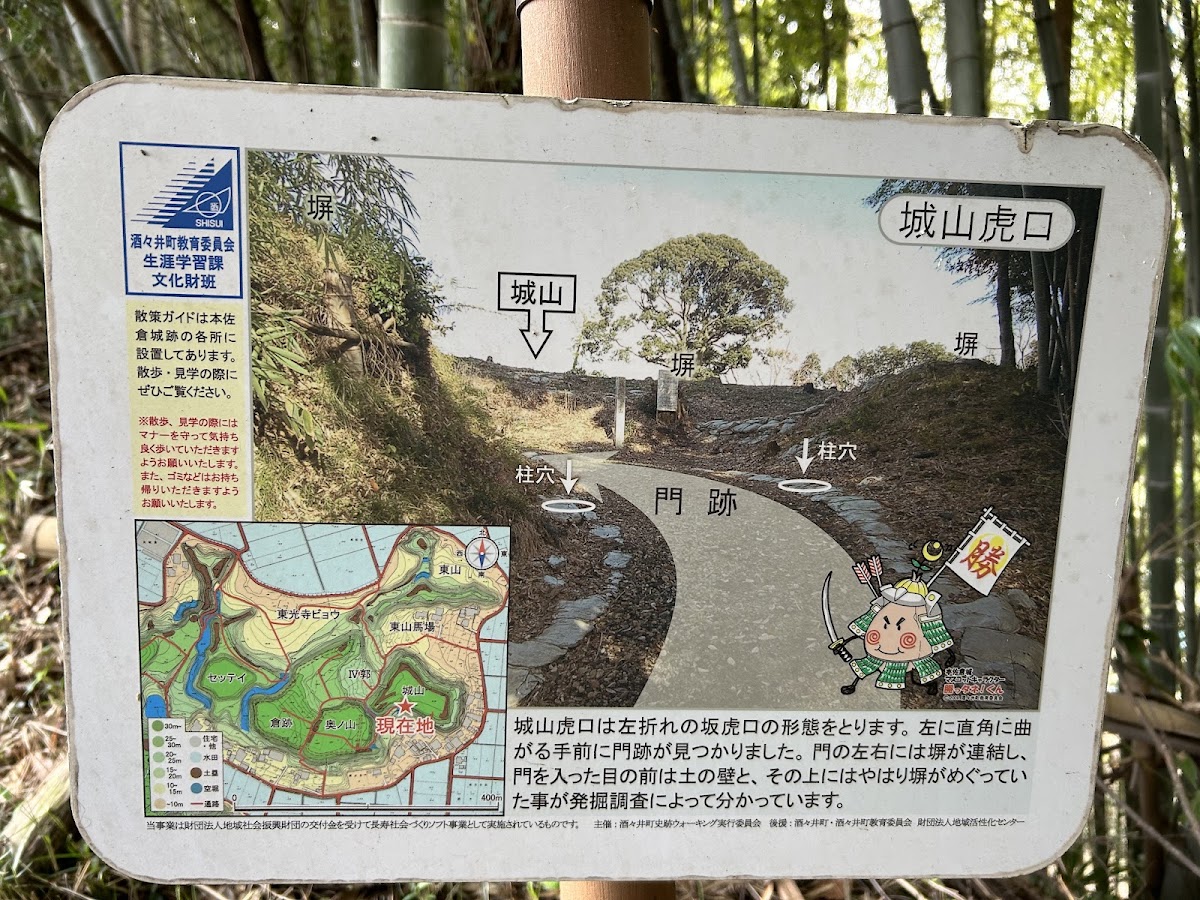
The entrance to the main enclosure, the “koguchi” (gateway), was accessed via an earthen bridge spanning the dry moat. The bridge was approximately 2 meters wide, a narrow structure that prevented large numbers of people from passing at once. This was a defensive design intended to prevent a large-scale enemy invasion.
The entrance area was surrounded by earthen ramparts, employing the “yokoya-gari” (flanking fire) technique, allowing for attacks on invading enemies from both sides.
Existence of Koshikuruwa (Lower Enclosures)
Several small, flat areas called “koshikuruwa” can be seen around the main enclosure. These are thought to be auxiliary structures that supported the defense of the main enclosure, used as lookout posts or defensive positions. While some areas are now covered in vegetation, careful observation reveals changes in the terrain.
Highlights of Nakazawa Castle (Castle Notes)
Information Board at the Entrance
A visit to Nakazawa Castle begins with the information board located at the entrance. This board provides a detailed explanation of the castle’s history and structure, and reading it before your visit will deepen your understanding of the castle.
The information board was installed by the Tomisato City Board of Education and includes a map of the castle’s layout and the results of archaeological excavations. Photography is permitted, so it’s a good idea to take a commemorative photo.
Earthworks of the Main Enclosure
Upon entering the main enclosure from the entrance, the first thing you’ll see is the surrounding earthworks. The western earthworks, in particular, are well-preserved and retain their height. It’s possible to climb onto the earthworks, from which you can view the main enclosure and the surrounding scenery.
There is a difference in elevation between the inside (main enclosure side) and outside of the earthworks, allowing you to appreciate its function as a defensive structure. While grass grows on the surface of the earthworks, the mounds of earth are clearly visible.
Eastern Dry Moat
The most impressive feature of Nakazawa Castle is the dry moat remaining on the east side of the main enclosure. This dry moat retains considerable depth and width, making it a valuable historical site that allows visitors to experience the defensive structures of a medieval castle.
While descending to the bottom of the moat is not recommended, its scale and shape can be appreciated by viewing it from the main enclosure side or the outside. Winter, in particular, offers excellent visibility due to the withered vegetation, making it ideal for observing the remains.
Earthen Bridge and Entrance Gate
The earthen bridge spanning the end of the dry moat is an important historical site that conveys the appearance of the entrance at the time. The narrow width of the bridge indicates a design that prioritized defense.
Crossing the earthen bridge and entering the main enclosure through the entrance gate truly gives you the feeling of climbing a medieval castle. The structure of the entrance gate, flanked by earthen ramparts on both sides, can also be understood through actual walking, allowing you to appreciate its defensive function.
Flat Area within the Main Enclosure
The interior of the main enclosure is currently a flat space, suggesting that the lord’s residence and soldiers’ quarters once stood here. An explanatory sign is installed within the main enclosure, allowing visitors to learn about the castle’s history and structure.
The main enclosure is well-maintained, with benches provided, allowing for leisurely sightseeing and rest. It’s a place where you can enjoy the changing seasons, with cherry blossoms in spring and beautiful autumn foliage.
Surrounding Views
From the main enclosure and the earthworks, you can overlook the surrounding farmland and settlements. The former lord of the castle likely surveyed his territory from this spot. Although development is progressing, the topography of the Shimosa Plateau can be seen in the distance, demonstrating how skillfully Nakazawa Castle was built utilizing the terrain.
Access to Nakazawa Castle
Access by Car
Approximately 5 minutes from Tomisato IC on the Higashi-Kanto Expressway
After exiting the Tomisato IC, head south on Prefectural Road 44 (Tomisato-Shisui Line) and follow the signs for the Nakazawa area. There are several parking spaces near the castle ruins. If using a car navigation system, search for “290 Nakazawa, Tomisato City” or “Nakazawa Castle Ruins.”
Approximately 15 minutes from Narita Airport
It’s relatively close to Narita Airport, and you can access it quickly by rental car. It’s also possible to combine a visit with sightseeing around the airport.
Access by Public Transportation
By Bus from JR Narita Station
From Narita Station, take the Chiba Kotsu bus bound for “Tomisato Central Park” or “Tomisato City Hall,” get off at the “Nakazawa” bus stop, and walk for approximately 10 minutes. Since bus service is limited, it is recommended to check the timetable in advance.
Access by Bus from Keisei Narita Station (Keisei Main Line)
You can use the same bus routes as from JR Narita Station. Keisei Narita Station and JR Narita Station are within walking distance of each other.
Parking Information
There are several free parking spaces near the castle ruins. However, some areas are unpaved, so caution is advised in rainy weather. Visiting in a large vehicle is difficult, so we recommend visiting by passenger car.
Points to Note When Visiting
- Estimated Visiting Time: Approximately 20-30 minutes
- Admission Fee: Free
- Visiting Hours: Daytime (There are no specific restrictions, but please avoid visiting at night)
- Toilets: None at the castle ruins. We recommend completing the following beforehand:
- Attire: Comfortable walking shoes are essential as you will be viewing the earthworks and moats.
- Season: Winter is more suitable for observing the ruins than summer due to the overgrown vegetation.
- Insect Repellent: Mosquitoes and other insects are abundant in summer, so it’s a good idea to bring insect repellent spray.
Information on nearby spots around Nakazawa Castle
Other castle ruins in Tomisato City
Kuno Castle Ruins
This is a medieval castle located approximately 2km northeast of Nakazawa Castle. It is also thought to be a castle related to the Chiba clan, and visiting both Nakazawa Castle and Kuno Castle will help you understand the castle network in this region.
Tachizawa Castle Ruins
This castle ruin is located approximately 3km north of Nakazawa Castle, and remnants of earthworks and moats remain. It’s a good addition to a tour of medieval castles in Tomisato City.
Hon-Sakura Castle Ruins (Shisui Town)
Located approximately 10km west of Nakazawa Castle, this was the base of the Chiba clan. It is an important castle site designated as a National Historic Site, with well-preserved large earthworks and dry moats. As it was the main castle of Nakazawa Castle, a visit to both is highly recommended. A visit requires approximately 1-2 hours.
Naritasan Shinshoji Temple
Located approximately 5km east of Nakazawa Castle in Narita City, this is one of the leading temples in the Kanto region. A venerable temple founded in the Heian period, it boasts one of the highest numbers of New Year’s visitors in the country. A visit to the temple in conjunction with a castle ruins tour is highly recommended.
Boso-no-Mura (Sakae Town)
Located approximately 15km northwest of Nakazawa Castle, this is a prefectural interactive museum. It recreates the townscape of Boso from the Edo to Meiji periods, making it ideal for history learning. Combining a visit to a medieval castle with learning about early modern life allows for a multifaceted understanding of the region’s history.
Aviation Science Museum
This is an aviation-specialized museum located adjacent to Narita Airport. It is approximately 7 km from Nakazawa Castle. After exploring the history, experiencing modern aviation technology would be an interesting experience.
Nakazawa Castle Survey and Research
Results of Archaeological Excavations
Nakazawa Castle has been surveyed in the past by the Tomisato City Board of Education, and a detailed layout map has been created. While archaeological excavations have been limited, trial excavations have been conducted in a portion of the main enclosure, yielding medieval artifacts.
These investigations have clarified the castle’s structure and scale, confirming that it was built in the late Muromachi period. Further investigations may yield new insights into the castle’s lord and specific periods of use.
Limitations of Documentary Sources
The biggest challenge regarding Nakazawa Castle is the scarcity of documentary sources. The name of Nakazawa Castle does not directly appear in historical documents related to the Chiba clan, forcing us to rely on estimations regarding the castle’s lord, construction year, and abandonment year.
However, based on place names in the surrounding area, local legends, and the remains that still exist, it is almost certain that it was a branch castle of the Chiba clan. It is hoped that the history of Nakazawa Castle will become clearer in the future through the discovery of new historical materials and advancements in research.
Position in Local History
Nakazawa Castle is one of the most important historical sites for Tomisato City. Its importance is evident from its designation as the city’s first designated cultural property. It is also used as teaching material for local history in local schools, making it a valuable place to learn about local history.
Model Course for Visiting Nakazawa Castle
Half-Day Course (Focusing on Nakazawa Castle)
- Visiting Nakazawa Castle Ruins (30 minutes): Starting from the explanatory sign at the castle entrance, visit the main enclosure, earthworks, and dry moat in order.
- Kuno Castle Ruins (30 minutes): Travel by car to visit another castle ruin in Tomisato City.
- Tomisato City Library (30 minutes): Browse historical materials of Tomisato City.
- Lunch: Enjoy local cuisine at a restaurant in Tomisato City.
Full-Day Course (Tour of Chiba Clan Castles)
- Hon-Sakura Castle Ruins (2 hours): A detailed tour of the Chiba clan’s base.
- Lunch: In Shisui Town or Tomisato City.
- Nakazawa Castle Ruins (30 minutes): Confirm the structure of the subsidiary castle.
- Kuno Castle Ruins (30 minutes): Visit another subsidiary castle.
- Naritasan Shinshoji Temple (1 hour): Visit and stroll through the temple town
Weekend Course (Medieval Castle Tour of Boso Peninsula)
Day 1
- Hon-Sakura Castle Ruins (2 hours)
- Nakazawa Castle Ruins (30 minutes)
- Kuno Castle Ruins (30 minutes)
- Tatezawa Castle Ruins (30 minutes)
- Accommodation: Narita City or Sakura City
Day 2
- Sakura Castle Ruins (2 hours)
- Usui Castle Ruins (1 hour)
- National Museum of Japanese History (2 hours)
Manners When Visiting Nakazawa Castle
Nakazawa Castle Ruins are a valuable cultural asset, and there are also private houses and farmland in the surrounding area. Please observe the following manners when visiting.
- Do not damage the remains: Do not dig earthworks or moats, or take stones home.
- Take your trash with you: There are no trash cans at the castle ruins. Please be sure to take it home with you.
- Do not trespass on private property: There is private property around the castle ruins. Please do not enter areas where entry is prohibited.
- Do not shout: As it is close to a residential area, please view it quietly.
- Parking etiquette: Please do not park anywhere other than the designated area.
- No open flames: Smoking and the use of fire are strictly prohibited within the castle ruins.
- Protection of flora and fauna: Please do not collect or harm the flora and fauna at the castle ruins.
Summary: The Charm and Value of Nakazawa Castle
Although Nakazawa Castle is not large in scale, it is a valuable historical site that preserves the structure of a medieval castle in good condition. Basic defensive facilities such as earthworks, dry moats, earthen bridges, and gates can be clearly seen, making it a place of great value as a place where you can actually experience a medieval castle as learned in textbooks.
Its historical significance as a branch castle of the Chiba clan, a powerful samurai group in the Kanto region, and its role in the network of regional control, cannot be overlooked. Understanding the relationship between Hon-Sakura Castle, the main castle, and the group of subsidiary castles including Nakazawa Castle reveals the realities of medieval territorial rule.
Nakazawa Castle, designated as Tomisato City’s first cultural property and cherished by the community, is a valuable educational resource for learning about local history and deepening one’s understanding of the region. Its proximity to Narita Airport and easy access make it a must-visit for anyone interested in medieval history in Chiba Prefecture.
Nakazawa Castle, though manageable in a short visit, offers a full appreciation of the charm of a medieval castle. Why not visit “Shiroyama” in Tomisato City, Chiba Prefecture, on your next day off and immerse yourself in the historical romance of the Sengoku period?