Fukuseiji Castle (Yotsukaido City, Chiba Prefecture) – A Complete Overview of a Medieval Castle that Functioned as a Branch Castle of the Usui Clan
Located in Yoshioka, Yotsukaido City, Chiba Prefecture, Fukuseiji Castle is a medieval castle built by the Yoshioka clan, a branch of the Usui clan, during the Sengoku period. Currently used as Fukuseiji Temple of the Shingon-shu Buzan sect, the grounds retain well-preserved remains of the original earthworks, dry moats, and watchtower bases. It was designated a Yotsukaido City Historic Site on April 15, 1983. This article comprehensively introduces information useful for visiting Fukuseiji Castle, including its history, detailed remains, highlights, and access methods.
History and Construction Background of Fukuseiji Castle
Construction Period and Builder
The exact construction period of Fukuseiji Castle is unclear, but it is believed to have been built during the medieval period by the Yoshioka clan, a branch of the Usui clan. The Usui clan was a powerful samurai family within the Chiba clan, wielding considerable influence in Shimosa Province. Their base was Usui Castle (present-day Sakura City), and they strategically positioned several branch castles in the surrounding area. Fukuseiji Castle was a crucial stronghold within this network of branch castles.
The Yoshioka clan, along with other Usui family members such as the Yamanashi, Warabi, Nakadai, and Onagi clans, is believed to have ruled the area around Yamanashi-go in Chiba-sho (present-day southern Yotsukaido City). This region was a strategically important transportation hub within Shimosa Province, both militarily and economically.
Role during the Sengoku Period
During the Sengoku period, Fukuseiji Castle functioned as a branch castle of Usui Castle. It is thought to have served as a residence alongside the adjacent Kide Castle, playing a vital role in maintaining the Usui clan’s sphere of influence. Records also indicate that the Hara clan, a branch of the Chiba family, used this castle as a base during this period, suggesting that multiple samurai families may have utilized it.
During the late Sengoku period, this region was embroiled in power struggles between the Hojo, Satomi, and Satake clans. It is highly probable that Fukuseiji Castle also functioned as part of the defensive line when Usui Castle was attacked by Uesugi Kenshin in 1566 (the Battle of Usui Castle).
Abandonment of the Castle and Conversion to a Temple
After Tokugawa Ieyasu unified Japan, in the early Edo period, in 1616 (Genna 2), a temple was founded on the site of the abandoned castle by the Gon-sozu Yusho. This is the origin of the present-day Fukuseiji Temple. Although it lost its function as a castle, defensive structures such as earthworks and moats remained as the temple’s boundaries, resulting in their excellent preservation to this day.
Castle Structure and Layout
Basic Structure
Fukuseiji Castle is a flatland castle of a type called a “hokeikan” (square-shaped mansion). Centered around the present-day Fukuseiji Temple, it has a simple yet robust structure surrounded on all four sides by earthworks and dry moats. The castle grounds measure approximately 100 meters east-west and 80 meters north-south, a standard size for a medieval local lord’s residence.
The main enclosure (equivalent to the main keep) is located where the current Fukuseiji Temple’s main hall stands, surrounded by earthen ramparts 3 to 5 meters high. A dry moat about 5 meters deep surrounds the ramparts, demonstrating their high level of defense even today.
Characteristics of the Earthen Ramparts
The earthen ramparts of Fukuseiji Castle are particularly well-preserved on the right side (east side) facing the temple gate, reaching a maximum height of approximately 5 meters. The top of the ramparts is flat, suggesting that fences or walls were once erected there. Examination of the cross-section of the ramparts reveals that they were constructed using a method called rammed earth construction, where soil is compacted.
The earthen ramparts on the north and west sides are also relatively well-preserved, with approximately 80% of the entire circumference remaining. This medieval castle, with its earthworks preserved in such a complete state, is a rare example even within Chiba Prefecture.
Condition of the Dry Moat
The dry moat surrounding Fukusei-ji Temple still maintains a depth of 3-5 meters and a width of 8-10 meters. The moats on the east and south sides are particularly deep, clearly demonstrating their function as defensive structures. The moat bottoms are still lower than the ground surface, and rainwater sometimes accumulates there.
On the outside of the moat, traces of an outer earthwork (sotodorui), made from excavated earth from the original earthworks, can be seen in some places, indicating the formation of a double defensive line.
Turret Base and Entrance
Earth mounds believed to be turret bases can be seen at the four corners of the castle grounds. The turret base at the southeast corner is particularly well-preserved, appearing as an earthen platform approximately 2 meters high. It is thought that a watchtower or corner turret stood here.
The entrance (koguchi) is presumed to have been located on the south side where the current temple gate stands. Traces of an earthen bridge crossing the moat remain, allowing us to imagine the flow of movement during the castle’s era.
Highlights of Fukuseiji Castle
Preservation of the Remains
The greatest highlight of Fukuseiji Castle is the extremely well-preserved remains of the medieval castle. In particular, the earthworks and dry moats are considered to have retained almost their original form from the time of construction. Because it was used as a temple, it avoided large-scale development, resulting in its preservation as a valuable historical heritage site.
Among castle enthusiasts and history buffs, it is highly regarded as a “textbook example of a square-shaped fortified residence,” and is considered an ideal place to learn about the structure of medieval castles.
The Weeping Cherry Tree of Fukuseiji
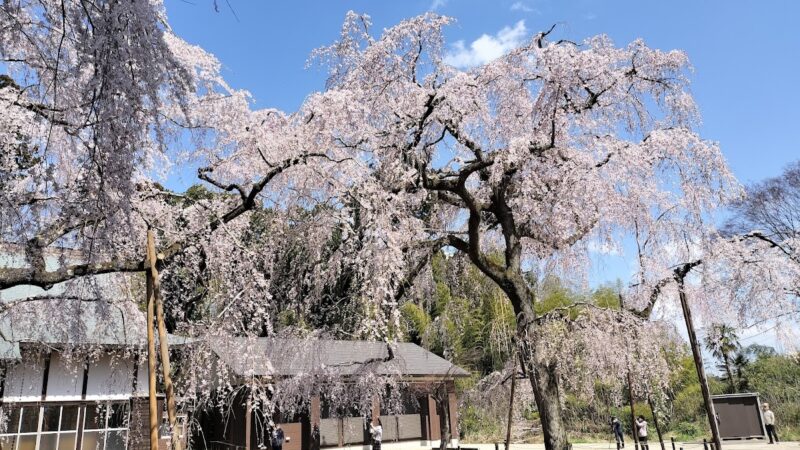
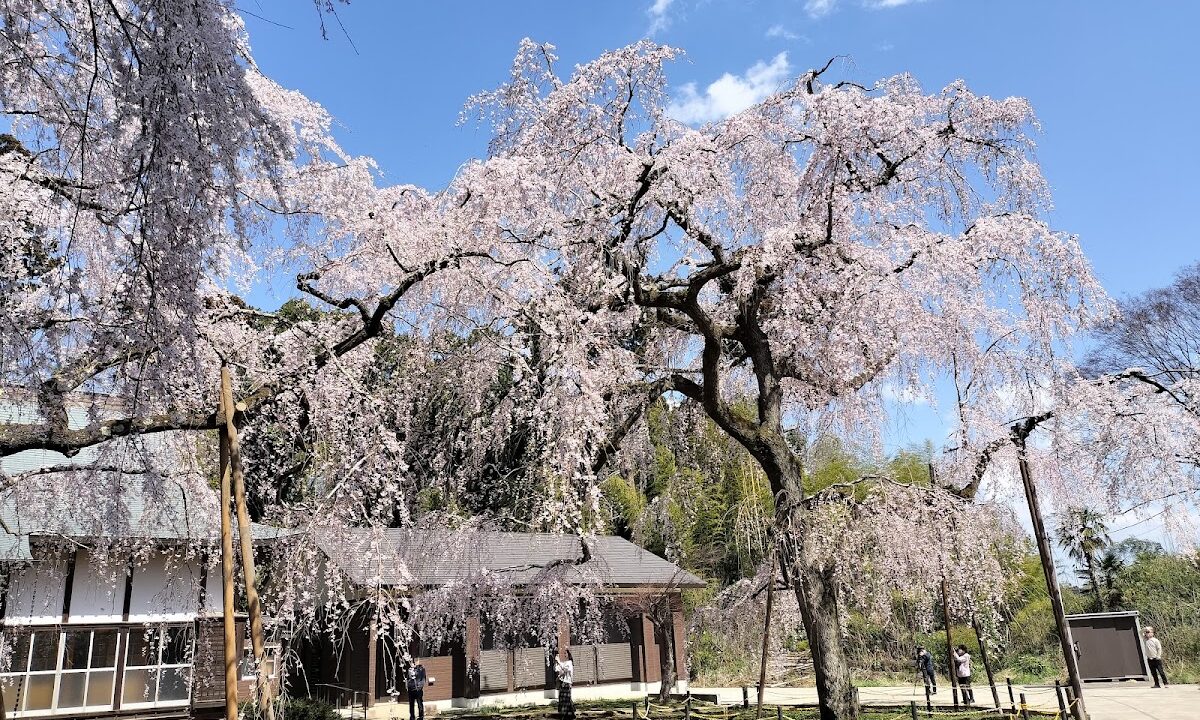
Along with the castle remains, what captivates visitors to Fukuseiji Temple is the weeping cherry tree on the temple grounds, estimated to be about 400 years old. This weeping cherry tree is designated as a natural monument of Yotsukaido City and is in full bloom every year in mid-April. This giant tree, approximately 15 meters tall and 3 meters in circumference, boasts a waterfall of pale pink blossoms when in full bloom, creating a magnificent spectacle against the backdrop of the earthen ramparts and dry moat.
The combination of the Sengoku period castle ruins and the cherry blossoms creates a unique landscape where history and natural beauty merge, making it a popular spot for photography. Because many tourists visit during the cherry blossom season, weekday mornings are recommended for a more leisurely visit.
Atmosphere of the Temple Gate and Grounds
The temple gate of Fukusei-ji Temple is built on the site of the former castle’s entrance. Passing through the gate, a unique space surrounded by earthen ramparts unfolds, giving the feeling of entering the interior of a castle. The grounds are enveloped in tranquility, making it an ideal environment for a stroll while reflecting on the Sengoku period.
The main hall was rebuilt during the Showa period, but its placement was carefully considered to harmonize with the surrounding earthen ramparts and moat. From the grounds, one can appreciate the height of the ramparts and the depth of the moat, experiencing the formidable defensive capabilities of the time.
Relationship with Surrounding Castles
Several castles related to the Usui clan remain near Fukuseiji Castle. In particular, Kide Castle is about 1 kilometer from Fukuseiji Castle, and it is believed that the two castles worked together to form a defensive line. Those with ample time can gain a deeper understanding of the Usui clan’s branch castle network by visiting these surrounding castles as well.
Access and Visiting Information
Access by Train and Bus
Nearest Station: JR Sobu Main Line/Narita Line, Yotsukaido Station
Take the Chiba Inland Bus from the south exit of Yotsukaido Station and get off at the “Fukuseiji Entrance” bus stop. Fukuseiji Temple is about a 2-minute walk from the bus stop. Buses run only 1-2 times per hour, so it is recommended to check the timetable in advance.
If walking, it is about 2.5 kilometers from the south exit of Yotsukaido Station to Fukuseiji Temple, taking about 30 minutes. The route is relatively flat and easy to follow, making it a pleasant walk.
Access by Car
Approximately 10 minutes from Yotsukaido IC on the Higashi-Kanto Expressway
Fukuseiji Temple has parking space for visitors, but the number of spaces is limited (approximately 10). Especially during the cherry blossom season, congestion is expected, so we recommend using public transportation.
Address: 898 Yoshioka, Yotsukaido City, Chiba Prefecture
Precautions for Visitors
Fukuseiji Temple is an active temple and a place of worship for local residents. Please observe the following points when visiting:
- Do not enter areas where entry is restricted, such as the main hall or cemetery.
- Avoid loud conversations and noise.
- Always take your trash with you.
- Do not damage the remains of earthworks or moats.
- Photography is permitted, but please be considerate of worshippers and religious services.
Visit during daylight hours, avoiding early mornings and evenings. The temple is generally open from 9:00 AM to 5:00 PM, but this may vary depending on the season and weather.
Estimated Visiting Time
If you want to carefully observe the remains of Fukuseiji Castle, it will take approximately 30-45 minutes. Including photography and exploring the surrounding area, it’s best to allow about an hour. During cherry blossom season, it gets crowded, so it’s recommended to allow a little more time.
Nearby Tourist Attractions
Usui Castle Ruins
The Usui Castle Ruins, the main castle of Fukuseiji Castle, are located in Usuida, Sakura City. It’s about a 20-minute drive from Fukuseiji Temple. Known for repelling an attack by Uesugi Kenshin, it’s now maintained as Usui Castle Ruins Park. Situated on a hill overlooking Lake Inba, it offers magnificent views.
Yotsukaido City Local History Museum
This museum allows you to learn about the history of Yotsukaido City, and includes exhibits on castles within the city, including Fukuseiji Castle. It’s about a 10-minute drive from Fukuseiji Temple and about a 15-minute walk from Yotsukaido Station. Admission is free, and the museum is closed on Mondays and the day after national holidays.
Kide Castle Ruins
This castle, along with Fukuseiji Castle, is believed to have been a residence of the Yoshioka clan. Located about a 15-minute walk from Fukuseiji Temple, it also retains remnants of earthworks and moats. As it is located in a residential area, consideration for nearby residents is necessary when visiting.
Research and Evaluation of Fukuseiji Castle
Academic Value
Fukuseiji Castle is highly regarded academically as a typical example of a medieval square-shaped residence. The fact that the earthworks and dry moats remain in perfect condition is particularly valuable for castle research. It is among the best-preserved medieval castles in Chiba Prefecture and is an important site for understanding the structure of a local powerful family’s residence.
Evaluation from Castle Enthusiasts
Fukuseiji Castle has received high praise from castle enthusiasts who have visited it, as seen on castle information websites such as “Kojodan.” Many visitors have commented, “I was surprised by the height of the earthworks,” “The moat was deeper than I imagined,” and “I gained a good understanding of the structure of a medieval castle.”
On the other hand, there have also been requests for improvements, such as “There are not enough information boards” and “More explanations of the remains are needed.” Further improvements and increased information boards by Yotsukaido City are expected in the future.
Things to Know Before Visiting Fukuseiji Castle
Clothing and Items to Bring
No special equipment is required to visit Fukuseiji Castle, but the following points will make your visit more comfortable:
- Comfortable walking shoes (especially important if you plan to walk on the earthworks)
- Hat and drinking water in summer
- Insect repellent (spring to autumn)
- Camera (for photographing the remains and cherry blossoms)
- Binoculars (for observing the details of the earthworks and moats)
Best Time to Visit
Fukuseiji Castle is open year-round, but each season offers a different charm:
Spring (mid-April): The best time to see the weeping cherry blossoms. This is the time when the most tourists visit.
Early Summer (May-June): The fresh greenery is beautiful, and the earthworks and moats are a vibrant green.
Autumn (November): While there are fewer autumn leaves, the weather is pleasant and ideal for sightseeing.
Winter (December-February): The fallen leaves make it easier to observe the structure of the earthworks and moats. Recommended for those who want to carefully study the castle ruins.
Photography Tips
Recommended points for photographing Fukuseiji Castle:
- From in front of the main gate: Photograph the main gate with the earthworks and moat in the background.
- Eastern earthworks: The highest point, offering impressive photographs.
- From the bottom of the moat: An angle looking up at the earthworks to convey the castle’s strong defenses.
- Site of the watchtower: An important point for understanding the castle’s structure.
- Weeping cherry blossoms and earthworks: A spectacular spot only available in spring.
Future Preservation and Utilization of Fukuseiji Castle
Fukuseiji Castle is protected as a Yotsukaido City designated historical site, but further development and utilization are expected in the future. Currently, Yotsukaido City is considering tourism promotion utilizing the city’s historical heritage, and Fukuseiji Castle is positioned as one of its core elements.
Specifically, improvements to information boards, development of viewing paths, and the establishment of a “castle tour course” in cooperation with surrounding castles are being considered. Furthermore, VR restoration utilizing digital technology and explanatory services via smartphone apps may be realized in the future.
Local residents are actively engaged in preservation activities, including regular cleaning and grass cutting. It is important for visitors to treat the ruins with care and be mindful of passing them on to future generations.
Summary
Fukuseiji Castle is a valuable medieval castle ruin remaining in Yotsukaido City, Chiba Prefecture. Built by the Yoshioka clan, a branch of the Usui clan, this castle played an important role as a subsidiary castle of Usui Castle during the Sengoku period. Although currently used as Fukuseiji Temple, the remains of earthworks, dry moats, and watchtower bases are well-preserved, making it a valuable historical site for learning about the structure of medieval castles.
In particular, the earthworks reaching 5 meters in height and the dry moat 5 meters deep are valuable remains that convey the actual state of the defensive facilities at the time. Also, the 400-year-old weeping cherry tree creates a unique landscape where history and natural beauty blend, attracting many tourists in the spring.
This historical site is easily accessible by bus and on foot from Yotsukaido Station, and the visit takes only 30 minutes to an hour, making it a convenient place to visit. It’s recommended not only for castle enthusiasts but also for anyone interested in history or looking for a cherry blossom viewing spot.
When visiting, please remember that it is an active temple and observe proper etiquette. Immerse yourself in the atmosphere of the Sengoku period and fully appreciate the charm of this medieval castle.