Complete Guide to Tateyama Castle (Chiba Prefecture) | Detailed Explanation of History, Remains, and Access Information
Tateyama Castle is a medieval hilltop castle located in Okido-cho, Midori-ku, Chiba City, Chiba Prefecture. It is believed to have functioned as a subsidiary castle of Oshi Castle and is also known by the nickname “Inkyo-jo” (Retirement Castle). While detailed historical records are limited, well-preserved remains such as earthworks and dry moats remain at the site, making it a valuable historical site for understanding medieval castles in Chiba Prefecture.
This article comprehensively explains the historical background of Tateyama Castle, its structure, the remains that can be seen on-site, and access methods—all the information you should know before visiting.
Historical Background of Tateyama Castle
Construction Period and Builder
The construction period and builder of Tateyama Castle are unknown due to the lack of reliable historical records. However, several theories exist.
One theory suggests that it was built between the late Heian period and the early Kamakura period, possibly predating Oshi Castle. In this case, it’s thought that the first fort was built by a powerful local clan that ruled the area.
A more plausible view is that the Sakai clan, based at Toke Castle during the Sengoku period, developed and expanded it as part of the defense system for Oshi Castle. Tateyama Castle is located west of Oshi Castle, across the Murata River, and is presumed to have served as a subsidiary castle complementing Oshi Castle’s defenses.
Relationship with Oshi Castle
Understanding Tateyama Castle is crucial to understanding its relationship with Oshi Castle. Oshi Castle was the residence of the Sakai clan, a branch of the Chiba clan, and Tateyama Castle was part of their network of subsidiary castles.
The two castles are located in a north-south direction across the Murata River, within visual range of each other. This arrangement suggests that Tateyama Castle functioned as a forward base responsible for the western defense of Oshi Castle. It likely played a role in detecting the approach of enemy forces early and delaying or preventing attacks on the main Oshi Castle.
Character as a “Retirement Castle”
Tateyama Castle has the alternative name of “Retirement Castle.” This is based on the legend that it was the castle where the lord of Oshi Castle resided after retirement.
In medieval castles, retirement castles were not necessarily just quiet residences after retirement; they also served as bases where the former lord maintained a certain degree of influence, complementing the defensive functions of the main castle. Considering the size of Tateyama Castle (approximately 200m x 250m) and the richness of its remains, it is clear that it possessed military functions beyond mere residential facilities.
While there is little historical evidence to support whether it was actually used as a retirement castle, considering its proximity to Oshi Castle and its degree of independence, this legend has a certain degree of rationality.
Structure and Layout of Tateyama Castle
Location and Topography
Tateyama Castle is a flatland castle built on a plateau approximately 35 meters high. This plateau overlooks the surrounding lowlands, making it a highly defensible location that skillfully utilizes the natural terrain.
The castle grounds measure approximately 200 meters east-west and 250 meters north-south, a considerable size for a medieval subsidiary castle. Defensive facilities were mainly arranged along the edge of the plateau, and it is believed that multiple enclosures were constructed within.
Existing Remains
The following remains can still be seen at Tateyama Castle:
Earthworks: Traces of earthworks remain in various parts of the castle grounds. Clear earthworks are particularly visible around the main enclosure, with heights ranging from 1 to 2 meters in some places. These earthworks served to prevent enemy intrusion and also provided a foundation for fences and walls.
Dry Moats: Dry moats separating enclosures can be seen in multiple locations. These dry moats served to hinder enemy advances and clearly demarcate the baileys. While some of the moats have been altered in later periods, their basic shape remains.
Baileys: Multiple baileys (flat areas) are arranged on the plateau. A basic structure of a main bailey surrounded by secondary baileys is presumed, but due to the lack of detailed archaeological excavations, the exact number and arrangement of baileys remain a subject for future research.
Cliffs: Steep, artificially carved slopes (cliffs) are visible along the edge of the plateau. This was a technique used to enhance defensive capabilities by making the natural terrain even steeper.
Characteristics of the Castle Layout
The layout (design and arrangement) of Tateyama Castle exhibits the characteristics of a typical medieval flatland castle. It maximizes the use of the natural plateau terrain, minimizing artificial modifications while constructing an effective defensive system.
Considering its positional relationship with Oshi Castle, it is presumed that Tateyama Castle’s main defensive directions were west and north. It is highly probable that multiple lines of defense, consisting of dry moats and earthen ramparts, were in place to protect against enemy approaches from these directions.
Highlights of Tateyama Castle
Castle Site Monument and Information Signs
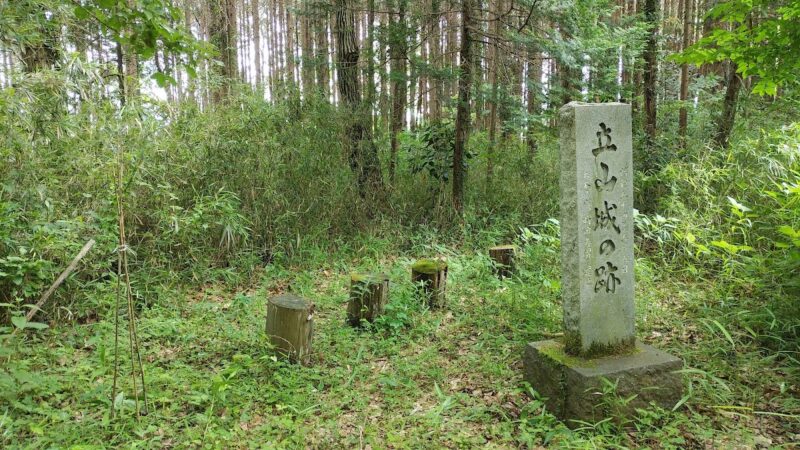
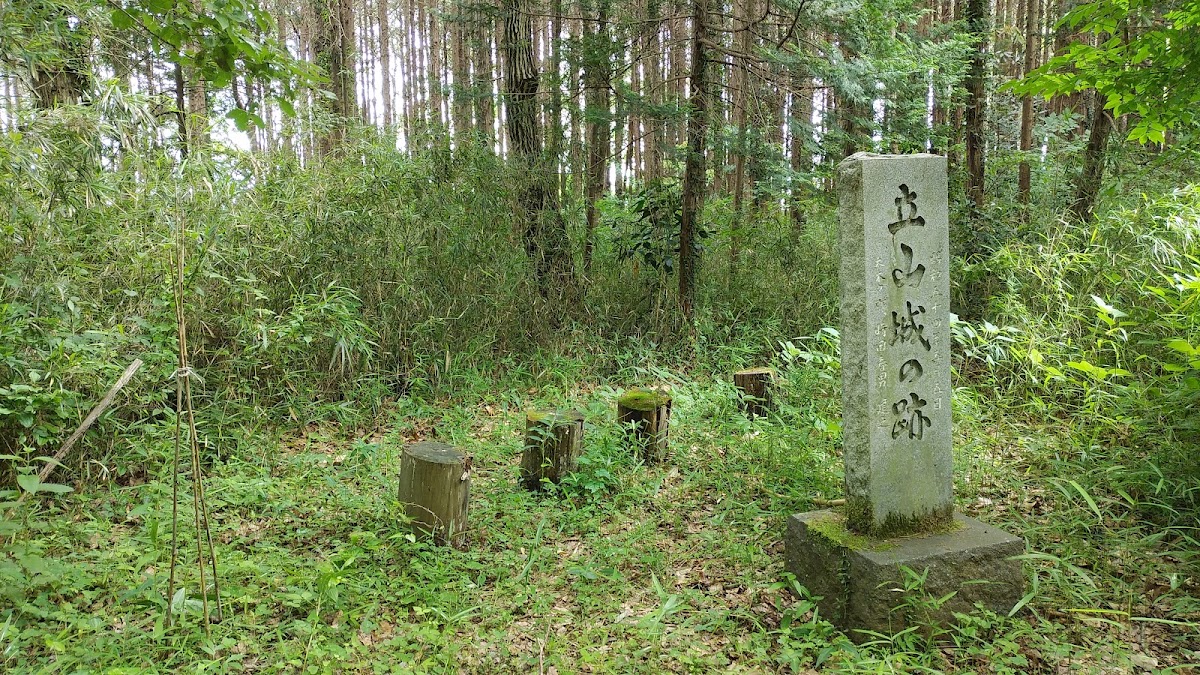
A castle site monument is installed at the site, indicating that it is the site of Tateyama Castle. You will reach this monument by climbing around the plateau. For visitors, it serves as an important landmark to confirm that it is a castle site.
However, detailed information boards and explanatory signs are limited, so it is recommended to acquire basic knowledge about Tateyama Castle before visiting.
Observation of Earthen Ramparts and Dry Moats
The greatest highlight of Tateyama Castle is the well-preserved earthen ramparts and dry moats. These remains are valuable examples for understanding the defensive systems of medieval castles.
When observing the earthen ramparts, pay attention to their height, width, and their position relative to the enclosures. Considering how the earthen ramparts are positioned to enhance their defensive effect will help you understand the design philosophy of the castle.
Regarding the dry moat, observe its depth, width, and the shape of its bottom (whether it’s a V-shaped or box-shaped moat). Considering the direction from which attacks were anticipated will reveal the castle’s defensive plan.
Views and Surrounding Topography
From the plateau, you can overlook the surrounding topography. By observing the direction of Oshi Castle, the flow of the Murata River, and the surrounding lowlands, you can appreciate the strategic significance of why this castle was built in this location.
Especially on a clear day, the surrounding topography is clearly visible, allowing you to understand how much importance medieval castles placed on the terrain.
Access Information
Access by Public Transportation
Nearest Station: JR Sotobo Line “Toke Station”
It’s approximately a 25-minute walk from Toke Station to the Tateyama Castle Ruins. Exit the station and head southeast towards Okido-cho. Since the route passes through a residential area, it’s recommended to check the route beforehand using a map app.
Regarding bus services, there may be buses running towards Okido-cho, but the number of services is limited, so please check the timetable in advance.
Access by Car
Location: Near 1051 Okido-cho, Midori-ku, Chiba City, Chiba Prefecture
It is accessible from Chiba city center in about 30 minutes via national and prefectural roads. However, there is no dedicated parking lot around the castle ruins, so please avoid street parking and consider using parking lots at nearby public or commercial facilities, or using public transportation.
If using a car navigation system, we recommend searching for “Okido-cho, Midori-ku, Chiba City” and confirming your exact location with a map app once you are close to the site.
Precautions for Visiting
- The castle ruins are not a well-maintained park, but a historical site with preserved natural terrain. Please wear comfortable shoes and clothing.
- The ground can be slippery during and after rain, so please be careful.
- In summer, vegetation can grow thickly, making it difficult to see the remains. Visiting in spring or autumn is recommended.
- Please take precautions against insects.
- Please be sure to take your trash with you.
- Please be careful not to trespass on private property.
Related Historical Sites in the Surrounding Area
Oshi Castle
If you visit Tateyama Castle, you should definitely also visit Oshi Castle. Oshi Castle is the main castle of Tateyama Castle, and visiting both castles together will give you a deeper understanding of the medieval castle network.
Oshi Castle is also within walking distance from Toke Station, and it is possible to visit both castles in about half a day.
Toke Castle
Toke Castle, the base of the Sakai clan, is also an important castle site for understanding the medieval history of this region. It is easily accessible from Toke Station, and visiting it together with Tateyama Castle and Oshi Castle as part of the “Toke Three Castles Tour” is recommended.
The Historical Value of Tateyama Castle
Tateyama Castle has no records of being the site of a spectacular battle, nor was it ruled by a famous warlord. However, this is precisely why the castle holds significant value.
Many medieval castles, like Tateyama Castle, were regional subsidiary castles. These castles functioned as part of a defensive network supporting the main castle and are important historical remains that reveal the realities of regional governance. Studying “nameless castles” like Tateyama Castle allows us to approach the true picture of medieval society.
Furthermore, Tateyama Castle is valuable because it has suffered relatively little alteration in later periods, preserving its medieval remains in excellent condition. Having escaped large-scale development, this castle site serves as a living textbook for conveying the castle-building techniques and defensive philosophies of the time.
Current Status and Challenges of Tateyama Castle Research
Research on Tateyama Castle is still insufficient. Due to the scarcity of documentary sources, empirical research through archaeological investigations is highly anticipated.
Further research and investigation are desired for the following:
- Archaeological Excavation: To clarify the detailed layout, age, and technology used of the remains.
- Survey: To create an accurate map of the castle’s layout.
- Literature Research: To uncover information about the castle from local historical documents and temple records.
- Comparative Research: To clarify the regional castle network through comparison with surrounding castles.
As these studies progress, the historical position of Tateyama Castle will become clearer, deepening our understanding of medieval history in Chiba Prefecture.
Recommendation for Visiting Tateyama Castle
Tateyama Castle is not a famous tourist destination, but that is precisely why it is a place where you can quietly experience the atmosphere of the Middle Ages. It offers a valuable opportunity to observe remains preserved in a near-natural state, unlike well-maintained castle parks.
A visit to Tateyama Castle will be a meaningful experience for castle enthusiasts, those interested in local history, and those studying medieval history. Visiting it along with Oshi Castle and Toke Castle will allow for a more fulfilling castle tour.
Chiba Prefecture boasts numerous medieval castles, but many, like Tateyama Castle, have little known about them. However, it is precisely in these castles that undiscovered historical truths may lie. Visit Tateyama Castle, examine the remains with your own eyes, and use your imagination to envision its medieval past.
Summary
Tateyama Castle is a medieval hilltop castle located in Midori Ward, Chiba City, Chiba Prefecture, and is believed to have functioned as a subsidiary castle of Oshi Castle. While its detailed history is unknown, the remains, such as earthworks and dry moats, are well-preserved, making it a valuable historical site for learning about the structure of medieval castles.
Known as “Inkyo-jo” (Retirement Castle), it is said to have served as a retirement residence for the lord, but its scale and remains clearly indicate that it possessed military functions beyond mere residential facilities.
It is accessible in approximately 25 minutes on foot from Toke Station on the JR Sotobo Line. Visiting it along with the nearby Oshi Castle and Toke Castle will allow you to understand the medieval castle network of this region.
Although it may not have a glamorous history, Tateyama Castle is an important legacy that conveys the reality of medieval local communities and castles. If you are interested in the medieval history of Chiba Prefecture, please be sure to visit it at least once.