Oyamada Castle (Machida City, Tokyo) Complete Guide | History, Highlights, and Access Explained in Detail
Located in the northern part of Machida City, Tokyo, surrounded by the lush greenery of the Tama Hills, Oyamada Castle played an important role in southern Musashi Province from the Kamakura period to the Sengoku period. Currently, its remains are preserved within the grounds of Daizenji Temple and the surrounding area, attracting attention from history enthusiasts as the birthplace of the Oyamada clan, descendants of the Kanmu Taira clan. This article provides a thorough explanation of Oyamada Castle’s detailed history, the remains that can be seen on-site, and points to note when visiting.
Overview and Basic Information of Oyamada Castle
Oyamada Castle is a flatland castle located in Shimo-Oyamada-cho, Machida City, Tokyo, built on a hill approximately 120 meters above sea level and 90 meters above ground level. Also known as “Oyamada Fortress” and “Ogigayatsu Fortress,” it was one of the important key castles in medieval Musashi Province.
Basic Data
- Location: Near 3629 Shimo-Oyamada-cho, Machida City, Tokyo (around Daizenji Temple)
- Year of Construction: Jōan 1 (1171)
- Builder: Oyamada Arishige
- Castle Type: Hilltop Castle
- Main Lord: Oyamada Clan
- Current Status: Within the grounds of Daizenji Temple and surrounding hills (some areas have restricted access)
The remains of Oyamada Castle are mainly found on the hills north of Daizenji Temple. However, since it is within the temple grounds, access is restricted to temple parishioners only, so caution is advised when visiting.
History of the Oyamada Clan and the Construction of Oyamada Castle
Origins of the Oyamada Clan and Oyamada Manor
The Oyamada clan was a family of Musashi samurai descended from the Kanmu Taira clan. The family’s ancestor, Chichibu Shigehiro’s second son, Oyamada Arishige, settled in Oyamada-sho (present-day Oyamada area of Machida City) in 1171 (Shoan 1), and adopted the name Oyamada after gaining control of the land.
Oyamada-sho belonged to Tama District in Musashi Province and was a strategically important area located at a key point on the Kamakura Road. Arishige built a castle there and developed it as the family’s base. This castle was the beginning of Oyamada Castle.
The Oyamada Family’s Role in the Kamakura Shogunate
The Oyamada family served as retainers of Minamoto no Yoritomo from an early stage when he raised an army, and held an important position as a powerful retainer of the Kamakura Shogunate. In particular, in 1190, after the fall of the Taira clan, when Yoritomo entered Kyoto, Arishige’s sons, Saburo Shigenari, Shiro Shigetomo, and Goro Yukishige, served as vanguard guards alongside Hatakeyama Shigetada and others, achieving military distinction.
The Oyamada clan was known within the Kamakura shogunate as a family of exceptional military prowess and is said to have enjoyed Yoritomo’s deep trust. While their base was Oyamada Castle, the clan built subsidiary castles such as Onoji Castle, Ozawa Castle, and Masugata Castle in the surrounding area, expanding their influence in the Tama region.
Purges and Dispersal of the Clan by Hojo Tokimasa
After the death of Minamoto no Yoritomo, Hojo Tokimasa, who seized real power in the Kamakura shogunate, proceeded to eliminate powerful vassals. Following the Hiki Yoshikazu Rebellion of 1203, the Hatakeyama Shigetada Rebellion occurred in 1205, and the Oyamada clan became embroiled in this political turmoil.
Through the machinations of Hojo Tokimasa, the Oyamada clan, along with the Kajiwara clan, were targeted for purge. However, a branch of the Oyamada clan that fled to Kai Province (present-day Yamanashi Prefecture) survived and developed into the Kai Oyamada clan. From this Kai Oyamada clan came Oyamada Nobushige, later known as a retainer of Takeda Shingen during the Sengoku period.
Oyamada Castle from the Muromachi to the Sengoku Period
The Territory of the Ogigayatsu Uesugi Clan and the Nagao Kageharu Rebellion
After the turmoil of the Kamakura period, the Oyamada region became part of the Ogigayatsu Uesugi clan’s territory during the Muromachi period. In 1476 (Bunmei 8), Nagao Kageharu, the chief retainer of the Yamanouchi Uesugi clan, the Kanto Kanrei (governor of the Kanto region), rebelled against his lord, triggering the Nagao Kageharu Rebellion.
During this rebellion, Oyamada Castle, along with its subsidiary castle Onoji Castle, became an important base for the Ogigayatsu-Yamanouchi forces. It is believed that the Uesugi forces, led by Ota Dokan and others, fought against Kageharu’s forces in this area, suggesting that Oyamada Castle functioned as a strategic stronghold.
Oyamada Castle in the Sengoku Period
With the arrival of the Sengoku period, the Kanto region underwent significant changes due to the expansion of the Hojo clan (later Hojo clan). While the Oyamada region is believed to have eventually come under Hojo control, there are few historical records detailing the history of Oyamada Castle during this period, leaving many points unclear.
Meanwhile, descendants of the Oyamada clan who moved to Kai Province served as important retainers of the Takeda clan. In particular, Oyamada Nobushige served both Takeda Shingen and Katsuyori, and wielded considerable power as a lord of the Gun’nai region. However, in 1582, during the fall of the Takeda clan, he betrayed his lord, Takeda Katsuyori, and was punished by Oda Nobunaga, who executed him after the Koshu campaign. This marked the end of the main line of the Oyamada clan from history.
Structure and Layout of Oyamada Castle
Castle Location and Utilization of Topography
Oyamada Castle is a flatland castle built on a hill approximately 120 meters above sea level in the Tama Hills. The elevation difference of approximately 90 meters provided sufficient defensive capabilities for the time. The castle is surrounded by valleys called “yato” from the north to the east, and its layout skillfully utilizes the natural terrain.
The current location of Daizenji Temple is thought to be the site of the main enclosure, the central part of the castle, or the residence during peacetime. Even from the temple grounds, it can be confirmed that the castle is situated on higher ground than its surroundings, retaining many characteristics of a medieval castle’s location.
Current Status of the Remains
The remains of Oyamada Castle are mainly located on the hillside north of Daizenji Temple. The main remains confirmed are as follows:
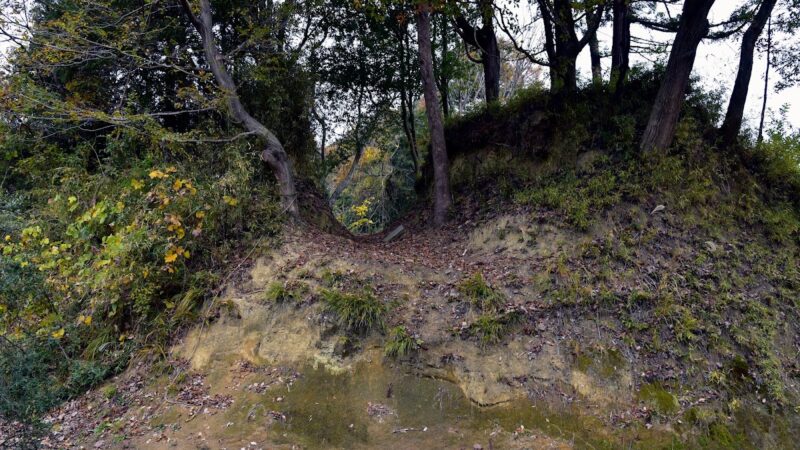
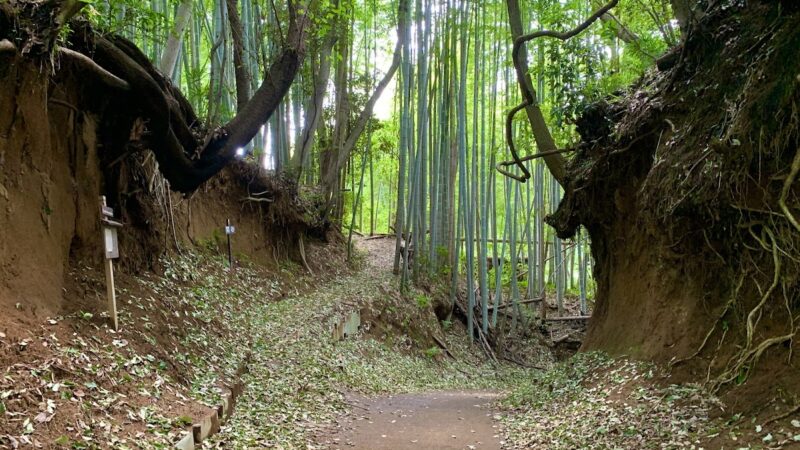
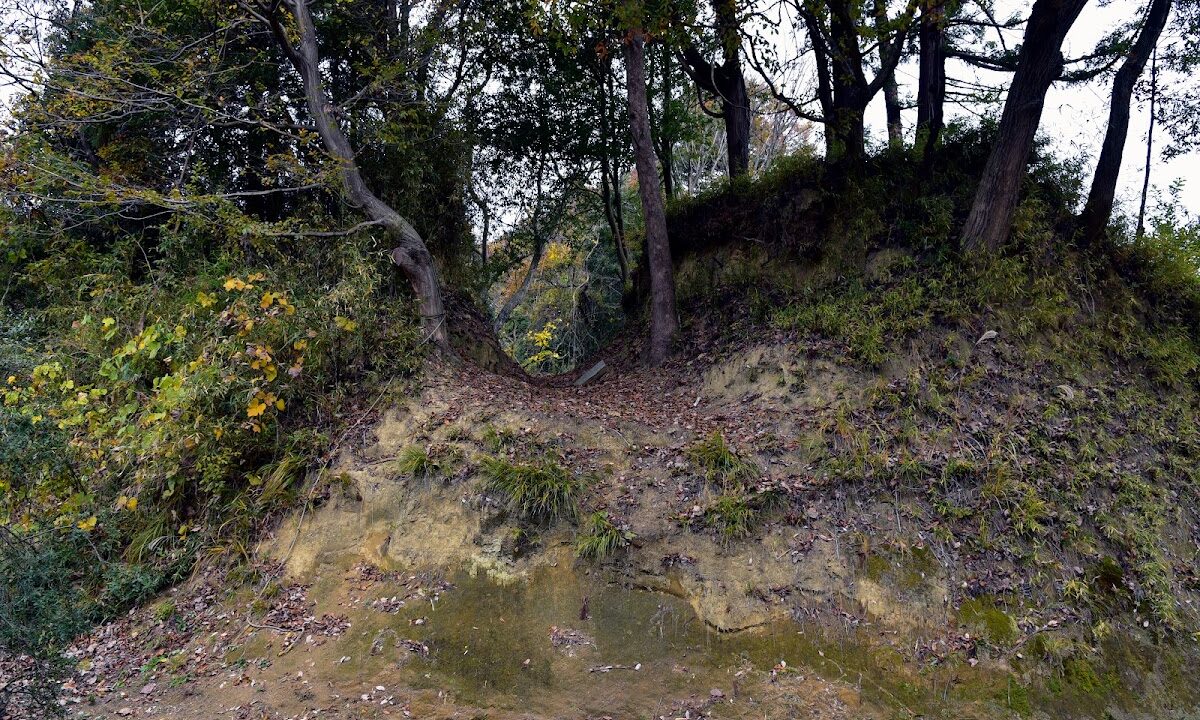
Earthworks: These are earthen defensive walls surrounding the castle, and some parts still exist. However, due to later alterations and weathering, only a limited number of sections are clearly identifiable.
Moats: These are dry moats that cut off ridges to prevent enemy intrusion, and are important defensive structures that demarcate the castle area. It is believed that Oyamada Castle had multiple moats, but currently they are overgrown with vegetation and difficult to confirm.
Enclosures (Kuruwa): These are flat areas within the castle that were used as building sites and soldier encampments. Several elevation changes, including within the grounds of Daizenji Temple, are presumed to be traces of former enclosures.
Unfortunately, due to development in the modern era and the construction of Daizenji Temple, much of the remains of Oyamada Castle as a medieval castle have been lost. Furthermore, many of the existing remains are located on private land (temple grounds) and are off-limits to anyone other than authorized personnel, making detailed investigation and viewing difficult.
Estimated Residence Location
The grounds of Daizenji Temple are estimated to be the location of the Oyamada clan’s peacetime residence. Medieval samurai often used mountain castles for wartime and residences for peacetime, and Oyamada Castle is thought to follow this pattern.
Looking from the entrance to the Daizenji Temple approach, it is clear that the temple is situated on high ground. This is a typical location for a medieval residence, a layout that balanced defense and habitability. Elevation differences remain around the temple, which may indicate the layout of the residence at the time.
Highlights and Visiting Guide to Oyamada Castle
Daizenji Temple and Castle Site Monument
Daizenji Temple is the central point of interest when visiting Oyamada Castle. Within the temple grounds stand the “Oyamada Castle Ruins Monument” and the “Oyamada Takaie Memorial Monument,” indicating the site’s connection to the Oyamada clan.
Daizenji Temple is a Rinzai Zen temple of the Kenchoji branch and is said to have deep ties to the Oyamada clan. The temple grounds are well-maintained, allowing visitors to quietly reflect on history while experiencing the atmosphere of the castle ruins.
Important Notes for Visitors
The following are important points to note when visiting the Oyamada Castle Ruins:
Restricted Access: While the main remains of the castle are believed to be located on the hillside north of Daizenji Temple, a sign reads “No Entry Except for Temple Members.” There is a rope hanging from the west side of the temple, indicating access, but entry without permission is prohibited.
Visitable Area: General visitors are only permitted to freely explore the grounds of Daizenji Temple and the area around the castle ruins monument. To view detailed remains of the castle, you must contact Daizenji Temple in advance and obtain permission. Maintenance Status: Maintenance and guidance for the castle ruins are minimal, and explanatory signs for the remains are limited. It is recommended to learn about the historical background beforehand.
Related Historical Sites in the Surrounding Area
When visiting Oyamada Castle, visiting the surrounding historical sites related to the Oyamada clan will allow for a deeper understanding of the history:
Onoji Castle: This castle was built by the Oyamada clan during the Jōan era (1171-1174) as a branch castle of Oyamada Castle. Located approximately 2 kilometers east of Oyamada Castle, it is an important historical site demonstrating the Oyamada clan’s sphere of influence.
Ozawa Castle: One of the branch castles built by a branch of the Oyamada clan, located west of Oyamada Castle.
Masugata Castle: This castle also functioned as a branch castle of the Oyamada clan.
These branch castles are part of the castle network that the Oyamada clan spread throughout the Tama region, illustrating the extent of their power. ### Photo Spots
When visiting the Oyamada Castle Ruins, here are some recommended photo spots:
- Castle Site Monument: The castle site monument and the commemorative monument are must-see photo spots to commemorate your visit to Oyamada Castle.
- Daizenji Temple Main Hall: The main hall and surrounding temple grounds offer a historical atmosphere, offering a view from the presumed site of the residence.
- Surrounding Nature: The lush greenery of the Tama Hills helps to imagine the environment in which the medieval castle stood.
Access Information
Access by Public Transportation
The following routes are convenient for using public transportation to reach Oyamada Castle (Daizenji Temple):
By Bus from the Nearest Station:
- From Tama Center Station (Keio Line, Odakyu Line, Tama Monorail), take the Kanagawa Chuo Kotsu bus bound for Machida Bus Center, get off at the Shimo-Oyamada bus stop, and walk for approximately 10 minutes.
- From Machida Station (Odakyu Line), take the Kanagawa Chuo Kotsu bus bound for Tama Center Station, get off at the Shimo-Oyamada bus stop, and walk for approximately 10 minutes.
Walking from the Nearest Station:
- Approximately 30 minutes on foot (approximately 2.5 kilometers) from Karakida Station (Tama Monorail)
Since bus services are limited, it is recommended to check the timetable in advance.
Access by Car
If visiting by car:
- Chuo Expressway: Approximately 30 minutes from Kunitachi-Fuchu IC
- Tomei Expressway: Approximately 25 minutes from Yokohama-Machida IC
While Oizumi-ji Temple has parking spaces for visitors, the number of spaces is limited, so we recommend using public transportation whenever possible. Also, some surrounding roads are narrow, so please drive carefully.
Best Time to Visit
Oyamada Castle Ruins are accessible year-round, but please consider the following:
Spring (March-May): The season of fresh greenery, when the nature of the Tama Hills is beautiful. The weather is mild and ideal for strolling.
Autumn (October-November): The autumn foliage is beautiful, making it the perfect season to enjoy the nature around the castle ruins.
Summer (June-August): The greenery is lush, but the dense undergrowth may make it difficult to see the remains. Also, it is a season with many insects.
Winter (December-February): The terrain becomes easier to see due to the falling leaves, but cold weather precautions are necessary.
Historical Significance of Oyamada Castle
A Typical Medieval Castle in Southern Musashi Province
Oyamada Castle holds significant importance as a typical example of a medieval castle in southern Musashi Province. Its structure, utilizing the topography of the Tama Hills, is a valuable example of how medieval samurai in this region constructed defensive strongholds.
Headquarters of a Kamakura Shogunate Retainer
As the headquarters of the Oyamada clan, a powerful retainer of the Kamakura Shogunate, Oyamada Castle is an important historical site for understanding the power base of samurai groups during the Kamakura period. The history of the Oyamada clan’s service to Minamoto no Yoritomo and their contribution to the establishment and development of the Kamakura Shogunate can be felt through this castle.
Connection to Oyamada Nobushige, a Vassal of Takeda Shingen
An important point is that the roots of Oyamada Nobushige, known as a senior retainer of Takeda Shingen, a famous general of the Sengoku period, lie in this Oyamada Castle. The history of the family, from the Oyamada clan of Musashi Province to the Oyamada clan of Kai Province, is an interesting example of the movement and development of samurai from the medieval period to the Sengoku period.
Nobushige wielded considerable power as a lord of the Gun’nai region under the Takeda clan, but ultimately met a tragic end, being executed for betraying his lord. This historical event is an indispensable element in discussing the history of Oyamada Castle.
Current Status and Challenges of Oyamada Castle Research
Limitations of Historical Sources
Historical sources concerning Oyamada Castle are limited, and many points remain unclear, particularly regarding the detailed structure and changes of the castle. While Kamakura period historical sources such as the “Azuma Kagami” record the activities of the Oyamada clan, detailed descriptions of the castle itself are scarce.
The Need for Archaeological Excavation
To reveal the true nature of Oyamada Castle, a full-scale archaeological excavation is necessary. However, since the site is currently occupied by Daizenji Temple, large-scale excavations are difficult. Limited investigations and the use of non-destructive testing methods such as ground-penetrating radar are expected.
Balancing Preservation and Utilization
Because the Oyamada Castle site is privately owned and also a religious facility, careful consideration is needed for its preservation and utilization as a historical site. A balance is required between widely publicizing its value as a regional historical heritage site and respecting the temple’s functions and the privacy of its parishioners.
Summary: The History of Medieval Musashi as Told by Oyamada Castle
Oyamada Castle in Machida City, Tokyo, is a castle of significant historical importance as the base of the Oyamada clan, who were active in southern Musashi Province from the Kamakura period to the Sengoku period. Built in 1171 by Oyamada Arishige, this castle served as a base for the Oyamada clan, who contributed to the establishment of the Kamakura Shogunate as retainers of Minamoto no Yoritomo. It remained deeply involved in the history of the region throughout the Muromachi and Sengoku periods.
Currently, much of the castle site is within the grounds of Daizenji Temple, and while access to the remains is restricted, its history can be commemorated through the castle site monument and other memorial plaques. Visiting this area, surrounded by the rich natural beauty of the Tama Hills, allows visitors to experience the atmosphere of the era in which medieval samurai lived.
Oyamada Castle is a valuable historical site, one of the few remaining medieval castles in Tokyo, and its proper preservation and research are highly anticipated. Those interested in the history of Machida City and the Tama region, or fans of medieval castles, should definitely visit this site and trace the footsteps of the history built by the Oyamada clan.