A Complete Guide to the History and Highlights of Kujidoi Castle (Kami City, Kochi Prefecture)
Kujidoi Castle, located in Kami City, Kochi Prefecture, is one of the important mountain castles of Tosa Province during the Sengoku period (Warring States period). Built on a strategic location overlooking the Monobe River basin, this castle functioned as a base for regional control, and its remains, such as earthworks and baileys, remain in good condition today. This article provides a detailed explanation of everything you need to know before visiting Kujidoi Castle, from its historical background to its highlights and access methods.
Historical Background of Kujidoi Castle
Era and Purpose of Construction
Kujidoi Castle is a mountain castle built during the Sengoku period by a powerful local clan of Tosa Province. Taking advantage of its geographical location in the Monobe River basin of Kami City, it played an important role as a base for controlling the region.
The name “Doi” refers to a residence or castle surrounded by earthworks, indicating that this castle was a base equipped with defensive facilities. The name “Kujidoi Castle,” combined with the place name, gives it a unique castle name specific to this region.
The Situation in Tosa Province During the Sengoku Period
Before the rise of the Chosokabe clan, Tosa Province during the Sengoku period was a region where many local lords vied for power. The Monobe River basin was no exception, with powerful local families building castles and engaging in power struggles.
Kujidoi Castle is a valuable historical site that conveys the reality of regional governance in Tosa during the Sengoku period. It is believed that castles in this region played a significant role in the Chosokabe clan’s process of unifying Tosa.
Castle Lords and the System of Rule
While it is presumed that local lords were involved in the specific lordship of Kujidoi Castle, detailed records are limited. However, given the castle’s size and structure, it is undoubtedly a base for a powerful local family.
The Monobe River basin is located at the intersection of mountainous and plain areas, and was also a strategically important transportation hub. Controlling this land held significant economic and military importance.
Structure and Characteristics of Kujidoi Castle
Location and Layout
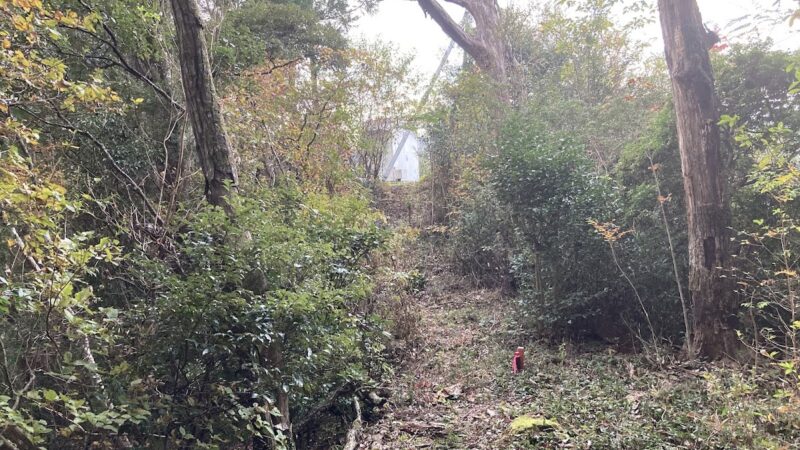
Kujidoi Castle is built on a hill overlooking the surrounding area. This location fulfills the basic function of a mountain castle: early detection of approaching enemies and strengthening defenses.
The castle’s layout (design) skillfully utilizes the terrain, demonstrating ingenuity in using natural elevation differences for defense. Multiple baileys are arranged around the main enclosure, forming a tiered defensive line.
Remains of Earthworks and Moats
The main remains that still exist today are earthworks and moats. Earthworks are earthen walls designed to prevent enemy intrusion, and they are found in relatively good condition at Kujidoi Castle.
Moats are dry moats dug to cut across ridges, and were important defensive structures that blocked enemy routes. These remains are valuable resources for understanding castle construction techniques of the Sengoku period. ### Layout and Function of the Enclosures
An enclosure (kuruwa) is a flat area within a castle where buildings were constructed and troops were stationed. At Kujidoi Castle, the main enclosure (chumaru) is located at the highest point, surrounded by multiple enclosures.
Each enclosure is thought to have had a different function, such as a living space, a defensive base, or a storage area for supplies. Visiting the site allows you to visualize the overall layout of the castle from the arrangement of these enclosures.
Highlights of Kujidoi Castle
Main Enclosure Area
The main enclosure, the heart of the castle, was the most important defensive point and is presumed to have been the location of the lord’s residence. Although now covered with trees, the flat terrain remains, allowing us to imagine what it looked like in its heyday.
From the main enclosure, the surrounding view opens up, offering a panoramic view of the Monobe River basin. This excellent view clearly enhances its value as a military base.
Preservation of the Earthworks
The earthworks of Kujidoi Castle remain in relatively good condition even after several hundred years. Their height and width allow us to infer the high level of defensive capability at the time.
Walking along the earthworks allows you to feel firsthand the technology and effort involved in their construction. Here, you can experience the charm of a mountain castle where natural terrain and artificial structures are integrated.
Moats and Cut Slopes
Moats are defensive structures dug into ridges to cut off enemy incursions. The moats at Kujidoi Castle are deep and wide, indicating their crucial defensive importance.
Cut slopes are areas around baileys that have been artificially excavated to create steep slopes, a technique to make ascent difficult for enemies. Observing these remains allows us to appreciate the high level of castle-building technology during the Sengoku period.
Surrounding Views
From the castle ruins, you can see the flow of the Monobe River, the townscape of Kami City, and the surrounding mountains. This view is one of the reasons why Kujidoi Castle was chosen as a military base.
On a clear day, you can see the distant mountain range, allowing you to relive the scenery that the castle lord of the Sengoku period must have seen. It’s a moment that evokes a sense of historical romance.
How to Access Kujidoi Castle
Access by Public Transportation
The nearest station to Kujidoi Castle is Tosa-Yamada Station on the JR Dosan Line. It’s about a 15-20 minute drive from the station. Access by public transportation alone is difficult, so we recommend using a taxi or renting a car.
There are rental car companies around Tosa-Yamada Station, which is convenient if you’re combining a visit with other historical sites in Kochi Prefecture.
Access by Car
You can access the castle via National Route 195 from the Nangoku IC or Otoyama IC on the Kochi Expressway. Once you enter Kami City, follow the signs.
Since there may not be a dedicated parking lot around the castle ruins, you will need to park in a safe place on the roadside or use the parking lot of a nearby public facility. It is recommended to check with the Kami City tourist information center beforehand.
Precautions when visiting the castle
Kujidoi Castle is a mountain castle, so a certain level of physical fitness is required for the climb. We recommend wearing comfortable shoes and clothing suitable for walking.
In summer, insect repellent is necessary, and in winter, warm clothing is required. Also, bring drinking water and be aware of changes in the weather. Visiting in a group is safer than visiting alone.
Nearby Tourist Attractions
Kami City Yanase Takashi Memorial Museum
Kami City is the birthplace of Yanase Takashi, the creator of “Anpanman.” At the Yanase Takashi Memorial Museum, you can enjoy the world of his works, and it is a popular spot for families.
Combining a visit to Kujidoi Castle with a visit to the Yanase Memorial Museum allows you to enjoy Kami City from both a historical and cultural perspective.
Monobe River and Ryugado Cave
The Monobe River is one of Kochi Prefecture’s representative clear rivers, offering enjoyable drives and walks along its banks. Ryugado Cave, one of Japan’s three largest limestone caves, is also located in Kami City, allowing visitors to experience the mysteries of nature.
Ryugado Cave is designated a national natural monument and historical site, a valuable place where visitors can see the beauty of stalactites and Yayoi period ruins.
Historic Townscape of Tosa-Yamada
Tosa-Yamada Town in Kami City retains old townscapes and historical buildings. Strolling through the town, soaking up the atmosphere of a castle town, is a delightful experience for history buffs.
There are also restaurants serving local cuisine using local ingredients, allowing visitors to savor Kochi’s unique food culture.
Preservation and Utilization of Kuji-Doi Castle
Local Preservation Activities
The remains of Kuji-Doi Castle are being preserved as a local historical heritage. Surveys and maintenance are continuously carried out by local history enthusiasts and the local government.
Preserving the ruins requires addressing natural erosion and tree growth. Through proper management, efforts continue to pass on this historical heritage to future generations.
Use in History Education
Kujidoi Castle is also used as teaching material for local history education. Local elementary and junior high schools sometimes visit the castle ruins as part of their local history studies.
Actual contact with the ruins deepens understanding of history beyond what can be gained from textbooks alone. Such experiential learning is also important for fostering a sense of attachment to the region.
Potential as a Tourism Resource
Kochi Prefecture has many remaining castle ruins, and Kujidoi Castle is one of them, possessing potential as a tourism resource. It is a place worth visiting for castle enthusiasts and history lovers.
In the future, improvements such as the installation of signposts and enhancement of walking paths will make it easier for more people to visit. Further utilization is expected as a place where visitors can enjoy both local history and nature.
Tosa and Mountain Castle Culture in the Sengoku Period
Characteristics of Mountain Castles in Tosa
Tosa Province (present-day Kochi Prefecture) is characterized by its mountainous terrain, and numerous mountain castles were built there during the Sengoku period. Kujidoi Castle is one such example, characterized by its defensive structure that utilizes the terrain.
Mountain castles in Tosa often employ earthworks and trenches, with very few stone walls. This reflects the difficulty in obtaining stone materials and the region’s expertise in civil engineering.
The Chosokabe Clan’s Unification of Tosa and Mountain Castles
In the late 16th century, during the process of Chosokabe Motochika’s unification of Tosa, many mountain castles became battlegrounds. Kujidoi Castle is also thought to have played some role in the turmoil of this era.
After the Chosokabe clan’s unification, many mountain castles were abandoned, but their remains still exist today as important historical sites that convey the history of Tosa.
From Mountain Castles to Modern Castles
With the end of the Sengoku period and the beginning of the Edo period, mountain castles transformed into flatland castles and hill castles. Modern castles like Kochi Castle were built, and the political center shifted.
Medieval mountain castles like Kujidoi Castle ceased to play a role in this transformation, but their remains are valuable resources for understanding castle architecture and military technology of the Sengoku period.
Points to Note When Visiting Kujidoi Castle
Best Time to Visit
The best time to visit Kujidoi Castle is spring (March to May) and autumn (October to November). The weather is mild during these times, making it ideal for exploring mountain castles.
Spring offers beautiful fresh greenery, and autumn provides stunning autumn foliage. Summer is hot and insect-heavy, so adequate precautions are necessary. While Kochi Prefecture is relatively mild in winter, mountainous areas can get quite cold.
Equipment to Bring
For your visit to the mountain castle, we recommend bringing the following:
- Trekking shoes or comfortable walking shoes
- Long-sleeved shirt and long pants (to protect yourself from plants and insects)
- Hat and sunscreen
- Drinking water and snacks
- Insect repellent spray
- Towel and gloves
- Camera (for documenting the ruins)
- Map or GPS device
Estimated Time Required
For a visit to Kujidoi Castle, you should allow approximately 1 to 1.5 hours, including the time spent ascending and descending. If you wish to carefully observe the ruins, we recommend allocating more time.
If combining with other nearby tourist attractions, a half-day to full-day schedule will allow you to enjoy Kami City at a leisurely pace.
Historical Value of Kujidoi Castle
Significance in Regional History Research
Kujidoi Castle is an important historical site for studying the Sengoku period history of the Monobe River basin. Given the limited availability of documentary sources, the ruins themselves serve as invaluable evidence of the history of that time.
Further archaeological investigations may reveal more detailed information about the castle’s history and the realities of the Sengoku period in this region.
Position in the History of Castle Architecture
The structure of Kujidoi Castle exhibits the typical characteristics of a mountain castle in Tosa during the Sengoku period. Its defensive system, primarily consisting of earthworks and moats, provides valuable insight into the level of castle construction technology in the region.
Comparative research with mountain castles across Japan allows for an understanding of regional differences in castle construction techniques and their evolution over time.
Value as a Cultural Heritage Site
Kujidoi Castle is not merely the remains of a military facility, but a cultural heritage site that conveys the lives of people who lived during the Sengoku period. Imagining what happened here and who lived deepens our understanding of history.
As a source of regional pride and a historical heritage site to be passed down to future generations, Kujidoi Castle possesses the value to be carefully preserved.
Summary
Kujidoi Castle is a Sengoku period mountain castle located in Kami City, Kochi Prefecture. Its remains, such as earthworks and baileys, are well-preserved. Built on a location overlooking the Monobe River basin, this castle played an important role as a base for regional control.
The remaining remains offer insights into the castle-building techniques and defensive strategies of the Sengoku period. The view from the castle ruins is magnificent, making it a place where you can feel the romance of history.
When visiting, it is recommended to wear comfortable walking shoes and take safety precautions while exploring. Nearby attractions include Ryugado Cave and the Yanase Takashi Memorial Museum, allowing you to enjoy the charm of Kami City from multiple perspectives.
Kujidoi Castle is a valuable cultural heritage site that tells the history of the region. Visiting this castle site will allow you to reflect on Tosa during the Sengoku period and deepen your understanding of history. When visiting Kochi Prefecture, be sure to visit Kujidoi Castle.