Kioka Castle (Takamatsu City, Kagawa Prefecture) Complete Guide | History, Ruins, and Access Information
What is Kioka Castle?
Kioka Castle (Kioka-jo) was a medieval mountain castle located in Takamatsu-cho, Takamatsu City, Kagawa Prefecture. It is an important historical site that is the origin of the current place name of Takamatsu City. It is also known as “Takamatsu Castle,” but it is a different castle from Tamamo Castle (the current Takamatsu Castle), which was the residence of the Ikoma and Matsudaira clans during the Edo period.
It was built in 1335 by Takamatsu Yorishige, who served as the governor of Sanuki Province, and functioned as the residence of the Takamatsu clan for approximately 250 years. It fell during Toyotomi Hideyoshi’s conquest of Shikoku in 1585, ending its role, but traces of the castle remain today in the grounds of Kioka-ji Temple and the surrounding area.
About the Name of Kioka Castle
The name “Kioka Castle” originates from the local place name “Kioka.” It was also known as “Takamatsu Castle,” a name taken from the name of the castle’s lord, the Takamatsu clan. Later, Tamamo Castle inherited the name “Takamatsu Castle,” so today, for distinction, it is generally referred to as “Kioka Castle” or “Former Takamatsu Castle.”
The place name Takamatsu in Sanuki Province is said to have originated from Kioka Castle and its castle town, and is the origin of the name of the entire present-day Takamatsu City.
History of Kioka Castle
Construction during the Kenmu Period (1335)
The history of Kioka Castle begins in 1335 (Kenmu 2). After the fall of the Kamakura Shogunate, during the Kenmu Restoration under Emperor Go-Daigo, Takamatsu Yorishige (also known as Funaki Yorishige), who was appointed as the governor of Sanuki Province, built a castle in this location.
Takamatsu Yorishige is known as a key figure in the Kenmu Restoration, and during the turbulent period of the Northern and Southern Courts, he selected Kioka Castle as the base of operations for governing Sanuki Province. At that time, Sanuki held a crucial position as a strategic point on the Seto Inland Sea, making the construction of a castle in this location strategically significant.
Fall and Reconstruction in Kenmu 3 (1336)
Just one year after its construction, in Kenmu 3 (1336), Kioka Castle faced a major trial. Defeated in a battle against Hosokawa Sadazane, the castle temporarily fell. This battle, part of the turmoil of the Northern and Southern Courts, illustrates the intensity of the power struggles within Sanuki Province.
However, shortly after its fall, the Takamatsu clan recaptured the castle and made it their residence once again. From then on, Kioka Castle continued to function as the Takamatsu clan’s base for approximately 250 years.
Kioka Castle in the Sengoku Period
With the arrival of the Sengoku period, Sanuki Province became strongly influenced by the surrounding daimyo powers. Kioka Castle was no exception; it survived as the residence of the Takamatsu clan, despite being tossed about by the tides of the times.
In the latter half of the 16th century, the power of Chosokabe Motochika, who rose to prominence as the ruler of Shikoku, extended to Sanuki, and Takamatsu Yorimura, the lord of Kioka Castle, chose to submit to the Chosokabe clan. This choice would determine the castle’s fate.
The Fall of Kioka Castle in 1585
The greatest historical event for Kioka Castle occurred in 1585. When Toyotomi Hideyoshi’s forces, in their conquest of Shikoku, invaded Sanuki, Takamatsu Yorimura, who sided with the Chosokabe, faced off against approximately 20,000 Toyotomi troops.
The castle was defended by only about 200 soldiers. Despite the overwhelming difference in troop numbers, Takamatsu Yoriyuki and his soldiers fiercely resisted, but ultimately met a tragic end with the castle’s defenders all being killed. In this battle, Kioka Castle completely fell, bringing to an end its approximately 250-year history as the residence of the Takamatsu clan.
After the castle’s fall, Sanuki Province came under the control of Toyotomi Hideyoshi, and later, Ikoma Chikamasa was granted Sanuki. The Ikoma clan built Tamamo Castle (present-day Takamatsu Castle) as their new residence, and the center of Sanuki’s governance shifted from Kioka Castle.
Structure and Layout of Kioka Castle
Castle Location
Kioka Castle is a flatland castle built on a hillside in what is now Takamatsu-cho, Takamatsu City. Located inland from the Seto Inland Sea, it was strategically situated overlooking the Sanuki Plain. The Kasuga River flows nearby, and it is believed that the castle’s defenses utilized the natural terrain.
Main Enclosure and Major Facilities
The site where Kioka-ji Temple now stands is believed to be the site of the main enclosure of Kioka Castle. It is presumed that the main enclosure was surrounded by the second and third enclosures, but a detailed layout map does not exist.
It is thought to have been a relatively large castle for a medieval mountain castle, and may have also functioned as a shugo (provincial governor’s) residence. The fact that approximately 200 soldiers were able to withstand the siege in 1585 (Tensho 13) suggests that it was a castle of considerable size.
Defensive Structures
As is characteristic of medieval mountain castles, Kioka Castle is thought to have had defensive structures such as earthworks, dry moats, and baileys. However, many remains have been lost due to later development, making it difficult to know the detailed structure at the time of its construction.
Current Status of Kioka Castle
Kioka-ji Temple and Castle Ruins
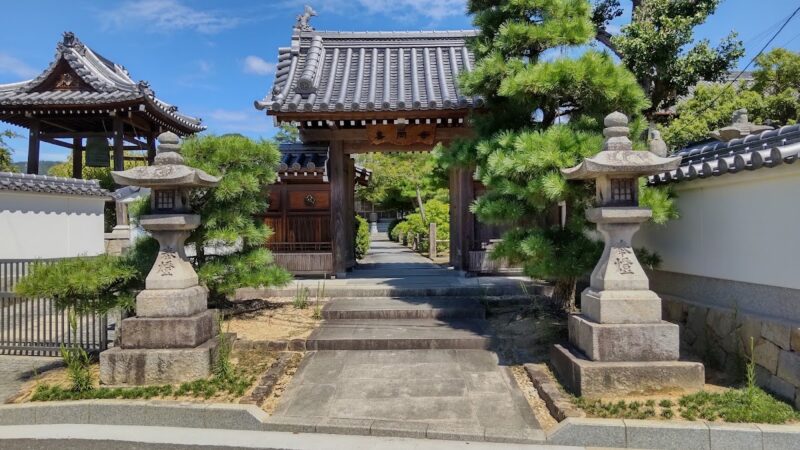
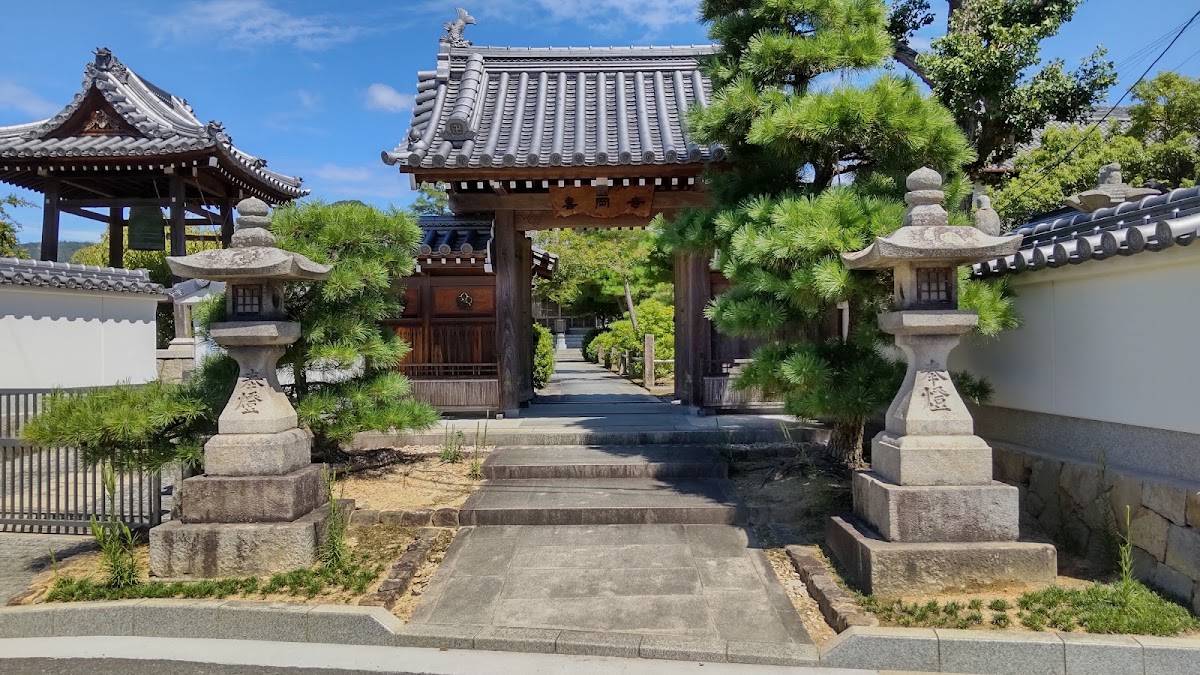
Currently, Kioka-ji Temple, a Shingon sect Omuro school temple, stands on the site of the main enclosure of Kioka Castle. The temple’s mountain name is Eishozan, and its principal deity is Fudo Myoo. Because the temple grounds are located on the site of a former castle, one can feel a sense of history.
Within the grounds of Kioka-ji Temple remain the graves of Takamatsu Yorimura, Tojin Danjo, and Katayama Shima, who died in battle during the castle’s fall in 1585 (Tensho 13). These gravestones are a valuable historical site that conveys the castle’s final moments. These gravestones were erected to commemorate the warriors who perished along with approximately 200 soldiers.
Castle Site Monument and Information Board
Near Kioka-ji Temple stands a stone monument marking the “Takamatsu Castle Site,” indicating that this is a historical castle site. Furthermore, to the west of the temple grounds are a shrine and a park, where information boards explaining the castle’s history are also installed.
These monuments and information boards play an important role in conveying the history of Kioka Castle to visitors and are carefully preserved as local historical heritage.
Status of Remains
Unfortunately, most of the remains of Kioka Castle have been lost due to later development. While it’s difficult to identify clear remains such as stone walls and moats, the topography and layout offer a glimpse into the former castle’s appearance.
Although the area around present-day Takamatsu-cho is a residential area, observing the topography around Kioka-ji Temple reveals traces of the medieval castle. For history enthusiasts, it’s a place where they can use their imagination to contemplate the castle’s former glory.
Origin of the Place Name Takamatsu
Kioka Castle is an important historical site that directly gave rise to the name of present-day Takamatsu City. The name of the castle lord, the Takamatsu clan, became established as the local name, and later, Tamamo Castle, built by the Ikoma clan, also came to be called “Takamatsu Castle.”
During the Edo period, it developed as a castle town, and the name Takamatsu continued to be used after the Meiji era, developing into the present-day Takamatsu City. In short, Kioka Castle is the birthplace of the place name “Takamatsu,” and the root of Takamatsu City, one of Shikoku’s leading cities.
The role of the center of Sanuki Province was passed down from Kioka Castle to Tamamo Castle, and then to the present-day city of Takamatsu. This historical continuity is an extremely important element in understanding the history of Kagawa Prefecture.
Relationship between Kioka Castle and Tamamo Castle
Two “Takamatsu Castles”
Kioka Castle and Tamamo Castle are often confused because both are sometimes called “Takamatsu Castle.” However, they are completely different castles with different construction periods, locations, and lords.
Kioka Castle is a medieval mountain castle built in 1335 and was the residence of the Takamatsu clan. On the other hand, Tamamo Castle is a modern castle built around 1590 by Ikoma Chikamasa, designed as a coastal castle facing the Seto Inland Sea. Currently, Tamamo Castle is the one generally known as “Takamatsu Castle.”
Inheritance of Name
When Ikoma Chikamasa built a new castle, the area was called “Takamatsu,” so the new castle was also named “Takamatsu Castle.” This inherited the tradition of the place name “Takamatsu” established by Kioka Castle.
While Tamamo Castle has the beautiful alternative name “Tamamo,” the fact that it continued to be officially called “Takamatsu Castle” can be seen as a result of prioritizing the historical identity of the region.
Cultural Significance of Kioka Castle
Position in the History of Sanuki Province
Kioka Castle is a castle that symbolizes the history of Sanuki Province from the Nanboku-cho period to the Sengoku period. As a shugo (provincial governor’s) residence and the residence of a powerful local lord, it played a central role in the politics and military of Sanuki for approximately 250 years.
The fall of the castle in 1585 (Tensho 13) is also a symbolic event of the end of medieval Sanuki and the transition to the early modern period. With Toyotomi Hideyoshi’s conquest of Shikoku, Sanuki entered a new era, and its center shifted from Kioka Castle to Tamamo Castle.
Importance of Local History Research
Research on Kioka Castle is essential for understanding the local history of Takamatsu City and Kagawa Prefecture. Through the castle’s history, we can learn about the political situation in medieval Sanuki, the activities of samurai groups, and the realities of battles during the Sengoku period.
In particular, the valiant efforts of the castle’s defenders during the castle’s fall in 1585 (Tensho 13) are recounted as a source of local pride and are an important subject in local history education.
Access Information
Location
Kioka-ji Temple (Kioka Castle Ruins)
2899 Takamatsu-cho, Takamatsu City, Kagawa Prefecture
Transportation Access
Access by Train and Bus
- Take the Kotoden Bus “Takamatsu Line” from JR Takamatsu Station, get off at the “Takamatsu” bus stop, and walk for approximately 5 minutes.
- Approximately 15 minutes on foot from Kotoden Shido Line “Furutakamatsu Station”.
Access by Car
- Approximately 15 minutes from Takamatsu Chuo IC on the Takamatsu Expressway
- Approximately 20 minutes from central Takamatsu City via National Route 11
- Parking: Parking is available at Kioka-ji Temple for visitors (limited number of spaces).
Visiting Information
Visiting Hours
While you can generally visit the Kioka-ji Temple grounds freely, please be mindful of respectful behavior as it is a temple.
Admission Fee
Free (for temple visits)
Main Highlights
- Kioka-ji Temple Main Hall (site of the main keep)
- Graves of Takamatsu Yorimura, Tojin Danjo, and Katayama Shima
- Stone monument at Takamatsu Castle site
- Castle site information board (west side of the temple)
Nearby Historical Sites
When visiting Kioka Castle ruins, we recommend also visiting the following historical sites:
- Takamatsu Castle (Tamamo Castle Ruins/Tamamo Park): Approximately 5.9km from Kioka Castle, about 15 minutes by car
- Yashima: Ancient battlefield of the Genpei War, approximately 8km from Kioka Castle
- Ritsurin Garden: National Special Place of Scenic Beauty, approximately 6km from Kioka Castle
Points to Note When Visiting Kioka Castle
Condition of Remains
As mentioned above, most of the remains of Kioka Castle have been lost. Visitors expecting clear castle remains such as stone walls and moats may be disappointed. It’s recommended to visit as a historical site, using your imagination.
Temple Etiquette
The castle ruins are located within the grounds of Kioka-ji Temple, an active temple. Please be considerate of other visitors and local residents, and observe quietly. When taking photographs, please be careful not to disturb other visitors.
Best Time to Visit
Kioka Castle Ruins are accessible year-round, but the scenery is particularly beautiful during the cherry blossom season in spring and the autumn foliage season. Also, it’s recommended to take precautions against the heat in summer and the cold in winter.
Summary
Kioka Castle is an important historical site indispensable to understanding the history of Takamatsu City, Kagawa Prefecture. Built in 1335 by Takamatsu Yorishige, it served as the stage for the history of Sanuki Province for approximately 250 years until its dramatic fall in 1585.
Although it now quietly preserves its history as the grounds of Kioka-ji Temple, this very place is the birthplace of the name “Takamatsu” and the starting point of the history that led to modern-day Takamatsu City. As a castle that witnessed a major turning point in history—Toyotomi Hideyoshi’s conquest of Shikoku—and as the tragic site where approximately 200 soldiers, including Takamatsu Yorimura, perished, Kioka Castle continues to captivate the hearts of many history enthusiasts.
Unlike Tamamo Castle (the current Takamatsu Castle), no large-scale remains survive, but standing on the grounds of Kioka-ji Temple, you can truly feel that this was once the center of Sanuki Province. When you visit Takamatsu City, be sure to visit this historical starting point.