Kurokawa Castle (Koka City, Shiga Prefecture) Complete Guide | A Thorough Explanation of the Remains and History of the Mountain Castle of the Koga Twenty-One Families
What is Kurokawa Castle?
Kurokawa Castle is a Sengoku period mountain castle located in Ayukawa, Tsuchiyama-cho, Koka City, Shiga Prefecture. It is said to have been built during the Eiroku era (1558-1569) by the Kurokawa clan, one of the Koga Twenty-One Families, and functioned as a castle protecting a strategic location on the western foot of the Suzuka Mountains in eastern Omi Province.
It is built on a hill approximately 390 meters above sea level, overlooking the confluence of the Yasugawa River and its tributary, the Ayukawa River (Ugui River), with a relative height of about 50 meters from the base of the hill. Although small in scale, its solid layout centered around the main enclosure, along with well-preserved defensive structures such as stone walls, earthworks, and gangi (covered walkways), makes it a valuable historical site that conveys the characteristics of a Sengoku period mountain castle.
Also known as “Kurokawa-shi Yashiki” and “Kurokawa Castle,” it is sometimes referred to locally as Ayukawa Castle. Currently preserved as a historical site by Koka City, it is a hidden gem of a castle, attracting castle enthusiasts and history buffs.
The History of the Kurokawa Clan and the Twenty-One Families of Koka
The Roots of the Kurokawa Clan
The Kurokawa clan is a family that claims descent from Fujiwara no Hidesato, a military commander of the Heian period. During the Ōnin-Bunmei War (1467-1477), Kurokawa Yoshirō is said to have served as a local administrator in Mabuchi, Gamō District. Later, he came to serve the Rokkaku clan, the shugo daimyo of Ōmi Province. He was granted the land of Ayukawa in Koka District by the Rokkaku clan, and his settlement in this area is considered the beginning of the Kurokawa clan’s presence in Koka.
What are the Twenty-One Families of Koka?
The Twenty-One Families of Koka are a collective term for powerful clans that held influence primarily in Koka District from the medieval period to the Sengoku period. The Mochizuki, Yamanaka, Ukai, Naiki, and Ueno clans, among others, each governed their respective regions as independent lords, yet possessed a distinctive organizational structure that allowed them to unite and act in alliances when necessary. The Kurokawa clan was also a member, governing the villages around Ayukawa.
The Koga Twenty-One Families were deeply connected to the origins of the so-called “Koga Ninja” and were known as a group skilled in information gathering and espionage.
Kurokawa Genbanosuke and the Construction of the Castle
It is believed that Kurokawa Genbanosuke built a castle in this area during the Eiroku era. This was in the midst of the Sengoku period, a time when the power of the Rokkaku clan was beginning to decline. While serving the Rokkaku clan, the Kurokawa clan is thought to have maintained their own sphere of influence while carefully observing the changing times.
Later, when Oda Nobunaga advanced into Omi Province, many Koga clans, including the Kurokawa clan, became subordinate to the Oda clan. In particular, some point out that the stone walls and layout of Kurokawa Castle show the influence of Azuchi Castle, built by Oda Nobunaga, and it is highly likely that the castle was renovated after the Kurokawa clan submitted to the Oda clan.
History of the Castle’s Abandonment
It is said that Kurokawa Castle was abandoned in connection with the attack on Saika in Kishu in 1585. At this time, the Kurokawa clan, along with other Koga samurai, were stripped of their domain for disobeying Toyotomi Hideyoshi’s orders or for some other reason incurring his wrath. As a result, Kurokawa Castle was abandoned, bringing an end to its short history of just over 20 years.
However, historical records are limited regarding the details of the castle’s abandonment, and alternative theories exist. One theory suggests that it was abandoned when small castles in the Koga region were consolidated as a precursor to the Toyotomi regime’s “One Castle Per Province” decree.
Layout and Remains of Kurokawa Castle
Structure of the Main Enclosure
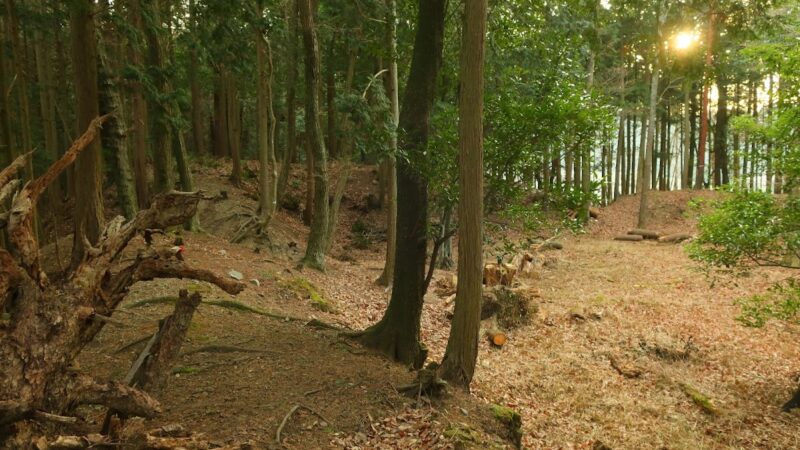
The main enclosure of Kurokawa Castle is a rectangular enclosure, measuring approximately 30 meters east-west and 20 meters north-south. The enclosure is surrounded by an earthen rampart approximately 2 meters high, enhancing its defensive capabilities.
Of particular note are the gangi (stepped steps) built inside this rampart. Gangi are a structure with stepped levels inside the rampart, designed to allow castle soldiers to quickly ascend to the top of the rampart for defense. The gangi at Kurokawa Castle are relatively well-preserved, making them valuable remains for understanding the practical castle structure of the Sengoku period.
Entrances and Stone Walls
The main enclosure has two entrances (koguchi) on the west and north sides. These entrances are not merely openings, but are solid structures reinforced with stone walls.
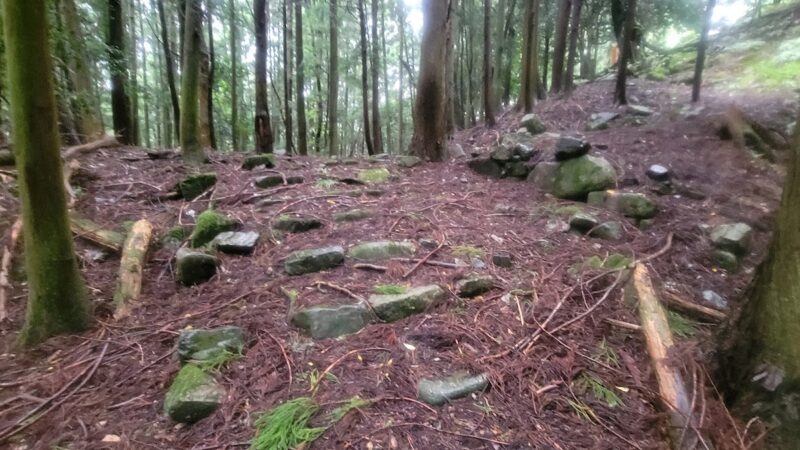
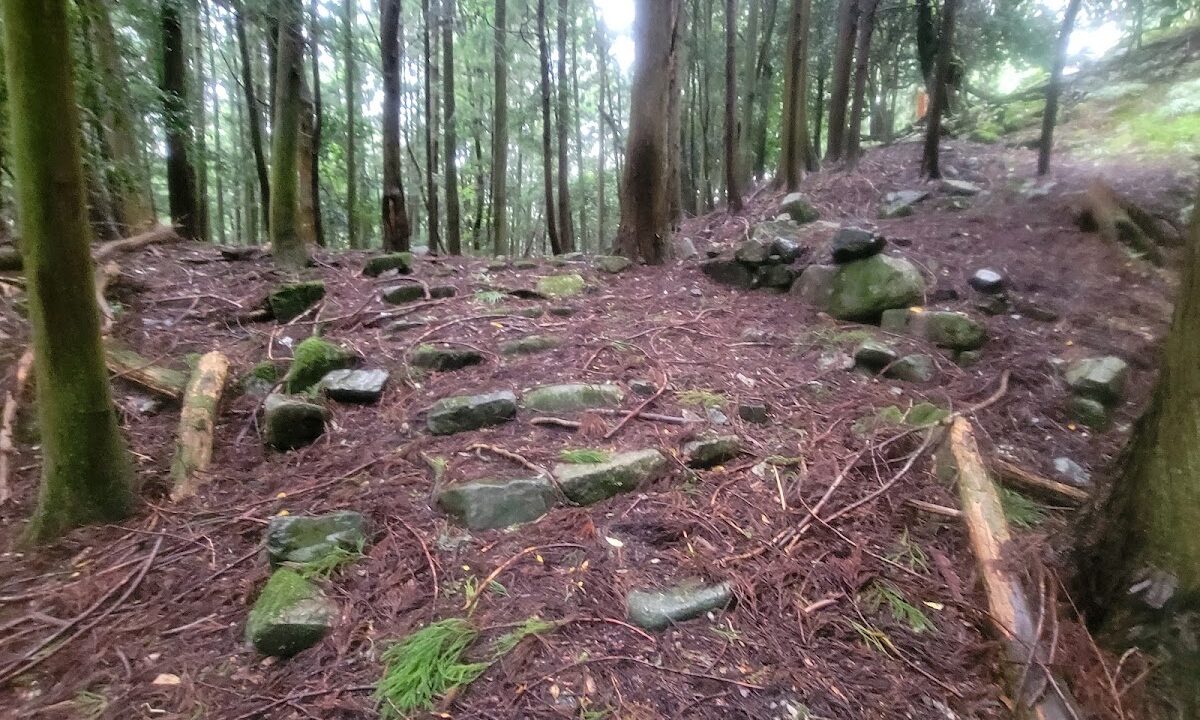
The stone wall at the western gate, in particular, was constructed using the nozura-zumi technique, a method of stacking natural stones, and is thought to have been influenced by the stonework techniques that developed during the time of Oda Nobunaga. The stone wall is approximately 1.5 to 2 meters high, but it also features a “yokoya-gakari” structure, allowing for attacks from the flank against enemies passing through the gate, indicating a layout designed with actual combat in mind.
Similar stonework is found at the northern gate, suggesting an intention to heavily defend the access route to the castle. These stone walls remain intact even after more than 400 years, demonstrating the high level of stonework technology of the time.
Enclosures and Moats
Several enclosures are arranged around the main enclosure. To the east of the main enclosure is a lower enclosure, and further outside, a small flat area can be seen. These are thought to have functioned as the second and third enclosures, forming a multi-layered defensive structure that progressively prevented access to the main enclosure.
A moat is located behind the castle (on the east side), preventing enemy incursions along the ridge. The moat is approximately 3-4 meters deep and 5 meters wide, providing sufficient defense for a small mountain castle.
Stone Steps and Pathways
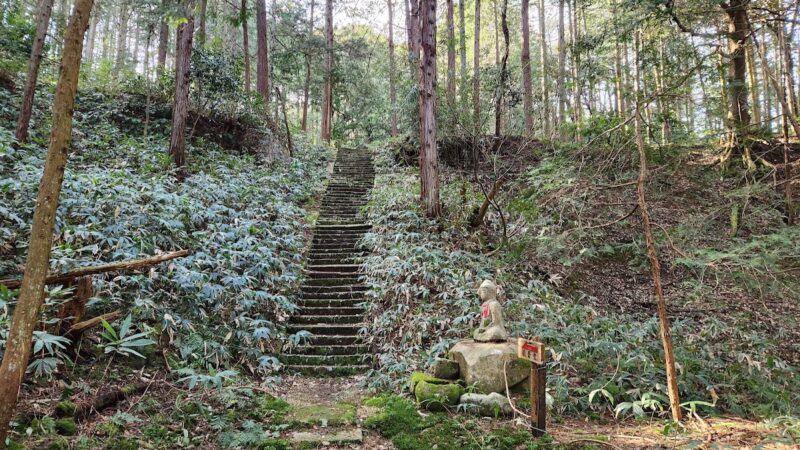
Several stone steps are provided within the castle grounds, facilitating movement between enclosures. These steps, like the stone walls, are constructed using natural stones, combining practicality and defensive capabilities.
The path leading to the main enclosure is also reinforced with stonework, demonstrating a design that considered both peacetime convenience and wartime defense. This extensive use of detailed stonework is a technique that became widespread after Oda Nobunaga’s construction of Azuchi Castle, and is considered evidence that Kurokawa Castle underwent extensive renovations after becoming a vassal of the Oda clan.
Features of the Earthworks
The earthworks surrounding the main enclosure are not simply mounds of earth, but are reinforced in places with stonework. In particular, stone masonry to prevent collapse is strategically placed around the gate and corners of the enclosures, demonstrating ingenious technical ingenuity.
The height of the earthworks varies depending on the location, but the highest point reaches approximately 2.5 meters. The top of the earthworks is leveled, suggesting it functioned as a space for castle soldiers to move around and shoot arrows.
Access and Visiting Information for Kurokawa Castle
Location
Address: Ayukawa, Tsuchiyama-cho, Koka City, Shiga Prefecture
Kurokawa Castle is located in the mountainous area in the eastern part of Koka City, near the border with Mie Prefecture. It sits on a hill southeast of the Ayukawa settlement, near the confluence of the Yasugawa and Ayukawa rivers.
Access by Car
Nearest Interchange: Approximately 15 minutes from the Koga-Tsuchiyama Interchange on the Shin-Meishin Expressway
- Exit the Koga-Tsuchiyama Interchange and head east on National Route 1
- Head north on Prefectural Road 9 (Ogawara-Kita-Tsuchiyama Line)
- Arrive near the intersection with Prefectural Road 507 (Ayukawa-Inohana Line)
Parking: Parking is available at Uguigawa Park (free)
Access by Public Transportation
Access by public transportation is difficult. The nearest station is JR Kusatsu Line’s Kibukawa Station, but bus services from there to the Ayukawa area are limited, making taxi travel the most practical option. It takes approximately 30 minutes by taxi from Kibukawa Station.
Entrance to the Castle and Information Board
The entrance to the castle is located around the corner of a curve on Prefectural Road 507. A signpost installed by the Tsuchiyama Town Board of Education serves as a landmark; this is where you enter the mountain trail. The signpost contains explanations about the castle’s history and structure, so it’s recommended to read it before climbing.
Near the entrance to the castle, there’s a gas station; you enter the mountain by opening the animal-proof net behind it. Please be sure to close the net after opening it.
Climbing Route and Estimated Time
From the entrance to the main enclosure, you’ll climb approximately 50 meters in elevation. The climbing route is relatively clear, but there are some steep sections, so non-slip shoes are recommended. The climb takes about 15-20 minutes one way.
Including time for sightseeing inside the castle, it’s best to allow 1 to 1.5 hours in total.
Points to Note When Visiting
- Attire: Long-sleeved shirt, long pants, and trekking shoes are recommended.
- Items to Bring: Drinking water, insect repellent (summer), flashlight (due to early sunset in winter).
- Season: Spring and autumn are the best times to visit. Summer is overgrown with vegetation, and winter may bring snow.
- Safety: Avoid visiting alone; please visit in groups if possible.
- Manners: Do not damage the ruins, take your trash with you, and always close the animal-proof netting.
Nearby Attractions
Ayukawa’s Thousand Cherry Trees: In spring, approximately 600 cherry trees bloom along the Yasugawa River in the Ayukawa area, known as “Ayukawa’s Thousand Cherry Trees.” Enjoy this in conjunction with a visit to Kurokawa Castle.
Tamura Shrine: An ancient shrine located within the Ayukawa settlement, associated with Sakanoue no Tamuramaro.
Michi-no-Eki Aino Tsuchiyama: Located near the Koga Tsuchiyama Interchange, you can enjoy local specialties and meals.
Historical Value and Charm of Kurokawa Castle
Conveying the Castle Culture of Koga Samurai
Kurokawa Castle is an extremely valuable example of a castle built by the unique Koga Twenty-One Families, a group of samurai. Unlike the large-scale castles of the early modern period with their towering keeps and stone walls, it preserves the practical and functional form of a mountain castle.
The Koga samurai did not completely submit to the daimyo, but governed their regions while maintaining a degree of independence. The scale and structure of Kurokawa Castle are valuable historical materials that tell the story of the realities of such small and medium-sized lords.
Stone Wall Techniques Influenced by Oda Nobunaga
The most distinctive feature of Kurokawa Castle is its extensive use of stone walls and stonework throughout, despite being a small mountain castle. This is considered evidence that the advanced castle-building techniques adopted by Oda Nobunaga at Azuchi Castle spread to smaller castles in the Koka region.
It is presumed that when the castle was first built during the Eiroku era, it was a traditional mountain castle centered on earthworks and moats. However, after becoming a vassal of the Oda clan, it is thought that a large-scale renovation using stone walls was carried out during the Tensho era. This renovation significantly improved the defensive capabilities of Kurokawa Castle, making it a castle that represents a transitional period towards early modern castles.
Excellent State of Preservation
Although more than 400 years have passed since the abandonment of Kurokawa Castle, the main remains such as the earthworks of the main enclosure, the gangi (stone steps), stone walls, and the gate remain in excellent condition. This is due to the lack of large-scale development after the castle’s abandonment and the high level of preservation awareness among local residents.
In recent years, the Koka City Board of Education has also been conducting surveys and maintenance, including the installation of information boards and the improvement of the access road to the castle. Further detailed excavations are likely to yield new discoveries, making it a focus of attention in the field of castle research.
Importance of Local History Research
Kurokawa Castle is an important historical site for understanding the history of the region. It provides clues to many historical themes, including the history of the Ayukawa area, the lives of Koga samurai, and the realities of local powerful families during the Sengoku period.
Local traditions and historical materials concerning the Kurokawa clan remain, and comprehensive research of these along with the castle remains will allow for a more detailed historical picture to be drawn.
Summary
Kurokawa Castle is a Sengoku period mountain castle located in Ayukawa, Tsuchiyama-cho, Koga City, Shiga Prefecture. It was built during the Eiroku era by the Kurokawa clan, one of the 21 Koga families. Situated on a hill approximately 390 meters above sea level overlooking the confluence of the Yasugawa and Ayukawa rivers, it boasts a solid layout centered around the main enclosure and excellent defensive facilities such as stone walls, earthworks, and covered walkways.
Particularly noteworthy is the extensive use of stone walls throughout the castle, despite its small size. This is believed to be the result of renovations influenced by Oda Nobunaga’s Azuchi Castle. Although the castle was abandoned in 1585 when the Kurokawa clan was dispossessed by Toyotomi Hideyoshi, its remains have been preserved in excellent condition for over 400 years.
Kurokawa Castle is a valuable historical site that conveys the castle culture of the Koga samurai, and is important for understanding the castles of local powerful families during the transitional period from the Sengoku period to the early modern period. While access is somewhat inconvenient, it is a hidden gem worth visiting for castle enthusiasts and history buffs.
Exploring the castle ruins amidst the beautiful natural environment of Ayukawa, while feeling the spirit of the Sengoku period, not only deepens our understanding of history but also offers many insights for us living in the modern age. When visiting the Koga region, be sure to visit Kurokawa Castle.