Tsuchiyama Castle (Koka City, Shiga Prefecture) Complete Guide | History, Highlights, and Access Information
Tsuchiyama Castle, located in Tsuchiyama-cho, Koka City, Shiga Prefecture, is a mountain castle that served as the residence of the Tsuchiyama clan during the medieval period. It played a crucial role as a strategic point on the Tokaido road and has a turbulent history, including being captured by Takigawa Kazumasu, a retainer of Oda Nobunaga, during the Sengoku period. This article comprehensively introduces information about Tsuchiyama Castle, from its detailed history to its remaining structures, highlights, and access methods.
Basic Information about Tsuchiyama Castle
Tsuchiyama Castle is a medieval mountain castle located in Kitatsuchiyama, Tsuchiyama-cho, Koka City, Shiga Prefecture. Also known as “Omi Tsuchiyama Castle,” it functioned as an important strategic fortress in the Koka region.
Location: 1352 Kitatsuchiyama, Tsuchiyama-cho, Koka City, Shiga Prefecture
Castle Classification: Mountain Castle
Construction Period: Bunmei era (1469-1487)
Builder: Tsuchiyama Shikanosuke Moritada
Main Lord: Tsuchiyama clan
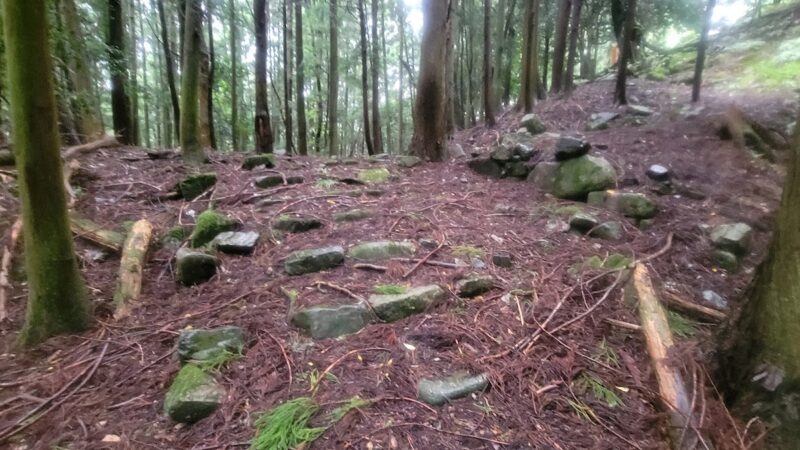
Remains: Enclosures, earthworks, moats
Designated Cultural Property: None
Tsuchiyama Castle is built on a mountaintop approximately 300 meters above sea level, strategically located overlooking the Tokaido road. Even today, the remains such as enclosures and earthworks are well-preserved, making it a valuable historical site for learning about the structure of medieval mountain castles.
History and Changes of Tsuchiyama Castle
Construction History and the Tsuchiyama Clan
Tsuchiyama Castle is said to have been built during the Bunmei era (1469-1487) by Tsuchiyama Shikanosuke Moritada. The Tsuchiyama clan was a local samurai family, counted among the 53 families of Koga, and held considerable influence in the Koga region.
The Tsuchiyama clan ruled this area for generations, and it is believed they benefited from its strategic location by controlling Tsuchiyama-juku, a key point on the Tokaido road. The Koga region was a unique area controlled by a coalition of local samurai called the “Koga-shu,” and the Tsuchiyama clan was a member of this coalition.
Tsuchiyama Castle in the Sengoku Period
With the arrival of the Sengoku period, Tsuchiyama Castle became embroiled in conflicts with surrounding forces. The Koga region, located in the southeastern part of Omi Province, was strategically important as a route to Ise and Iga. Therefore, as Oda Nobunaga’s power expanded, the Koga region gradually came under his influence.
In 1582, immediately after the Honnoji Incident, Takigawa Kazumasu, a retainer of Oda Nobunaga, advanced from Ise towards the Koga region. Records indicate that Tsuchiyama Castle, whose lord was Tsuchiyama Moritsuna, was attacked by Takigawa Kazumasu and fell during this conflict. The Tsuchiyama clan is believed to have perished in this battle, and Tsuchiyama Castle is thought to have been abandoned.
Toyotomi Hideyoshi and Tsuchiyama Castle
According to one theory, during the Battle of Komaki and Nagakute (1584), Hashiba Hideyoshi (later Toyotomi Hideyoshi) renovated Tsuchiyama Castle and resided there for a period. Hideyoshi may have considered Tsuchiyama an important strategic point in his military operations towards Ise, and may have used Tsuchiyama Castle to control traffic along the Tokaido road.
However, there is little reliable historical evidence to support this theory of Hideyoshi’s presence at the castle, and it remains largely a legend. Nevertheless, it is an interesting piece of information that illustrates the strategic importance of Tsuchiyama.
After the Edo Period
During the Edo period, Tsuchiyama Castle was completely abandoned and lost its function as a castle. However, Tsuchiyama-juku flourished as the 49th post town on the Tokaido highway, maintaining its importance as a transportation hub.
The current Tsuchiyama town merged with Minakuchi, Koka, Konan, and Shigaraki towns on October 1, 2004, to form part of Koka City. The Tsuchiyama Castle ruins are preserved as a valuable local historical heritage site and attract visitors from castle enthusiasts and history buffs.
Layout and Structure of Tsuchiyama Castle
Main Enclosure and Bailey Arrangement
Tsuchiyama Castle has a typical medieval mountain castle structure, with the main enclosure located on the mountaintop and multiple baileys arranged in a stepped pattern around it. The main enclosure measures approximately 40 meters east-west and 30 meters north-south, and is surrounded by an earthen rampart.
The second and third baileys are located to the east and west of the main enclosure, further strengthening its defenses. These baileys are positioned utilizing the difference in elevation, demonstrating ingenuity to make enemy intrusion difficult.
Defensive Structures
The most notable defensive structures of Tsuchiyama Castle are the moat and earthworks. A large moat was constructed behind the main enclosure (on the north side), serving to block enemy incursions along the ridge. This moat is approximately 5 meters deep and 10 meters wide, and is still clearly visible today.
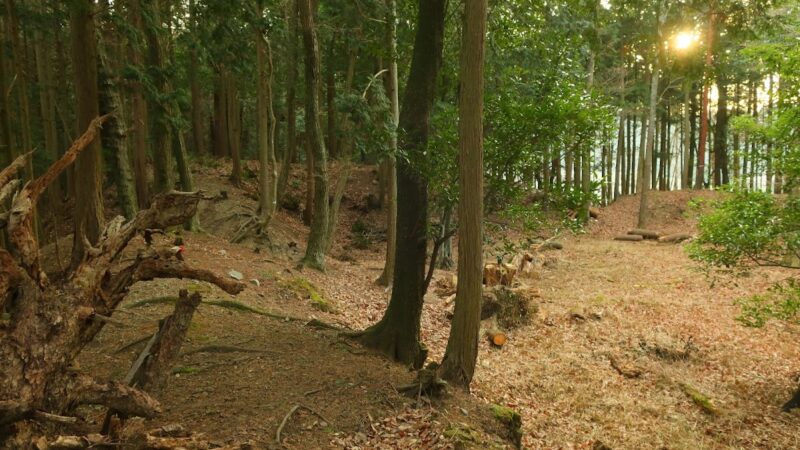
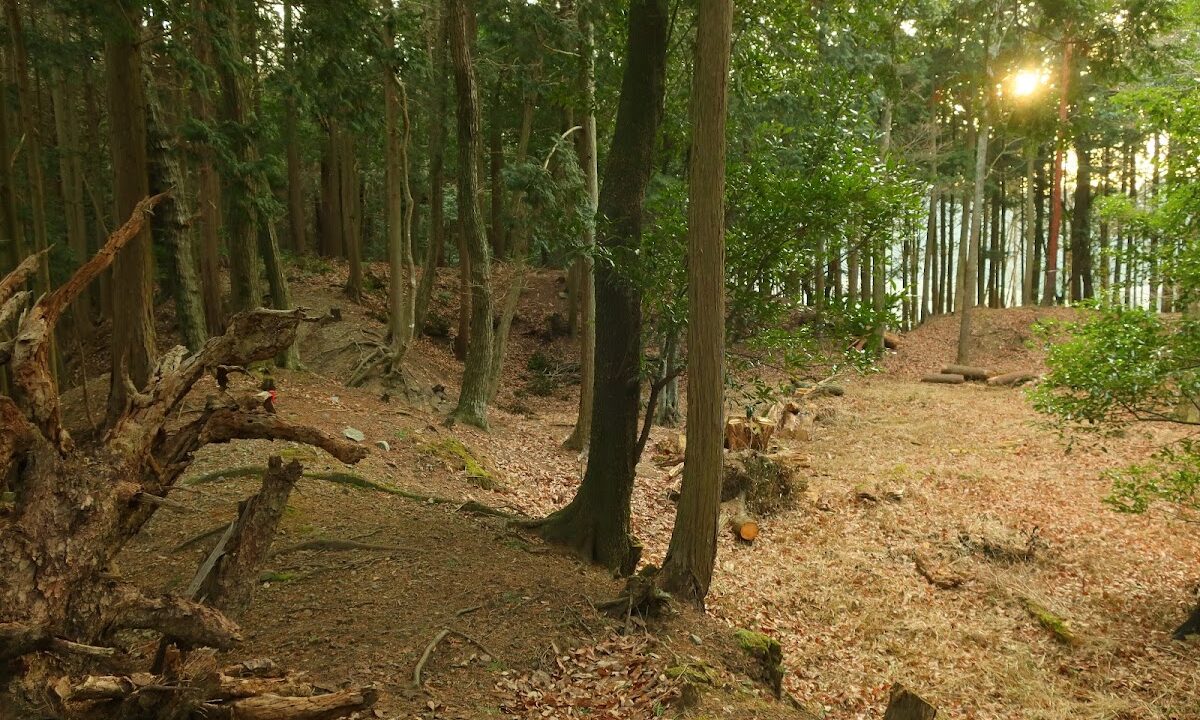
The earthworks surrounded the main enclosure, reaching a maximum height of approximately 2 meters. It is presumed that fences or walls were built on top of the earthworks, further enhancing its defensive capabilities.
Entrance and Ascent Route
The entrance to the castle, the “koguchi” (gate), was located on the south side of the main enclosure. This entrance was not a simple opening, but rather a “staggered koguchi” structure with staggered earthworks to prevent direct enemy advances.
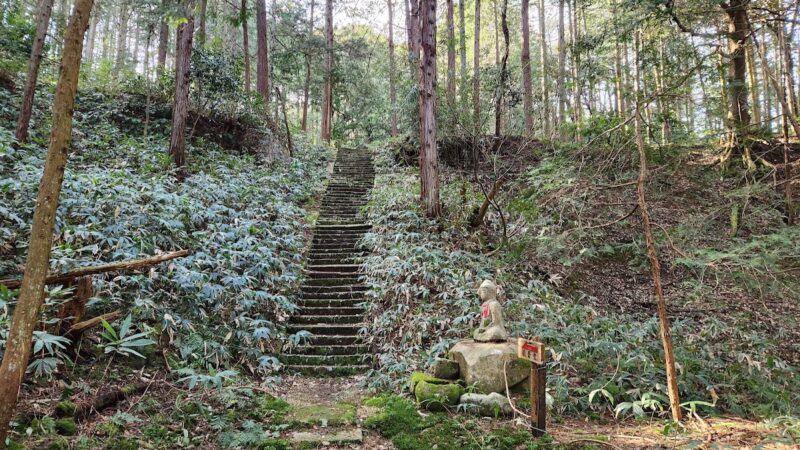
It is believed that an ascent route existed from the foot of the mountain, through the enclosures, to the main enclosure, but clear remains are difficult to identify today.
Highlights and Remains of Tsuchiyama Castle
Main Enclosure Ruins
The greatest highlight of Tsuchiyama Castle is the well-preserved remains of the main enclosure. The enclosure maintains a relatively flat terrain, allowing visitors to imagine the buildings that once stood there. From the main enclosure, one can overlook the Tsuchiyama-juku area and the Tokaido road, appreciating the castle’s excellent location.
The earthen ramparts surrounding the main enclosure are also well-preserved, making them valuable remains for observing the defensive structure of a medieval mountain castle up close. By observing the height, width, and construction method of the ramparts, one can learn about the castle-building techniques of the time.
Moat
The moat on the north side of the main enclosure is one of the most impressive remains of Tsuchiyama Castle. The deeply excavated moat was a crucial defensive feature of the mountain castle, and its sheer size is astonishing. Standing at the bottom of the moat and looking up, one can appreciate the height of the cliffs on both sides, understanding the effectiveness of this defensive structure.
Enclosures
The enclosures surrounding the main enclosure are also a highlight. Each enclosure is skillfully positioned according to the terrain, demonstrating ingenuity in maximizing the limited space on the mountaintop. Observing the elevation differences and arrangement between the enclosures allows for an understanding of the castle’s overall defensive plan.
Views
The views from the Tsuchiyama Castle ruins are another attraction. On a clear day, you can see the town of Tsuchiyama and the Tokaido road below, and the Suzuka Mountains in the distance. This view speaks to Tsuchiyama Castle’s importance as a strategic point for monitoring important transportation routes.
How to Access Tsuchiyama Castle
Access by Public Transportation
By Train and Bus:
- Get off at “Kibukawa Station” on the JR Kusatsu Line
- Take the Koka City Community Bus
- Get off at the “Omi-Tsuchiyama” bus stop
- From the bus stop, it’s about a 9-minute walk to the Tsuchiyama Castle Ruins trailhead
- From the trailhead, it’s about a 15-20 minute walk to the main enclosure
Since the number of Koka City Community Bus services is limited, we recommend checking the timetable in advance. You can check the bus timetable and route map on the Koka City official website.
Access by Car
If traveling by car:
- Approximately 5 minutes from the Koga-Tsuchiyama Interchange on the Shin-Meishin Expressway
- Head towards the Kita-Tsuchiyama area of Tsuchiyama-cho along National Route 1
- Set your car navigation system to “1352 Kita-Tsuchiyama, Tsuchiyama-cho, Koka City, Shiga Prefecture” or “Tsuchiyama Regional Community Center”
Parking Information:
There is no dedicated parking lot for Tsuchiyama Castle Ruins, but you may be able to use the parking lots of the nearby Tsuchiyama Regional Community Center or other public facilities. However, if you do not intend to use these facilities, it is recommended to check with them in advance.
There may be some space for roadside parking near the trailhead, but please be careful not to obstruct other traffic.
Precautions When Visiting the Castle
Tsuchiyama Castle Ruins are a mountain castle, and the following points should be noted when visiting:
- Clothing: Comfortable walking shoes, long-sleeved shirt and long pants are recommended (to protect against vegetation and insects)
- Items to Bring: Drinking water, towel, insect repellent, map or smartphone
- Season: Be aware of the heat and insects in summer; there is a possibility of snow in winter
- Estimated Time: Expect approximately 1-1.5 hours from ascent to descent and sightseeing
- Solo Visit: It is recommended to visit in groups if possible.
Some parts of the climbing path are not well-maintained, so it is important to proceed carefully and pay attention to your footing.
Tsuchiyama Castle Visiting Information
Visiting Hours and Fees
Tsuchiyama Castle Ruins are always open, and there are no time restrictions for visiting. Admission is also free. However, as it is a mountain castle, visiting during daylight hours (sunrise to sunset) is strongly recommended.
Estimated Visiting Time
The general estimated visiting time is as follows:
- From the entrance to the castle path to the main enclosure: Approximately 15-20 minutes
- Visiting the main enclosure and surrounding baileys: Approximately 20-30 minutes
- Descending the mountain: Approximately 15 minutes
- Total: Approximately 50 minutes to 1 hour 15 minutes
If you want to carefully observe the remains or enjoy taking photographs, it is recommended to allow 1.5 to 2 hours.
Castle Stamp Information
Castle stamps for Tsuchiyama Castle may be available at some sales locations. Castle stamps have become popular items in recent years due to the castle boom, and the number of enthusiasts collecting them as souvenirs of their visits is increasing.
For information on Tsuchiyama Castle stamps, we recommend checking with tourist information centers in Koka City or the Tsuchiyama Regional Community Center. Availability and prices may change, so it is best to inquire in advance.
Guides and Information Boards
Information boards explaining the history and structure of the castle are installed at the Tsuchiyama Castle ruins. Referring to these information boards while visiting will allow you to understand Tsuchiyama Castle more deeply.
Also, Koka City sometimes offers historical guided tours depending on the season. Touring with a professional guide allows you to learn about the unique features of the ruins and the historical background that you might not notice on your own. For information on guided tour schedules, it’s best to inquire with the Koka City Tourism Association.
Tourist Attractions Around Tsuchiyama Castle
When visiting Tsuchiyama Castle, exploring the surrounding tourist attractions will make your trip even more fulfilling.
Michi-no-Eki Aino Tsuchiyama
Michi-no-Eki Aino Tsuchiyama is a facility that showcases the charm of Tsuchiyama, known as the 49th post town on the Tokaido road. It offers a variety of local specialties unique to Tsuchiyama, the largest tea producing area in Shiga Prefecture, where you can purchase fresh local agricultural products and processed goods.
The restaurant serves dishes using Tsuchiyama tea and local gourmet food, making it an ideal rest stop. It’s about a 5-minute drive from Tsuchiyama Castle.
Tokaido Tenma-kan (Tsuchiyama-juku Honjin Site)
The Tokaido Tenma-kan is a museum that tells the history of Tsuchiyama-juku, a post town during the Edo period. It features a reconstructed wholesale market and exhibits related to the highway and post towns, allowing visitors to learn about the lives of people who traveled the Tokaido.
A local products sales corner and a hands-on workshop are also located on the premises, allowing visitors to experience Tsuchiyama’s traditional culture. Learning about Tsuchiyama’s history as a post town, along with the history of Tsuchiyama Castle, allows for a deeper understanding of the region’s multifaceted history.
Tamura Shrine
Tamura Shrine is a shrine dedicated to Sakanoue no Tamuramaro and is known as a shrine for warding off evil. Sakanoue no Tamuramaro was a military commander in the early Heian period who played an active role in the subjugation of the Emishi people in the Tohoku region.
Many legends related to Tamuramaro remain in the Tsuchiyama area, and Tamura Shrine is the center of this faith. The shrine grounds are enveloped in a tranquil atmosphere, allowing visitors to enjoy a historical stroll while paying their respects. ### Suzuka Pass
To the east of Tsuchiyama Town lies Suzuka Pass, known as a difficult section of the Tokaido Road. Located on the border between Omi and Ise Provinces, it has played an important role as a transportation hub since ancient times.
Intriguing folktales, such as the legend of the “Mysterious Mirror Rock,” are passed down at Suzuka Pass. Walking along the pass allows you to relive the journey along the Tokaido Road experienced by travelers in the Edo period.
Koga Ninja Village
Koga is famous as a ninja village. Koga Ninja Village offers exhibits and hands-on programs related to ninjas, making it a tourist spot enjoyable for families.
You can experience various activities such as shuriken throwing and wearing ninja costumes, learning about the history and culture of Koga ninjas. It is approximately a 20-minute drive from Tsuchiyama Castle.
The History of Tsuchiyama Castle and the Koga Region
The Fifty-Three Families of Koga and Local Samurai Culture
Understanding Tsuchiyama Castle is essential to understanding the existence of the “Fifty-Three Families of Koga,” a unique group of local samurai in the Koga region. These 53 powerful local samurai families within Koga County cooperated with each other to govern their region.
The Tsuchiyama clan was also a member of these Fifty-Three Families, protecting their territory while maintaining cooperative relationships with other Koga groups. In the Koga region, instead of being ruled by a single powerful lord, a unique social structure was formed where multiple local samurai coexisted while maintaining horizontal connections.
This local samurai culture also formed the basis for the later “Koga Ninja,” who would play an active role in the Sengoku period as a group skilled in information gathering and espionage.
The Tokaido Road and Tsuchiyama Post Town
Tsuchiyama developed as an important post town on the Tokaido Road. Tsuchiyama-juku, the 49th post town on the Tokaido highway, was a bustling hub on the road connecting Kyoto and Edo, attracting many travelers.
In particular, the Suzuka Pass, known for its difficulty, lay east of Tsuchiyama-juku, and the town flourished as a resting place for travelers before and after crossing the pass. Tsuchiyama Castle, overlooking the Tokaido highway, is thought to have played a crucial role in monitoring and controlling traffic.
Oda Nobunaga and Koga
During the Sengoku period, Oda Nobunaga expanded his influence into the Koga region in his quest for national unification. Nobunaga valued the military strength of the Koga people and sought to incorporate them into his ranks.
On the other hand, some Koga people resisted Nobunaga, and Tsuchiyama Castle was one such example. The attack by Takigawa Kazumasu in 1582 is thought to have been part of Nobunaga’s expansion of control over Koga. After Nobunaga’s death in the Honnoji Incident, the Koga region was once again embroiled in complex political situations. ## Recommended Itinerary for Visiting Tsuchiyama Castle
This is a recommended itinerary for efficiently visiting Tsuchiyama Castle and its surrounding area.
Half-Day Course (Approx. 4 Hours)
Morning:
- 9:00 Arrive at Aino Tsuchiyama Roadside Station, park
- 9:15 Visit the Tokaido Tenma-kan (approx. 45 minutes)
- 10:00 Move to Tsuchiyama Castle Ruins
- 10:15 Climb and tour Tsuchiyama Castle (approx. 1.5 hours)
- 11:45 Descend
Lunch:
- 12:00 Lunch at Aino Tsuchiyama Roadside Station (approx. 1 hour)
Afternoon:
- 13:00 Visit Tamura Shrine (approx. 30 minutes)
- 13:30 Depart
Full-Day Course (Approx. 7 Hours)
Morning:
- 9:00 Arrive at Aino Tsuchiyama Roadside Station
- 9:15 Visit the Tokaido Tenma-kan
- 10:00 Climb and tour Tsuchiyama Castle Ruins
- 11:45 Descent
Lunch:
- 12:00 Lunch at Michi-no-Eki Aino Tsuchiyama
Afternoon:
- 13:30 Visit to Tamura Shrine
- 14:00 Stroll around Suzuka Pass (approx. 1 hour)
- 15:00 Travel to Koga no Sato Ninja Village (approx. 20 minutes)
- 15:30 Visit and experience at the Ninja Village (approx. 1.5 hours)
- 17:00 Departure
This course allows you to comprehensively enjoy the history, culture, and nature of Tsuchiyama, centered around Tsuchiyama Castle.
Tsuchiyama Castle Photo Spots
Tsuchiyama Castle ruins are also suitable spots for photography. Here are some recommended points for taking castle photos.
Main Enclosure Earthworks
The earthworks surrounding the main enclosure are well-preserved and make excellent subjects for conveying the atmosphere of a medieval mountain castle. Taking photos from angles that emphasize the curves and height of the earthworks will result in powerful images.
Utilizing the slanted light of early morning or evening will accentuate the three-dimensional effect of the earthworks, resulting in impressive photographs.
Moat
The deeply excavated moat is the most impressive structure of Tsuchiyama Castle. Recommended angles include looking up from the bottom of the moat or capturing it from the side to emphasize its depth.
Using a wide-angle lens will more effectively convey the scale of the moat.
View
The view from the main enclosure is also a great photo opportunity. You can capture photographs that convey the atmosphere of the castle ruins with the townscape of Tsuchiyama, the Tokaido road, and the distant mountains in the background.
On clear days, the contrast between the blue sky and the green mountains is beautiful, and you can enjoy different expressions depending on the season.
Information Board and Ruins
Photographing the information board and ruins together at the castle site enhances the value of the photograph as a record. Taking photos so that the information on the information board is legible will be helpful when reviewing the photos later.
What to Wear and What to Bring When Visiting Tsuchiyama Castle
This guide summarizes what to wear and what to bring to comfortably visit Tsuchiyama Castle, a mountain castle.
Clothing
- Shoes: Trekking shoes or athletic shoes (with non-slip soles)
- Clothing: Comfortable long-sleeved shirt and long pants (to prevent abrasions from vegetation and insect bites)
- Hat: Protect your head from the sun and branches
- Seasonal Outerwear: The mountaintop is cooler than the lowlands, so wear clothing that can be adjusted to your temperature.
Items to Bring
- Drinking Water: Bring plenty, especially in summer.
- Towel: For wiping sweat.
- Insect Repellent Spray: Essential from spring to autumn.
- Map or Smartphone: A GPS app is convenient.
- Camera: For recording the ruins.
- Work Gloves: Useful for putting your hands down on steep slopes.
- First Aid Kit: Basic items such as bandages and disinfectant.
- Garbage Bag: Always take your own trash home.
Seasonal Precautions
Spring (March-May):
- The mild weather makes it the perfect season for visiting the castle.
- The fresh greenery is beautiful, making it ideal for photography.
- Insects begin to increase, so take precautions against them.
Summer (June-August):
- Heat protection and sufficient hydration are essential.
- Insect repellent spray and long-sleeved shirts and long pants are recommended due to the abundance of insects.
- Visiting the castle in the cooler hours of early morning or evening is recommended.
Autumn (September-November):
- The autumn foliage is beautiful, making it the perfect season for visiting the castle.
- Bring a jacket as temperatures drop.
- Be careful as fallen leaves can make the ground slippery.
Winter (December-February):
- Check the weather beforehand as there is a possibility of snow.
- Take thorough precautions against the cold.
- Visit the castle earlier as the sun sets early.
Historical Value and Future Preservation of Tsuchiyama Castle
Tsuchiyama Castle holds significant historical value as a medieval mountain castle in the Koga region.
Academic Value
The remains of Tsuchiyama Castle are invaluable resources for studying the construction techniques and layouts of medieval mountain castles. In particular, the well-preserved defensive structures such as earthworks and moats are highly valued in castle research.
Furthermore, as the residence of the local samurai clan, the Tsuchiyama clan, it is an important historical site for understanding the regional society and political structure of the Koka region.
Preservation Activities
Currently, Tsuchiyama Castle is being preserved by local volunteers and history enthusiasts. The castle site is being protected through steady activities such as mowing and maintaining the remains.
The city of Koka also recognizes its value as a cultural property and is working to increase awareness of Tsuchiyama Castle through the installation of information boards and dissemination of information.
Future Challenges
There are several challenges in preserving and utilizing Tsuchiyama Castle:
- Deterioration of Remains: The remains are gradually deteriorating due to natural erosion and vegetation.
- Improved Access: Improvement of the climbing route and enhanced signage are needed.
- Information Dissemination: Public relations activities to let more people know about the charm of Tsuchiyama Castle.
- Collaboration with the Community: Building a cooperative system with local residents and the tourism industry.
It is important for the government, local residents, and castle enthusiasts to work together to address these challenges.
Frequently Asked Questions about Tsuchiyama Castle
Q: Can beginners climb Tsuchiyama Castle?
A: Yes, it is possible. While there are some steep sections on the climbing route, it is manageable with average physical fitness. However, comfortable shoes and clothing are essential.
Q: Is a reservation required to visit Tsuchiyama Castle?
A: No, a reservation is not required. Tsuchiyama Castle Ruins are always open to the public and can be freely visited.
Q: Is there parking at Tsuchiyama Castle Ruins?
A: There is no dedicated parking lot, but you may be able to use the parking lots of nearby public facilities. We recommend checking in advance.
Q: Can I visit even if it rains?
A: Visiting is possible, but it is not recommended as the ground can become slippery. We recommend choosing a sunny or cloudy day.
Q: Can I get a castle stamp at Tsuchiyama Castle?
A: The availability of castle stamps varies, so we recommend checking in advance at the tourist information center in Koka City or the Tsuchiyama Regional Community Center.
Q: Is it okay to bring children?
A: It is fine for children in upper elementary school or older. However, there are steep slopes, so parents need to pay close attention.
Q: How long does it take to visit Tsuchiyama Castle?
A: It takes approximately 1 to 1.5 hours from climbing up to the castle, visiting, and descending. If you plan to explore thoroughly, allow about two hours.
Q: Are there any places to eat nearby?
A: There is a restaurant at the Aino Tsuchiyama roadside station where you can enjoy dishes made with local ingredients. There are also restaurants along National Route 1.
Summary
Tsuchiyama Castle is a medieval mountain castle located in Tsuchiyama-cho, Koka City, Shiga Prefecture. It flourished as the residence of the Tsuchiyama clan, one of the 53 prominent families of Koka. Built during the Bunmei era, it functioned as an important base protecting a strategic point on the Tokaido road until its fall to Takigawa Kazumasu in 1582.
Even today, the remains of the main enclosure, earthworks, and moats are well-preserved, making it a valuable historical site for learning about the structure of medieval mountain castles. The view from Tsuchiyama Castle is magnificent, offering panoramic views of the town of Tsuchiyama and the Tokaido road below.
While public transportation is available, a car is more convenient. For the climb to Tsuchiyama Castle, comfortable shoes and clothing are essential, and you should expect the visit to take approximately 1 to 1.5 hours.
Around Tsuchiyama Castle, there are many attractive tourist spots, including the Aino Tsuchiyama Roadside Station, the Tokaido Tenma Museum, and Tamura Shrine. Combining these attractions allows you to enjoy the history and culture of Tsuchiyama comprehensively.
For those interested in the history of the Koka region, mountain castle enthusiasts, and those who want to take castle photographs, Tsuchiyama Castle is a historical site well worth visiting. Why not visit Tsuchiyama Castle and reflect on the Koka region in the Middle Ages?