Complete Guide to the History and Highlights of Igamine Castle (Omura City, Nagasaki Prefecture) | Visiting the Remains of a Sengoku Period Mountain Castle
What is Igamine Castle?
Igamine Castle (Igamine-jo) is a Sengoku period mountain castle located in Mizoriku-cho, Omura City, Nagasaki Prefecture. Also known as “Ika-mine Castle,” it is known as a typical Hizen region mountain castle built on a mountaintop at an altitude of 115m. Even today, the remains such as stone walls, earthworks, baileys, and moats are well-preserved, making it one of the castle ruins attracting attention from castle enthusiasts and history lovers.
Omura City, Nagasaki Prefecture, is located almost in the center of Nagasaki Prefecture, facing Omura Bay, and flourished as the base of the Omura clan during the Sengoku period. Igamine Castle, as one of the branch castles built within the Omura clan’s sphere of influence, played an important role in the Omura clan’s rule of their territory.
Basic Information about the Castle
- Location: Mizoriku-cho, Omura City, Nagasaki Prefecture
- Castle Structure: Mountain Castle
- Elevation: 115m
- Relative Height: Approximately 110m
- Construction Period: Sengoku Period (Warring States Period)
- Main Remains: Stone walls, earthworks, baileys, moats
- Other Names: Ika-mine Castle
History of Iga-mine Castle
Background of Construction and the Omura Clan in the Sengoku Period
During the Sengoku period, when Iga-mine Castle was built, Hizen Province (present-day Nagasaki and Saga Prefectures) was a turbulent era where local lords such as the Ryuzoji, Arima, and Omura clans competed for power. The Omura clan was a powerful family that established its influence around Omura Bay. During the time of Omura Sumitada, also known as a Christian daimyo, they left their mark on history as Japan’s first Christian daimyo.
Iga-mine Castle is believed to have been built as one of the Omura clan’s bases for governing their territory. Its mountainous location provided a defensive advantage against enemy invasions, while also serving as an important base for monitoring and controlling the surrounding area.
Relationship between the Omura Clan and Surrounding Forces
During the Sengoku period in the Hizen region, the Omura clan repeatedly engaged in complex alliances and conflicts with powerful daimyo such as the Ryuzoji and Arima clans. Especially during the period when Ryuzoji Takanobu expanded his power, the Omura clan was sometimes under the influence of the Ryuzoji clan.
Iga-mine Castle is presumed to have played a vital role in the Omura clan’s defenses amidst these tense Sengoku-era relationships. Within Omura City, several castles were built, including Kushima Castle, Mitsushiro Castle, and Kobu Castle, and these castles worked together to protect the Omura clan’s territory.
Changes Since the Edo Period
During the Edo period, the Omura clan was incorporated into the shogunate system as the Omura Domain, and Kushima Castle was developed as the domain’s administrative center. The first lord, Omura Yoshiaki, built Kushima Castle, and it remained the political center of the Omura Domain for over 270 years, until the 12th lord, Sumihiro.
During this process, mountain castles like Igamine Castle lost their military role and were likely abandoned. However, the castle’s remains were preserved in remarkably good condition by being left untouched, and remain so to this day.
Structure and Layout of Igamine Castle
Characteristics as a Mountain Castle
Igamine Castle is a typical mountain castle built on a mountaintop at an altitude of 115m and a relative height of approximately 110m. Mountain castles had the advantage of higher defensive capabilities and being easier to defend with fewer troops compared to castles on flat land. Igamine Castle also features a layout that skillfully utilizes the steep terrain. The structure of mountain castles generally consists of a central enclosure (shukaku) surrounded by multiple smaller enclosures (kuruma) arranged in a stepped pattern. Iga-mine Castle also exhibits this typical structure, with the main enclosure located at the mountaintop and multiple smaller enclosures surrounding it.
Stone Walls and Stone Masonry Techniques
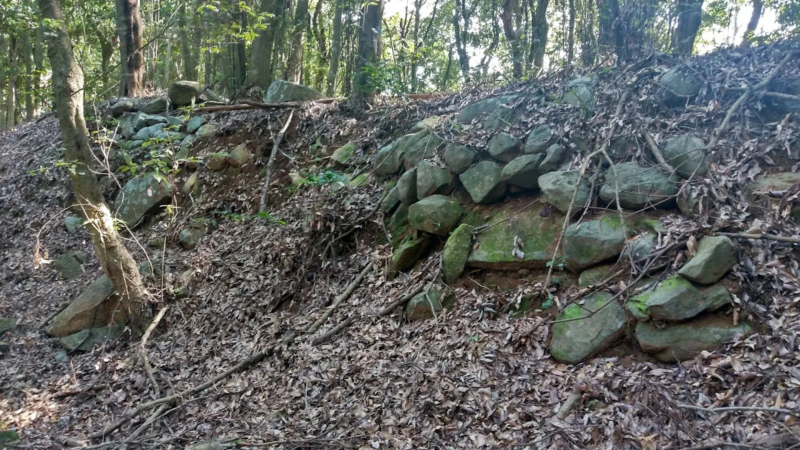
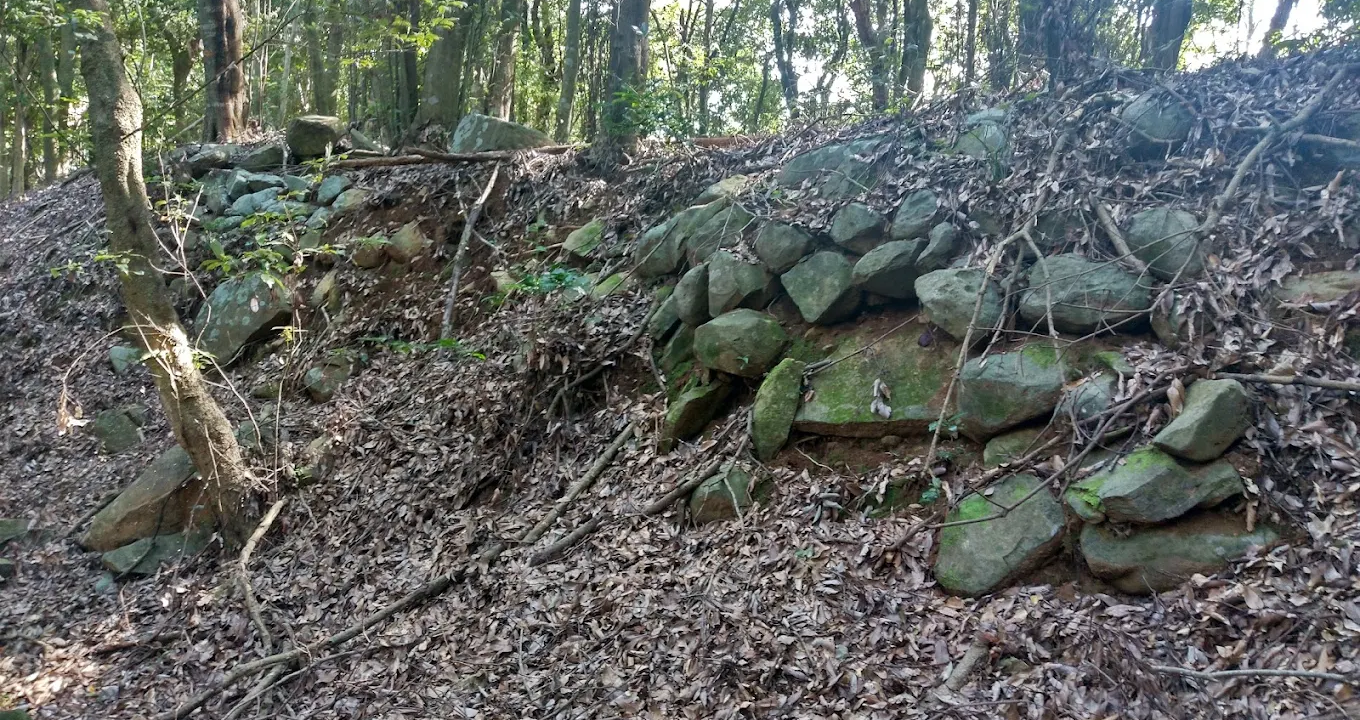
One of the highlights of Iga-mine Castle is its existing stone walls. While the stone walls of mountain castles from the Sengoku period (Warring States period) were not as sophisticated as those of later early modern castles, examples of rough-hewn stone walls (nozurazumi) can be seen.
These stone masonry structures not only enhanced the castle’s defenses but also served to construct the enclosures and retain the earth. The scale and technique of the stone walls indicate that Iga-mine Castle was not merely a fort, but a castle with a certain scale and function.
Earthworks and Moats
Along with the stone walls, Iga-mine Castle also retains the remains of earthworks and moats. Earthen ramparts are defensive structures built by piling up earth, serving to prevent enemy intrusion and clearly defining the boundaries of the castle’s enclosures.
Moats were important defensive structures built between enclosures and around the outer perimeter of the castle, hindering enemy advances. In the case of mountain castles, dry moats (karabori) were common, rather than water-filled moats like those found in castles on flat ground, and remains of dry moats have been confirmed at Iga-mine Castle.
Arrangement and Function of Enclosures
The enclosures of Iga-mine Castle are arranged around the main enclosure at the mountaintop, with multiple terraced enclosures. The main enclosure was the central location where the lord and commanders were stationed, and was built to be the most heavily fortified. The surrounding enclosures are thought to have housed soldier garrisons, storage areas for supplies, and various facilities supporting the castle’s functions.
The arrangement of the enclosures cleverly utilizes the terrain, limiting enemy intrusion routes and creating a structure that is easy to defend. Such a layout demonstrates the high level of castle-building technology during the Sengoku period.
Highlights of Iga-mine Castle
Preservation of the Remains
The greatest appeal of Iga-mine Castle is the remarkably well-preserved remains of this Sengoku period mountain castle. Major remains such as stone walls, earthworks, baileys, and moats still exist, allowing visitors to imagine the castle’s appearance at the time.
The stone walls, in particular, are a valuable example of the nozurazumi technique using natural stones, allowing for close observation. Furthermore, the height of the earthworks and the depth of the moats demonstrate the castle’s strong defensive capabilities.
View from the Main Bailey
From the main bailey, located on a mountaintop at an altitude of 115m, you can enjoy a panoramic view of Omura city and Omura Bay. This view is not only beautiful, but also speaks to how important this castle was as a base for monitoring and controlling the surrounding area during the Sengoku period.
On a clear day, you can even see the Nagasaki Peninsula across Omura Bay, experiencing the geographical expanse of the Hizen region.
Information Boards and Guides
Information boards are installed at the castle ruins, allowing visitors to learn about the history and structure of Iga-mine Castle. The boards include a map of the castle’s layout and historical background, making it easier for first-time visitors to understand the castle.
Ascent Route and Walking
The ascent route to Iga-mine Castle involves climbing a mountain path. The visit takes approximately 30 minutes, allowing you to see the main remains of the castle in a relatively short time. However, there are steep slopes typical of mountain castles, so comfortable shoes and clothing are recommended.
While walking the ascent route, observing the layout of the baileys and the structure of the moats allows you to appreciate the castle-building techniques and defensive ingenuity of the Sengoku period.
Access and Visiting Guide
Location and Map
Iga-mine Castle is located in Mizoriku-cho, Omura City, Nagasaki Prefecture. It is relatively close to the city center of Omura, making it easily accessible.
Access
Access by Car
- Approximately 15 minutes from the Omura Interchange on the Nagasaki Expressway
- Approximately 20 minutes by car from Nagasaki Airport
- Please check parking availability in advance.
Access by Public Transportation
- Take a taxi or bus from Omura Station on the JR Omura Line
- Approximately 10 minutes by car from Omura Station to the castle ruins
Precautions for Visiting
- As it is a mountain castle, please wear comfortable shoes and clothing.
- In the summer, it is recommended to bring insect repellent and a hat.
- Be careful as the ground can be slippery during and after rain.
- As the castle ruins are a historical site, please be considerate and do not damage the remains.
- Please take all your trash with you.
Estimated Visiting Time
Please allow approximately 30 minutes to 1 hour for visiting the castle ruins. If you wish to carefully observe the remains or enjoy taking photographs, it is advisable to allow a little more time.
Nearby Tourist Attractions
Kushima Castle Ruins (Omura Park)
Located approximately 6.6 km from Igamine Castle, Kushima Castle Ruins was used as the administrative center of the Omura Domain and is now maintained as Omura Park. It has been selected as one of “Japan’s Top 100 Cherry Blossom Viewing Spots,” and in spring, a total of 2000 cherry trees bloom.
In particular, the “Omura Cherry Blossom,” a nationally designated natural monument, is famous for its rare blossoms, with 60 to as many as 200 petals. Many tourists visit not only during cherry blossom season but also during iris season.
Sanjo Castle
Located in Omura City, Nagasaki Prefecture, Sanjo Castle is approximately 7.8 km from Igamine Castle. As one of the castles associated with the Omura clan, visiting both together provides a comprehensive understanding of the Omura clan’s rule over their territory.
Isahaya Castle and Owadani Castle
In the neighboring city of Isahaya, there are castle ruins such as Isahaya Castle (approx. 4.0 km) and Owadani Castle (approx. 3.8 km). These castles are also important historical sites for understanding the Sengoku period in the Hizen region.
Yoshitake Castle
Yoshitake Castle, located in Omura City, is approximately 7.7 km from Igamine Castle. As one of the Omura clan’s branch castles, it played a similar role to Igamine Castle.
Nagasaki Airport
Nagasaki Airport, the world’s first full-fledged offshore airport, is located in Omura City. There are observation decks and commercial facilities around the airport, allowing visitors to watch planes taking off and landing up close.
History and Culture of Omura City
Christian Daimyo Omura Sumitada
Omura Sumitada, known as a Christian daimyo, is indispensable when discussing the history of Omura City. In 1563 (Eiroku 6), Sumitada was baptized by the Jesuit missionary Cosme de Torres, becoming Japan’s first Christian daimyo (feudal lord).
Sumitada actively supported the spread of Christianity within his domain and, in 1580, dispatched the Tenshō Embassy to Europe. This embassy, centered around four boys—Ito Mansho, Chijiwa Miguel, Nakaura Julian, and Hara Martino—is historically significant as the first official Japanese mission sent to Europe.
Establishment and Development of the Ōmura Domain
During the Edo period, the Ōmura clan was incorporated into the shogunate system as the Ōmura Domain. The first lord, Ōmura Yoshiaki, built Kushima Castle and developed the castle town. Although the Ōmura Domain was a small domain with a yield of just over 28,000 koku, the Ōmura clan ruled for over 270 years and remained in power until the Meiji Restoration without being dispossessed.
The Omura Domain also played a crucial role in guarding Nagasaki, contributing significantly to the shogunate’s isolationist policy. Furthermore, its domain school, the Gokyokan, provided education centered on Confucianism, producing many talented individuals.
Omura City in the Modern Era
After the Meiji Restoration, Omura City continued to develop as part of Nagasaki Prefecture. The opening of Nagasaki Airport, in particular, greatly contributed to Omura City’s development. Today, it is known as a transportation hub located almost in the center of Nagasaki Prefecture, and as a tourist destination with rich nature and historical culture.
The Significance of Visiting Iga-mine Castle
Experiencing a Sengoku Period Mountain Castle
Iga-mine Castle is a valuable historical site that conveys the appearance of a Sengoku period mountain castle to the present day. By actually seeing the remains such as stone walls, earthworks, baileys, and moats, you can experience the castle construction techniques and defensive ingenuity of the time.
For castle enthusiasts and history buffs, it is an excellent opportunity to learn about the characteristics of Sengoku period mountain castles, which differ from early modern castles. Furthermore, the view from the castle ruins allows us to imagine how the feudal lords of the Sengoku period surveyed and governed their territories.
Learning about the History of the Omura Clan
Visiting Iga-mine Castle is an entry point to learning about the history of the Omura clan. The Omura clan was a family that left an important mark on Japanese history as Christian daimyo, and we can understand a part of their territorial rule through Iga-mine Castle.
Visiting Iga-mine Castle in conjunction with other castle ruins in Omura City, such as Kushima Castle, Sanjo Castle, and Yoshitake Castle, will provide a clearer overall picture of the Omura clan’s territorial rule.
Learning about the Sengoku History of the Hizen Region
Iga-mine Castle is also an important historical site for learning about the Sengoku history of the Hizen region. Through the castle ruins, we can gain a concrete understanding of the history of the Hizen region during the Sengoku period, when local lords such as the Ryuzoji, Arima, and Omura clans competed.
Many castle ruins remain in Nagasaki Prefecture, and visiting them will allow you to gain a deeper understanding of the Sengoku period history of northern Kyushu.
Photography Tips
Stone Walls and Earthworks
The stone walls and earthworks of Iga-mine Castle are valuable historical remains that demonstrate the castle-building techniques of the Sengoku period. The stone walls, constructed using the nozura-zumi method (a method of stacking natural stones), change their appearance depending on how the light hits them, so it’s recommended to photograph them at different times of day.
For the earthworks, try experimenting with angles to capture their height and shape.
View from the Main Enclosure
The view from the main enclosure is the most important point for photographing Iga-mine Castle. You can take photos that convey the atmosphere of the castle ruins with Omura city and Omura Bay in the background.
Mornings and evenings on sunny days are particularly suitable times for photography due to the beautiful lighting.
Layout of the Enclosures
Photographing the stepped arrangement of the enclosures visually conveys the structure of the mountain castle. Try to find angles that show the elevation differences between the enclosures and the depth of the moats.
Seasonal Changes
Iga-mine Castle shows different appearances depending on the season. Visiting and photographing the castle in each season—the fresh green of spring, the deep green of summer, the autumn foliage, and the bare trees of winter—is one of the joys of visiting.
How to Enjoy Castle Tours
Recommendation for Pre-Visit Study
Before visiting Igamine Castle, learning about the history of the Omura clan and the Hizen region during the Sengoku period will make your visit to the castle ruins much more fulfilling. Gather information from related books and websites to understand the castle’s historical background.
Utilizing Castle Layout Maps
While there are explanatory signs at the castle ruins, obtaining a castle layout map beforehand will allow you to understand the castle’s structure more deeply. By examining the actual remains while looking at the layout map, the overall picture of the castle becomes clearer.
Visiting Multiple Castles
Visiting not only Igamine Castle but also other castle ruins in Omura City and the surrounding area will provide a more comprehensive understanding of the region’s history. Planning a one-day castle tour route that includes Kushima Castle, Sanjo Castle, and Yoshitake Castle is a good idea.
Keeping Records
Keeping records of your visits to castle ruins, such as photos or a diary, will be helpful when you look back later. Using castle-visiting apps or websites to digitally manage your visit records is also recommended.
Summary
Iga-mine Castle is a Sengoku period mountain castle located in Mizoriku-cho, Omura City, Nagasaki Prefecture. The remains of the castle, including stone walls, earthworks, baileys, and moats, are well-preserved. Built on a mountaintop 115m above sea level, this castle played an important role in the Omura clan’s rule of their territory.
From the castle ruins, you can enjoy a panoramic view of Omura city and Omura Bay, allowing you to experience how the lords of the Sengoku period viewed this land. The visit takes about 30 minutes, making it a relatively easy castle ruin to visit.
Omura City has many historical sites, including Kushima Castle. Visiting Iga-mine Castle along with these will allow you to gain a deeper understanding of the history of the Omura clan and the Sengoku period in the Hizen region.
For those interested in mountain castles from the Sengoku period, those who want to learn about the history of the Omura clan, and those who want to enjoy touring castles in Kyushu, Iga-mine Castle is a must-see historical site. When you visit Nagasaki Prefecture, be sure to stop by Iga-mine Castle.
-680x450.png)