Complete Guide to Namaike Castle (Iki City, Nagasaki Prefecture) | Thorough Explanation of History, Remains, and Access
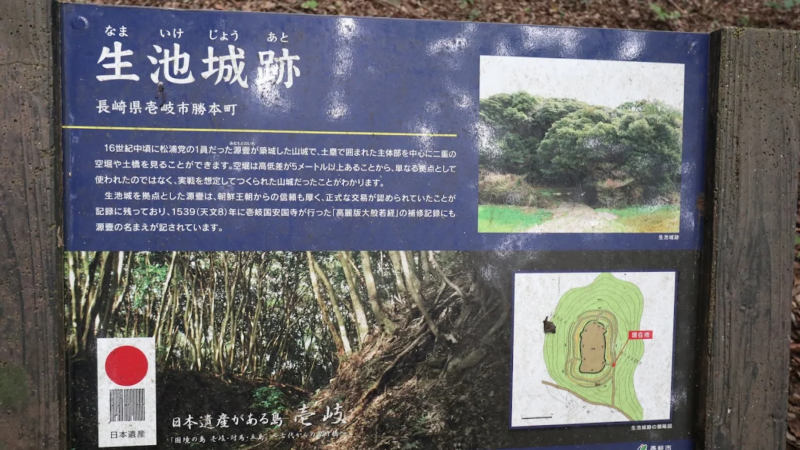
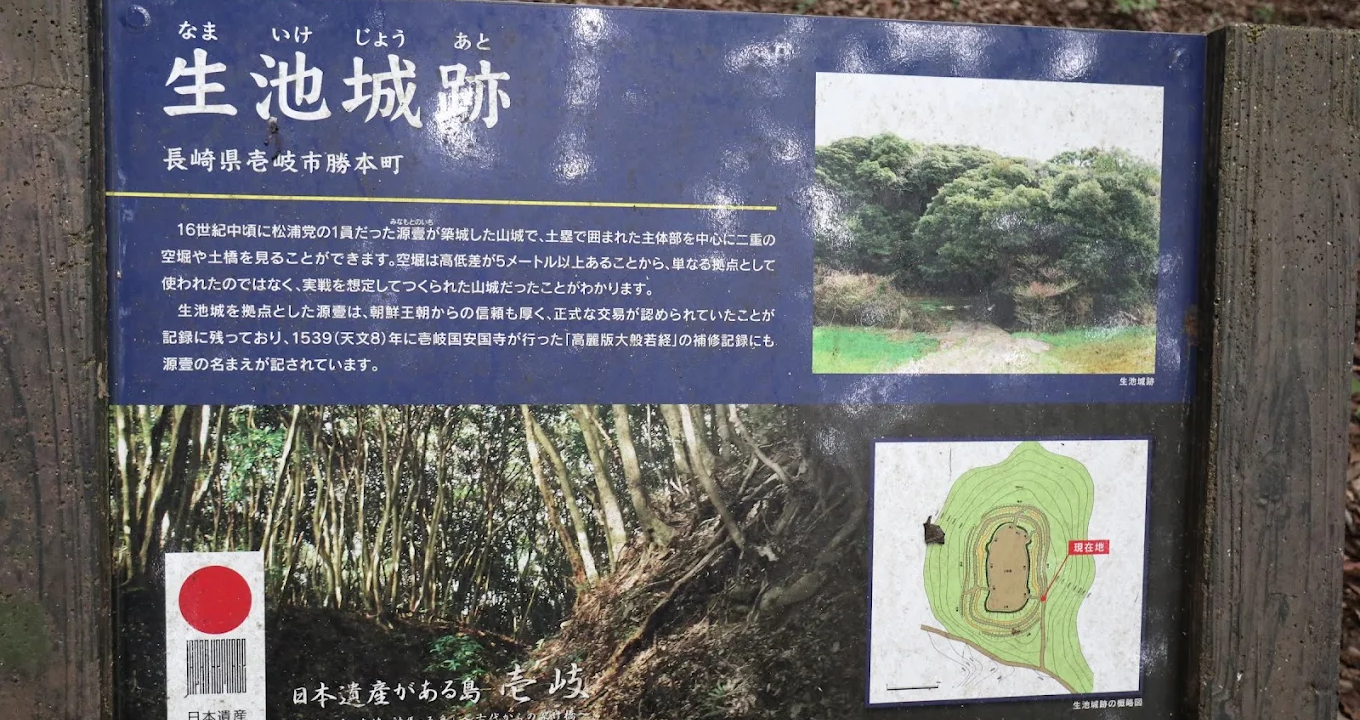
Namaike Castle, located in Yurihata-fure, Katsumoto-cho, Iki City, Nagasaki Prefecture, is a medieval mountain castle remaining on Iki Island in the Genkai Sea. Flourished as the residence of the Matsuura clan’s Honjo family, and deeply involved with Wako pirates, this castle boasts remarkably well-preserved defensive structures such as double dry moats and fortified gates, making it one of the finest examples of medieval castle remains on Iki. This article provides a detailed explanation of this fascinating mountain castle, from its historical background and castle structure to its highlights and access methods.
Basic Information on Namaike Castle
Namaike Castle is a hill castle built on a hill approximately 118 meters above sea level and 40 meters above ground level. It is designated as a historical site by Iki City and is currently located within a group of ancient burial mounds surrounding the “Iki Fudoki no Oka” (Iki Historical Site Hill).
Location: Shiroyama, Yurihata-fure, Katsumoto-cho, Iki City, Nagasaki Prefecture
Castle Type: Hill Castle (Mountain Castle)
Elevation: Approximately 118m
Relative Height: Approximately 40m
Cultural Property Designation: Iki City Designated Historic Site
Major Remains: Earthworks, Dry Moat (Double), Enclosure, Gate, Well, Stone Wall, Stone Masonry
The “Ikeike” pond, from which the castle’s name originates, still exists on the west side of the castle and is presumed to have been an important water source for the castle.
History and Lords of Ikeike Castle
The Honjo Clan of the Matsuura Clan and Ikeike Castle
Ikeike Castle is presumed to have been the residence of the Honjo clan, a branch of the Matsuura Clan. The Matsuura Clan was a samurai group that was active mainly in the Matsuura region of Hizen Province from the late Heian period to the Sengoku period, and extended its influence to Iki Island.
The Activities of Lord Minamoto no Ichi
Regarding Minamoto no Ichi, believed to be the lord of Ikeike Castle, important records remain in the documents found inside the Eleven-Faced Kannon Bodhisattva at Hoonji Temple. According to these documents, it is confirmed that Minamoto no Ichi donated the Kannon Bodhisattva in 1543 (Tenbun 11).
Minamoto no Ichi is believed to have actively engaged in Wokou (Japanese pirate) activities before conducting formal trade with the Korean Dynasty. In the 16th century, pirate groups known as Wokou were active in the East Asian seas, and some of these groups focused primarily on trade. Minamoto no Ichi is thought to have been one such maritime trader, establishing formal trade relations with the Korean Peninsula.
Iki Island and Ikeike Castle in the Sengoku Period
During the Sengoku period, Iki Island was divided among various Matsuura clans. It is presumed that Ikeike Castle was also renovated and expanded by the Honjo clan during this period. In particular, defensive features such as the double dry moats and well-developed gate structures are thought to reflect the castle-building techniques of the Sengoku period.
Ikeike Castle’s Structure and Features
Overall Layout
Ikeike Castle is a castle with a layout based on a circular plan. This circular plan is a common feature of medieval castles on Iki Island, but Ikeike Castle boasts a particularly excellent defensive structure.
Double Dry Moats
The most distinctive feature of Ikeike Castle is the double dry moats surrounding the main keep. This double structure is an effective defensive system that prevents attackers from entering in two stages, making it a standout feature among Iki castles. The dry moats remain well-preserved today, and their depth and scale demonstrate the high level of castle-building technology of the time.
Koguchi (gateway) and flanking fire
At Ikeike Castle, the koguchi (gateway) was well-developed, and the flanking fire technique can also be observed. Flanking fire is a defensive technique that involves creating bends in the castle walls and moats to attack invading enemies from the flanks. This structure allowed for defense not only from the front but also from the sides.
Earthworks and stone walls
Earthworks are well-preserved around the main keep site. Earthworks are defensive walls made by piling up earth, preventing enemy intrusion and also serving as a base for attacks. In addition, stone walls and stone masonry can be seen in some areas, indicating that a defensive structure combining earthworks and stone walls was employed.
Arrangement of baileys (enclosures)
Multiple baileys were arranged within the castle. A bailey is a flat area within the castle where buildings were constructed or soldiers were stationed. Several baileys were arranged in a stepped pattern around the main keep, creating an efficient defensive system. ### Wells and Water Supply
The castle’s name originates from “Ikeike,” a pond located on the west side of the castle. It is believed to have been the castle’s primary water source. Securing water was crucial for mountain castles, and Ikeike was a vital resource during sieges. Furthermore, the remains of wells within the castle grounds indicate that multiple water sources were secured.
Highlights of Ikeike Castle (Castle Notes)
Main Enclosure Site
The main enclosure site is the central part of the castle, where the lord’s residence and important facilities were located. Currently, it is a flat area surrounded by earthen ramparts. From here, you can overlook the scenery of Iki Island and experience the perspective of the castle lord at the time.
The Impressive Double Moat
A must-see when visiting Ikeike Castle is the double moat. The double structure of the inner and outer moats is truly awe-inspiring in its scale and depth when viewed in person. The significant difference in elevation from the bottom of the moat to the top of the earthworks makes this a valuable historical site that allows us to truly appreciate the defensive capabilities of a medieval castle.
Defensive Structure of the Entrance
At the entrance to the castle, the entrance to the castle, we can observe ingenious defensive structures. Instead of simple straight lines, the incorporation of bends and curves makes it difficult for enemies to penetrate. The technique of flanking fire can also be seen, making this a valuable example for learning about castle construction techniques of the Sengoku period.
Combination of Earthworks and Stone Masonry
The earthworks around the main keep are tall and well-preserved. Stone masonry is also used in some areas, allowing us to observe defensive techniques that combine earthworks and stone masonry.
Ikeike Pond (Water Source)
Ikeike Pond, from which the castle derives its name, still exists on the west side of the castle. Securing a water source was extremely important for medieval mountain castles, and this is a place where we can truly appreciate how this pond supported the castle’s functions.
Coexistence with the Iki Fudoki-no-Oka Burial Mounds
Ikeike Castle is located within the burial mounds surrounding the “Iki Fudoki-no-Oka” (Iki Burial Mounds). This area, where Kofun period ruins and medieval castles coexist, is a valuable place to experience Iki’s long history. Visiting the burial mounds in conjunction with exploring the castle ruins will provide a deeper understanding of Iki’s history.
How to Access Ikeike Castle
Access to Iki Island
Iki Island, where Ikeike Castle is located, can be accessed from Fukuoka Prefecture or Nagasaki Prefecture.
High-Speed Boat/Ferry:
- From Hakata Port, Fukuoka City to Gonoura Port, Iki Island: Approximately 1 hour by high-speed boat, approximately 2 hours 20 minutes by ferry.
- From Karatsu East Port, Saga Prefecture to Intoji Port, Iki Island: Approximately 1 hour 40 minutes by ferry.
Airplane:
- From Nagasaki Airport to Iki Airport: Approximately 30 minutes.
Access to Ikeike Castle Ruins
Access by Car:
Ikeike Castle Ruins are located in Yurihata-fure, Katsumoto-cho, Iki City. It’s about a 20-30 minute drive from Gonoura Port or Ashibe Port. While there’s a road leading close, the road is narrow, so it’s recommended to park in a wider area beforehand and access on foot.
Signposts: Signposts are installed along the prefectural road on the south side; you can use them as a guide.
Estimated Time Required: Approximately 10-15 minutes on foot from the parking area to the castle ruins.
Notes for Visitors
- As it is a mountain castle, please wear comfortable shoes and clothing.
- Don’t forget insect repellent during the summer.
- Bringing drinking water is recommended.
- Be careful as the ground can be slippery during and after rain.
- Please do not damage the earthworks or stone walls to protect the remains.
Other Castles and Historical Spots on Iki Island
Nearby Castles
If you visit Ikeike Castle, we recommend visiting other castles on Iki Island as well.
Katsumoto Castle: A castle built during Toyotomi Hideyoshi’s invasion of Korea, with well-preserved stone walls. You can compare the castle construction techniques of a different era with those of Ikeike Castle.
Kameoka Castle: One of Iki’s representative medieval mountain castles, and like Ikeike Castle, it is a castle of the Matsuura clan.
Ushigajo Castle: One of the medieval castles on Iki Island, it boasts a unique layout.
Visiting these castles allows you to understand the evolution of castles on Iki Island from the medieval to the early modern period.
Combining with Iki Island Sightseeing
In addition to visiting Ikeike Castle, you can also enjoy other tourist spots on Iki Island.
Iki Fudoki Hill: Located very close to Ikeike Castle, it features a group of ancient burial mounds and a historical museum.
Iki-no-Kuni Museum: A museum where you can learn about the history of Iki Island from ancient to medieval times.
Saruiwa Rock: A representative natural landscape of Iki Island, famous for its strangely shaped rock resembling a monkey.
Shrine Pilgrimage: Iki Island has over 150 shrines, and it is said that “the entire island is a power spot.”
Gourmet: You can enjoy Iki’s unique cuisine, such as Iki beef, fresh sea urchin, and seafood.
Cultural Value of Ikeike Castle
Ikeike Castle is protected as a historical site designated by Iki City and possesses high historical value in the following respects:
Excellence in Castle Construction Techniques
The defensive facilities, such as the double dry moat, well-developed gate, and flanking fire, are considered particularly outstanding among Iki’s medieval castles. While based on a circular plan, Ikeike Castle incorporated the latest technology of the Sengoku period, making it a prime example of the pinnacle of local powerful families’ castle construction techniques.
History of Maritime Trade
The history of the castle lord, Minamoto no Ichi, who was active as a Wokou (Japanese pirate) and later engaged in formal trade with the Joseon Dynasty, provides valuable information for understanding the realities of trade in the East Asian seas during the 16th century. It is believed that Ikeike Castle was not merely a military facility, but also served as a base for maritime trade.
Preservation of the Remains
Major remains such as earthworks, dry moats, and gatehouses are well-preserved, making it a valuable example for understanding the structure of medieval mountain castles. Visiting the site allows you to experience the three-dimensional structure of the castle, which is difficult to understand from documents alone.
Current Status and Future Challenges of Ikeike Castle Research
Excavation and Research
While layout surveys and documentary research are progressing regarding Ikeike Castle, large-scale excavations are limited. If planned excavations are conducted in the future, it may be possible to obtain more information about the castle’s detailed structure, age, and the life of its lord.
Research on the Honjo Clan and Gen’ichi
Only limited historical materials remain regarding the Honjo clan and Gen’ichi, who are believed to be the castle lords, such as the documents found inside the Hoonji Temple. A future challenge is to clarify their activities in more detail by comparing them with records of the Joseon Dynasty and other documents.
Preservation and Utilization
While the remains of Ikeike Castle are well-preserved, the risk of natural disasters and deterioration over time always exists. Alongside proper preservation and management, utilizing the site as a tourist resource and for educational purposes are also important issues.
Summary
Ikeike Castle in Iki City, Nagasaki Prefecture, is a medieval mountain castle that flourished as the residence of the Honjo clan of the Matsuura clan. It boasts excellent defensive structures such as double dry moats, well-developed gates, and flanking fire, making it a particularly noteworthy example among Iki’s medieval castles.
The castle’s lord, Minamoto no Ichi, is known for his activities as a Wokou (Japanese pirate) and for conducting formal trade with the Joseon Dynasty. It is believed that Ikeike Castle served not only as a military base but also as a hub for maritime trade.
Built on a hill 118 meters above sea level with a relative height of 40 meters, the castle still retains well-preserved remains such as earthworks, dry moats, and gates, making it a valuable historical site for learning about the structure of medieval castles. This area, coexisting with the burial mounds of Iki Fudoki Hill, is a valuable place to experience Iki’s history from ancient to medieval times. When you visit Iki Island, be sure to stop by the ruins of Ikeike Castle and experience the atmosphere of the Sengoku period. This medieval mountain castle on an island floating in the Genkai Sea is sure to provide an unforgettable historical experience.
-680x450.png)