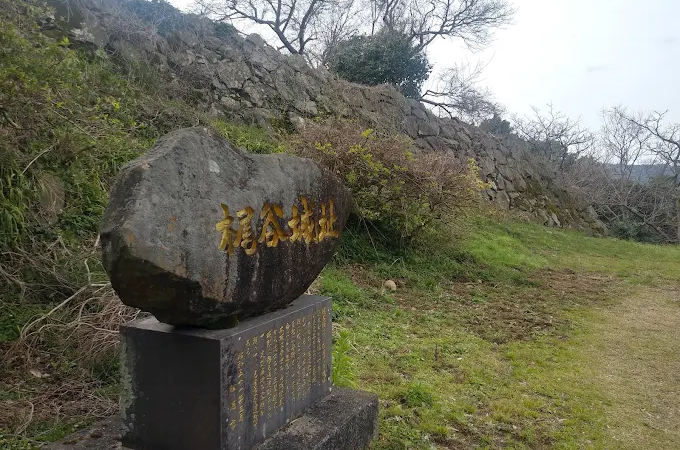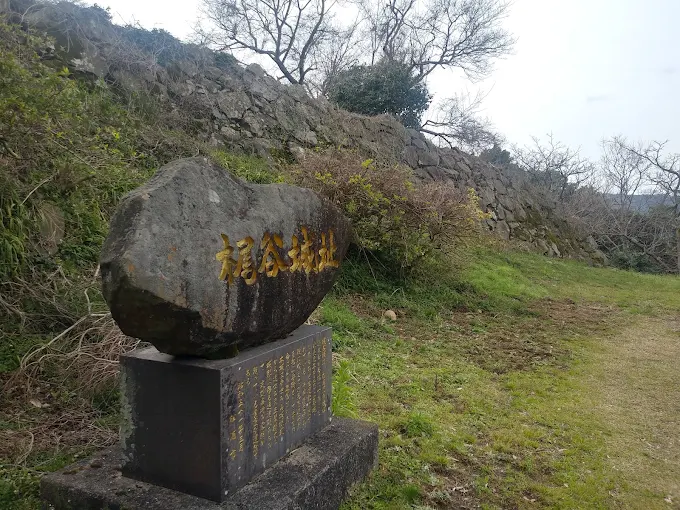
Kajitani Castle (Matsuura City, Nagasaki Prefecture) Complete Guide | The Birthplace of the Matsuura Clan and Highlights of its Stone Wall Remains
Located in Imafuku-cho, Matsuura City, Nagasaki Prefecture, Kajitani Castle is a historical mountain castle that functioned as a base for the Matsuura clan from the late Heian period to the Sengoku period. Built on the summit of Jōyama Mountain (197 meters above sea level), this castle is said to have been constructed by Minamoto no Hisa, considered the ancestor of the Matsuura clan, and played an important role as a center of samurai groups in northern Hizen Province. Even today, the remains such as the baileys, stone walls, and earthworks are well-preserved and protected as a Nagasaki Prefecture designated historical site, “Matsuura Clan Kajitani Castle Ruins.”
History of Kajitani Castle and the Founding of the Matsuura Clan
Minamoto no Hisa’s Arrival and the Birth of the Matsuura Clan
The history of Kajitani Castle dates back to the first year of Enkyū (1069), at the end of the Heian period. Minamoto no Hisa, a descendant of the Saga Minamoto clan, moved from Watanabe Manor in Settsu Province (present-day Osaka Prefecture) to Matsuura District in Hizen Province, where he was appointed Kengyo (inspector) and Kebiishi (police and judicial official) of Uno Mikuriya. Minamoto no Hisa settled in Imafuku, changed his name to Matsuura Hisa, and adopted the title of Taifu Hangan (chief magistrate), governing Matsuura District, parts of Sonogi District, and Iki District.
Under this Matsuura Hisa, a warrior group known as the “Matsuura Party” was formed. The Matsuura Party expanded its influence from northern Hizen Province to Iki Island, developing into a powerful warrior group that controlled key points of maritime traffic from the late Heian period through the Kamakura and Muromachi periods. Kajitani Castle is believed to have been built as the headquarters of this Matsuura Party.
The Role of Kajitani Castle in the Medieval Period
From the Kamakura period to the Muromachi period, Kajitani Castle continued to function as the residence of the Matsuura clan. The Matsuura clan also played an active role during the Mongol invasions, playing a crucial role as a naval force in the Bun’ei War (1274) and the Kōan War (1281). It is believed that Kajitani Castle also functioned as a rear support base during these battles.
With the arrival of the Sengoku period, the Matsuura clan split into several branches and began to fight amongst themselves. In 1567, Matsuura Chikashi of Aigamiura was destroyed by Matsuura Takanobu of Hirado, and Kajitani Castle became a branch castle of the Hirado Matsuura clan. During this period, the strategic importance of Kajitani Castle is thought to have relatively declined.
Renovation by Toyotomi Hideyoshi and Transformation into a Modern Castle
A noteworthy aspect of Kajitani Castle’s history is the large-scale renovation carried out by Toyotomi Hideyoshi. Between 1591 and 1592, Hideyoshi planned the invasion of Korea (the Bunroku-Keicho War) and developed various castles in northern Kyushu as bases for the campaign.
It is believed that Kajitani Castle was also renovated during this period, transforming from a medieval mountain castle into a modern castle. Many of the stone walls visible today are attributed to this renovation and exhibit characteristics of castles from the Oda-Toyotomi period. The construction of the stone walls and the arrangement of the baileys reflect the latest technology of the time, making it a valuable historical site that conveys the transitional period from medieval to modern castles.
After the invasion of Korea, Kajitani Castle gradually lost its function and is believed to have been abandoned in the early Edo period.
Structure and Layout of Kajitani Castle
Overall Layout and Topographical Utilization
Kajitani Castle is a typical mountain castle built on the summit of Shiroyama Mountain, at an altitude of 197 meters. Located northeast of the Imafuku settlement, the castle boasts an excellent location offering panoramic views from its summit, stretching from the Genkai Sea to Imari Bay. This location is ideal for both monitoring maritime traffic and defending the inland area, clearly reflecting the Matsuura clan’s role as a maritime power.
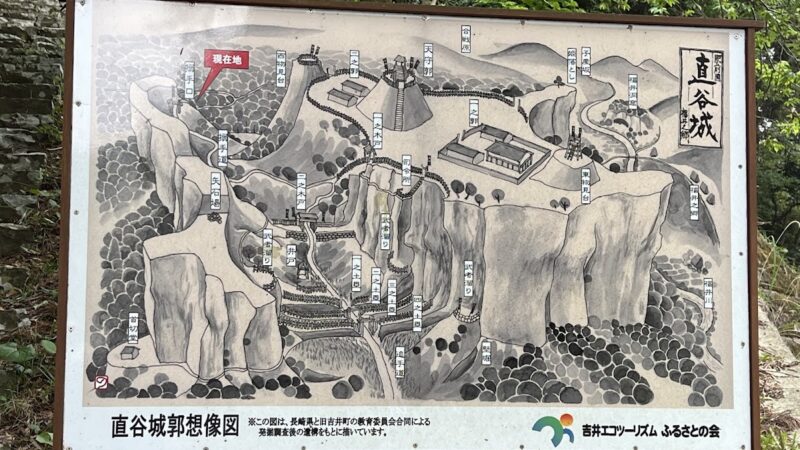
The castle’s layout features an oval-shaped main enclosure (honmaru) created by leveling the mountaintop, surrounded by multiple baileys (kuruma). With a relative elevation of approximately 170 meters, it was a formidable mountain castle requiring considerable effort to attack.
Main Enclosure and Major Baileys
The main enclosure (honmaru) is located in the center of the castle, an oval-shaped flat area created by leveling the mountaintop. Measuring approximately 50 meters east-west and 30 meters north-south, it is surrounded by earthen ramparts. The view from the main enclosure is magnificent; on clear days, one can see the islands of the Genkai Sea, Imari Bay, and even the distant mountains of Saga Prefecture. This view is thought to have served not only a military surveillance function but also a symbolic meaning, demonstrating the authority of the lord.
The second bailey is located north of the main bailey. Situated at a lower level than the main bailey, it functioned as an important defensive enclosure. A clear difference in elevation exists between the second bailey and the main bailey, indicating a defensive design.
The observation post is located south of the main bailey and served to monitor enemy movements from the south. The observation post offered a wide view of the surrounding area, suggesting it functioned as part of an early warning system.
Remains of the Stone Walls and Main Gate
The greatest highlight of Kajitani Castle is the well-preserved remains of its stone walls. In particular, the stone walls around the main gate are thought to have been renovated during the Oda-Toyotomi period, demonstrating the high level of stonework technology at the time.
The stone walls were constructed using a technique called “nozurazumi,” resulting in a simple appearance with natural stones stacked almost unprocessed. However, the arrangement and slope of the walls demonstrate calculated engineering, and they remain intact even after more than 400 years.
Stone walls remain on both sides of the main gate site, allowing us to estimate the size of the castle gate in its heyday. The gate is estimated to have been approximately 3 meters wide, indicating that it was a relatively large gate for a medieval mountain castle.
The stone walls of the castle are mostly around 2-3 meters high and are arranged to surround the baileys. These stone walls, combined with earthworks, were designed to enhance defensive capabilities.
Earthworks and Moats
Besides the stone walls, earthworks and moats played an important role as defensive structures. The earthworks surrounding the main bailey are approximately 1-2 meters high and, combined with the stone walls, form a defensive line.
Moats are defensive structures built to cut across ridges, limiting enemy incursion routes. Multiple moats have been identified at Kajitani Castle, indicating the adoption of a multi-layered defensive structure.
Highlights and Remains of Kajitani Castle
Breathtaking Panoramic View from the Main Enclosure
The greatest attraction of visiting Kajitani Castle is the 360-degree panoramic view from the main enclosure. The view from the 197-meter-high mountaintop is spectacular. To the north lies the Genkai Sea, and on clear days, you can even see Iki and Tsushima islands. To the east stretches Imari Bay, and to the west, you can see the city of Matsuura and the direction of Takashima Island.
This view makes you truly understand why the Matsuura clan controlled maritime traffic. It was an ideal location for monitoring ships at sea and understanding the movements within the territory, demonstrating the keen strategic vision of Minamoto no Hisashi, who built the castle here.
Well-Preserved Stone Walls
The stone walls of Kajitani Castle are particularly well-preserved among medieval castles in Nagasaki Prefecture. The following areas are especially noteworthy:
Stone walls around the main gate: This is the most well-maintained stone wall, with approximately 3-meter-high walls remaining on both sides of the gate. The arrangement of the stones is regular, demonstrating the techniques of the Oda-Toyotomi period.
Stone walls around the main enclosure: These stone walls surround the main enclosure, maintaining a height of 2-3 meters in some sections. One can appreciate the simple beauty of the rough-hewn stonework.
Stone walls along the path to the second enclosure: Stone walls remain along the path descending from the main enclosure to the second enclosure, showing ingenuity in restricting movement.
These stone walls are attracting attention from researchers as valuable historical materials illustrating the changes in castle construction techniques during the transition from the medieval to the early modern period.
Arrangement of enclosures and earthworks
The layout of Kajitani Castle is a typical example of a medieval mountain castle that skillfully utilizes the terrain. Multiple enclosures are arranged in a stepped fashion around the main enclosure, with each enclosure providing mutual support.
Each enclosure is surrounded by earthen ramparts, which, combined with stone walls, enhance its defensive capabilities. The height of the ramparts varies, but at their highest points, they reach nearly 2 meters, allowing us to imagine their former appearance.
The flat areas of the enclosures remain clearly visible, allowing us to imagine the original building layout. While archaeological excavations have been limited, traces of foundation stones and post holes have been confirmed in some areas, suggesting that the main hall was located in the main enclosure and the residences of retainers were in the second enclosure.
Ascent Route and Signposts
The ascent route to Kajitani Castle is still well-maintained, making it relatively easy to reach the summit. Signposts are installed along the route, ensuring that even first-time visitors can reach the main enclosure without getting lost.
The ascent route is thought to largely follow the route of the main approach road in the past, and along the way, traces of moats and enclosures can be seen. The climb from the foot of the mountain to the main enclosure takes approximately 20-30 minutes on foot, a moderate hike that provides a good workout.
Along the way, you can appreciate the castle’s defensive structure as you climb, and enjoy the way the view opens up at each enclosure. This is thought to have been a clever way to prevent the enemy from grasping the overall layout of the castle.
Access and Visiting Information for Kajitani Castle
Access by Public Transportation
By Train
The nearest station is Imafuku Station on the Matsuura Railway Nishikyushu Line. It’s about a 15-20 minute walk from Imafuku Station to the entrance to the Kajitani Castle ruins. After leaving the station, head northeast along National Route 204 and follow the signs to reach the entrance.
Imafuku Station is about 40 minutes from Sasebo Station and about 30 minutes from Imari Station by Matsuura Railway. There are only 1-2 trains per hour, so it’s recommended to check the timetable in advance.
By Bus
The Matsuura City Community Bus operates in the Imafuku area, but the number of buses is limited, so you need to check the timetable in advance. The nearest bus stop is about a 10-minute walk from the castle entrance.
Access by Car and Parking
By Car
It’s about 15 minutes from the Matsuura IC on the West Kyushu Expressway, and about 20 minutes from the Sasa IC. Take National Route 204 towards Imafuku-cho. There are signs at key points, making it a relatively easy route to follow.
Parking Information
There is free parking space near the castle entrance, accommodating about 5-6 regular cars. It’s a short walk from the parking lot to the entrance, and there are restrooms nearby. However, parking space is limited, so early arrival is recommended during peak tourist season and weekends.
Notes and Preparations for Visiting
Clothing and Equipment
Since Kajitani Castle is a mountain castle, appropriate clothing and footwear for hiking are necessary. Please wear sneakers or trekking shoes and comfortable clothing. In summer, it is recommended to bring insect repellent, a hat, and drinking water.
Estimated Time Required
The round trip from the entrance to the main keep takes approximately 1 hour. Including time spent exploring the main keep, allow 1 hour 30 minutes to 2 hours. Those who wish to carefully observe the remains should allow an additional 30 minutes to 1 hour.
Visiting Hours
Kajitani Castle Ruins is an outdoor historical site and is generally open 24 hours a day. However, for safety reasons, daytime visits are strongly recommended. Especially in winter, sunset is early, so it is recommended to begin descending by 3 PM.
Toilets and Rest Facilities
Toilets are available near the entrance to the castle. There are no toilets at the summit, so it is recommended to use them before climbing. Rest facilities are limited, but there is a space to rest in the main keep.
Places to Visit Alongside Nearby Tourist Attractions
Historical Spots in Matsuura City
Matsuura Historical Museum (Matsuura City Buried Cultural Properties Center)
This facility exhibits the history of the Matsuura clan, including Kajitani Castle, and archaeological discoveries in Matsuura City. Artifacts excavated from the Kajitani Castle ruins and historical materials related to the Matsuura clan are on display. Visiting before or after your visit will allow you to gain a deeper understanding of the history of Kajitani Castle.
Takashima Kanzaki Ruins (Historical Site Related to the Mongol Invasions)
Takashima in Matsuura City has numerous historical sites related to the Mongol invasions. In particular, the artifacts recovered from the underwater ruins are attracting attention as a globally valuable discovery. This is an important spot for understanding the role the Matsuura clan played in the Mongol invasions.
Tsuchiya Rice Terraces
This spot allows you to enjoy the beautiful rice terrace scenery of Matsuura City. Located about 20 minutes by car from Kajitani Castle, it offers a glimpse into the quintessential Japanese landscape. The view at sunset is especially spectacular.
Nearby Castles
Hirado Castle (Hirado City)
This was the residence of the Hirado Matsuura clan, who controlled Kajitani Castle. Currently, there is a reconstructed keep, offering beautiful views of Hirado Bay. Located about 40 minutes by car from Kajitani Castle, it’s an essential spot for tracing the history of the Matsuura clan.
Karatsu Castle (Karatsu City, Saga Prefecture)
Located across Imari Bay, Karatsu Castle, like Kajitani Castle, was developed in connection with Toyotomi Hideyoshi’s invasion of Korea. Located about 30 minutes by car from Kajitani Castle, it showcases the appearance of a modern castle.
Gourmet Food and Souvenirs
Matsuura Horse Mackerel
Matsuura City is known as the “holy land of fried horse mackerel,” and you can enjoy dishes made with fresh horse mackerel. Restaurants in the city serve fried horse mackerel and sashimi made with locally caught horse mackerel.
Matsuura Pickles
A traditional pickle from Matsuura, popular as a souvenir. It features a simple flavor using local vegetables.
Cultural Property Designation and Preservation Activities of Kajitani Castle
Value as a Nagasaki Prefecture Designated Historic Site
Kajitani Castle ruins were designated as a Nagasaki Prefecture Designated Historic Site on September 14, 1971, as “Matsuura Clan Kajitani Castle Ruins.” The designated area includes 2288 Higashimen, Imafuku-cho, Matsuura City, and other locations, with the main part centered around the main keep being protected.
The following points were evaluated as reasons for the designation:
- Historical importance as the birthplace of the Matsuura Clan: It was the base of the Matsuura Clan, which held great influence in northern Hizen Province from the late Heian period to the Sengoku period.
- Remains from the transitional period between medieval mountain castles and early modern castles: Due to renovations by Toyotomi Hideyoshi, valuable remains illustrating the transition from medieval to early modern castles are preserved.
- Excellent state of preservation: Remains such as stone walls, baileys, and earthworks remain clearly visible, allowing visitors to imagine the castle’s former appearance.
- Cultural property that tells the history of the region: An indispensable cultural property for understanding the history of Matsuura City.
Preservation and maintenance efforts
The Matsuura City Board of Education and local residents are working together to preserve and maintain the Kajitani Castle ruins. The main activities are as follows:
Weeding and cleaning activities: Several times a year, local residents and volunteers carry out weeding and cleaning activities to preserve the remains and maintain a pleasant viewing environment.
Maintenance of the castle approach: Maintenance of the castle approach and installation of signposts are being carried out to ensure safe ascents. In recent years, efforts have been made to install more easily understandable signage.
Research and Study: Surveys and document research are continuously being conducted by the Nagasaki Prefectural Board of Education and experts, advancing the understanding of the historical value of Kajitani Castle.
Awareness Activities: Activities are being conducted in local schools and lifelong learning settings to convey the history of Kajitani Castle, aiming to pass on cultural heritage to future generations.
Kajitani Castle Photo Spots and Photo Guide
Recommended Photo Spots
Panoramic Photography from the Main Enclosure
The main enclosure is the best photo spot for Kajitani Castle. We recommend using a wide-angle lens to take panoramic shots, taking advantage of the 360-degree view. Especially on sunny mornings, the contrast between the blue sea of the Genkai Sea and the sky is beautiful, making for excellent shooting conditions.
Detailed Photography of the Stone Walls
The stone walls around the main gate are suitable for photography that highlights the texture of the rough-hewn stonework. Utilizing the slanted light of dawn and dusk emphasizes the three-dimensionality of the stones, resulting in impressive photographs. Using a macro lens to capture the texture of the stones is also an interesting approach.
Evening Photography
The time before sunset creates a beautiful scene with the setting sun in the west and the silhouette of Imari Bay. Long exposures using a tripod allow for dramatic sunset photographs. However, please allow ample time for your descent.
Seasonal Highlights
Spring (March-May)
In the season of fresh greenery, the entire castle mountain is enveloped in vibrant green, creating a refreshing atmosphere for your visit. The temperature is moderate, making it the perfect season for visiting the castle.
Summer (June-August)
While summer requires precautions against the heat, the contrast between the lush green trees and the blue sea is beautiful. Early morning or evening visits are recommended.
Autumn (September-November)
Autumn offers the most expansive views thanks to the autumn foliage and clear air. The view from the main keep is exceptional, making it an ideal time for photography.
Winter (December-February)
During winter, the air is clear, and there are many days when you can see the distant mountains. However, the sun sets early, so plan your visit to be in the morning or earlier.
Useful Information for Visiting Kajitani Castle
What was the Matsuura Clan?
The Matsuura Clan was a samurai group that was active mainly in the northern part of Hizen Province (present-day northern Nagasaki Prefecture and western Saga Prefecture) from the late Heian period to the Sengoku period. Its characteristics are as follows:
Naval Power: The Matsuura Clan controlled maritime traffic in the Genkai Sea and also engaged in pirate-like activities. They excelled in naval warfare and played an active role as a naval force during the Mongol invasions.
Organization as a Family Alliance: The Matsuura Clan was a family group centered around the descendants of Minamoto no Hisashi, and was composed of numerous branches, sometimes referred to as the 48 clans. Each branch clan maintained its independence while forming loose alliances as needed.
Characteristics of Regional Rule: The Matsuura clan built its economic base by controlling key points in maritime traffic, accumulating wealth through trade and fishing.
The Bunroku Campaign and Kajitani Castle
Toyotomi Hideyoshi’s invasion of Korea (the Bunroku-Keicho Campaign) marked a significant turning point in the history of Kajitani Castle. Hideyoshi developed various castles in northern Kyushu as bases for his campaigns, giving them the function of supply bases.
Kajitani Castle was also renovated as part of this campaign, with the construction of stone walls and the expansion of its baileys. This renovation transformed it from a medieval earthen castle into a modern castle with stone walls.
The Korean campaign had a significant impact on Japanese castle construction techniques. Castle building techniques learned on the Korean Peninsula were brought back to Japan and reflected in subsequent castle architecture. The stone walls of Kajitani Castle are also noteworthy as relics demonstrating the results of this technological exchange.
Origin of the Place Name “Imafuku”
The place name “Imafuku,” where Kajitani Castle is located, has an interesting origin. One theory suggests that when Minamoto no Hisa descended to this area, it was named “Imafuku,” meaning “fortune has now arrived.”
Another theory suggests that this area was a transportation hub from ancient times, and was named “Imafuku” meaning “a place that brings fortune (prosperity) even now.”
In any case, the place name “Imafuku” indicates that this area was recognized as an important place from ancient times.
Research on Kajitani Castle and Future Challenges
Current Status of Archaeological Investigations
Several surveys have been conducted at the Kajitani Castle site, revealing details of the castle’s layout. However, full-scale excavation has been limited, and many aspects remain unexplained.
Future research challenges include the following:
Identifying the Construction Date: Determining the most accurate construction date by comparing historical documents and archaeological evidence.
Clarifying the Building Layout: Revealing the types of buildings in each enclosure through archaeological excavations.
Detailed Study of the Stone Walls: Investigating the construction techniques and dates of the stone walls in detail to clarify the renovation process.
Analysis of Excavated Artifacts: Analyzing excavated artifacts such as ceramics and metal products to clarify the castle’s function and the lifestyle of its inhabitants.
Balancing Preservation and Utilization
Balancing the preservation of cultural properties with tourism utilization is a challenge faced by many historical sites. At Kajitani Castle Ruins, a crucial issue is how to balance the impact of increased visitor numbers on the remains with tourism utilization for regional revitalization.
Currently, Matsuura City is pursuing a policy of improving the viewing environment while protecting the remains, and is proceeding with the development of access roads and the installation of information boards. The introduction of a digital technology-based explanation system is also being considered for the future.
Utilization in Local History Education
Kajitani Castle Ruins are a valuable teaching material for learning local history. Schools in Matsuura City provide opportunities to learn about the history of Kajitani Castle as part of local history studies, and experiential learning activities involving visits to the castle ruins are also conducted.
Through these educational activities, it is hoped that conveying the value of local history and cultural assets to the next generation will lead to the sustainable preservation of Kajitani Castle Ruins.
Summary: Historical Significance and Value of Visiting Kajitani Castle
Kajitani Castle is an important mountain castle that watched over the history of northern Hizen Province from the late Heian period to the Sengoku period. Built by Minamoto no Hisa, the ancestor of the Matsuura clan, this castle functioned for a long time as the Matsuura clan’s base and as a base to monitor a strategic point for maritime traffic.
After renovations by Toyotomi Hideyoshi, Kajitani Castle transformed from a medieval mountain castle to a modern castle, and it is a valuable historical site that conveys the transitional period in the history of Japanese castles. The well-preserved stone walls, baileys, and earthworks evoke the castle’s former glory, allowing visitors to feel the romance of history.
The panoramic view from the 197-meter-high summit, stretching from the Genkai Sea to Imari Bay, is truly breathtaking. This view allows us to appreciate the reasons why the Matsuura clan prospered as a maritime power, and teaches us the beauty of the harmony between history and nature.
When visiting Matsuura City in Nagasaki Prefecture, be sure to visit the Kajitani Castle ruins. Experiencing the breath of history and gazing upon the same scenery seen by our ancestors from the same spot will surely create unforgettable memories. Kajitani Castle is a hidden gem recommended not only for history buffs but also for those who want to enjoy nature and scenery.
-680x450.png)