Complete Guide to Tsushima Shimizuyama Castle | Fortress and Highlights of the Bunroku-Keicho War [Tsushima City, Nagasaki Prefecture]
Tsushima Shimizuyama Castle, located in Nishizato, Izuhara-cho, Tsushima City, Nagasaki Prefecture, is an important mountain castle built by Toyotomi Hideyoshi as a military staging point connecting Nagoya Castle in Hizen Province to the Korean Peninsula during the Bunroku-Keicho War. The castle ruins, centered on the summit of Mt. Shimizuyama (206 meters above sea level), are a valuable historical site that conveys the castle-building techniques of the Azuchi-Momoyama period, and were designated a national historic site in 1984.
This article comprehensively introduces information you should know before visiting Tsushima Shimizuyama Castle, from its historical background and castle structure to its highlights and access methods.
Historical Background of Tsushima Shimizu-yama Castle
Strategic Importance in the Bunroku-Keicho War
Tsushima Shimizu-yama Castle was built in 1591 (Tensho 19). When Toyotomi Hideyoshi planned the invasion of Korea (the Bunroku-Keicho War), he built Nagoya Castle in Matsuura, Hizen Province, to serve as the main camp. At the same time, to establish a military supply route from Nagoya Castle to Busan Castle on the Korean Peninsula, he ordered the construction of Katsumoto Castle on Iki Island and Shimizu-yama Castle on Tsushima.
These castles were called “station castles” and served as supply bases. Tsushima is geographically the closest Japanese territory to the Korean Peninsula, and Shimizu-yama Castle played an extremely important role as a frontline supply base in the Korean invasion.
Various Theories Regarding the Builder
There are several theories regarding the builder of Shimizu-yama Castle. The most common theory is that the castle was built by Mori Takamasa, who was stationed in Tsushima as a military supervisor for Toyotomi Hideyoshi. While this is recorded in late Edo period documents, no primary sources have been found to date.
On the other hand, there is also a theory that the castle was built primarily by So Yoshitomo, the lord of Tsushima, with the cooperation of Sagara Nagatsune of Hitoyoshi in Higo, Takahashi Naotsugu of Miike in Chikugo, and Chikushi Hirotomo of Fukushima in Chikugo. In any case, it is certain that it was a large-scale castle completed in a short period of time by multiple daimyo under the orders of Toyotomi Hideyoshi.
Relationship with Kaneishi Castle
Shimizu-yama Castle was built behind Kaneishi Castle, the residence of the Tsushima So clan. Kaneishi Castle was a flatland castle facing Izuhara Port and was the base of the So clan for generations. Shimizu-yama Castle is located on the hill behind Kaneishi Castle, and it is believed that the two castles formed an integrated defense system. After the end of the Bunroku-Keicho War, Shimizu-yama Castle was abandoned, and the So clan continued to use Kaneshi Castle as their base. However, the magnificent stone wall remains of Shimizu-yama Castle remain as a valuable legacy that conveys the castle-building technology and military tension of the time.
Castle Structure and Layout
Three-Tiered Enclosure Arrangement
Tsushima Shimizu-yama Castle is built around the summit of Shimizu-yama (206 meters above sea level), at the tip of the eastern spur extending from Ariake-yama (approximately 558 meters above sea level). The castle grounds extend along the ridge for approximately 500 meters from east to west, and have a three-tiered structure with the main enclosures being Ichinomaru (Honmaru), Ninomaru, and Sannomaru.
Ichinomaru (Honmaru) is located at the summit of Shimizu-yama and forms the core of the castle. From here, one can see Izuhara Port and the Tsushima Strait, making it an ideal location for monitoring the Korean Peninsula. Ninomaru was located on a level between Ichinomaru and Sannomaru, functioning as a key defensive point.
Sannomaru was located at the tip of the eastern ridge, serving as an important enclosure protecting the eastern side of the castle.
Between these three main enclosures, stone walls were intermittently placed, forming a magnificent group of stone walls stretching approximately 500 meters in length, winding along the mountainside.
The Construction Technique of All-Stone Walls
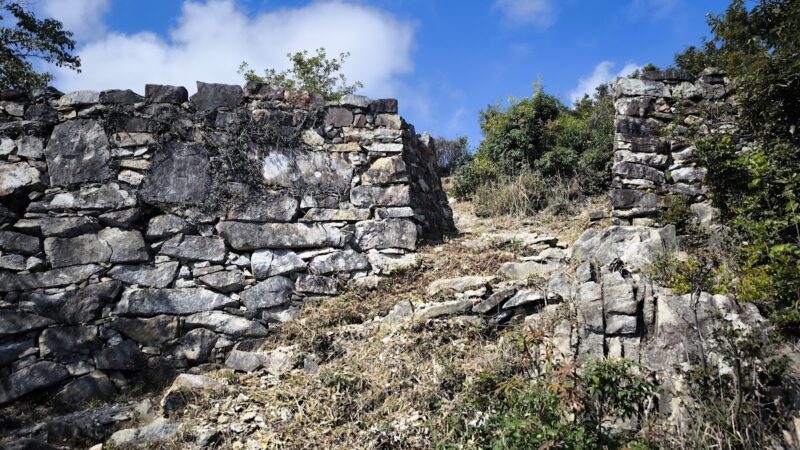
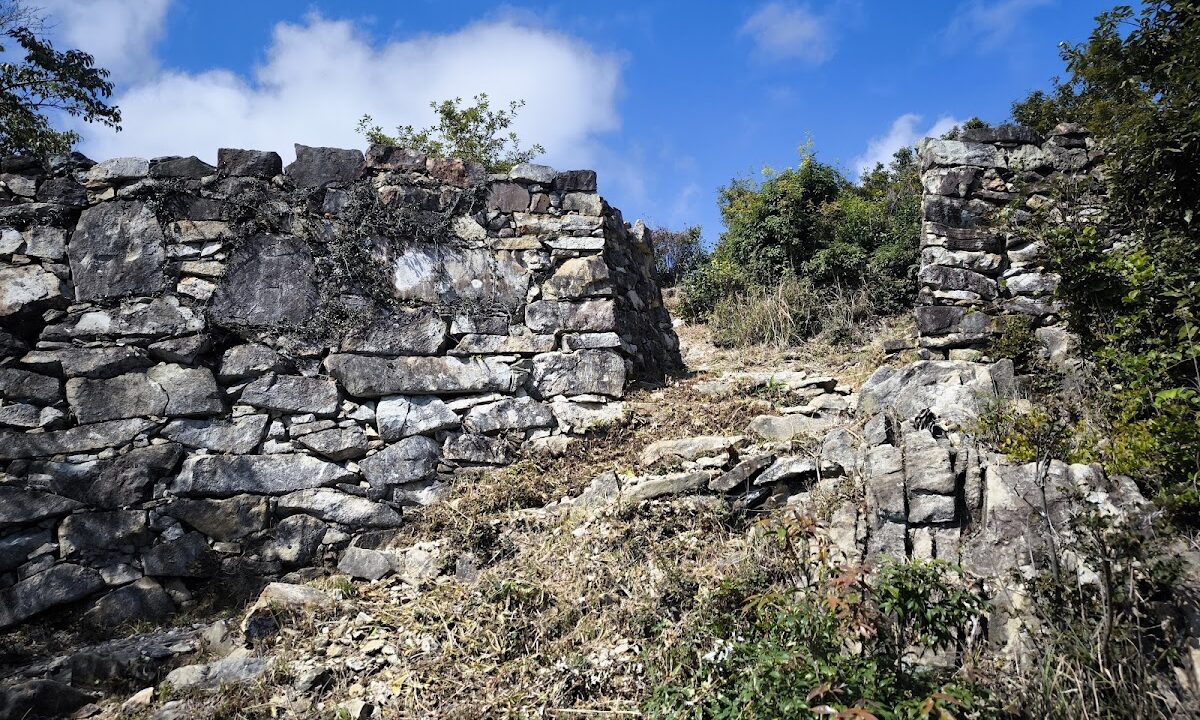
The most distinctive feature of Tsushima Shimizu-yama Castle is that, despite being a mountain castle, it is constructed entirely of stone walls. This is an extremely rare technique for a mountain castle of the Azuchi-Momoyama period, achieving a robust defensive system by reinforcing the steep slopes with stone walls.
The stone walls are based on the Nozura-zumi (rough stone masonry) method, using natural stones, and are valuable remains that demonstrate the level of stonework technology at the time. In some areas, a technique called “sangizumi,” which strengthens the corners, can be observed, showcasing characteristics of a transitional period in castle construction technology.
Even today, much of the stone wall is well-preserved, enhancing its value as a nationally designated historical site. Experiencing the grandeur of the stone walls clinging to the slopes while walking along the mountain trail is a major attraction of visiting Shimizu-yama Castle.
Ascent Route and Defensive System
The ascent route to Shimizu-yama Castle was established by climbing the mountainside from the town of Izuhara. While a well-maintained mountain trail is currently available, traces of the original ascent route can still be seen in some areas.
As a defensive system unique to mountain castles, a tiered defense utilizing the elevation differences between enclosures was employed. Even if the enemy breached one enclosure, they could be met in the next, a design that allowed for effective defense even with limited defending forces.
Highlights of Tsushima Shimizu-yama Castle
Magnificent Stone Walls
The greatest reason to visit Shimizu-yama Castle is undoubtedly the magnificent stone walls that can be seen up close. As you climb the mountain trail, the sight of the stone walls winding along the mountainside is breathtaking. You’ll be amazed by the skillful use of the natural terrain and the high level of craftsmanship required to construct the walls on the steep slopes.
The stone walls around the Ichinomaru (first bailey) are particularly well-preserved, with the stonework from over 400 years ago still standing strong. The harmony with the trees growing through the gaps in the walls is beautiful, allowing you to enjoy a landscape where historical remains and nature blend seamlessly.
View from the Summit
From the summit, where the Ichinomaru is located, you can enjoy a panoramic view of the town of Izuhara, Izuhara Port, and the Tsushima Strait. On a clear day, you can even see the Korean Peninsula in the distance. This view speaks volumes about why Shimizu-yama Castle was chosen as a supply base.
It’s conceivable that this location was used to monitor the Korean Peninsula and track ship traffic at the time. Today, it’s a popular spot for tourists to enjoy the scenic views, and a visit on a sunny day is especially recommended.
Layout and Design of the Enclosures
While walking along the mountain trail, you can observe the layout of the three main enclosures. Understanding the role each enclosure played and how they worked together to form the overall defensive system of the castle offers insights into the castle-building philosophy of the Sengoku period.
The flat areas of the second and third enclosures are relatively large and are thought to have been used for troop garrisoning and storage of supplies. Experiencing the elevation differences and distances between the enclosures firsthand will help you understand the castle’s three-dimensional structure.
Historical Information Boards
Information boards explaining the castle’s history and structure are placed at key points along the mountain trail. Reading these boards while climbing will deepen your understanding of the historical background and construction techniques of Shimizu-yama Castle.
As a nationally designated historical site, it is well-preserved and managed, ensuring a safe environment for visitors to view the historical remains.
Access Information
Access to Tsushima
Tsushima City, Nagasaki Prefecture, can be accessed by plane or ferry.
By Plane:
- Approximately 30 minutes from Nagasaki Airport to Tsushima Yamaneko Airport
- Approximately 35 minutes from Fukuoka Airport to Tsushima Yamaneko Airport
By Ferry:
- Approximately 4 hours 30 minutes from Hakata Port in Fukuoka City to Izuhara Port (approximately 2 hours 15 minutes using a jetfoil)
- Approximately 4 hours 40 minutes from Nagasaki Port to Izuhara Port
Access to the Shimizu-yama Castle Entrance
The Shimizu-yama Castle entrance is approximately 1 kilometer from Izuhara Port, about a 15-minute walk. Head west from the center of Izuhara town and follow the signs to the castle entrance.
By Car:
There are several parking spaces near the castle entrance. If you rent a car from Tsushima Yamaneko Airport, it takes approximately 30 minutes to arrive.
By Public Transportation:
You can take a bus or taxi from Izuhara Port, but since the number of services is limited, it is recommended to check the timetable in advance.
Time and Preparation for Climbing the Castle
From the castle entrance to the summit (Ichinomaru), it takes approximately 30 to 40 minutes at a normal hiking pace. Including the round trip and sightseeing time, it’s best to allow 1 hour 30 minutes to 2 hours.
Clothing and Items to Bring:
- Comfortable walking shoes (hiking boots or trekking shoes recommended)
- Comfortable clothing
- Drinking water
- Insect repellent spray (in summer)
- Camera (for photographing stone walls and views)
The hiking trail is well-maintained, but there are steep slopes typical of mountain castles, so a certain level of physical fitness is required. Especially in summer, the heat and humidity are high, so be sure to stay hydrated. ### Important Notes for Visitors
- As this is a nationally designated historical site, climbing on the stone walls or damaging the remains is strictly prohibited.
- The ground can become slippery in rainy weather, so please be extra careful.
- As this is a habitat for wild animals (such as the Tsushima leopard cat), please be sure to take all your trash with you.
- In winter, the sun sets early, so please allow ample time for your visit.
Nearby Tourist Attractions
Kaneshi Castle Ruins
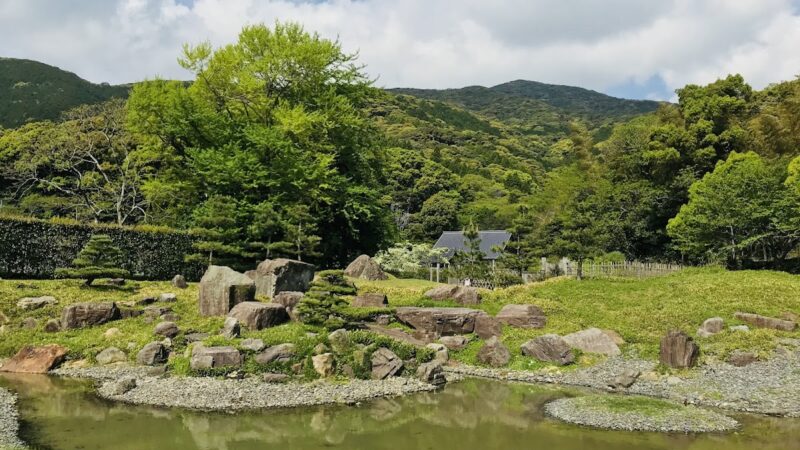
Located at the foot of Shimizu-yama Castle, Kaneshi Castle is a flatland castle that served for a long time as the residence of the Tsushima So clan. Currently, the gardens and turret gate have been restored, and visiting both Shimizu-yama Castle and Kaneshi Castle together will allow you to gain a deeper understanding of Tsushima’s castle history.
Tsushima Historical and Folk Museum
Located in the town of Izuhara, this museum allows you to learn about Tsushima’s history, culture, and history of exchanges with Korea. There are also exhibits on the Bunroku-Keicho War, the background to the construction of Shimizu-yama Castle, so visiting before or after your visit will deepen your understanding.
Banshoin Temple
Banshoin Temple, the family temple of the So clan, is famous for its 132 stone steps known as Hyakuganki. It houses the tombs of successive feudal lords and is an important spot where one can feel the history of Tsushima.
Cultural Value of Tsushima Shimizu-yama Castle
Significance as a National Historic Site
Tsushima Shimizu-yama Castle was designated a national historic site in 1984. This designation was based on the evaluation that the castle is a valuable historical site related to the important historical event of the Bunroku-Keicho War, and that it well preserves the characteristics of a mountain castle from the Azuchi-Momoyama period.
In particular, its rare form as a mountain castle with all-stone walls is highly valued in castle history research as an important example demonstrating the level of castle construction technology at the time.
Position in the Study of Wajo Castles
During the Bunroku-Keicho War, numerous “Wajo” (Japanese castles) were built on the Korean Peninsula. Shimizu-yama Castle is a key strategic point on the supply route connecting Nagoya Castle to the Yamato Castle complex, and is therefore a focus of research in Yamato Castle studies.
Alongside Katsumoto Castle on Iki Island, it is a valuable historical site as one of the remaining post castle ruins in Japan, and is essential for understanding the military strategy and logistics system of the time.
Visitor Ratings and Reviews
Shimizu-yama Castle in Tsushima has received high praise from many castle enthusiasts and history buffs who have visited. On castle information websites such as “Kojodan,” it has an average rating of ★★★★☆ 3.63, with an average visit time reported as 1 hour and 17 minutes.
Visitors have shared the following impressions:
- “I was overwhelmed by the sheer scale of the stone walls clinging to the mountainside.”
- “The view from the summit was magnificent, and I felt a sense of historical romance.”
- “The well-maintained hiking trail allowed for safe sightseeing.”
- “It was well worth the trip to Tsushima.”
On the other hand, some visitors noted that “access is somewhat inconvenient” and “heat precautions are necessary in summer,” highlighting the importance of timing and preparation for visits.
Summary: The Charm of Tsushima Shimizu-yama Castle
Tsushima Shimizu-yama Castle, located in Tsushima City, Nagasaki Prefecture, is a valuable historical site related to the important event in Japanese history: the Bunroku-Keicho War, led by Toyotomi Hideyoshi. Built on Shimizu-yama Mountain at an altitude of 206 meters, this mountain castle with its entirely stone walls preserves the castle-building techniques of the Azuchi-Momoyama period and is protected as a nationally designated historical site.
Built as a supply base connecting Hizen Nagoya Castle to the Korean Peninsula, this castle was a large-scale military facility completed with the involvement of multiple warlords, including Mori Takamasa and So Yoshitomo. The three-tiered baileys (Ichinomaru, Ninomaru, and Sannomaru) stretching approximately 500 meters from east to west, along with the stone walls clinging to the mountainside, speak to the military tension and advanced construction techniques of the time.
Despite its relatively accessible location, just a 15-minute walk from Izuhara Port, the mountaintop offers breathtaking panoramic views of the Tsushima Strait. A 30-40 minute climb along the well-maintained hiking trail allows you to enjoy a beautiful landscape where historical remains and nature harmonize.
When visiting Tsushima, be sure to visit Tsushima Shimizu-yama Castle and experience the history of the Bunroku-Keicho War and its magnificent stone wall remains. Visiting nearby historical sites such as Kaneshi Castle and Banshoin Temple will allow you to gain a deeper understanding of Tsushima’s rich history.
-680x450.png)