Kaneda Castle (Tsushima City, Nagasaki Prefecture) Complete Guide | Thorough Explanation of the History, Remains, and Access of this Ancient Mountain Castle
What is Kaneda Castle? | An Ancient Mountain Castle that Protected a Border Island
Kaneda Castle (also known as Kaneda-jo or Kanata-no-ki) is an ancient Japanese mountain castle located in Kurose, Mitsushima-cho, Tsushima City, Nagasaki Prefecture. Built on a 276-meter-high mountain, this castle was constructed in 667 AD during the Asuka period under Emperor Tenji and functioned as the front line of national defense against invasions from the Korean Peninsula.
Located on the southern edge of Soto-Asaji, west of Asaji Bay in the central part of Tsushima Island, Shiroyama is a natural stronghold surrounded by the sea on three sides. Because of its location offering views of the Korean Peninsula, it played an extremely important role as a strategic point for foreign defense in ancient Japan.
The castle ruins are designated as a National Special Historic Site, and as the first cultural property in Nagasaki Prefecture to receive this designation, its high historical value is recognized. Furthermore, in 2017, it was selected as one of the “Continued Top 100 Japanese Castles,” attracting attention from history enthusiasts and castle fans.
History of Kaneda Castle | From the Battle of Baekgang to the Present
Background of Construction and the Battle of Baekgang
The construction of Kaneda Castle is closely related to the Battle of Baekgang, which took place in 663. The crushing defeat of the Wa (Japan) and Baekje allied forces against the Tang and Silla allied forces in this battle increased the risk of invasion of the Japanese archipelago.
The *Nihon Shoki* (Chronicles of Japan) states, “In the 6th year of Emperor Tenji’s reign, in November, Takayasu Castle was built in Wa, Yashima Castle in Yamada District, Sanuki Province, and Kaneda Castle in Tsushima Province,” clearly recording that Kaneda Castle was built in 667. During this period, numerous ancient mountain castles were built throughout western Japan, but Kaneda Castle was the frontline defensive stronghold closest to the Korean Peninsula.
Role in Ancient Times
Kaneda Castle is an ancient mountain castle classified as a Korean-style mountain castle. Korean-style mountain castles are characterized by their construction techniques incorporating those of the Korean Peninsula, utilizing rugged terrain and surrounded by stone walls.
The castle contained facilities for housing soldiers and supplies, and a vast space was secured to allow residents of Tsushima to evacuate in times of emergency. The Korean Peninsula was visible from the mountaintop, and it is believed to have functioned as a base for information transmission via beacon fires.
Changes from the Medieval Period Onward
From ancient times onward, Kaneda Castle’s military function gradually declined, but because Tsushima maintained its importance as a border island, it was never completely forgotten.
In the modern era, from the Meiji period to the early Showa period, it once again attracted attention as a military facility. Around the time of the Russo-Japanese War, artillery batteries were installed, and the remains of these batteries still exist near the summit of the castle mountain. While some ancient remains were destroyed due to military use during this period, the main stone walls were preserved in good condition.
Cultural Property Designation and Modern Preservation Activities
On March 23, 1982 (Showa 57), the Kaneda Castle Ruins were designated a National Special Historic Site. This was the first Special Historic Site designation in Nagasaki Prefecture, signifying its recognition as an extremely important historical site that tells the story of ancient Japan.
Special Historic Sites are the highest rank of designation given to particularly important sites among nationally designated historic sites. There are only 62 Special Historic Sites nationwide (as of 2024), and Kaneda Castle is one of them, possessing national treasure-level value.
Currently, the Tsushima City Board of Education is leading continuous efforts to preserve and maintain the remains. The development of trekking courses has made it possible for the general public to safely visit the castle ruins, and it is being utilized for historical education and as a tourist resource.
Remains of Kaneda Castle | Stone Walls from 1350 Years Ago Still Remain
Magnificent Stone Walls
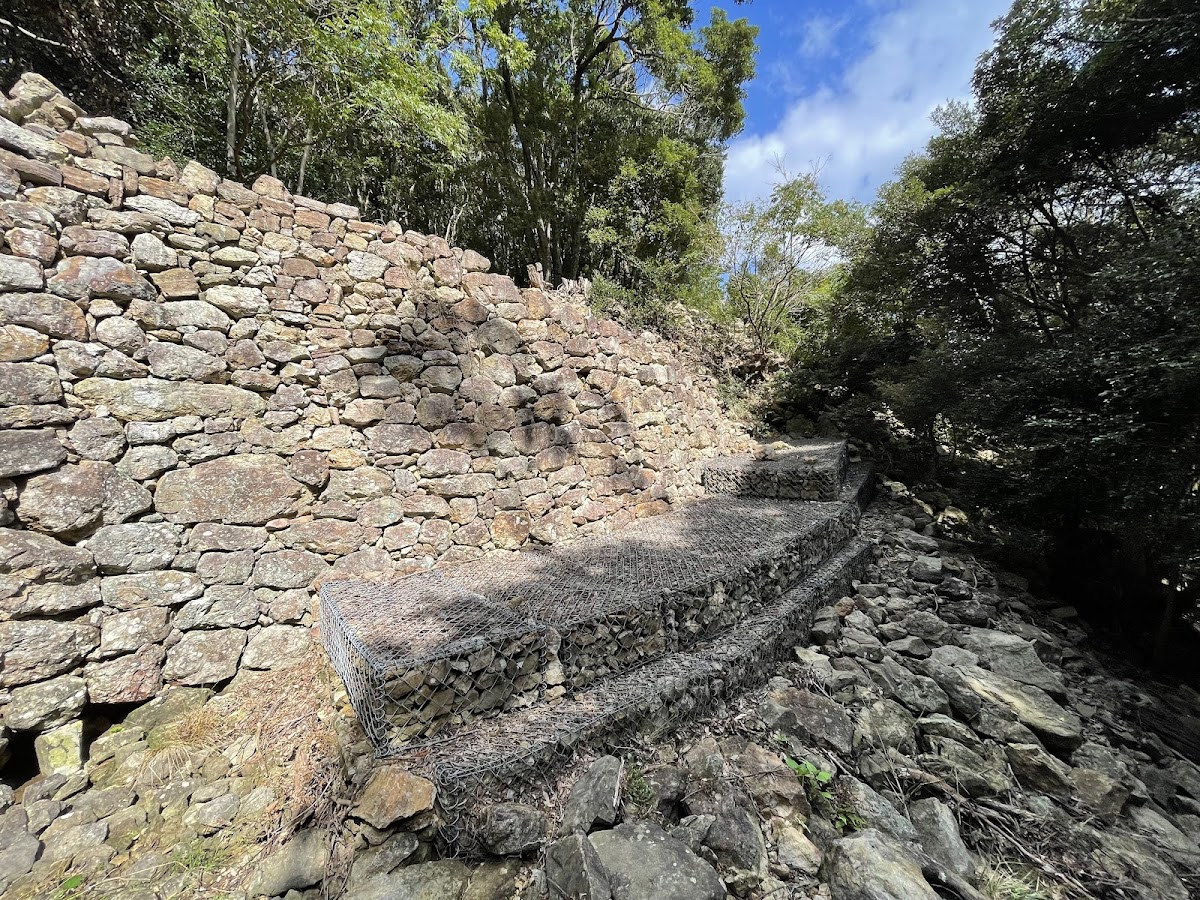
The greatest highlight of Kaneda Castle is the stone walls, built over 1350 years ago, which remain in remarkably good condition. The total length of the stone wall is approximately 2.8 kilometers, and it runs along the mountain ridges and valleys.
The stone wall is constructed using Shiratake quartz schist, a hard type of stone, and its high durability has contributed to its long-term preservation. Shiroyama (Castle Mountain) is formed from a Shiratake quartz schist dike extending north from Shiratake (elevation 519 meters), indicating the use of high-quality stone quarried locally.
The height of the stone wall varies depending on the location, but in the best-preserved sections, it reaches over 5 meters in height and 3-4 meters in width. Different construction methods are observed, including cut stone masonry and rough stone masonry, demonstrating the diversity of castle-building techniques.
Three Castle Gates
Kaneda Castle had three castle gates. A castle gate is a gate used to pass through the defensive line of the stone wall, and is a crucial defensive point.
First Castle Gate is located at the southeastern corner of the castle and is the best-preserved. From here, you can enjoy a panoramic view of Kurose Bay, and it is known as the best viewpoint at Kaneda Castle. The sight of the beautifully arranged stone walls is breathtaking and captivates visitors. It is accessible in about 20 minutes on foot from the trailhead, making it a relatively easy place to experience the atmosphere of an ancient mountain castle.
Ninokido is located on the east side of the castle, and the structure of the stone walls can be clearly seen. Here, a structure similar to a “staggered gate” can be seen, with stone walls protruding on both sides of the gate, indicating its high level of defensive function.
Sannokido is located on the north side of the castle, and research and investigation are still ongoing. It is clear that the three gates functioned as entrances and exits in different directions, and that intrusion into the castle was strictly controlled.
Military Road
An ancient road called a military road remains within the castle grounds. The military road connected the gates and was an important communication route leading to the mountaintop and various defensive positions. Part of the current trekking course utilizes this ancient military road, allowing you to follow the path walked by soldiers 1350 years ago.
The military road is approximately 2-3 meters wide, and sections paved with stones have been identified. Traces of staircase-like construction on steep slopes indicate that large-scale civil engineering work was carried out.
Remains of the Gun Battery on the Summit
Near the summit of Shiroyama, the remains of a modern gun battery can be found. Built during the Meiji era, around the time of the Russo-Japanese War, it was established to monitor and defend the Tsushima Strait.
Around the gun battery remains, concrete structures and ammunition depots remain, creating a unique landscape where ancient remains and modern military facilities coexist. This is valuable evidence that Kaneda Castle consistently served as a strategic point for national defense from ancient times to the modern era.
Sluice Gate and Water Reservoir
Within the castle grounds, the remains of a sluice gate and water reservoir utilizing the valley have also been confirmed. Securing water was a matter of life and death for mountain castles, and facilities were in place to prepare for long-term sieges.
The remains of stone-built waterways and weirs have been discovered, indicating the use of advanced civil engineering techniques. These facilities were crucial infrastructure supporting the lives of soldiers stationed within the castle and residents who had sought refuge there.
Excavated Artifacts and Archaeological Findings
The excavation of the Kaneda Castle site has yielded many valuable artifacts. These remains provide important clues to understanding the reality of ancient mountain castles.
Pottery
The most frequently excavated artifacts are Haji ware and Sue ware dating from the late 7th to 8th centuries. These are dishes and cooking utensils used in daily life, providing insights into the lives of soldiers stationed within the castle.
Of particular note is the inclusion of pottery of Korean Peninsula origin. This suggests the possibility that engineers and laborers from the Korean Peninsula were involved in the castle’s construction, making it important evidence of cultural exchange.
Iron Artifacts
Iron artifacts such as iron arrowheads, small knives, and nails have also been unearthed. These were used as weapons and tools, confirming the castle’s military character.
The well-preserved iron arrowheads suggest the high level of weapon manufacturing technology at the time. Furthermore, the large number of nails found suggests that numerous wooden structures existed within the castle grounds.
Tiles
Tiles have also been unearthed within the castle grounds, confirming the existence of tiled buildings. In ancient times, tiled roofs were only used for important facilities such as temples and government offices, indicating that Kaneda Castle had important command facilities or ceremonial buildings.
Some of the unearthed tiles exhibit manufacturing techniques of the Baekje region, making them valuable historical materials illustrating technological exchange with the Korean Peninsula.
Other Artifacts
Artifacts related to written culture, such as inkstones and ink-inscribed pottery, have also been discovered. This indicates that documents were created and records were kept within the castle, suggesting that it was not merely a military facility but a complex with administrative functions as well.
Furthermore, earthenware and stone artifacts believed to have been used in rituals have been unearthed, suggesting that ceremonies praying for the castle’s safety and victory in battle may have been held there.
Access to Kaneda Castle and Local Information
Access to Tsushima
To visit Kaneda Castle, you must first travel to Tsushima Island. There are two main ways to access Tsushima: by plane and by ferry.
By Plane: Approximately 35 minutes from Nagasaki Airport to Tsushima Airport, and approximately 30 minutes from Fukuoka Airport. It’s about a 20-minute drive from Tsushima Airport to the Kaneda Castle trailhead.
By Ferry: Approximately 2 hours and 15 minutes by high-speed boat and approximately 4 hours and 30 minutes by ferry from Fukuoka Port to Izuhara Port in Tsushima. There are also flights from Hakata Port, with a similar travel time.
Access to the Kaneda Castle Trailhead
The trailhead for Kaneda Castle is located in the Kurose area of Mitsushima-cho, Tsushima City. Renting a car from Tsushima Airport or Izuhara Port is the most convenient option.
There is a parking lot at the trailhead with space for about 10 cars. A signpost for the “Shiroyama (Kaneda Castle Ruins) Trekking Course,” built by the border guards, is installed at the trailhead, providing a map of the entire course and estimated time.
If using public transportation, take a Tsushima Kotsu bus to the “Kurose” bus stop, and then it’s about a 20-minute walk to the trailhead. However, bus services are limited, so it’s recommended to check the timetable in advance.
Trekking Course Details
The trekking course to Kaneda Castle is well-maintained. The entire course is approximately 5.2 kilometers round trip, and the estimated time is about 3 hours round trip.
Trailhead to Southeast Corner Stone Wall (Ichinokido): Approximately 20 minutes
From the trailhead, proceed along a gentle uphill slope. After about 15 minutes, you’ll reach a viewpoint offering a spectacular view of Kurose Bay. Another 5 minutes of walking will take you to the Southeast Corner Stone Wall, the most scenic spot at Kaneda Castle. Here, you can enjoy the beautifully arranged stone wall and the magnificent view of Asaji Bay.
Southeast Corner Stone Wall to Battery Ruins: Approximately 35 minutes
Climb the mountain along the stone wall. Following the ancient military road, you’ll pass through Ninokido and Sanokido. Along the way, there are several points where you can observe the structure of the stone wall up close.
Battery Ruins to Summit: Approximately 10 minutes
From the battery ruins to the summit, the slope is steep. From the summit (276 meters above sea level), a 360-degree panoramic view unfolds, and on a clear day, you can see the Korean Peninsula.
Important Notes for Visitors
Clothing and Equipment: Trekking shoes or athletic shoes are essential as you will be walking on mountain trails. Avoid sandals and high heels as some areas can be slippery. In summer, bring a hat, sunscreen, and insect repellent.
Drinking Water: There are no vending machines or water sources in the mountains, so bring plenty of drinking water. Especially in summer, it is recommended to bring extra.
Weather Check: The stone ramparts become slippery and dangerous in rainy or windy conditions. Avoid hiking on days with unstable weather, or check the latest information at the local tourist information center.
Estimated Time Required: Allow approximately 3 hours for the round trip. If you plan to take photos or carefully observe the ruins, allow an additional hour or so.
Toilets: There are toilets at the trailhead, but none in the mountains. Be sure to use the restroom before hiking.
Visitor Etiquette
Kaneda Castle Ruins are a National Special Historic Site. Please observe the following rules of etiquette when visiting:
- Do not climb on the stone walls or move any stones.
- Please take all your trash with you.
- Collecting plants or capturing animals is prohibited.
- The use of fire is strictly prohibited.
- Photography of the ruins is permitted, but prior permission is required for drone use.
Nearby Tourist Attractions
When visiting Kaneda Castle, we recommend also visiting other tourist attractions on Tsushima Island.
Asaji Bay: One of Japan’s leading ria coastlines, offering breathtaking views of intricately indented bays and numerous islands. Sightseeing boats are also available.
Banshoin Temple: The family temple of the Tsushima domain’s lord, the So family, famous for its 132 stone steps and the landscape known as Hyakugangi (Hundred Gangs).
Korean Observatory: Located at the northern tip of Tsushima, on a clear day you can see the cityscape of Busan, South Korea with the naked eye.
Watatsumi Shrine: A mystical shrine with a torii gate standing in the sea, and an ancient shrine mentioned in the Kojiki (Records of Ancient Matters).
Tourist Information Center/Inquiries
Tsushima City Board of Education Cultural Properties Division
- Address: 661-3 Imayashiki, Izuhara-cho, Tsushima City, Nagasaki Prefecture
- Phone: 0920-52-1566
Tsushima Tourism and Products Association
- Address: 672-1 Imayashiki, Izuhara-cho, Tsushima City, Nagasaki Prefecture
- Phone: 0920-52-1566
If you contact them in advance, you can get detailed trekking information and the latest local conditions. Guided tours can also be arranged.
Information on the Continued Top 100 Japanese Castles Stamp
Kaneda Castle was selected as one of the “Continued Top 100 Japanese Castles” in 2017 (No. 85). The stamp is located at the following location.
Location:
- Tsushima Tourism and Products Association (inside Izuhara Port Terminal)
- Mitsushima District Community Center
You can freely get your stamp during business hours. Don’t forget to bring your stamp book.
The Cultural Value of Kaneda Castle
Significance of Special Historic Site Designation
The reasons why Kaneda Castle has been designated a Special Historic Site are as follows:
- Historical Significance: It is one of the few ancient mountain castles with a confirmed construction date of 667 AD, as evidenced by the Nihon Shoki (Chronicles of Japan).
- Preservation: Even after more than 1350 years, the stone walls remain in excellent condition, making it extremely valuable for understanding ancient castle construction techniques.
- Location Importance: As the closest frontline of national defense to the Korean Peninsula, it is an important site that tells the story of ancient Japan’s foreign relations history.
- Scale and Structure: The stone walls, totaling approximately 2.8 kilometers in length, three gates, and military roads provide a comprehensive understanding of the structure of an ancient mountain castle.
- International Perspective: As a castle built within the context of East Asian international relations, it is important not only in Japanese history but also in the context of East Asian history.
Progress in Academic Research
Excavation surveys have been continuously conducted at the Kaneda Castle site since the 1970s. These surveys have gradually revealed the castle’s structure, construction techniques, and period of use.
In recent years, surveys utilizing cutting-edge technologies such as 3D surveying and aerial photography using drones have been conducted. This has made it possible to perform detailed topographic surveys and understand the layout of archaeological remains, which were previously difficult, leading to a continuous stream of new discoveries.
International Recognition
Kaneda Castle holds an important position in the study of ancient mountain castles in East Asia. Comparative studies with mountain castles on the Korean Peninsula are revealing the realities of the transmission of castle-building techniques and cultural exchange.
Joint research with Korean researchers is also being conducted, making it a platform for academic exchange across national borders. It is an interesting fact that an ancient defense facility is now serving as a bridge for international exchange.
Visitor Reviews of Kaneda Castle
Kaneda Castle receives high ratings on castle information websites such as “Kojodan.” The average visitor rating is a high 4.00 stars, with many reporting highly satisfying visitor experiences.
The following are some of the comments received from visitors:
- “I was deeply moved by the sight of the stone walls, still standing from 1350 years ago.”
- “It’s a wonderful trekking course, where you can enjoy both spectacular scenery and history.”
- “I was able to feel the history of this border island firsthand.”
- “I was amazed by the high level of civil engineering skills of the ancient people.”
- “The state of preservation was better than I imagined, and it was well worth seeing.”
In 2019, Kaneda Castle was selected as the “strongest castle” in the NHK General TV program “You’ll Definitely Want to Go! Japan’s ‘Strongest Castles’ Special, Part 4.” This increased its national recognition and led to an increase in the number of visitors.
Summary | Historical Heritage Preserved on a Border Island
Kaneda Castle is a nationally designated special historic site with a history of over 1350 years, built in 667 as an ancient mountain castle. Built after the Battle of Baekgang in preparation for invasions from the Korean Peninsula, this castle played an important role as the front line of Japan’s national defense.
The stone walls, stretching approximately 2.8 kilometers in total, are still well-preserved, conveying the high level of ancient castle-building technology to the present day. With its three castle gates, military roads, and fortifications, Kaneda Castle offers plenty to see and is a popular trekking destination.
Located on Tsushima, a border island, Kaneda Castle has consistently served as a crucial strategic point for national defense from ancient times to the modern era. Its history is invaluable evidence of how Japan protected itself within the context of East Asian international relations.
Kaneda Castle has received numerous accolades, including being the first Special Historic Site in Nagasaki Prefecture, one of the Continued Top 100 Japanese Castles, and selected as NHK’s “Strongest Castle.” When visiting Tsushima, be sure to visit this historical site and listen to the story told by its 1350-year-old stone walls. A special experience woven from breathtaking scenery and history awaits you.
-680x450.png)