
Kumano Castle, Matsue City, Shimane Prefecture – A Complete Overview of a Mountain Castle that Flourished as a Fortress of the Amago Clan
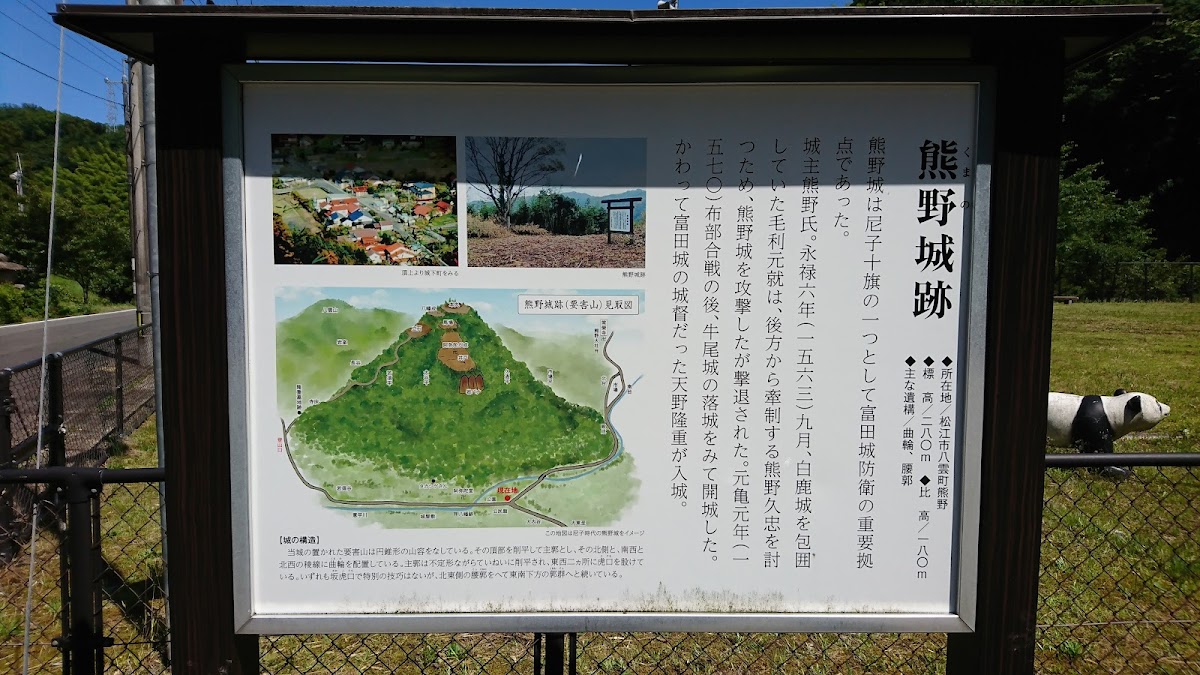
Kumano Castle, located in Yakumo-cho, Matsue City, Shimane Prefecture, is a mountain castle that functioned as an important branch castle of the Amago clan during the Sengoku period. Also known as “Izumo Kumano Castle” and “Yogaiyama,” this castle, counted as one of the Amago’s Ten Fortresses, was an indispensable strategic base for the defense of Gassan-Toda Castle. This article provides a detailed overview of Kumano Castle, including its history, structure, highlights, and access methods.
History and Lords of Kumano Castle
Construction and Development by the Kumano Clan
Kumano Castle is believed to have been built in the 15th century by Kumano Hisatada. The Kumano clan was a powerful family in the Izumo Province, holding considerable influence in the region. Built around the summit of Yogaiyama, Kumano Castle developed into a strong mountain castle that skillfully utilized the natural terrain.
The Kumano clan was subordinate to the Amago clan, and as an important branch castle of the Amago clan, whose base was Gassan-Toda Castle, they developed and strengthened Kumano Castle. The “Ten Amago Castles” refer to the ten important branch castles protecting Gassan-Toda Castle, the Amago clan’s main castle, and Kumano Castle held a particularly important position among them.
Battles with Mori Motonari during the Eiroku Era
Kumano Castle first appears on the historical stage in Eiroku 6 (1563). In September of that year, Mori Motonari was besieging Shiraga Castle, but launched an attack on Kumano Castle to eliminate Kumano Hisatada, who was keeping him in check from the rear.
However, the Mori army’s attack was repelled by Kumano Castle’s strong defenses and Kumano Hisatada’s skillful tactics. This battle demonstrated the high defensive capabilities of Kumano Castle and the military prowess of its lord, Kumano Hisatada. The castle’s advantageous terrain as a mountain castle, combined with the defensive structures the Kumano clan had built over many years, proved successful.
The Fall of Gassan-Toda Castle and the Surrender of Kumano Castle
In 1566 (Eiroku 9), Gassan-Toda Castle, the main stronghold of the Amago clan, fell after a long siege by the Mori clan. Following the fall of Gassan-Toda Castle, Kumano Castle was also forced to surrender. As the Amago clan’s sphere of influence collapsed, Kumano Castle also came under the control of the Mori clan.
The Amago Clan’s Restoration Uprising and the Recapture of Kumano Castle
Even after the fall of Gassan-Toda Castle, efforts to restore the Amago clan continued. In response to the uprising of the Amago restoration army, led by Amago Katsuhisa, the Kumano clan rose again. The Kumano clan recaptured Kumano Castle from the Mori forces and once again made it a base for the Amago clan.
During this period, Kumano Castle became one of the important bases for the Amago clan’s restoration movement, supporting Amago activities in the surrounding area. However, the momentum of the Amago restoration army did not last long.
The Battle of Nunobe in 1570 and the Final Surrender
In 1570, the Amago restoration army, led by Amago Katsuhisa, clashed with the Mori army at Mount Nunobe. In this Battle of Nunobe, the Amago army suffered a crushing defeat. Following this defeat, Ushio Castle, another Amago stronghold, fell, and Kumano Castle lost its strategic value, ultimately surrendering.
With this surrender, Kumano Castle withdrew from the turbulent stage of the Sengoku period, ending its military role. It is believed that Kumano Castle was abandoned during the Keicho era.
Structure and Layout of Kumano Castle
A Mountain Castle Utilizing the Topography of Yogaiyama Mountain
Kumano Castle was built on Yogaiyama Mountain, a mountain approximately 300 meters high, offering an excellent vantage point overlooking the surrounding area. Ridges extend south and east from the summit, and Kumano Castle has a typical mountain castle structure, with its baileys arranged in a stepped fashion along these ridges.
As a mountain castle, Kumano Castle featured defensive structures that made maximum use of the natural terrain. By utilizing the steep slopes and ridges, it made enemy intrusion difficult, and the structure allowed for effective defense even with a small number of defending forces.
Arrangement of Baileys and Defensive System
The layout of Kumano Castle centers around the main bailey at the summit, with multiple baileys arranged in a stepped fashion along the ridges. Each bailey was demarcated by earthworks and trenches, and each was designed to function as an independent defensive base.
The main enclosure offered a wide view of the surrounding area, providing a surveillance function that allowed for early detection of enemy movements. Furthermore, the communication routes between the enclosures were designed in a complex manner, suggesting that measures were taken to prevent easy enemy intrusion.
Doinaru and the Kumano Clan’s Residence
At the eastern foot of Yogaiyama mountain lies a residential area called “Doinaru,” where the Kumano clan’s residence is believed to have been located. Kumano Castle, a mountain castle, served as a defensive base during wartime, while daily life was conducted in the residence at the foot of the mountain during peacetime.
The remains of Doinaru reveal traces of the Kumano clan’s life and topographical features indicating its function as a residence. The combination of a mountain castle and a residence is a typical form of mountain castle from the Sengoku period, and Kumano Castle is no exception.
Existing Remains
Currently, the remains of enclosures, earthworks, and moats at the Kumano Castle site are well-preserved. In particular, the earthworks around the main enclosure and the trenches that cut across the ridge are clearly visible, providing valuable information for understanding the structure of the castle at that time.
Furthermore, around Doi-nari at the foot of the mountain, flat areas and traces of earthworks indicating the site of a residence remain, allowing observation of both the living and defensive spaces of the Kumano clan. These remains are valued as important historical sites for understanding the reality of mountain castles during the Sengoku period.
The Role of Kumano Castle in the Amago Ten Castles
The Key to the Defense of Gassan-Toda Castle
The Amago Ten Castles refer to the ten important branch castles that constituted the Amago clan’s defense network centered around Gassan-Toda Castle. Kumano Castle, as one of these, played a crucial role in protecting the area south of Gassan-Toda Castle.
Located south of Gassan-Toda Castle, Kumano Castle functioned as a first-line defensive base against invasions from the Izumo region. It was expected that enemy forces would be stopped at Kumano Castle before reaching Gassan-Toda Castle.
Cooperation with Other Amago Ten Castles
The castles of the Amago Ten Castles were each independent defensive strongholds, yet they also cooperated to form a defensive network protecting Gassan-Toda Castle. Kumano Castle also shared information with other branch castles and dispatched reinforcements as needed.
The fact that Mori Motonari adopted a strategy of capturing these branch castles one by one when conquering the Amago clan demonstrates the importance of the Amago Ten Castles’ defensive network. Kumano Castle’s repelling of the Mori army’s attack in 1563 is a prime example of the effectiveness of this defensive network.
Highlights and Attractions of Kumano Castle
Preservation of Castle Remains
The greatest attraction of Kumano Castle is the excellent state of preservation of its remains as a mountain castle. The main enclosure, second enclosure, third enclosure, and other enclosure groups remain clearly visible, and the earthworks and moats retain their original appearance.
In particular, the moats, which are deep trenches dug into the ridges to prevent enemy intrusion, can be seen in multiple locations at Kumano Castle. Seeing these defensive structures firsthand allows you to experience how mountain castles defended themselves during the Sengoku period.
Stunning Views
From the main enclosure located at the summit of Yogaiyama Mountain, you can enjoy a panoramic view of Matsue city and the surrounding mountains. On a clear day, you can see far into the distance, giving you a real sense of why the castle was built in this location.
While this excellent view was important for military surveillance, it also serves as a spectacular scenic spot for modern visitors. You can enjoy the scenery of the four seasons while reflecting on the Sengoku period.
Ascent Route and Natural Environment
The ascent route to Kumano Castle involves climbing a mountain path, but some sections are well-maintained, making it relatively easy to climb. The climb takes about 30 to 40 minutes one way, so allow about 1 to 1.5 hours for the entire visit.
The natural environment unique to mountain castles is one of their attractions. The castle ruins, surrounded by forest, display different scenery with each season: the fresh green of spring, the deep green of summer, the vibrant autumn foliage, and the snowy landscape of winter. You can spend your time peacefully in a space where nature and history harmonize.
Visitor Guide and Access Information
Location and Basic Information
Location: Kumano, Yakumo-cho, Matsue City, Shimane Prefecture
Castle Type: Mountain Castle
Construction Period: 15th Century
Builder: Kumano Hisatada
Main Lords: Kumano Clan
Remains: Enclosures, earthworks, moats, residence ruins
Access Methods
Access by Car:
- Approximately 15 minutes south from central Matsue City on National Route 432 towards Yakumo-cho
- Approximately 20 minutes by car from Matsue-Nishi IC on the San’in Expressway
- Parking space is limited, so please park in a safe place on the roadside.
Access by Public Transportation:
- Take the Ichibata Bus bound for Yakumo from JR Matsue Station, get off at Kumano bus stop, and walk approximately 20 minutes to the castle entrance.
- Since bus services are limited, we recommend checking the timetable in advance.
Precautions when visiting the castle
- As it is a mountain castle, appropriate clothing and shoes for hiking are necessary.
- Don’t forget insect repellent in summer and warm clothing in winter.
- Bring drinking water with you.
- Be careful as the ground can be slippery during and after rain.
- Cell phone reception is poor in some areas, so we recommend avoiding solo visits.
Estimated time required for visit
- From the entrance to the main enclosure: Approximately 30-40 minutes
- Castle interior tour: Approximately 30 minutes
- Descending the castle: Approximately 20-30 minutes
- Total: Approximately 1 hour 15 minutes to 1 hour 40 minutes
If you want to carefully observe the remains and enjoy taking photographs, it’s best to allow about 2 hours.
Nearby Tourist Attractions
Matsue Castle (National Treasure)
Located approximately 15km north of Kumano Castle, Matsue Castle is one of the twelve remaining original castle keeps and was designated a National Treasure in 2015. Also known as “Chidori Castle,” the top floor offers panoramic views of Matsue city and Lake Shinji. Visiting both Kumano Castle and Matsue Castle will allow you to appreciate the differences between mountain castles and hilltop castles.
Gassan Tomita Castle Ruins
The Gassan Tomita Castle Ruins, the main castle of the Amago clan, are located in Yasugi City, approximately 20km east of Kumano Castle. This castle was the center of the Amago clan’s ten banners and is an essential historical site for understanding its relationship with Kumano Castle. It is also selected as one of Japan’s 100 Famous Castles.
Yaegaki Shrine
Located in Matsue City, Yaegaki Shrine is an ancient shrine dedicated to Susanoo-no-Mikoto and Kushinada-hime, and is known as a shrine for matchmaking. It is a suitable place to visit before or after visiting Kumano Castle.
Lake Shinji
Lake Shinji, the seventh largest lake in Japan, is famous for its beautiful sunsets. The sunsets, especially from autumn to winter, are spectacular and have been selected as one of “Japan’s Top 100 Sunsets.” A recommended itinerary is to enjoy the sunset over Lake Shinji after visiting Kumano Castle.
Historical Value and Preservation Activities of Kumano Castle
Academic Value
Kumano Castle is of high academic value as a historical site that well preserves the structure of a mountain castle from the Sengoku period. It is an important site for understanding the Amago clan’s branch castle system and is a valuable resource for the study of medieval mountain castles.
It attracts attention from castle researchers and history enthusiasts because it allows for observation of even the smallest details of defensive facilities, such as the layout of the baileys, the structure of the earthworks, and the form of the moats. Furthermore, its relationship with the residence ruins at the foot of the mountain provides important information for understanding the lives of samurai during the Sengoku period.
Local Preservation Activities
The Kumano Castle ruins are being protected and maintained by local history enthusiasts and preservation societies. Efforts are being made to create a safe environment for visitors, including maintenance of the approach to the castle and the installation of information boards.
It is also used as a place for local history education, and is sometimes visited by local elementary and junior high school students for their local history studies. Efforts are ongoing to pass on this local historical heritage to future generations.
How to Enjoy Visiting Kumano Castle
Experiencing Historical Romance
The greatest pleasure of visiting Kumano Castle is experiencing the historical romance of the Sengoku period. Numerous dramas are etched into this castle, such as the battle of Eiroku 6 (1563) where the attack of Mori Motonari was repelled, and the struggles of the Kumano clan to restore the Amago clan.
By viewing the remains and imagining how the samurai of that time defended the castle and fought, you can feel history more closely connected.
Photo Spots
Kumano Castle is also a great spot for photography. There are various subjects to photograph, such as the view from the main enclosure, the depth of the moats, and the beautiful curves of the earthworks. Photography is especially recommended during the early morning hours when sunlight streams in, and in the soft evening light.
The combination of the castle ruins and the changing seasons is also appealing; you can enjoy different expressions depending on the season you visit: cherry blossoms in spring, lush greenery in summer, colorful foliage in autumn, and snowscapes in winter.
As a Mountain Castle Trekking Trip
Climbing to Kumano Castle can also be enjoyed as a moderately strenuous trek. The elevation difference is about 200 meters, making it a course suitable for beginners to intermediate hikers. You’ll be able to refresh both your mind and body while walking through nature.
For those who enjoy visiting mountain castles, it’s a must-visit castle, representing Shimane Prefecture’s mountain castles.
Summary
Located in Yakumo-cho, Matsue City, Shimane Prefecture, Kumano Castle is an important mountain castle that played a key role in the defense of Gassan-Toda Castle as one of the Ten Banners of the Amago clan. Built in the 15th century by Kumano Hisatada, Kumano Castle holds a significant place in history, having been the site of fierce battles against Mori Motonari during the Sengoku period and serving as a base for the Amago clan’s restoration movement.
Its robust structure, utilizing the terrain of the fortified mountain, well-preserved remains such as baileys, earthworks, and moats, and the magnificent views from the main enclosure are major attractions. As a valuable historical site where one can experience the reality of a Sengoku-era mountain castle, it is a place well worth visiting for history buffs and castle enthusiasts.
When visiting Matsue City, why not also visit Kumano Castle along with the national treasures Matsue Castle and Gassan Tomita Castle? You’ll gain a deeper understanding of Izumo’s history during the Sengoku period. While climbing the castle requires preparation for a mountain hike, the historical value and natural beauty that await visitors are well worth the effort.
--680x450.png)