A Complete Guide to the History and Highlights of Yabase Castle (Kotoura-cho, Tohaku-gun, Tottori Prefecture)
What is Yabase Castle?
Yabase Castle is a Japanese castle ruin located in Yabase, Kotoura-cho, Tohaku-gun, Tottori Prefecture. Also known as Ooe Castle and Tateishi Castle, it played an important role as a strategic point in eastern Hoki Province during the Sengoku period. Currently designated as a historical site by Kotoura-cho, the castle ruins remain right next to Yabase Station on the JR San’in Main Line.
The most distinctive feature of Yabase Castle is that the castle grounds were divided north and south by the construction of the San’in Main Line. Because the station building was constructed within the castle grounds, two bailey remains are now located north of the tracks, and remnants of stone walls can still be seen. The castle ruins are only about 300 meters in a straight line from the Sea of Japan, and it was built as a flatland castle close to the sea.
Located in the central part of Hoki Province but belonging to Tohaku District, Yatsuhashi Castle has a history of being ruled by many powerful forces from the medieval to the early modern period, including the Amago, Mori, Nanjo, Nakamura, Ichihashi, Ikeda, and Tsuda clans.
History of Yatsuhashi Castle
Construction by the Yukimatsu Clan and Early History
Yatsuhashi Castle is known as the ancestral residence of the Yukimatsu clan, who were vassals of the Hoki Yamana clan. It is said that the castle was built by Yukimatsu Masamori, and the Yukimatsu clan ruled this area for generations. As a powerful local lord, the Yukimatsu clan played an important role in the control of eastern Hoki Province.
Yatsuhashi Castle, functioning as the residence of the Yukimatsu clan, was both a center of governance for the surrounding region and a strategically important military point in eastern Hoki. Its location near the Sea of Japan and at the intersection of major roads made it a highly valuable location both economically and militarily.
The May Collapse of Daiei and the Rule of the Amago Clan
The history of Yatsuhashi Castle underwent a major transformation in 1524 (Daiei 4). In this year, Amago Tsunehisa invaded Hoki Province, the so-called “May Collapse of Daiei.” The Amago clan, based in Izumo Province, was advancing their invasions of surrounding provinces in an attempt to seize hegemony in the Chugoku region, and Hoki Province became one of their targets.
After capturing Yatsuhashi Castle, Amago Tsunehisa appointed Yoshida Sakyo-no-suke as its commander, making it a crucial base for controlling Hoki Province. During this period, Yatsuhashi Castle functioned as a central fortress in the Amago clan’s control of Hoki, becoming a base for exerting influence over the surrounding region. The Yukimatsu clan lost their castle in this attack, and Yatsuhashi Castle came under the direct control of the Amago clan.
The Struggle Between the Amago and Mori Clans
From the mid-to-late Sengoku period, Yatsuhashi Castle became the battleground for the struggle between the Amago and Mori clans, the two major powers of the Chugoku region. Hoki Province, located on the border between these two powers, was frequently embroiled in conflict, and Yatsuhashi Castle was strongly affected.
As the Mori clan expanded its power, the Amago clan’s territory gradually shrunk. From the Eiroku era (1558-1570) to the Tensho era (1573-1592), the battles between the two powers in Hoki Province intensified, and the ownership of Yatsuhashi Castle fluctuated. Ultimately, the Mori clan prevailed, and Yatsuhashi Castle came under their influence.
Even during the Azuchi-Toyotomi period, the area around Yatsuhashi Castle remained an exclave of the Mori clan, but later, the Nanjo clan briefly controlled the area, resulting in a complex web of power relationships.
Castle Lords in the Early Edo Period
In 1600 (Keicho 5), after the Battle of Sekigahara, Nakamura Kazutada became the ruler of Hoki Province and entered Yonago. At this time, Nakamura Kazue, Kazutada’s uncle, became the lord of Yatsuhashi Castle with a 30,000 koku stipend. During the Nakamura clan’s rule, the castle was reportedly developed with the western side as the main keep and the eastern side as the second keep, surrounded by a moat.
In 1609 (Keicho 14), Ichihashi Nagakatsu was appointed lord of Yatsuhashi Castle from Imao in Mino Province. Although the Ichihashi clan’s rule was relatively short, they continued to maintain and manage the castle.
In 1617 (Genna 3), Ikeda Nagaaki became the castle lord. The Ikeda clan was a branch of the Ikeda family of the Tottori Domain and governed the surrounding area from Yatsuhashi Castle.
In 1632 (Kanei 9), the Tsuda clan took control of the area, and they ruled Yatsuhashi until the Meiji Restoration. During the Tsuda era, the castle functioned as a fortified residence, and its role as an administrative center in peacetime became stronger. Throughout the Edo period, Yatsuhashi Castle continued to occupy an important position as the center of regional governance.
Structure and Layout of Yatsuhashi Castle
Location and Topography of the Castle
Yatsuhashi Castle is a flatland castle built on a small hill approximately 15 meters above sea level. While the elevation difference is not particularly high, it offers a panoramic view of the surrounding plains. The castle’s northern side is close to the Sea of Japan, providing a strategic location for guarding against sea invasions.
The hill on which the castle was built is long and narrow from east to west, and the castle’s layout took advantage of this topography. Its strategic location, facing a major highway and controlling a key transportation hub, was one of the reasons Yatsuhashi Castle was considered important.
Layout of the Main Enclosure and Second Enclosure
According to records from the early Edo period, Yatsuhashi Castle was laid out with the main enclosure (Honmaru) on the west side and the second enclosure (Ninokuruwa) on the east side. The Honmaru, as the core of the castle, is thought to have housed the lord’s residence and important facilities. The Ninokuruwa likely contained defensive structures protecting the Honmaru and residences for retainers.
Currently, the castle grounds are divided by the San’in Main Line, making it difficult to grasp the overall layout of the castle at the time. However, the two remaining enclosure sites north of the tracks suggest that multiple enclosures were arranged in a stepped fashion. It is also estimated that the castle grounds extended south of where the station building now stands.
Remains of Stone Walls and Moats
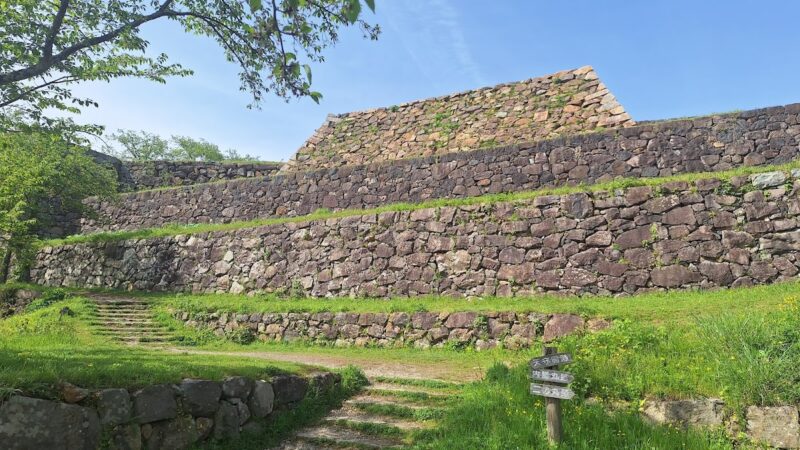
The most important remains currently identifiable at the Yatsuhashi Castle site are the stone walls. A short climb up the stairs on the small hill in front of JR Yatsuhashi Station reveals a small section of stone wall on the left. This stone wall is thought to have been built as part of the castle’s defensive structure.
Interestingly, some of the remaining stone walls contain stones with holes. It has been suggested that these stones may have been repurposed from materials originally used for other purposes, or that they were processed to fulfill a specific function. Given the castle’s proximity to the sea, it’s also possible that fishing-related materials were repurposed.
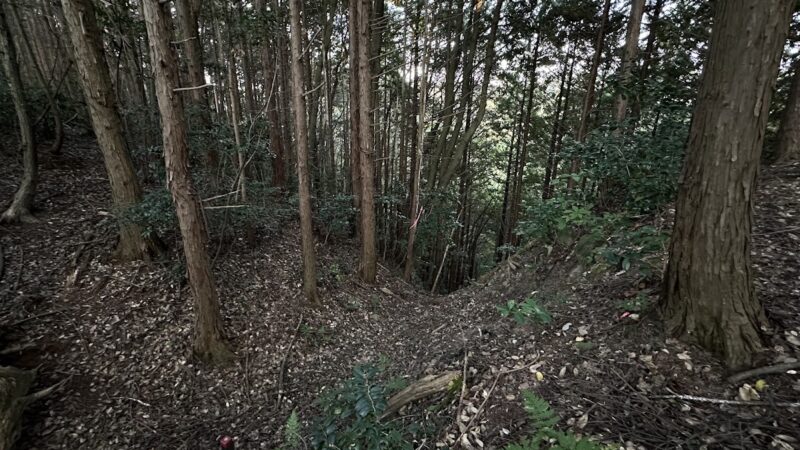
Edo period records indicate that the castle was surrounded by a moat. While this has since been filled in or lost due to modernization, it is presumed that the castle grounds were once demarcated by a water or dry moat.
Division of the Castle Grounds by the San’in Main Line
In the Meiji era, the construction of the San’in Main Line significantly impacted the Yabashi Castle ruins. The castle grounds were divided north and south to accommodate the railway tracks, and the JR Yabashi Station building was constructed within the castle grounds.
This excavation work resulted in the loss of many of the castle’s remains, making it difficult to understand its original layout. However, conversely, the fact that the castle ruins remain in such an easily accessible location right next to the station makes it a convenient historical site for visitors.
Currently, two bailey remains are preserved in relatively good condition on the north side of the railway tracks, allowing visitors to experience a glimpse of the castle’s original atmosphere. While much of the southern castle area has been lost due to the station building and surrounding development, research is ongoing to estimate its former extent based on topography and old maps.
Highlights and Current State of Yatsuhashi Castle
Preservation as a Kotoura Town Designated Historic Site
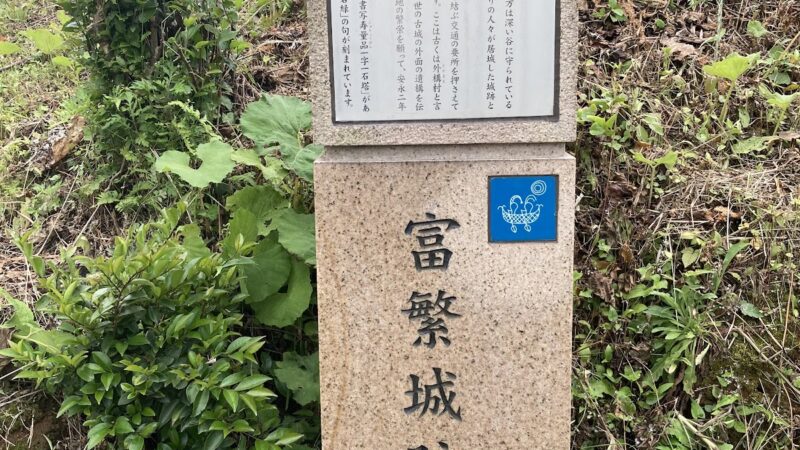
The Yatsuhashi Castle ruins are protected as a designated historic site of Kotoura Town. As an important cultural property that conveys the town’s history, information boards and other resources are provided to visitors.
Access to the castle ruins is excellent; you can reach the ruins immediately after alighting at JR Yatsuhashi Station. The small hill in front of the station is part of the castle ruins, and you can climb the stairs to view the remains. The unusual situation of the station building itself being located within the castle grounds is an interesting case study when considering the relationship between the railway and the castle ruins.
Points of Interest Regarding the Stone Walls
The main highlight when visiting the Yatsuhashi Castle ruins is the remaining stone walls. While not large in scale, they are valuable historical remains that showcase stonework techniques from the Sengoku period to the early Edo period.
When observing the stone walls, pay attention to the way the stones are stacked and processed. By examining details such as how perforated stones are used and how the size and shape of the stones are combined, you can understand the castle-building techniques of the time.
Surrounding Historical Environment
Several historical sites related to the castle remain around the Yatsuhashi Castle ruins. Temples and shrines associated with the castle lord, such as the family temple of the Yukimatsu clan, are also nearby, allowing you to explore the remnants of the castle town.
There are also other historical sites scattered throughout Kotoura town dating from the medieval to early modern periods. Visiting these sites along with the Yatsuhashi Castle ruins will provide a deeper understanding of the region’s history. This area boasts a multifaceted history, including a history of maritime transport taking advantage of its proximity to the Sea of Japan, and its development as a post town along a major highway.
Points to Note When Visiting
When visiting the Yatsuhashi Castle ruins, there are several points to keep in mind. First, the castle ruins are divided by the railway tracks, so crossing the tracks is not permitted. Only the area north of the station is accessible for viewing.
The remains are small, and only a portion of the stone walls remain, so those expecting a large-scale castle may be disappointed. However, its convenient location and the fact that it can be visited in a short time make it an ideal stop as part of a castle tour in Tottori Prefecture.
The area surrounding the castle ruins is residential, so consideration for nearby residents is necessary when visiting. Parking is available in front of the station, but long-term parking should be avoided.
Yatsuhashi Castle and the Sengoku Period History of Hoki Province
The Position of Yatsuhashi Castle in Hoki Province
Hoki Province corresponds to the central-western part of present-day Tottori Prefecture. During the Sengoku period, it was divided into East Hoki and West Hoki, resulting in a complex political situation. Yatsuhashi Castle, as one of the central fortresses in eastern Hoki Province, significantly influenced the regional military balance.
Hoki Province was a border region influenced by powerful surrounding daimyo such as the Amago clan of Izumo Province, the Mori clan of Aki Province, and the Yamana clan of Inaba Province. Therefore, strategically important castles like Yatsuhashi Castle were subject to the struggles of these forces, and their allegiance frequently changed.
The Amago Clan’s Rule of Hoki and Yatsuhashi Castle
The “Daiei May Collapse” of 1524, when Amago Tsunehisa invaded Hoki Province, was a crucial turning point in the Sengoku period history of Hoki Province. Through this invasion, the Amago clan brought most of Hoki Province under their control and utilized Yatsuhashi Castle as a vital base.
The placement of Yoshida Sakyo-no-suke as castle commander indicates that the Amago clan considered Yatsuhashi Castle not merely a provincial castle, but a core element of their Hoki rule. From Yatsuhashi Castle, it was possible to monitor and control various castles in eastern Hoki Province and the surrounding areas, making it an indispensable base for maintaining the Amago clan’s sphere of influence.
The Rise of the Mori Clan and the Shift in Power
From the mid-to-late 16th century, as the Mori clan rapidly expanded its power, the Amago clan’s control in Hoki Province began to waver. Through Mori Motonari’s skillful diplomacy and military strategies, the Amago clan gradually found themselves at a disadvantage.
From the Eiroku to the Tensho eras, battles between the two forces were repeatedly fought in Hoki Province. Yatsuhashi Castle was also the target of multiple battles, and it is believed that its rulers changed hands several times. Ultimately, when the Amago clan was destroyed, Hoki Province came under the influence of the Mori clan, and Yatsuhashi Castle also came under the control of forces affiliated with the Mori clan.
The Nanjo Clan and Yatsuhashi Castle
Although Hoki Province was under the control of the Mori clan, the situation changed again when Toyotomi Hideyoshi’s invasion of the Chugoku region began. During this period, the Nanjo clan, a powerful local lord in Hoki Province, rose to prominence, and for a time, the area around Yatsuhashi Castle came under their influence.
The Nanjo clan held a complex position, having defected from the Mori clan and sided with the Toyotomi, but they maintained a certain level of power in eastern Hoki Province. While historical records are limited regarding the role of Yatsuhashi Castle during this period, it is believed to have functioned as part of the Nanjo clan’s sphere of influence.
Yatsuhashi Castle and Jinya Control in the Edo Period
Castle Development during the Nakamura Clan Era
After the Battle of Sekigahara, Hoki Province came under the rule of Nakamura Kazutada, and his uncle, Nakamura Kazushige, became the lord of Yatsuhashi Castle with a 30,000 koku domain. It is believed that during this period, Yatsuhashi Castle underwent development as a modern castle.
The layout, with the main keep on the west and the second bailey on the east, was clearly defined, and a defensive system with a moat surrounding the castle was constructed. This can be considered a period of transformation from a military base of the Sengoku period to a governing center of the Edo period. Although the Nakamura clan’s rule was short-lived, they played a crucial role in the modernization of the castle. It is presumed that the basic structure of the castle, including the construction of the stone walls and the layout of the buildings, which would be carried over to later eras, was established during this period.
The Ichihashi and Ikeda Clan Eras
Yatsuhashi Castle saw a relatively short period of change in lords: Ichihashi Nagakatsu, who was appointed from Imao in Mino Province in 1609, and Ikeda Nagaaki, who became the lord in 1617. This was part of the Edo Shogunate’s daimyo allocation policy and represented a transitional period until the governing system of Hoki Province stabilized.
During this period, while the castle was maintained, it seems that no large-scale renovations were undertaken. Each lord focused on managing their territory, using Yatsuhashi Castle as their base to govern the surrounding area.
Tsuda Clan’s Rule of the Jinya (Fortified Residence)
When the Tsuda clan took control of the area in 1632 (Kanei 9), they ruled Yatsuhashi for approximately 240 years until the Meiji Restoration. Under this long period of stable rule, Yatsuhashi Castle functioned as a jinya (fortified residence).
From the mid-Edo period onward, the need to maintain castles diminished in many small domains, and governance began to be carried out in simpler facilities called jinya. Similarly, it is believed that Yatsuhashi Castle’s function as a military facility diminished, and its character as an administrative and residential facility strengthened.
During the Tsuda era, the castle town was developed and industries were promoted, and Yatsuhashi developed as a regional economic center. Taking advantage of its location near the Sea of Japan, the distribution of seafood and commercial activity along the highways became active, contributing to the prosperity of the castle town.
Cultural Value of Yatsuhashi Castle
Historical Value
Yatsuhashi Castle is an important historical site that tells the history of Hoki Province from the Sengoku period to the Edo period. The castle embodies the history of Japan’s transition from the medieval to the early modern period, encompassing the conflict between the two major powers of the Chugoku region, the Amago and Mori clans, the frequent changes in castle lords in the early Edo period, and the long-term stable rule of the Tsuda clan.
In particular, its role as the site of Amago Tsunehisa’s invasion of Hoki during the “Daiei May Collapse” holds significant importance in the study of regional history during the Sengoku period. Through the history of Yatsuhashi Castle, we can understand the relationship between the central government and local powers, and the rise and fall of power in border regions.
Archaeological Value
The stone walls and bailey remains at the Yatsuhashi Castle site are valuable resources for studying castle construction techniques from the Sengoku period to the early Edo period. In particular, the use of perforated stones reveals unique regional construction techniques and the actual practices of stone repurposing.
While the division of the castle grounds due to the construction of the San’in Main Line is unfortunate from the perspective of preserving the remains, the exposed cross-section has also made it easier to understand the castle’s structure. Further excavations may reveal even more detailed information about the castle’s structure. ### Significance in Local History
Yatsuhashi Castle is an important element of Kotoura Town’s historical identity. Located in the heart of the town, the castle ruins, cherished by the local people, also function as a base for local history education and cultural activities.
Its designation as a Kotoura Town Historic Site is proof that the local community cherishes its own history. Efforts continue to pass on the region’s historical characteristics to future generations through the preservation and utilization of the castle ruins.
Access and Visiting Information for Yatsuhashi Castle
Transportation Access
Access to Yatsuhashi Castle Ruins is very convenient. You can reach the castle ruins immediately after alighting at Yatsuhashi Station on the JR San’in Main Line. Since the station itself is located within the castle grounds, it’s practically a 0-minute walk from the station.
Access by Train:
- Immediately after alighting at Yatsuhashi Station on the JR San’in Main Line
- Approximately 40 minutes from Tottori Station
- Approximately 50 minutes from Yonago Station
Access by Car:
- Approximately 10 minutes from Kotoura-Higashi Interchange on the San’in Expressway
- Use the public parking lot in front of Yatsuhashi Station
Estimated Visit Time
A visit to Yatsuhashi Castle Ruins takes approximately 30 minutes to 1 hour. The castle ruins are not large, and the main remains are limited, so a short visit is possible.
Even if you want to carefully observe the stone walls and examine the surrounding terrain, 1 hour should be sufficient. This historical site is suitable for visiting in combination with other castle ruins and tourist attractions in Tottori Prefecture.
Facilities for Visitors
Information boards are installed at the castle ruins, providing basic information about the castle’s history and structure. However, there are no detailed explanations or museums, so researching the historical background beforehand will allow for a deeper understanding.
While the castle ruins are generally open to visitors, some areas are adjacent to residential areas, so consideration for local residents is necessary during your visit. Also, some areas are close to the railway tracks, so please exercise caution regarding safety.
Nearby Tourist Attractions
When visiting the Yatsuhashi Castle ruins, we recommend also visiting other tourist attractions in Kotoura Town.
- Nariishi Beach: A beautiful coastline facing the Sea of Japan, characterized by the sound of waves.
- Oyama Falls: A scenic spot representing the natural beauty of Kotoura Town.
- Kotoura Town Historical and Folk Museum: A facility where you can learn about the history of the region.
Furthermore, Kotoura Town is rich in seafood, and you can enjoy fresh seafood such as rock oysters and squid. Why not enjoy the local cuisine along with your castle ruins visit?
Summary
Yatsuhashi Castle is a historically important castle site located in Kotoura Town, Tohaku District, Tottori Prefecture. Beginning as the residence of the Yukimatsu clan, the castle was the stage for the Sengoku period’s struggle between the Amago and Mori clans, and continued under the rule of the Nakamura, Ichihashi, Ikeda, and Tsuda clans during the Edo period, before reaching the Meiji Restoration.
Although the castle grounds are now divided by the JR Yatsuhashi Station, the remaining stone walls and bailey remains offer a glimpse into its former glory. Protected as a designated historical site by Kotoura Town, it is an important cultural asset that conveys the history of the region.
With excellent transportation access and a short visit possible, it’s a historical site that can be easily visited when in Tottori Prefecture. It’s a place that those interested in the history of Hoki Province from the Sengoku to Edo periods, and those interested in Japanese castles, should definitely visit.