Complete Guide to Notsu Castle | A Thorough Explanation of its History and Remains in Kotoura-cho, Tohaku-gun, Tottori Prefecture
What is Notsu Castle?
Notsu Castle is a medieval castle located in Notsu, Kotoura-cho, Tohaku-gun, Tottori Prefecture. Also known as “Maki Castle,” it is a hill castle/sea castle built on a hill overlooking the Sea of Japan. Currently protected as a Kotoura-cho designated cultural property (designated June 2, 1975, registered as a former Akasaki-cho designated cultural property), it is an important historical site indispensable to understanding the medieval history of Hoki Province.
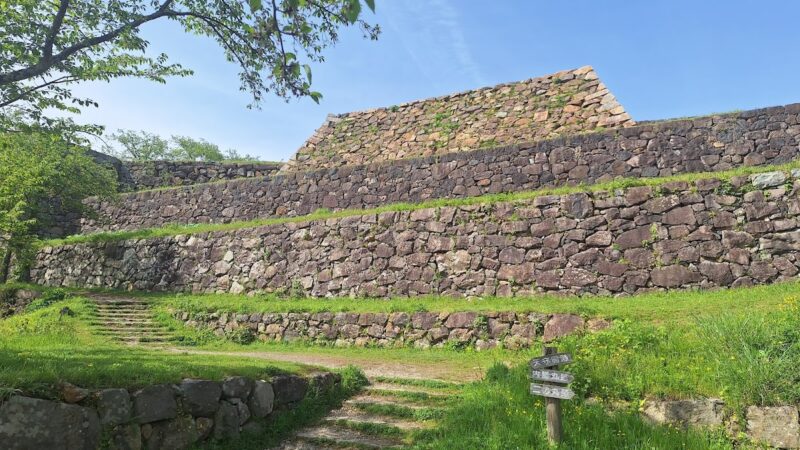
From the castle ruins, one can enjoy a panoramic view of the Sea of Japan, demonstrating its strategic location controlling a key point for maritime traffic at the time. As a typical example of a medieval castle in Tohaku-gun, defensive structures such as baileys, cliffs, earthworks, dry moats, gates, earthen bridges, and watchtower bases remain in excellent condition.
History of Noritsu Castle
Construction History and Builder
The exact construction date of Noritsu Castle is unknown, but it is said to have been built by the Maki clan. The Maki clan was a powerful local family in Hoki Province, controlling the Noritsu village area. The castle’s alternative name, “Maki Castle,” is derived from its construction by the Maki clan.
There are various theories regarding the construction period, but records suggest it was built sometime between the Kamakura and Nanboku-cho periods. At that time, Hoki Province was under the influence of the Rokuhara Tandai in Kyoto, and it was common for local families to build castles to protect their territories.
Castle Lord and Rokuhara Tandai in the Kamakura Period
Records indicate that Kasuya Shigeyuki, who served the Rokuhara Tandai, was the castle lord during the Kamakura period. The Rokuhara Tandai was an organization established by the Kamakura Shogunate in Kyoto, responsible for controlling the samurai of western Japan. The Kasuya clan held a position similar to a shogunate representative in Hoki Province, and it is believed they governed the surrounding area from their base at Notsu Castle.
Relationship between the Nanboku-cho Period and the Nawa Clan
During the Nanboku-cho period, Notsu Castle developed a deep connection with the Nawa clan. The Nawa clan was a powerful force in Hoki Province, producing Nawa Nagatoshi, who supported Emperor Go-Daigo and contributed to the overthrow of the Kamakura Shogunate.
It is believed that Akasaka Yukikiyo and Notsu Atsutada served as lords of the castle, serving as vassals of the Nawa clan. Local histories such as the *Hoki Mindanki* record the names of these individuals, suggesting that Noritsu Castle was an important base for the Nawa clan’s control of the eastern coastline of Hoki Province.
The Nawa clan was based at Senjōzan, but they valued coastal castles like Noritsu Castle to secure transportation routes along the Sea of Japan. It is presumed that the port of Noritsu functioned as a hub for the transport of goods and the transmission of information.
From the Sengoku Period to the Abandonment of the Castle
During the Sengoku period, Hoki Province became a battleground for powerful forces such as the Amago, Mōri, and Hashiba (Toyotomi) clans. It is thought that Noritsu Castle was also involved in these power struggles, but detailed records do not remain.
The castle is estimated to have been abandoned during the Tenshō era (1573-1591). The Tensho era was a period of unification of Japan, from Oda Nobunaga to Toyotomi Hideyoshi, and in the Chugoku region, the Mori clan was in the process of becoming subordinate to Hashiba Hideyoshi. During this time, many medieval castles lost their strategic value and were abandoned. It is believed that Noritsu Castle also ended its role within this trend.
On the other hand, in the Edo period, Noritsu Village came under the control of the Tottori Domain and developed into a peaceful farming village. The castle ruins were affectionately known as “Shiroyama” (Castle Mountain) by the local people, and this memory has been passed down to the present day.
Layout and Remains of Noritsu Castle
Structure and Characteristics of the Castle
Noritsu Castle is a castle that possesses characteristics of both a hill castle and a sea castle. It employs a terraced layout, with the main enclosure located on the top of a hill and multiple enclosures arranged on the slopes. Taking advantage of its location facing the sea, the structure was designed to withstand attacks from the sea.
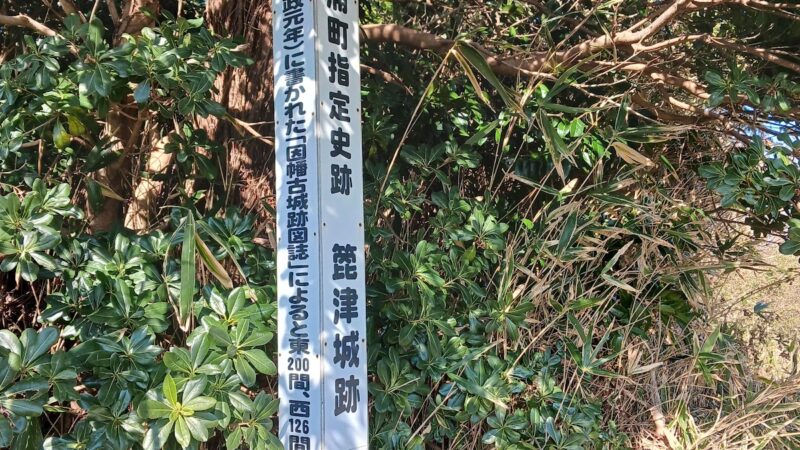
The castle grounds extend approximately 200 meters east-west and 150 meters north-south, a standard size for a medieval local lord’s residence. From the main enclosure, one can overlook the Sea of Japan, the settlement of Noritsu, and the surrounding roads, demonstrating the strategic advantage of its location, which combined both surveillance and defensive functions.
Explanation of Major Remains
Enclosure Remains
Several enclosure remains can be identified within the castle grounds. The main enclosure, located at the highest point, is presumed to be the site of the lord’s residence and command post. The second and third enclosures are arranged around the main enclosure, each demarcated by cliffs and earthworks.
The flat surfaces of the enclosures remain clearly visible, allowing for the imagination of the original building layout. While archaeological excavations have been limited, surface observations have partially confirmed traces of post holes and foundation stones.
Cliffs
Cliffs are constructed between enclosures, or around the outer perimeter of enclosures. A kirigishi (a type of fortified cliff) is a defensive structure created by artificially cutting into a natural slope to make it steeper, serving to make enemy intrusion difficult.
The kirigishi at Noritsu Castle are approximately 2 to 5 meters high and can still be clearly observed today. The kirigishi around the main enclosure, in particular, are well-preserved and serve as valuable resources for learning about medieval castle defense techniques.
Earthworks
Earthworks were built along the edges of the enclosures. Earthworks are embankment-like defensive structures made by piling up earth, serving to protect the castle from attacks by arrows and stones.
The earthworks at Noritsu Castle are approximately 1 to 2 meters high and are particularly noticeable at the boundary between the main enclosure and the second enclosure. It is presumed that fences or walls were built on top of the earthworks, further enhancing their defensive capabilities.
Dry Moats
Multiple dry moats were dug to strengthen the castle’s defenses. A dry moat is a moat that is not filled with water. It serves a dual purpose: obstructing enemy advances and utilizing the excavated soil for the construction of earthworks.
The dry moats of Noritsu Castle are approximately 3-5 meters wide and 2-3 meters deep, located between the main enclosure and the second enclosure, and on the north side of the castle. While some parts are now buried, their locations can be identified from the topography.
Koguchi (gate)
A koguchi is the entrance to a castle and the most crucial area for defense. At Noritsu Castle, traces of a koguchi can be seen at the entrance to the main enclosure.
It is presumed that the koguchi was not a simple opening, but rather a masugata (square-shaped) structure surrounded by earthworks and stone walls. This design prevented large enemy forces from entering at once, giving the defenders an advantage.
Dobashi (earthen bridge)
An earthen bridge was constructed to cross the dry moat. The earthen bridge was a bridge-like passageway created by leaving a section of the moat unexcavated, and it served as the only access route to the castle.
The earthen bridge at Noritsu Castle was approximately 2-3 meters wide and protected on both sides by dry moats. In times of emergency, the bridge could be destroyed to completely block enemy intrusion.
Watchtower Bases
Watchtower bases were constructed at key locations within the castle. These bases were foundations for watchtowers and attack towers, and were built on a raised platform above the surrounding area.
At Noritsu Castle, traces of a watchtower base have been found in the corner of the main enclosure, suggesting that the surrounding area was monitored from this location. From these bases, it would have been possible to detect the movement of ships in the Sea of Japan and approaching land routes at an early stage.
Cultural Property Designation and Preservation Status of Noritsu Castle
Noritsu Castle ruins were designated as a cultural property of Akasaki Town (now Kotoura Town) on June 2, 1975. Due to the Heisei-era municipal mergers, it is now protected as a Kotoura Town designated cultural property.
Local cultural property preservation groups and history enthusiasts regularly carry out preservation activities such as mowing and installing explanatory signs. Development activities within the castle grounds are restricted to prevent the destruction of the remains, and the medieval castle landscape is well-maintained.
In recent years, it has attracted attention as a tourist resource introducing ancient castle ruins of Hoki Province, and is featured in detail in publications such as the “Illustrated Catalogue of Ancient Castle Ruins of Hoki Province.” Locally, projects introducing ancient castles, such as “Shiro-Totsutan,” are being developed, and the number of visitors from history fans is increasing.
Access and Visiting Information for Noritsu Castle
Location
Address: Noritsu, Kotoura-cho, Tohaku-gun, Tottori Prefecture
Noritsu is a settlement located in the northern part of Kotoura-cho, facing the Sea of Japan. It is relatively easy to access, being close to National Route 9.
Access by Transportation
Access by Car
- Approximately 10 minutes from the Kotoura-Higashi Interchange on the San’in Expressway
- Enter the village from the Noritsu intersection on National Route 9
- Parking: There is no dedicated parking lot for the castle ruins, but there are parking spaces available around the Noritsu Community Center (we recommend checking with locals in advance)
Access by Public Transportation
- From Akasaki Station on the JR San’in Main Line, take the Nichiko Bus and get off at the Noritsu-Higashiguchi bus stop, then walk for approximately 10 minutes
- Bus services are limited, so please check the timetable in advance
Points to Note When Visiting
- Visiting Hours: The castle ruins are always open, but we recommend visiting during daylight hours.
- Estimated Time Required: If you want to leisurely explore the entire castle ruins, it will take about 1-2 hours.
- Attire: Since you will be walking on mountain paths, please wear comfortable clothing and non-slip shoes.
- Notes: The area may be overgrown with grass in the summer. Also, please be careful not to damage the earthworks or cliffs in order to protect the historical remains.
Related Historical Sites in the Surrounding Area
Here are some nearby historical sites that you might want to visit along with Notsu Castle.
- Funagami-yama: A historical site where Nawa Nagatoshi escorted Emperor Go-Daigo. Approximately 30 minutes by car from Notsu Castle.
- Akasaki Port: A port town that retains the atmosphere of the Middle Ages. Approximately 5 minutes by car from Notsu.
- Oyama: A mountain that was revered as a sacred mountain of Hoki Province. Approximately 40 minutes by car from Notsu Castle.
History and Culture of the Notsu Area
Origins of Notsu Village
The place name Notsu has appeared in historical documents since ancient times. “Notsu” is also written as “野津” and is thought to mean “port of the fields.” As a good port facing the Sea of Japan, it has been an important point for maritime traffic since ancient times.
In the Middle Ages, Noritsu formed an independent village and developed under the rule of the Maki and Nawa clans. During the Edo period, it came under the control of the Tottori Domain, and its administrative divisions were reorganized as part of Yasuda Village.
With the implementation of the town and village system in the Meiji era, Noritsu Village, along with the surrounding villages of Umeda, Yusaka, Hachiman, Hikari, and Owari, formed Yasuda Village. During the Showa-era municipal mergers, it became Akasaki Town, and during the Heisei-era mergers, it became the current Kotoura Town.
Industry and Life in Noritsu
The Noritsu area has historically based its economy on fishing and agriculture. Blessed with abundant fishing grounds in the Sea of Japan, it boasts thriving catches of squid, horse mackerel, and mackerel. Rice cultivation and vegetable farming are also practiced, taking advantage of the mild climate.
Noritsu Port still functions as a fishing port, with local fishermen going out to sea daily. There are also shops selling fresh seafood around the port, allowing visitors to enjoy fresh seafood.
Noritsu Police Station and Community Safety
The Noritsu Police Station of the Yabashi Police Station is located in the Noritsu area, protecting the safety of the community.
Noritsu Police Station
- Address: 44-6 Noritsu, Kotoura-cho, Tohaku-gun, Tottori Prefecture 689-2544
- Phone Number: (0858)55-2255
The police officers at the station build close relationships with local residents and conduct crime prevention activities, traffic safety guidance, and elderly care.
Research on Ancient Castles in Hoki Province and the Position of Noritsu Castle
Medieval Castles in Hoki Province
Numerous castles were built in Hoki Province (present-day central-western Tottori Prefecture) during the medieval period. These can be broadly classified into mountain castles, flatland castles, hill castles, and coastal castles.
Noritsu Castle is classified as a hill castle/coastal castle and played an important role as a strategic fortress controlling maritime traffic. Similar coastal castles include Akasaki Castle and Yodoe Castle, forming a network of castles protecting the transportation routes along the Sea of Japan coast.
Old County System and Castle Distribution
From ancient times to the Middle Ages, Hoki Province was divided into several counties. The area where Noritsu Castle is located belonged to the former Yatsuhashi County.
- Former Yatsuhashi District: Noritsu Castle, Akasaki Castle, etc.
- Former Kawamura District: Hagoromoishi Castle, Utsubuki Castle, etc.
- Former Kume District: Misasa Castle, etc.
- Former Aseiri District: Iwakura Castle, etc.
- Former Hino District: Sugafuku Castle, etc.
- Former Aimi District: Yoneko Castle, Odaka Castle, etc.
These castles were built by local powerful families and came under the control of major forces such as the Amago and Mori clans during the Sengoku period.
Current Status of Ancient Castle Site Research
In recent years, interest in ancient castle sites in Hoki Province has been growing, and research and investigations by local researchers and history enthusiasts have become more active. Publications such as “Illustrated Catalog of Ancient Castle Sites in Hoki Province” have been published, and detailed information on each castle has been compiled.
Furthermore, projects introducing ancient castles using characters such as “Shiro Totsutan” are being developed, conveying the charm of history to younger generations. The development of tourist routes combining local temples, shrines, and historical sites is underway, and its utilization as a historical and cultural resource is expected.
How to Enjoy Visiting Noritsu Castle
Points for Observing the Ruins
When visiting Noritsu Castle, paying attention to the following points will allow you to appreciate the castle’s charm more deeply.
- View from the Main Enclosure: Enjoy a panoramic view of the Sea of Japan and the village of Noritsu, and appreciate the importance of its location as a coastal castle.
- Observation of the Cut Slopes: Learn about medieval civil engineering techniques from the artificially carved steep slopes.
- Arrangement of Earthworks and Dry Moats: Observe how the defensive structures are combined.
- Structure of the Entrance: Imagine how the entrance to the castle was defended.
- View from the Watchtower Platform: Experience how far you could see from the watchtower.
A Stroll to Feel the History
While strolling through the castle ruins, you can reflect on the lives and battles of medieval samurai. – The scene of Kasuya Shigeyuki governing this area under the orders of the Rokuhara Tandai during the Kamakura period.
- The scene of the Nawa clan’s retainers working to restore Emperor Go-Daigo to power during the Nanboku-cho period.
- The fate of the castle caught in the power struggles between the Amago and Mori clans during the Sengoku period.
As you walk along, imagining these historical scenes, what is merely a mound of earth transforms into a living stage of history.
Recommended Photo Spots
- View of the Sea of Japan from the Main Enclosure: On clear days, you can even see the Oki Islands.
- Cross-section of the Cliff: Valuable historical evidence of medieval civil engineering techniques.
- Earthworks and Dry Moat: A three-dimensional photograph of the combination of defensive structures.
- Castle Ruins and Settlement: A contrast between the modern townscape of Noritsu and the castle ruins.
Seasonal Attractions
- Spring: Beautiful fresh greenery, the perfect season for exploring the castle ruins.
- Summer: Overgrown vegetation makes viewing somewhat difficult, but the cool sea breeze is refreshing.
- Autumn: The contrast between the autumn leaves and the Sea of Japan is beautiful.
- Winter: Snowfall can make viewing difficult, but you can experience the raw power of the winter Sea of Japan.
Summary
Noritsu Castle is a valuable medieval castle ruin remaining in Kotoura-cho, Tohaku-gun, Tottori Prefecture. Built by the Maki clan, the castle has a history of being ruled by figures such as Kasuya Shigeyuki of the Rokuhara Tandai, and Akasaka Yukikiyo and Noritsu Atsutada, vassals of the Nawa clan.
It possesses characteristics of a hill castle and a coastal castle, and defensive structures such as baileys, cliffs, earthworks, dry moats, gates, earthen bridges, and watchtower bases remain in excellent condition. Although it was abandoned during the Tensho era, it is now protected as a designated cultural property of Kotoura Town and is an important historical site that conveys the medieval history of Hoki Province.
With its location overlooking the Sea of Japan, its clearly preserved remains, and its connection to the Nawa clan, it is a castle of high historical and archaeological value. When visiting Toho District, be sure to visit the Noritsu Castle ruins and experience the history of medieval Hoki Province. Enjoying it in conjunction with local history and culture will surely lead to a deeper understanding and appreciation.
A journey through the ancient castles of Hoki Province, including Noritsu Castle, using the Hoki Province Ancient Castle Sites Illustrated Catalog and related books as references, will be an unforgettable experience for history buffs.