
Komaru Castle, Echizen City (Fukui Prefecture) Complete Guide | The Legendary Castle Ruins of Sasa Narimasa and the Charm of Oda-Toyotomi Style Stone Walls
What is Komaru Castle?
Komaru Castle was a Japanese castle located in Echizen City, Fukui Prefecture, and is now preserved as a prefectural designated historical site. It was a flatland castle built on a hill located on the alluvial fan of Ajimano, formed by the Kuratani River. It is a unique castle structure that incorporated part of the ruins of the ancient temple, Nonomiya-ji.
It was built in 1575 by Sasa Narimasa, a retainer of Oda Nobunaga, but is known as a “legendary castle” that was abandoned after only a little over six years. Despite its short lifespan, its remains possess extremely valuable historical significance as a typical example of Oda-Toyotomi style stone walls, and occupy an important position in castle research.
History of Komaru Castle
Background of Construction: The Arrangement of the Fuchu Three
The history of Komaru Castle is closely related to the establishment of Oda Nobunaga’s rule in Echizen Province. In 1575, after the fall of the Asakura clan, the Ikkō-ikki rebels rose up in Echizen, engaging in fierce battles with the Oda army. Nobunaga thoroughly suppressed the Ikkō-ikki rebellion and pacified Echizen once again.
After this re-pacification of Echizen, Oda Nobunaga entrusted the eight districts of Echizen to Shibata Katsuie, making Kita-no-shō Castle (present-day Fukui City) his residence. At the same time, he established a special governing system in Echizen Fuchu (present-day Echizen City). This was the joint rule of three warlords known as the “Fuchu Three.”
The three appointed as the Fuchu Three were:
- Sasa Narimasa (Constructed Komaru Castle)
- Maeda Toshiie (Entered Echizen Fuchu Castle)
- Fuwa Mitsuharu (Constructed Ryumonji Castle)
These three were granted a combined 100,000 koku in the two districts of Fuchu and were assigned as inspectors to Shibata Katsuie. Upon receiving this appointment, Sasa Narimasa began construction of Komaru Castle as his own residence.
Sasa Narimasa and Komaru Castle
Sasa Narimasa was a samurai known as a senior retainer of Oda Nobunaga, serving Nobunaga as one of the Kurohoro-shu (Black Cloak Corps). In governing Echizen Fuchu, he worked alongside Maeda Toshiie and Fuwa Mitsuharu to stabilize the region and establish a system of governance.
Construction of Komaru Castle began in 1575 (Tensho 3), incorporating the latest castle-building techniques of the time. The castle measured approximately 300 meters east-west and 350 meters north-south, and was planned as a full-fledged flatland castle with inner and outer moats. It had a triple-layered structure consisting of the main keep, second bailey, and third bailey, and was equipped with defensive structures such as stone walls, earthworks, and moats.
A Short-Lived Castle: Abandoned in Just 6 Years
The history of Komaru Castle was extremely short. In 1582, the Honnoji Incident occurred, and when Oda Nobunaga was killed by Akechi Mitsuhide, the system of rule in Echizen changed dramatically. In the subsequent power struggles, Sasa Narimasa left Echizen, and Komaru Castle was abandoned after only a little over six years.
Due to this short period of abandonment, it is highly likely that Komaru Castle was unfinished. However, this short lifespan conversely left behind a valuable legacy in castle history. While many castles reused or modified their stone walls after the Edo period, the stone walls of Komaru Castle were left largely untouched after the castle’s abandonment, preserving the stone wall construction techniques of the Oda-Toyotomi period in almost their original form.
Archaeological Excavation and Historic Site Designation
In the Showa era, the Komaru Castle site was recognized for its academic value, and archaeological excavations were conducted. The investigations revealed the structure of the stone walls, the arrangement of the moats, and the scale of the baileys, confirming that it possesses typical characteristics of Oda-Toyotomi style castles.
Based on these research findings, the Komaru Castle site was designated a historic site of Fukui Prefecture, and preservation measures have been implemented. Excavated artifacts such as roof tile fragments and ceramics also provide insights into the castle’s appearance at the time.
Structure and Characteristics of Komaru Castle
Layout and Bailey Arrangement
Komaru Castle was built as a flatland castle, but its layout skillfully utilizes the natural topography of the hills of the Ajimano alluvial fan. The basic structure of the castle is as follows:
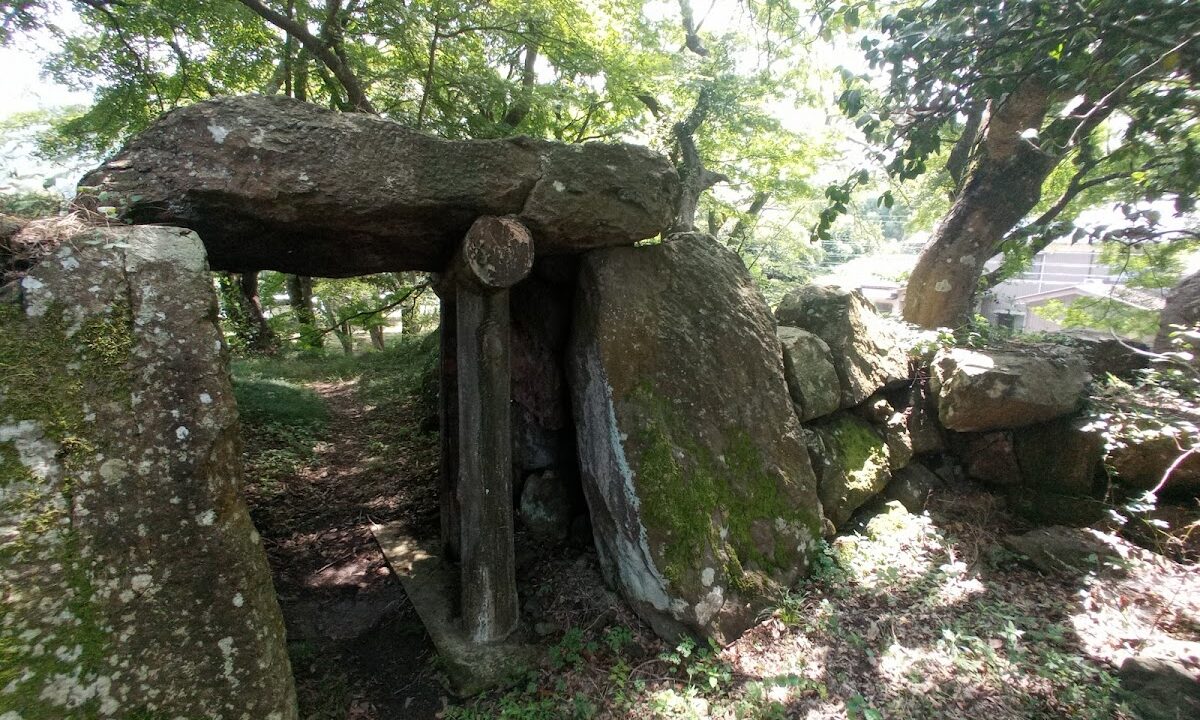
Honmaru: Measuring approximately 50 meters square, it functioned as the core of the castle. Some stone walls remain today, allowing us to imagine its appearance at the time. The Honmaru site is on a small hill, offering a panoramic view of the surrounding area.
Ninokuruwa: A flat area surrounding the Honmaru, it functioned as a defensive line protecting the Honmaru.
Sannomaru: Constituted the outer perimeter of the castle, marking the boundary with the castle town.
Earthwork: A large earthwork, approximately 20 meters at its base and 10 meters high, surrounded the castle. Corner turrets were attached to this earthwork, enhancing its defensive capabilities.
Moat: A moat approximately 20 meters wide surrounded the castle, forming a double moat structure with an inner and outer moat.
Characteristics of Oda-Toyotomi Style Stone Walls
The greatest highlight of Komaru Castle is the remains of Oda-Toyotomi style stone walls. The Oda-Toyotomi style of stonework refers to a stonework technique that developed from the time of Oda Nobunaga to Toyotomi Hideyoshi, and has the following characteristics:
- Nozurazumi: A technique of stacking natural stones with little to no processing.
- Slope: A relatively gentle incline.
- Drainage Function: A structure that allows water to drain through the gaps between the stones.
The stonework of Komaru Castle is highly regarded by castle researchers as a typical example of stonework techniques from this period. It possesses a powerful and simple beauty, different from the refined cut-and-fitted stonework of the Edo period.
Utilization of the Nonomiya Temple Ruins
One of the unique aspects of Komaru Castle is that it was built incorporating part of the ruins of the ancient temple, Nonomiya Temple. It is believed that utilizing the foundation stones and topography of this ruined temple shortened the construction period and reduced costs.
This structure, where a medieval castle is built on top of ancient ruins, is an interesting example in the history of Japanese castles and illustrates the layered nature of history.
Current Highlights of Komaru Castle Ruins
Main Enclosure Site
Currently, the best-preserved part of the Komaru Castle ruins is the main enclosure site. Located on a small hill on the northern edge of the Gobuichi town residential area, the main enclosure site is a flat area of approximately 50 meters square.
From the main enclosure site, you can overlook the surrounding landscape and imagine how the former castle lords looked out over their territory from this spot. The remaining stone walls retain their original appearance from over 400 years ago, evoking a sense of historical romance.
Remains of Earthworks and Moats
A large portion of earthworks remains around the main enclosure site. Its scale, approximately 20 meters at the base and 10 meters high, speaks to the advanced castle-building techniques of the time.
Remains of the moat also remain, and its width of approximately 20 meters suggests the castle’s strong defensive capabilities. Although much of it is now filled in, the topography allows us to imagine its former appearance. ### Observation Points for the Stone Walls
The stone walls of Komaru Castle are a valuable example of Oda-Toyotomi style stone walls, attracting attention from castle enthusiasts and history buffs. Observing them with the following points in mind will allow for a deeper appreciation:
- Type of Stone: Natural stones quarried locally were used.
- Stacking Method: The walls were constructed using the nozura-zumi technique, resulting in irregular stone sizes and shapes.
- Gaps: Gaps exist between the stones, providing drainage.
- Slope: The slope is relatively gentle, a characteristic that differs from Edo period stone walls.
Surrounding Historical Environment
The area surrounding the Komaru Castle ruins boasts the historical landscape of Ajimano. The alluvial fan formed by the Kuratani River, the remains of ancient settlements, and other features create an environment where one can feel the layered history.
Visitor Guide
Access Methods
Access by Train:
- Approximately 15-20 minutes on foot from JR Hokuriku Main Line “Takefu Station”
- Approximately 5 minutes by taxi from Takefu Station
Access by Car:
- Approximately 10 minutes from Hokuriku Expressway “Takefu IC”
- Parking: There is no dedicated parking lot, but you can use the parking lots of nearby public facilities.
Location:
Gobuichi-cho, Echizen City, Fukui Prefecture
Points to Note When Visiting
Komaru Castle Ruins are located in a residential area and are open to visitors at any time. However, please note the following:
- As it is located in a residential area, consideration for nearby residents is necessary.
- While there are information boards and explanatory signs, there are not many.
- The main keep site is on a small hill, so comfortable walking shoes are recommended.
- Caution is needed when it rains, as the ground can be slippery.
Estimated Visiting Time
It is recommended to allow 30 minutes to 1 hour to visit the castle ruins. If you plan to carefully observe the stone walls or explore the surrounding area, we recommend allocating at least one hour.
Nearby Tourist Attractions
When visiting Komaru Castle Ruins, visiting other historical sites in Echizen City will make your historical exploration more fulfilling:
- Echizen Fuchu Castle Ruins: The castle ruins where Maeda Toshiie resided
- Ryumonji Castle Ruins: The castle ruins built by Fuwa Mitsuharu
- Echizen Provincial Government Ruins: The ancient center of Echizen Province
- Tansu-machi Street: A townscape preserving the tradition of Echizen chests of drawers
- Murasaki Shikibu Park: A park commemorating the time when Murasaki Shikibu spent time in Echizen
Historical Significance of Komaru Castle
Value in the Study of Oda-Toyotomi Period Castles
Komaru Castle is an extremely important historical site for understanding castle construction techniques from the time of Oda Nobunaga to Toyotomi Hideyoshi. Because it was abandoned after only six years, the castle’s construction techniques from the Tensho era have been preserved almost entirely intact, without any subsequent alterations.
In particular, the stone walls are highly valued academically as a typical example of Oda-Toyotomi style stone walls, as they were not reused during the Edo period. While many castles had their stone walls rebuilt or stones removed over time, Komaru Castle has undergone minimal such alterations.
A Heritage Site Conveying the History of the Fuchu Three
Komaru Castle is a valuable historical heritage site that tells the story of the era of the “Fuchu Three”: Sasa Narimasa, Maeda Toshiie, and Fuwa Mitsuharu. These three later followed different paths:
- Maeda Toshiie: Laid the foundation for the Kaga domain of one million koku
- Sasa Narimasa: Became lord of Higo Province but fell from power
- Fuwa Mitsuharu: Was dispossessed of his domain after siding with the Western Army at the Battle of Sekigahara
The Komaru Castle ruins hold significant importance as a trace of the time when they jointly ruled Echizen Fuchu in their youth.
The Oda Regime’s System of Governance in Echizen
The existence of Komaru Castle is important evidence of the system Oda Nobunaga established for his rule over Echizen. The dual system of governance, with Shibata Katsuie as the overall governor of Echizen and the Fuchu Three under him, speaks to Nobunaga’s skillful governing strategy.
After the execution of the Ikkō-ikki rebels, in order to stabilize the unstable situation in Echizen, he established a system of mutual surveillance by placing several trustworthy warlords in positions of power. Komaru Castle functioned as a key part of this system.
How to Enjoy Visiting Komaru Castle
Experiencing Historical Romance
The greatest appeal of visiting the Komaru Castle ruins is the opportunity to feel the historical romance of the Sengoku period firsthand. Strolling around while imagining Sasa Narimasa standing on this land, building the castle, and governing the territory over 400 years ago, makes history feel much closer.
The fleeting nature of this “phantom castle,” abandoned after only six years, evokes a profound sense of the impermanence of history and stirs deep emotions.
Enjoying Stone Wall Observation
For castle enthusiasts, observing the stone walls of the Oda-Toyotomi period will be the greatest pleasure. You can carefully observe the simple beauty of the rough-hewn stonework, the ingenious arrangement of natural stones, and the strength of the walls that have withstood over 400 years of wind and snow.
Comparing them with the stone walls of other castles allows you to understand the changes in castle construction techniques over time, leading to a deeper appreciation of the castle.
Photography Tips
Komaru Castle Ruins are also an attractive spot for photography:
- Close-up of the stone walls: Capture the texture of the rough-hewn stonework
- View from the main keep: Include the surrounding scenery in your composition
- Undulations of the earthworks: Utilize the changes in the terrain
- Seasonal changes: Capture the seasonal expressions, such as the fresh greenery of spring and the autumn foliage
Experiencing Local History and Culture
We recommend taking this opportunity to experience the rich history and culture of Echizen City while visiting Komaru Castle Ruins. Echizen flourished as the center of Echizen Province from ancient times and is also known as the place where Murasaki Shikibu lived. Traditional crafts such as Echizen cutlery and Echizen chests of drawers are also thriving.
Visiting local history museums and experiencing traditional crafts in conjunction with your castle ruins visit will make your historical exploration even more fulfilling.
Summary
Komaru Castle is a valuable Sengoku period castle ruin remaining in Echizen City, Fukui Prefecture. Built by Sasa Narimasa in 1575, Komaru Castle was a short-lived castle, abandoned after only a little over six years. However, its remains possess extremely high historical value as a typical example of Oda-Toyotomi style stone walls.
The remains of the main keep, stone walls, earthworks, and moats still exist today and are preserved as a prefectural designated historical site. Despite being located in a residential area, it is a valuable spot where you can feel the spirit of the Sengoku period from over 400 years ago.
As the residence of Sasa Narimasa, one of the “Three Lords of Fuchu,” and as a legacy demonstrating Oda Nobunaga’s rule over Echizen, Komaru Castle ruins hold multifaceted historical significance. It is a historical site worth visiting for castle enthusiasts, history buffs, and anyone interested in local history.
When you visit Echizen City, be sure to visit Komaru Castle ruins and experience the historical romance of the Sengoku period and the charm of Oda-Toyotomi style stone walls.


