
Complete Guide to the History and Highlights of the Sabae Jinya Ruins | Visiting the Legacy of a Castleless Daimyo in Sabae City
Overview
The Sabae Jinya Ruins are the remains of the Edo period domain office located in Yakata-cho, Sabae City, Fukui Prefecture. For approximately 150 years, from 1720 (Kyoho 5) until the Meiji Restoration, it functioned as the political and administrative center of the Sabae Domain, ruled by the Manabe clan, with a 50,000 koku (later 40,000 koku) yield.
The Sabae Domain was a “castleless daimyo,” not permitted to construct a castle with a keep. Therefore, its domain office, the Jinya, was built on the site of the former shogunate magistrate’s office along the Hokuriku Road. While the Jinya buildings no longer remain, a stone monument stands on the site, and remnants of samurai residences, such as long gatehouses, are scattered around.
This is an important historical site indispensable to understanding the history of Sabae City, and its development as a jinya town during the Edo period laid the foundation for present-day Sabae City.
History of Sabae Jinya
Circumstances of the Establishment of the Sabae Domain
The establishment of the Sabae Domain dates back to the time of the 8th Shogun, Tokugawa Yoshimune. In September of Kyoho 5 (1720), when Manabe Akifusa, the lord of the Echigo Murakami Domain at the time, suddenly died, his younger brother, Manabe Akitoki, inherited the family headship.
However, Tokugawa Yoshimune decided to transfer Akitoki from Echigo Murakami to Echizen Sabae. This was not simply a change of domain, but a measure strongly influenced by the shogunate, involving the division and reorganization of the territories of the neighboring Mikuni and Fukui Domains to create the new Sabae Domain with a 50,000 koku stipend.
The Manabe family was descended from Manabe Akifusa, who wielded considerable power as a close advisor during the reign of the sixth shogun, Tokugawa Ienobu. It is believed that Yoshimune, wary of their influence, reassigned them to this new position. This transfer resulted in the creation of a new domain in Sabae, and a jinya town (fortified residence) centered around the jinya.
Construction and Structure of the Jinya
The Sabae Jinya was constructed on the site of the former shogunate magistrate’s office, located along the Hokuriku Road. For the Sabae domain, which was not permitted to possess a castle, the jinya was an important facility that served as both the lord’s residence and an office for conducting the domain’s affairs.
The jinya grounds extended across the area centered around present-day Yakata-cho in Sabae City, surrounded by samurai residences. While the specific architectural style and scale of the jinya are inferred from surviving drawings and documents, it is believed to have been a typical jinya with a palace, offices, and storehouses. While defensive structures such as moats and earthworks were built around the encampment, they were not on the scale of a castle and were primarily administrative facilities.
The Domain Administration of Sabae and the Manabe Family
The Manabe family, as a hereditary daimyo family, faithfully served the shogunate for generations. From the first lord, Manabe Akinobu, they ruled the Sabae Domain for eight generations until the Meiji Restoration.
In their domain administration, they focused on agricultural development and industrial promotion, particularly cultivating local industries such as lacquerware and textiles. These industrial development policies can be said to have laid the foundation for Sabae City’s later reputation as a center for eyeglasses and textiles.
During the late Edo period, the Sabae Domain was also caught up in the turmoil of the times. During the Boshin War, they sided with the new government and functioned as one of the new government’s bases in the Hokuriku region. Following the return of the feudal domains to the Emperor in 1869 (Meiji 2), the last lord of the domain, Manabe Akikatsu, became the governor of Sabae Domain. In 1871 (Meiji 4), with the abolition of the feudal domains and establishment of prefectures, Sabae Domain was officially abolished and incorporated into Fukui Prefecture via Sabae Prefecture.
Geography and Location
Location in Sabae City
The Sabae Jinya (fortified residence) site is located in Yakata-cho, the central area of Sabae City. It boasts convenient transportation access, being approximately an 8-minute walk from Sabae Station on the JR Hokuriku Main Line (now the Happy Line Fukui) and approximately a 5-minute walk from Nishi-Sabae Station on the Fukui Railway Fukubu Line.
The current urban area of Sabae has historically developed around this Jinya, and the area surrounding the site remains the city’s administrative and commercial center.
Surrounding Historical Landscape
Around the site of the Sabae Jinya (fortified residence), there are numerous historical sites that retain the atmosphere of the Edo period jinya town.
Of particular note is the nagaya-mon (long gatehouse) of the Ueda family, who served as chief retainers of the Sabae domain for generations. This nagaya-mon was the main gate of a residence belonging to a high-ranking samurai of the time, and it was part of a nagaya (long building) surrounding the property. It is preserved as a valuable relic of a samurai residence from the feudal period.
Furthermore, within walking distance of the Jinya site, there are temples and shrines associated with the Sabae domain and townscapes that retain the atmosphere of the old highway, making it a well-maintained route for historical walks.
Remains and Current Status
Existing Remains
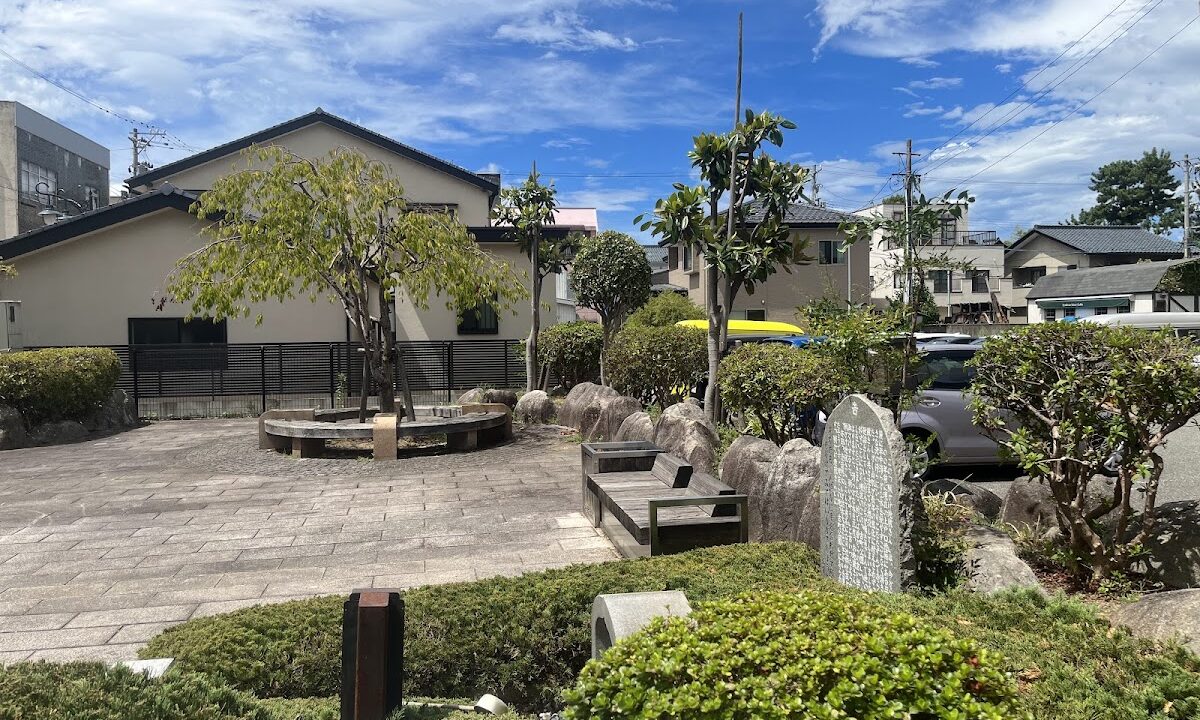
Unfortunately, the buildings of the Sabae Jinya were demolished after the Meiji era, and no buildings remain today. A stone monument inscribed with “Sabae Jinya Site” stands at the Jinya site, indicating that the domain’s administrative office once stood here.
Topographically, remnants of the original land division can be seen in part of the site where the jinya (fortified residence) once stood, but the majority has been altered by urban development. During archaeological excavations, some artifacts and remains related to the jinya were confirmed, and these findings are preserved as historical materials of Sabae City.
Stone Monument and Information Board
A stone monument and information board have been erected at the jinya site to convey history to visitors. The information board provides detailed explanations of the history from the establishment to the abolition of the Sabae Domain, the scale and structure of the jinya, and the genealogy of the Manabe family, aiding understanding during a visit to the site.
The area around the stone monument is like a small plaza and is used as a place of relaxation by local residents.
Related Historical Sites in the Surrounding Area
Although the jinya site itself is small in scale, there are several historical sites related to the Sabae Domain in the surrounding area.
Ueda Family Nagaya Gate: As mentioned above, the nagaya gate of the Ueda family, who served as chief retainers of the domain, is a valuable example of samurai residence architecture from that period. The site remains well-preserved and its exterior can be viewed.
Funatsu Shrine: A shrine revered by the Manabe family, the lords of the Sabae domain, and a place where prayers for the domain’s prosperity were offered.
Seishoji Temple: A temple that became central to the development of Sabae as a temple town, with a history dating back to the Kamakura period. It was a central presence in Sabae even before the establishment of the Jinya town.
A walking route called the “Sabae Historical Road” has been established, including these historical sites. Visiting these sites together with the Jinya ruins allows for a deeper understanding of Sabae’s history.
The Role of the Jinya in the History of Sabae City
From Jinya Town to Modern City
The development of Sabae as a city can be broadly divided into three stages.
The first stage is the development as a temple town of Seishoji Temple, which has continued since the Kamakura period. As a religious city centered around a Shinshu Buddhist temple, many believers gathered, and commerce also flourished.
The second stage involved the establishment of the Sabae Domain in 1720 and the construction of its administrative headquarters (jinya). Samurai residences and merchant districts were developed around the jinya, transforming the area from a temple town to a jinya town. As the political and economic center of the domain, more systematic urban planning was implemented.
The third stage was modernization after the Meiji Restoration. Even after the abolition of the feudal domains and the establishment of prefectures, Sabae continued to develop as a central city in the region, with local industries such as textiles and eyeglasses flourishing. The area around the former jinya site became the administrative and commercial center, forming the core of present-day Sabae city.
Foundation for Industrial Development
The industrial development policies of the Sabae Domain have had a significant impact on the current industrial structure of Sabae City.
During the feudal period, handicrafts such as lacquerware and textiles were encouraged, and efforts were made to train artisans and improve their skills. This traditional spirit of “monozukuri” (craftsmanship) and the accumulation of technology are believed to have led to the development of the eyeglass frame and textile industries after the Meiji Restoration.
Currently, Sabae City is known as the “city of eyeglasses,” accounting for approximately 90% of domestic eyeglass frame production. This industry is built on a foundation of craftsmanship and the transmission of techniques that have continued since the Edo period.
Access and Visiting Information
Transportation Access
Access by Train
- Approximately 8 minutes on foot from Sabae Station on the Hapiline Fukui (formerly the JR Hokuriku Main Line)
- Approximately 5 minutes on foot from Nishi-Sabae Station on the Fukui Railway Fukubu Line
Access by Car
- Approximately 10 minutes from the Sabae Interchange on the Hokuriku Expressway
- Parking: There is no dedicated parking lot, but public parking is available nearby.
Points to Note When Visiting
The Sabae Jinya Ruins are an outdoor historical site, and visits are free. There are no restrictions on admission fees or opening hours, but since it is adjacent to a residential area, consideration for local residents is necessary when visiting.
Estimated Visit Time: If you only want to see the monument and information board at the Sabae Jinya site, it will take about 10-15 minutes. However, if you plan to explore the surrounding area, including the Ueda family’s nagaya-mon gate and the historical road, allow 1-2 hours.
Recommended Visiting Route:
- Start from Sabae Station or Nishi-Sabae Station
- Check the monument and information board at the Sabae Jinya site
- Visit the Ueda family’s nagaya-mon gate
- Visit Seishoji Temple
- Learn more about the history at the Sabae City Manabe Museum (Local History Museum)
Nearby Tourist Facilities
When visiting the Sabae Jinya site, we recommend also visiting the following facilities:
Eyeglass Museum: A facility introducing the history and technology of Sabae’s eyeglass industry. You can also experience making eyeglasses. Approximately 5 minutes by car from the Jinya site.
Sabae City Manabe Museum: A local history museum named after the Manabe family, the lords of the Sabae domain. You can learn in detail about the history and culture of Sabae.
Nishiyama Park: A park selected as one of Japan’s 100 Best Historical Parks. Known for its azaleas, approximately 50,000 azalea bushes bloom there in spring.
Seishoji Temple: A Shinshu Buddhist temple that tells the history of Sabae as a temple town. It boasts a magnificent temple complex and garden.
History and Culture of Sabae City
Origin of the Place Name
There are several theories about the origin of the place name Sabae. The most famous theory is that during the reign of Emperor Sujin, Oohiko-no-Mikoto, who pacified the Hokuriku region, shot an arrow at a bandit that resembled a mackerel’s tail, hence it was called “sabaya” (mackerel arrow), which later transformed into “Sabae.”
This legend is passed down at Funatsu Shrine in Sabae City, where Ohiko-no-Mikoto is enshrined as the deity.
Cultural Properties and Traditions
Sabae City has many cultural properties besides the ruins of the Jinya (fortified residence).
Tangible Cultural Properties: Ueda Family Nagaya Gate, Seishoji Temple buildings, Funatsu Shrine Main Hall, etc.
Intangible Cultural Properties: Echizen lacquerware techniques and eyeglass frame manufacturing techniques, traditional crafts of Sabae
Traditional Events: Azalea Festival, Sabae Craftsmanship Expo, etc.
These cultural heritage sites are important elements that convey the history and traditions that have continued since the Sabae Domain era to the present day.
Historical Significance of the Sabae Jinya Ruins
Research Materials on “Daimyo Without Castles”
During the Edo period, there were approximately 300 daimyo families throughout Japan, but not all of them possessed castles. “Jinya daimyo,” such as the Sabae Domain, were daimyo with relatively small land holdings or those who were not permitted to build castles due to the shogunate’s policies.
The Sabae Jinya site is a valuable historical site for understanding the form of governance and lifestyle of these Jinya daimyo. It serves as an important case study for researching how domains without castles governed their territories and what kind of urban structures they formed.
Position in the History of Domain Administration in the Hokuriku Region
While the Hokuriku region had large domains like the Kaga Domain (Maeda family), it also had several smaller domains like the Sabae Domain. Although under the influence of the Fukui Domain (Echizen Matsudaira family), the Sabae Domain developed its own unique administration and contributed to the region’s development.
In particular, during the political developments in the Hokuriku region at the end of the Edo period, the Sabae Domain played a crucial role by siding with the new government. This decision is believed to have influenced the development of Sabae after the Meiji Restoration.
Passing on the Legacy to the Modern Age
While the Sabae Jinya Ruins are limited in terms of physical remains, they are an important historical heritage site that forms the identity of Sabae City. Efforts are being made to cultivate citizens’ historical awareness and to utilize the site as a tourist resource.
In recent years, as part of its “historical town development” initiative, Sabae City has been working on the preservation and utilization of the historical townscape, including the Jinya Ruins. Attempts are being made to harmonize the town layout and landscape from the Jinya era with modern urban functions.
Summary
The Sabae Jinya Ruins are a historical site that functioned as the administrative center of the 50,000-koku Sabae Domain for approximately 150 years, from 1720 (Kyoho 5) until the Meiji Restoration. Although no buildings remain, stone monuments and information boards convey the history of that time, and related historical sites such as the Ueda Family Nagaya Gate remain in the surrounding area.
The history of the Sabae Domain, ruled by the Manabe family, a “daimyo without a castle,” is a valuable case study for understanding the realities of small and medium-sized domains during the Edo period. It also represented a crucial era that formed the foundation of present-day Sabae City’s industry and culture.
When visiting Sabae, visiting not only the Jinya (fortified residence) site but also the surrounding historical streets, the Sabae City Manabe Museum, and the Glasses Museum will allow you to gain a deeper understanding of the region’s history and culture.
The prosperity of modern-day Sabae, the “city of glasses,” lies in its tradition of “manufacturing” that has continued since the Edo period, with the development of the Jinya town centered around the Sabae Jinya being at its heart. Understanding its history will undoubtedly deepen your appreciation of Sabae’s charm.


