Complete Guide to Nochiseyama Castle (Obama City, Fukui Prefecture) | The Residence of the Takeda Clan, the Shugo of Wakasa Province, and its Historical Value
What is Nochiseyama Castle?
Nochiseyama Castle is a Sengoku period mountain castle built on Nochiseyama Mountain (168 meters above sea level), located south of the city center of Obama City, Fukui Prefecture. Built in 1522 by Takeda Motomitsu, the Shugo of Wakasa Province, it functioned as the political and military center of Wakasa Province for approximately 80 years until the construction of Obama Castle began in 1601.
From the medieval period onward, Obama flourished as an important hub for maritime trade on the Sea of Japan and as a trading port with mainland China. The castle built on Nochiseyama Mountain, towering behind Obama Port, boasted one of the largest scales in Wakasa Province, serving as a strategically important location controlling a key point of maritime traffic.
Although no structures remain today, the remains of the castle, such as baileys, moats, earthworks, and stone walls, are well-preserved, making it a valuable cultural heritage site that conveys the appearance of a mountain castle from the Sengoku period.
History of Goseyama Castle
Background of Construction and the Takeda Clan Era
The construction of Goseyama Castle is rooted in the historical context of the turmoil of the Sengoku period and the establishment of the shugo (provincial governor) power in Wakasa Province. In 1522, Takeda Motomitsu, the shugo of Wakasa, built a full-fledged mountain castle on the summit of Goseyama Mountain, replacing the previous shugo residence.
The Takeda clan was a separate lineage from the Takeda clan of Kai Province and were shugo daimyo who ruled Wakasa Province for generations. Although Goseyama Mountain is relatively low in elevation at 168 meters, it offers a panoramic view of Obama Bay, making it an ideal location for monitoring and controlling maritime traffic. Furthermore, it has been known as a famous mountain since the Manyo period and was a symbolic landmark of Obama.
Because the mountain castle was built on a relatively high mountaintop, it was inconvenient for daily residence. Therefore, a large shugo (provincial governor) residence (the Takeda clan residence), surrounded by a moat, was established at the northern foot of the mountain, where political affairs were conducted during peacetime. This dual structure represents a typical arrangement of mountain castles and residences during the Sengoku period.
The Era of Oda Nobunaga and the Renovations by Niwa Nagahide
In 1573, when the Asakura clan was destroyed by Oda Nobunaga’s invasion of Echizen Province, Wakasa Province was incorporated into the Oda clan’s sphere of influence. In 1573, Niwa Nagahide, a senior retainer of Nobunaga, entered Goseyama Castle as the lord of Wakasa Province.
Niwa Nagahide extensively renovated Goseyama Castle. Stone walls were added to the existing earthen castle, giving it the characteristics of a modern castle. Nagahide, who had experience in the construction of Azuchi Castle, is said to have remodeled the castle into a stone-walled structure modeled after Azuchi Castle.
According to legend, a keep was also constructed during this period, but no reliable historical records remain. However, the remains of the stone walls and the scale of the castle’s layout suggest that a considerable renovation took place.
Changes in Castle Lords under the Toyotomi Regime
After the death of Niwa Nagahide in 1585, Wakasa Province became a direct territory of Toyotomi Hideyoshi. Subsequently, Asano Nagamasa and Kinoshita Katsutoshi (nephew of Kita no Mandokoro) served as castle lords. Kinoshita Katsutoshi was also known as a man of culture and was a poet who studied under Hosokawa Yusai. During his time, it is believed that Goseyama Castle played an important role from a cultural perspective.
Kyogoku Takatsugu’s Arrival and the Abandonment of the Castle
After the Battle of Sekigahara in 1600, Kyogoku Takatsugu was appointed to Wakasa Province with a stipend of 85,000 koku. Takatsugu is known as a samurai and the husband of Hatsuhime, the second daughter of the Asai sisters.
Recognizing the inconvenience of Goseyama Castle, Kyogoku Takatsugu began construction of a new castle (Obama Castle) on a plain facing Obama Bay in 1601. With the construction of Unohama Castle, Goseyama Castle closed its approximately 80-year history and was abandoned.
Structure and Layout of Goseyama Castle
Main Enclosures on the Mountaintop
The central part of Goseyama Castle is located near the mountaintop at an altitude of 168 meters. It has a typical mountain castle structure, with multiple enclosures arranged in a stepped pattern around the main enclosure.
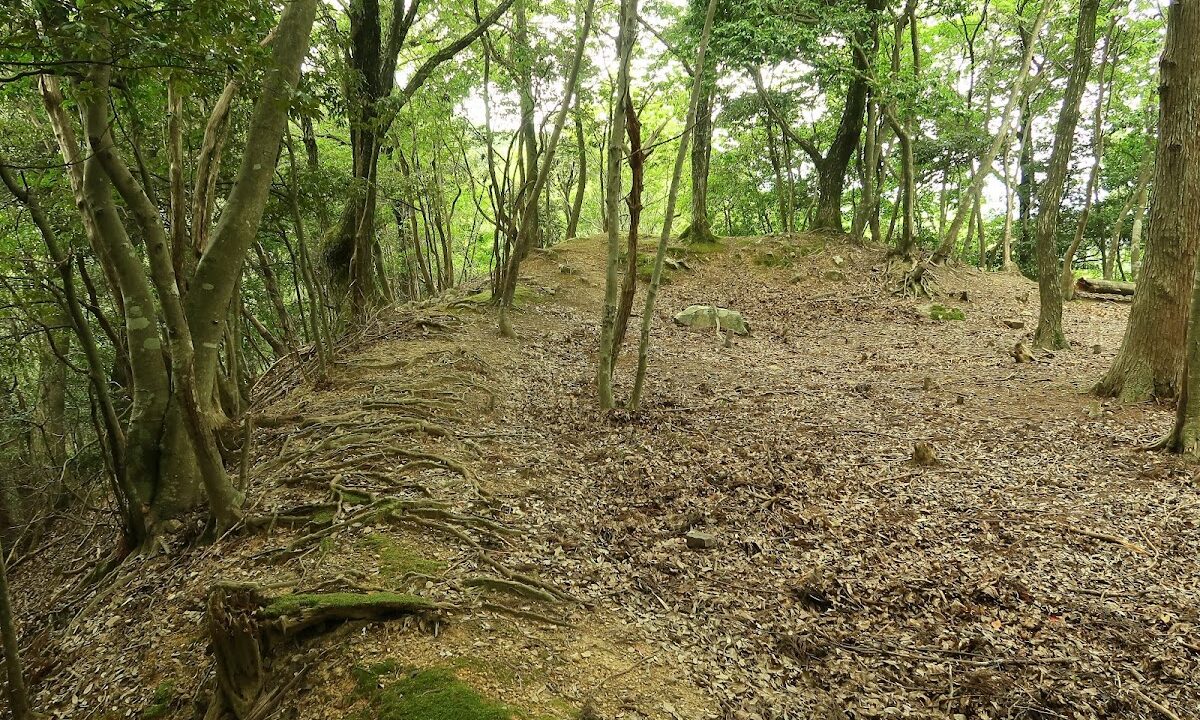
The main enclosure on the mountaintop measures approximately 50 meters east-west and 30 meters north-south, and is surrounded by earthen ramparts. The main enclosure offers a panoramic view of Obama Bay, making it an ideal location for monitoring maritime traffic in Wakasa Bay.
The main enclosure is surrounded by the second and third enclosures, each demarcated by moats and cliffs. Flat areas, believed to be the remains of buildings, can be seen within these enclosures, suggesting the presence of watchtowers and barracks.
Characteristics of the Stone Wall Remains
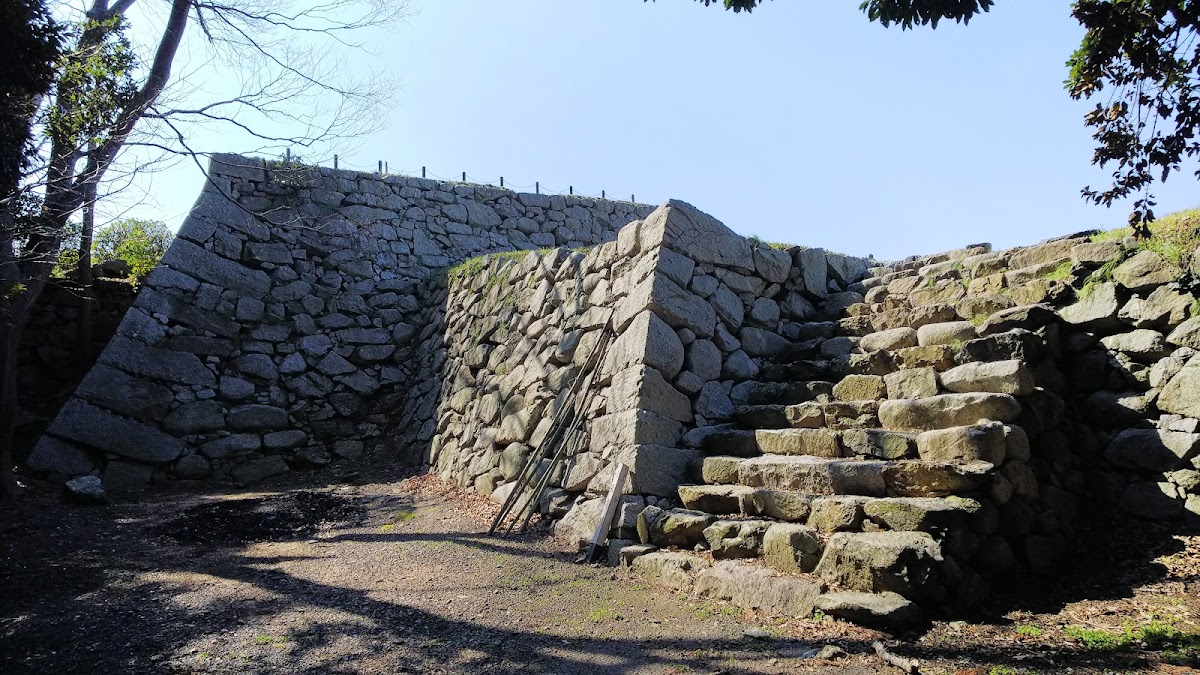
Stone walls, thought to have been added during renovations by Niwa Nagahide, remain in various locations within the castle. These walls were constructed using the nozurazumi technique, indicating a strong influence from Azuchi Castle and Oda-era castles.
The stone walls around the main enclosure are particularly well-preserved, providing valuable insights into the evolution of stone wall construction techniques from the late Sengoku period to the early modern period. The stone used is locally sourced granite, reflecting the actual stone procurement practices of the time.
Defensive System of Moats and Earthworks
The core of the defensive system at Goseyama Castle lies in its moats and earthworks. Moats were strategically placed at various points along the ridge descending from the main enclosure, designed to prevent enemy intrusion.
In particular, three large moats have been identified along the southern ridge, each measuring over 10 meters wide and over 5 meters deep. Earthworks were built on both sides of the moats, further enhancing the defensive capabilities.
The earthworks surround the main enclosure and other major baileys, reaching a height of approximately 2-3 meters. It is believed that fences or walls were built on top of the earthworks, serving both defensive and surveillance functions.
Takeda Clan Residence at the Foot of the Mountain
The remains of a Takeda clan residence have been confirmed at the northern foot of Goseyama Mountain. This residence was a rectangular building surrounded by a moat, measuring approximately 150 meters east-west and 120 meters north-south.
Archaeological excavations have confirmed the remains of foundation stones for buildings, garden structures, and wells, revealing that the site possessed the status of a residence befitting a shugo daimyo (provincial governor). During peacetime, government affairs were conducted here, while in times of war, the lord would retreat to the castle on the mountaintop.
Highlights of Goseyama Castle
Ascent Route and Time Required
The ascent route to Goseyama Castle begins near the eastern exit of the Goseyama Tunnel on National Route 27. Turn north at the traffic light, and the trailhead is located on the way to Hosshinji Temple. An information board is installed at the entrance, and parking is available nearby.
From the trailhead to the main enclosure at the summit, it takes approximately 30-40 minutes on foot along a well-maintained hiking trail. There are several points along the way where you can view the remains of various enclosures and moats; a leisurely round trip will take about 2 hours.
The hiking trail is relatively gentle, but there are some steep sections, so comfortable walking shoes are recommended. Also, insect repellent is necessary in the summer, and warm clothing is necessary in the winter.
View from the Main Enclosure
From the main enclosure at the summit, a spectacular view unfolds, overlooking Obama Bay and the city of Obama. On a clear day, you can see the beautiful coastline of Wakasa Bay stretching into the distance, giving you a real sense of the castle’s strategic importance as a base for monitoring maritime traffic.
The view opens up in all directions—east, west, north, and south—and the view towards Obama Bay to the north is particularly breathtaking. You can enjoy a landscape where the beauty of Mount Gose, cherished as a famous mountain since the Manyo period, and its functionality as a Sengoku period castle are beautifully harmonized.
Remains of Stone Walls and Enclosures
The stone wall remains within the castle grounds are one of the highlights of Goseyama Castle. The stone walls remaining around the main enclosure, in particular, are valuable remains showing traces of renovations by Niwa Nagahide, allowing you to observe the powerful stonework using the Nozurazumi technique up close.
The layout of each enclosure is clearly visible, making this an excellent resource for understanding the structure of a mountain castle from the Sengoku period. The cliffs and earthworks separating the enclosures are also well-preserved, allowing visitors to appreciate the ingenuity of the defensive system.
The Impressive Moats
The large-scale moats built along the ridge are remnants that attest to the high defensive capabilities of Goseyama Castle. The moats on the south side, in particular, are massive, and standing at the bottom of the deeply excavated moats is an awe-inspiring experience.
Moats were not merely ditches; they not only physically hindered enemy advances but also exerted psychological pressure. Experiencing the difficulty of crossing these moats allows one to imagine the harshness of siege warfare during the Sengoku period.
Access and Visit Information
Location and Access
Location: Fushihara, Obama City, Fukui Prefecture
Access by Public Transportation:
- Approximately 20 minutes on foot from JR Obama Line “Obama Station” to the trailhead
- Approximately 5 minutes by taxi from Obama Station
Access by Car:
- Approximately 10 minutes from Maizuru-Wakasa Expressway “Obama IC”
- Via National Route 27 to the vicinity of the eastern exit of the Goseyama Tunnel
- Parking space available near the trailhead (several cars)
Visiting Hours and Precautions
Visiting Hours: Flexible (however, visiting during daylight hours is recommended)
Estimated Time Required: Approximately 1.5 to 2 hours round trip (including viewing of ruins)
Precautions:
- As it is a mountain castle, comfortable clothing and shoes are essential
- Bring drinking water
- Insect repellent spray and a hat are recommended during summer
- Be careful as the ground can be slippery during and after rain
- In winter, snowfall is possible, so prior confirmation is necessary.
- Avoid traveling alone as cell phone reception may be unstable in some areas.
Nearby Tourist Attractions
It is recommended to visit tourist attractions in Obama City in conjunction with a visit to Goseyama Castle.
Obama Castle Ruins: A flatland castle built as a successor to Goseyama Castle. It is currently maintained as Obama Park.
Wakasa History Museum: A museum where you can learn about the history and culture of the Wakasa region. There are also exhibits related to Goseyama Castle.
Obama Nishigumi: An old townscape designated as an Important Preservation District for Groups of Traditional Buildings.
Hosshinji Temple: An ancient temple located near the entrance to Goseyama Castle. It is a temple associated with the Takeda clan.
Sotomon: A scenic spot on Obama Bay, which can be visited by sightseeing boat.
Cultural Value of Goseyama Castle
Importance as a National Historic Site
Goseyama Castle is valued as an important historical site representing the transition period from the medieval to the early modern period in the Wakasa region. The series of events—from a mountain castle built by the Takeda clan during the Sengoku period, to its renovation into an early modern castle using stone walls by Niwa Nagahide, and finally to the relocation of its functions to Obama Castle—represents a typical developmental process in the history of Japanese castles.
The excellent state of preservation of the remains also enhances its value as a cultural property. The baileys, moats, earthworks, and stone walls are clearly preserved, making it a valuable example where the overall layout can be understood without archaeological excavation.
A Heritage Site Conveying the History of Wakasa Province
Goseyama Castle was not merely a military facility, but a place that functioned as the political, economic, and cultural center of Wakasa Province. It is a symbolic presence of the era when Obama prospered as a hub for maritime transport on the Sea of Japan and as a trading port with the continent.
From the castle overlooks Obama Bay, a hub where numerous ships once traversed, exchanging goods and information. Goseyama Castle controlled this trade and served as a key center supporting the prosperity of Wakasa Province.
Designation as a Japan Heritage Site
The cultural heritage of the Wakasa region, including Goseyama Castle, has been designated a Japan Heritage site as “Wakasa’s Cultural Heritage Links Connecting the Sea and the Capital: Wakasa, the ‘Miketsukuni’ (Land of Imperial Provisions), and the Saba Kaido (Mackerel Road).” This designation recognizes Wakasa’s important role as a “Miketsukuni,” supplying seafood to Kyoto from ancient times, and the story of how its trade route, the “Saba Kaido,” has been passed down to the present day.
Goseyama Castle, a key point in this trade network connecting the sea and the capital, occupies an important position as a component of the Japan Heritage site.
Goseyama Castle and Castle Stamps
Castle stamps, which have become popular among castle enthusiasts in recent years, are also issued at Goseyama Castle.
In October 2022, an event was held at the mountaintop where handwritten “Goseyama Memorial Castle Stamps” were sold, attracting many castle enthusiasts. Such initiatives contribute to raising awareness of Goseyama Castle and promoting regional development.
The castle stamps are available for purchase at tourist facilities in Obama City and the Wakasa History Museum, and are popular as souvenirs. The design expresses the unique features of Goseyama Castle, making them valuable collector’s items.
Things to Know Before Visiting Goseyama Castle
Understanding the Historical Background
Before visiting Goseyama Castle, gaining basic knowledge about the history of Wakasa Province and the castle lords such as the Takeda, Niwa Nagahide, and Kyogoku clans will allow for a deeper understanding of the ruins. It is also recommended to study at the Wakasa History Museum before climbing the castle.
Seasonal Charms
Goseyama Castle displays different charms throughout the four seasons. In spring, you can enjoy the fresh greenery; in summer, the lush trees; in autumn, the vibrant autumn leaves; and in winter, the snowy landscape—each season offers a different and beautiful view. However, in summer, be mindful of the heat and insects, and in winter, be aware of the heavy snowfall.
Photography Tips
There are numerous photography spots, including the view from the main enclosure, close-ups of the stone walls, and panoramic views of the moat. Especially on sunny mornings, the sea of Obama Bay sparkles beautifully, making it an excellent time for photography.
Summary
Goseyama Castle is a valuable cultural heritage site from the Sengoku period, a source of pride for Obama City, Fukui Prefecture. From its construction in 1522 to its abandonment in 1601, it functioned as the center of Wakasa Province for approximately 80 years, with historically important figures such as the Takeda clan (Wakasa’s shugo), Niwa Nagahide (a retainer of the Oda clan), various generals under the Toyotomi regime, and Kyogoku Takatsugu serving as its lords.
Built on the summit of Mt. Goseyama, at an altitude of 168 meters, this mountain castle was strategically located overlooking Obama Bay and played a crucial role in monitoring and controlling the hubs of maritime trade in the Sea of Japan and continental trade. The remaining structures, such as baileys, moats, earthworks, and stone walls, convey the appearance of a Sengoku period mountain castle and serve as valuable resources for castle history research.
Located close to Obama city center and relatively easy to access, Goseyama Castle is a recommended spot not only for history buffs and castle enthusiasts but also for general hikers. Please visit Goseyama Castle and experience the spirit of the Sengoku period while immersing yourself in the history and culture of Wakasa.