Matsune Castle, Kanazawa City (Ishikawa Prefecture) | A Complete Overview of a Sengoku Period Mountain Castle that Flourished as a Strategic Point on the Kaga-Etchu Border
Overview of Matsune Castle
Matsune Castle is a Sengoku period mountain castle built on the summit of Mt. Matsune, at an altitude of 308 meters, located on the border between Kanazawa City, Ishikawa Prefecture, and Oyabe City, Toyama Prefecture. Situated at a crucial transportation hub connecting Kaga and Etchu provinces, it functioned as an important military base on the Kaga-Etchu border.
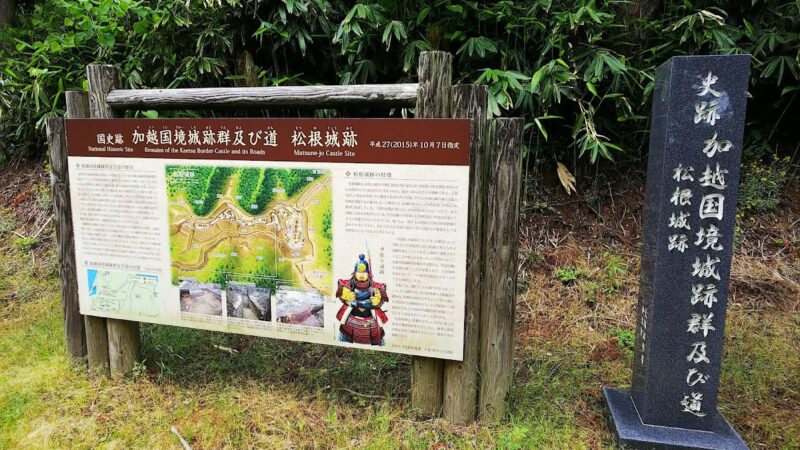
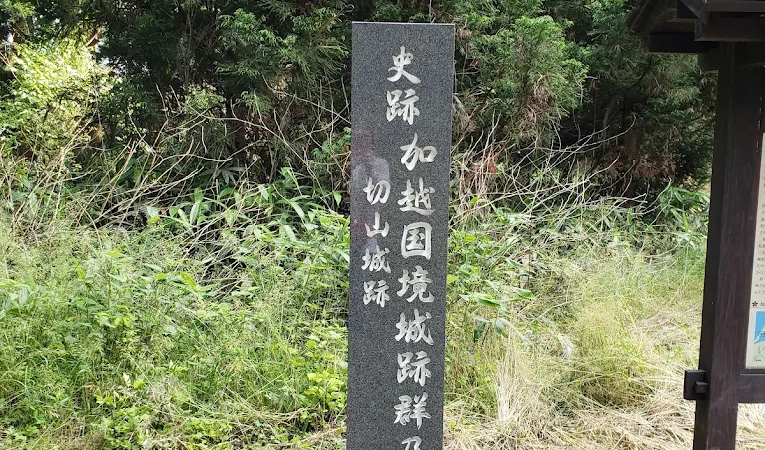
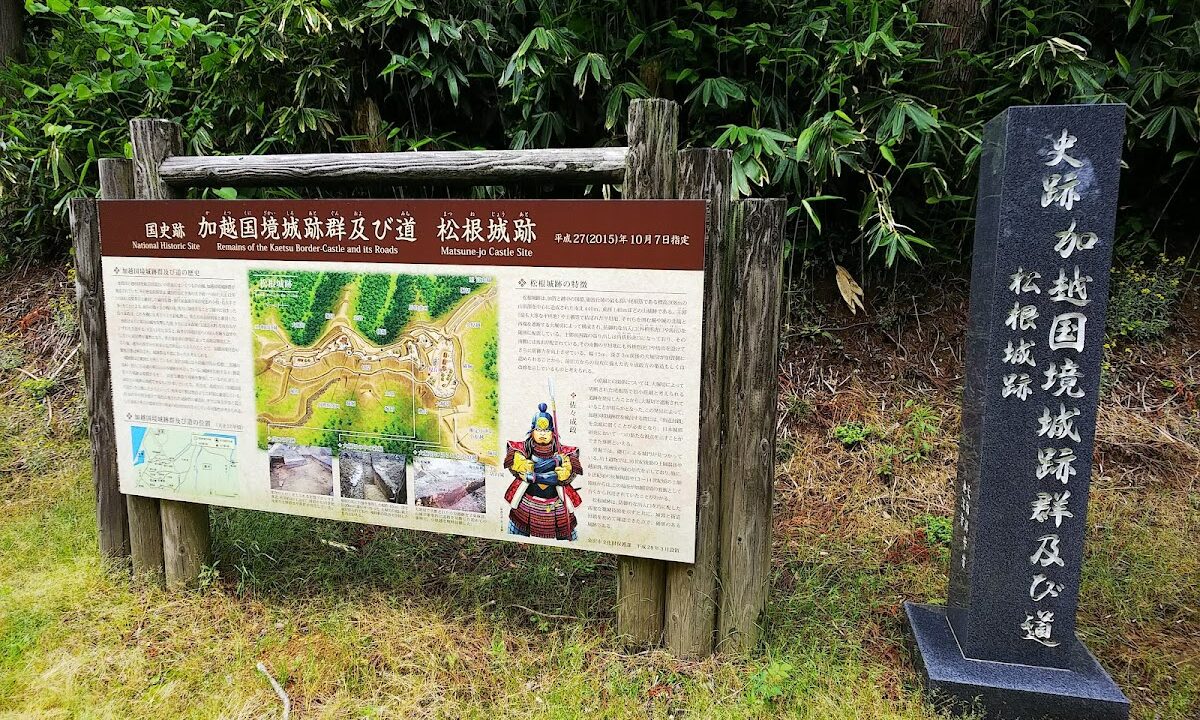
The castle complex boasts a size of approximately 440 meters from north to south and 140 meters from east to west, with a group of baileys spread along a long ridge extending north to south along the border. On October 7, 2015, along with Kiriyama Castle and Ohara Pass, it was designated a National Historic Site as part of the “Kaga-Etchu Border Castle Ruins and Road,” making it a valuable historical heritage site that conveys the border defense system of the Sengoku period.
Basic Information on Matsune Castle
Location: Obara-machi, Kanazawa City, Ishikawa Prefecture and Oyabe City, Toyama Prefecture
Castle Structure: Mountain Castle
Elevation: 308 meters (relative height approximately 100 meters)
Construction Period: Sengoku period
Main Lords: Ikkō-ikki rebels, subordinates of Sasa Narimasa
Year of Abandonment: Late Tenshō period to Keichō period
Remains: Enclosures, earthworks, moats, gates, gate ruins, road ruins
Designated Cultural Property: National Historic Site (designated October 7, 2015)
Common Name/Alternate Name: Castle on the Border of Kaga and Echizen Provinces
History of Matsune Castle
Matsune Castle During the Ikkō-ikki Period
While there are no clear records regarding the construction date of Matsune Castle, it is believed to have been built during the Sengoku period by the Kaga Ikkō-ikki rebels. From the late 15th to the 16th century, Kaga Province was a unique region ruled by the Ikkō-ikki, a branch of the Jōdo Shinshū Honganji sect, and Matsune Castle functioned as a key base for border defense with Etchū Province.
The Kaga Ikkō-ikki ruled Kaga Province for approximately 100 years, claiming it as “a country owned by peasants,” and during that time, several castles were built along the border. Matsune Castle was one of them, playing a crucial role in preparing for invasions from Etchū.
Oda Nobunaga’s Pacification of Kaga
In 1580 (Tenshō 8), Oda Nobunaga dispatched a large army led by Shibata Katsuie to quell the Kaga Ikkō-ikki. This battle brought an end to nearly 100 years of Ikkō-ikki rule, and Kaga Province came under the control of the Oda regime.
After the suppression of the Ikkō-ikki rebellion, Kaga Province was given to Maeda Toshiie, and Etchū Province came under the control of Sasa Narimasa. During this period, Matsune Castle continued to be considered important as a border castle, serving as a strategic base located in a buffer zone between the two powers.
Renovations by Sasa Narimasa and the Confrontation with Maeda Toshiie
In 1584, the Battle of Komaki-Nagakute, a conflict between Toyotomi Hideyoshi and Tokugawa Ieyasu, erupted, and its effects extended to the Hokuriku region. Sasa Narimasa, who ruled Etchū, sided with the Tokugawa, while Maeda Toshiie, who ruled Kaga, sided with the Toyotomi, resulting in a confrontation at the border between Kaga and Etchū.
During this period, Sasa Narimasa extensively renovated Matsune Castle to strengthen border defenses. Narimasa positioned Matsune Castle as a “border castle,” enhancing its defensive facilities in preparation for an invasion by Maeda Toshiie. This renovation transformed Matsune Castle into a formidable mountain castle reflecting the castle-building techniques of the late Sengoku period.
The remains of gates, paths, and the structure of the castle’s entrance discovered through archaeological excavations are believed to be traces of renovations carried out by Sasa Narimasa during this period. In particular, the structure of the castle’s entrance (koguchi) strongly retains characteristics of Sasa Narimasa’s era, demonstrating the high level of castle-building technology at the time.
The Etchu Campaign of 1585 and Matsune Castle
In 1585, Toyotomi Hideyoshi personally led a massive army of 100,000 men to invade Etchu Province to subdue Sasa Narimasa. During this “Etchu Campaign,” Maeda Toshiie advanced into Etchu from the border between Kaga and Etchu provinces as the vanguard of Hideyoshi’s army.
Matsune Castle, serving as a border defense base for the Sasa forces, attempted to halt the Maeda army’s advance, but it is presumed to have fallen due to the overwhelming difference in troop numbers. After this battle, Sasa Narimasa surrendered, and Etchu Province came under the control of Maeda Toshiie.
Abandonment of the Castle and its Aftermath
After the conquest of Etchu Province, Maeda Toshiie, who controlled both Kaga and Etchu Provinces, lost the need for border defense. It is believed that Matsune Castle was abandoned around the Keicho period (1596-1615), having fulfilled its purpose.
Although Matsune Castle was buried in the forest after its abandonment, the remains such as earthworks, moats, and baileys were preserved in good condition, conveying the appearance of a Sengoku period mountain castle to this day.
Layout and Remains of Matsune Castle
Overall Structure
Matsune Castle is a multi-bailey mountain castle built on a ridge extending north-south, centered around the summit of Mount Matsune (308 meters above sea level). The castle area extends approximately 440 meters north-south and 140 meters east-west, spreading out in a long, narrow shape along the ridgeline of the Kaga-Etchu border.
The castle’s structure features a central main enclosure (honmaru) located at the highest point, with multiple smaller enclosures (kuruma) arranged to the north and south of it. This arrangement clearly demonstrates Matsune Castle’s role in protecting the national border, and its design prepares for enemy invasions from both the north and south.
Main Enclosure (Honmaru)
Located on the mountaintop at an elevation of 307.9 meters, the main enclosure forms the core of Matsune Castle. Measuring approximately 30 meters east-west and 40 meters north-south, it is surrounded by earthen ramparts. From the main enclosure, one can overlook both the Kaga and Etchu sides, making it an ideal location for border surveillance.
The earthen ramparts of the main enclosure remain, approximately 1-2 meters high, conveying the appearance of defensive structures from the Sengoku period. The construction techniques of the earthen ramparts reveal the advanced castle-building techniques employed during the renovations by Sasa Narimasa.
Entrance and Gate Remains
One of the most distinctive features of Matsune Castle is the elaborately constructed entrance (koguchi) structure. In particular, archaeological excavations have confirmed the remains of the gate at the northern entrance, revealing a defensive structure skillfully combining stonework and earthworks.
The entrance was not merely an entrance, but a crucial defensive structure to prevent enemy intrusion. The entrance at Matsune Castle was designed to allow for flanking fire attacks on intruders, making it a valuable historical site showcasing the castle-building techniques of the Sasa Narimasa era.
Enclosures
Several enclosures are located to the north and south of the main enclosure. To the south is a large former horse training ground, believed to have been used for soldier training and horse management. This training ground measures approximately 50 meters east-west and 80 meters north-south, making it the largest flat area within Matsune Castle.
The northern enclosures have a long, narrow shape and are arranged in stages along the ridge. These enclosures form a defensive line to prepare for invasions from the north (Etchu side), and are designed with multiple defensive lines to halt enemy advances.
Moats and Dry Moats
Matsune Castle has several moats that separate the enclosures. These moats are dry moats dug to cut across the ridges, and were important defensive structures to prevent enemy intrusion.
In particular, the moats located north and south of the main enclosure reach a depth of 3 to 5 meters, conveying the scale of the large-scale civil engineering work of the time. These moats are thought to have been strengthened during renovations by Sasa Narimasa, demonstrating the high level of castle-building technology in the late Sengoku period.
Road Traces
Excavation surveys have also confirmed the traces of roads connecting the castle. These roads functioned as communication routes between the enclosures, facilitating the smooth movement of troops within the castle. The roads are approximately 1 to 2 meters wide, and sections with earthworks or stone walls on both sides have been confirmed.
Investigations of the road traces have revealed that Matsune Castle was not merely a defensive structure, but a “living castle” that was regularly traversed and managed by people.
Value as part of the Kaga-Etchu Border Castle Group
Significance of National Historic Site Designation
On October 7, 2015, Matsune Castle, along with Kiriyama Castle and Ohara Pass, was designated a National Historic Site as part of the “Kaga-Etchu Border Castle Group and Road.” This designation is highly significant because it evaluates the castle not as a standalone structure, but as part of an entire border defense system.
During the Sengoku period, multiple castles were built along the border between Kaga and Etchu provinces, forming a defensive line that cooperated to protect the border. Matsune Castle, as a central castle in this system, is a valuable historical relic that conveys the reality of the border defense system to the present day.
Relationship with Kiriyama Castle
Kiriyama Castle is a mountain castle located approximately 2 kilometers southwest of Matsune Castle, and it also functioned as a defensive base on the Kaga-Etchu border. The two castles were within visible distance of each other, and it is believed that they maintained communication using smoke signals (beacons) to defend the border.
Kiriyama Castle was also renovated by Sasa Narimasa, and along with Matsune Castle, it played an important role as a “border castle” in preparation for invasions by Maeda Toshiie. Comparative research of the remains of both castles is revealing the overall picture of Sasa Narimasa’s border defense strategy.
The Importance of the Ohara Pass (Ancient Road)
The Ohara Pass was an ancient road connecting Kaga and Etchu provinces, passing directly below Matsune Castle. This road was used as an important transportation route from ancient to medieval times, with a bustling flow of people and goods.
The primary reason for building Matsune Castle was to militarily control this Ohara Pass. By controlling this strategic transportation point, it was possible to prevent enemy invasions and facilitate the movement of one’s own troops. The remains of the Ohara Pass are included in the National Historic Site, preserving the reality of a defense system where the castle and the ancient road were integrated.
Preservation and Maintenance of Matsune Castle
Current Status and Preservation Condition
The Matsune Castle ruins are currently well-preserved within a forest. Although more than 400 years have passed since its abandonment, the main remains—earthworks, moats, baileys, and gatehouses—are clearly visible, conveying the appearance of a Sengoku period mountain castle.
Since its designation as a National Historic Site, Kanazawa City and Oyabe City in Toyama Prefecture have been cooperating in its preservation and management, promoting the protection and utilization of the remains. Maintenance work, such as tree felling and undergrowth clearing, has improved the visibility of the remains, creating a more accessible environment for visitors.
Results of Archaeological Excavations
The archaeological excavations conducted in preparation for the National Historic Site designation yielded numerous important discoveries, including the remains of gates, roads, and the structure of gatehouses. These findings have clarified the structure, changes, and construction techniques of Matsune Castle, significantly contributing to the understanding of the Sengoku period border defense system.
In particular, the structural investigation of the castle’s entrance revealed characteristic castle-building techniques from the era of Sasa Narimasa, uncovering specific castle structures that could not be known from historical documents alone. Further discoveries are expected through continued research.
Development and Utilization Plan
Kanazawa City has formulated a development and utilization plan to balance the preservation and utilization of the Matsune Castle ruins. While prioritizing the protection of the remains, progress is being made in areas such as improving access routes and installing information boards to ensure visitors can safely visit the castle ruins.
In the future, a broader regional utilization plan, linking with Kiriyama Castle and Ohara Pass, is being considered, and the development of a historical tourist route that allows visitors to experience the history of the Kaga-Echizen border is being explored.
Access
Access by Public Transportation
Access to the Matsune Castle ruins is inconvenient by public transportation. The nearest train stations are listed below, but all are a considerable distance from the castle ruins.
From JR Hokuriku Main Line, Kanazawa Station:
Approximately 40 minutes by car from Kanazawa Station (approx. 25 kilometers)
From Ainokaze Toyama Railway, Isurugi Station:
Approximately 20 minutes by car from Isurugi Station (approx. 12 kilometers)
If using public transportation, taking a taxi from either Kanazawa Station or Isurugi Station is the most practical option. However, there are no taxi stands near the castle ruins, so round-trip arrangements will be necessary.
Access by Private Car
Access by private car is the most convenient.
From Kanazawa City Center:
Head south on National Route 159 towards Obara-machi, Kanazawa City. Approximately 40 minutes.
From Oyabe City, Toyama Prefecture:
Take Prefectural Road 73 towards the Ishikawa Prefecture border. Approximately 20 minutes.
From the Hokuriku Expressway:
- Approximately 35 minutes from Kanazawa-Nishi IC
- Approximately 25 minutes from Oyabe IC
Parking and Entrance to the Castle
There is a simple parking area (for a few cars) near the entrance to the Matsune Castle ruins. However, it is unpaved and narrow, making it difficult for large vehicles to enter.
From the entrance to the main enclosure, it takes approximately 30-40 minutes on foot along a mountain path. The hiking trail is well-maintained, but there are steep slopes and slippery sections, so appropriate clothing and shoes for hiking are necessary.
Notes for Visitors
- Clothing: Appropriate clothing for hiking, trekking shoes recommended
- Items to Bring: Drinking water, map, mobile phone (good signal strength)
- Estimated Time Required: Expect approximately 2-3 hours round trip
- Season: Spring to autumn is the best time to visit. Access is difficult in winter due to snow.
- Weather: The ground is slippery and dangerous in rainy weather. Visiting on a sunny day is recommended.
- Beware of Bears: As this is a mountainous area, it is recommended to carry bear bells or other bear deterrents.
Surrounding Facilities
There are no restaurants, convenience stores, or other commercial facilities around the Matsune Castle ruins. It is recommended to eat and shop in Kanazawa city or Oyabe city beforehand.
The nearest tourist information center is the Kanazawa City Tourism Association (inside Kanazawa Station). For detailed information about Matsune Castle and the latest information on visiting the castle, it is recommended to contact the Kanazawa City Cultural Properties Protection Division or the Kanazawa City Tourism Association in advance.
Relationship between Matsune Castle and Maeda Toshiie and Sasa Narimasa
Maeda Toshiie’s Rule of Kaga
Maeda Toshiie served as a senior retainer of Oda Nobunaga and, after the suppression of the Kaga Ikko-ikki rebellion in 1580, was entrusted with the rule of Kaga Province. Toshiie is known as a warrior who made Kanazawa Castle his residence and laid the foundation for the Kaga domain, which was worth one million koku.
Toshiie was highly valued as a close confidant of Toyotomi Hideyoshi and participated in the Battle of Komaki and Nagakute on Hideyoshi’s side. During this period, he faced off against Sasa Narimasa at the border between Kaga and Etchu provinces, and Matsune Castle became the front line between the two.
Sasa Narimasa’s Rule of Etchu
Sasa Narimasa served as a retainer of Oda Nobunaga and participated in the suppression of the Kaga Ikko-ikki rebellion as an assistant to Shibata Katsuie. For his achievements, he was granted the entire province of Etchu, and made Toyama Castle his residence.
Narimasa is known as a warrior with excellent castle-building skills, and he built and renovated several castles within Etchu Province. The renovation of Matsune Castle was part of this effort, and it remains a valuable example of Narimasa’s high level of castle-building skill.
The Confrontation of Two Heroes and Matsune Castle
In 1584, when the Battle of Komaki and Nagakute broke out, Maeda Toshiie (of the Toyotomi side) and Sassa Narimasa (of the Tokugawa side) clashed in the Hokuriku region. The two sides faced off at the border between Kaga and Etchu provinces, maintaining a tense standoff.
During this period, Matsune Castle functioned as a frontline base for the Sassa side, and its defenses were strengthened in preparation for an invasion by the Maeda army. However, when Toyotomi Hideyoshi himself led a large army to invade Etchu the following year, Narimasa was forced to surrender, and Matsune Castle came under the control of the Maeda clan.
The Cultural Value of Matsune Castle
A Heritage Site Conveying the Border Defense System of the Sengoku Period
The greatest value of Matsune Castle lies in the well-preserved remains that concretely demonstrate the reality of the border defense system of the Sengoku period. The remains reveal that Matsune Castle functioned not as a standalone fortress, but as part of a defensive line integrated with Kiriyama Castle and Ohara Pass.
Such a comprehensive representation of a border defense system is rare nationwide, making it of extremely important value in the study of military history during the Sengoku period.
Remains Demonstrating Sasa Narimasa’s Castle Construction Techniques
The structure of the gate and earthworks at Matsune Castle reveals the advanced castle construction techniques of Sasa Narimasa’s era. Narimasa was a warrior who learned the latest castle construction techniques under Oda Nobunaga, and these techniques were utilized in the renovation of Matsune Castle.
In particular, the structure of the gate shows ingenious designs to effectively prevent enemy intrusion, making it a valuable remains that represents the pinnacle of castle construction technology in the late Sengoku period.
A Heritage Site Conveying Regional History
Matsune Castle is also an important heritage site that conveys the historical relationship between Kaga and Etchu provinces. The history of exchange and conflict between the two regions, which has continued since ancient times, is condensed in this castle site.
With its designation as a National Historic Site, Matsune Castle has been re-evaluated as a regional historical heritage site and is positioned as a core element of the region’s identity. In the future, it is expected to be utilized as a base for regional historical education and tourism promotion.
Summary
Matsune Castle is a Sengoku period mountain castle located on the border between Kanazawa City, Ishikawa Prefecture and Oyabe City, Toyama Prefecture. It played an important role as a transportation hub connecting Kaga and Etchu provinces. Built during the Ikko-ikki rebellion, it was later renovated by Sasa Narimasa and subsequently became the front line in the conflict with Maeda Toshiie.
In 2015, it was designated as part of the National Historic Site “Kaga-Etchu Border Castle Ruins and Roads,” and is preserved as a valuable historical heritage site that conveys the border defense system of the Sengoku period. The remains of the main enclosure, baileys, earthworks, moats, and gates are well-preserved, demonstrating the high level of castle construction technology of the time.
Access is most convenient by private car, about 40 minutes from downtown Kanazawa, and a 30-40 minute walk from the entrance to the main keep. We recommend visiting in appropriate clothing and equipment for mountain castle sightseeing. This is a valuable spot where you can experience the appearance of a Sengoku period mountain castle while reflecting on the history of the Kaga-Echizen border.