Hanawa Castle (Ibaraki Prefecture) Complete Guide: A Thorough Explanation of History, Remains, and Access
Located in Ami-machi, Inashiki-gun, Ibaraki Prefecture, Hanawa Castle is one of the important castle ruins of medieval Hitachi Province. Currently selected as one of the “100 Famous Places of Ami-machi,” its remains, such as earthworks and moats, are well-preserved. This article provides a comprehensive explanation of this castle site, from its historical background and layout to its highlights and access methods.
Basic Information on Hanawa Castle
Hanawa Castle is a medieval flatland castle located in Hanawa, Ami-machi, Inashiki-gun, Ibaraki Prefecture. It was built on a plateau extending north from the Hanawa settlement, east of Kimihara Elementary School, at an elevation of approximately 25 meters and a relative height of approximately 20 meters.
Location and Geographical Characteristics
The plateau on which Hanawa Castle was built is a tongue-shaped plateau extending north from a low-lying area near Lake Kasumigaura. The castle’s layout makes full use of the unique topography, with numerous defensive structures utilizing natural fortifications. While the surrounding area is still used for farming and residential purposes, the central part of the castle grounds remains well-preserved.
History of Hanawa Castle
Construction Period and Lord
Regarding the construction date of Hanawa Castle, there is a lack of clear historical records, making a definitive statement impossible. However, it is believed to have been built during the Sengoku period (Warring States period). Southern Hitachi Province was a region where multiple powers, including the Satake, Oda, and Edo clans, vied for supremacy, and Hanawa Castle is presumed to have played an important role in this regional situation.
There are various theories regarding the castle’s lord, but it is considered highly likely that it was built and maintained by a local powerful family. A connection to the Hanawa clan has been suggested due to the place name, but details remain unclear.
Hanawa Castle in the Sengoku Period
Southern Hitachi Province during the Sengoku period was a region where fierce conflicts between the Oda and Satake clans unfolded. The area around Ami Town, where Hanawa Castle is located, is situated on the border between the spheres of influence of both powers, making it a region of high military tension.
In particular, the Oda clan was based at Oda Castle (Tsukuba City), and Hanawa Castle is thought to have been located within or on the border of their sphere of influence. Therefore, Hanawa Castle may have been part of the Oda clan’s network of branch castles.
Period of Abandonment
The exact date of Hanawa Castle’s abandonment is unclear, but it is presumed to have been abandoned either after Toyotomi Hideyoshi’s siege of Odawara in 1590, when Hitachi Province was unified under the control of Satake Yoshinobu, or in 1602, when the Satake clan was transferred to Akita. It is thought that by the Edo period, it had already lost its function as a castle and was used as farmland.
Layout and Structure of Hanawa Castle
Overall Layout
Hanawa Castle is a castle with a multi-bailey layout utilizing a plateau extending northward. The main enclosures are located in two sections to the north, each separated by earthworks and moats. The tip of the plateau is elevated, resembling a watchtower base, and is presumed to have functioned as a lookout or command post.
Structure of the Main Enclosure
The main enclosure is located in the center of the castle grounds and is surrounded by earthworks. The earthworks remain approximately 1 to 2 meters high today, giving insight into the scale of the defensive structures at the time. The interior of the main enclosure is relatively flat, suggesting the presence of buildings, but no foundation stones or other remains have been confirmed.
Second Enclosure and Defensive Structures
The second enclosure is located to the north of the main enclosure. A moat separates the main and second enclosures, forming a defensive line. The second enclosure is also surrounded by earthworks, possessing a similar defensive structure to the main enclosure.
Characteristics of the Moat and Earthworks
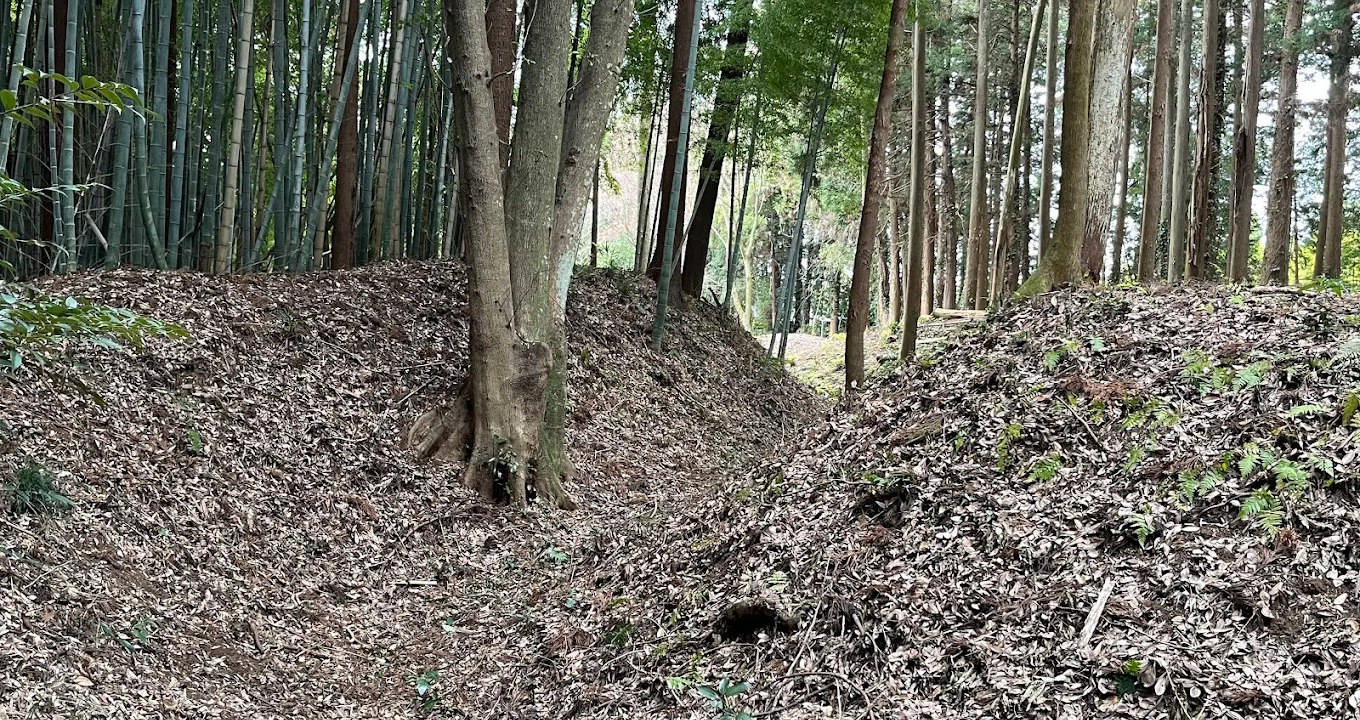
A notable feature of Hanawa Castle’s defensive structures is the well-preserved earthworks and moats. The earthen ramparts surround the enclosure, and their height varies depending on the location, reaching over 2 meters at their highest points. The moat is a dry moat, approximately 5 to 10 meters wide. These remains exhibit the typical form of defensive structures found in medieval castles.
Turret Platform and Entrance
The turret-like elevation at the tip of the plateau is located at the northernmost point of the castle grounds, a suitable location for overlooking the surrounding area. From here, one could see Lake Kasumigaura and the surrounding plateau, suggesting it was an important base for monitoring enemy movements.
The location of the entrance (koguchi) is difficult to determine due to the lack of clear remains, but it is highly likely that it was located on the side of the plateau.
Remains and Highlights of Hanawa Castle
Existing Remains
The following remains can be observed at the Hanawa Castle site:
Earthen Ramparts: The earthen ramparts surrounding the main enclosure and the second enclosure remain in good condition. The earthworks on the north side of the main enclosure are particularly well-preserved, and you can observe an earthwork approximately 2 meters high.
Moat: A moat separating the main enclosure and the second enclosure remains clearly visible. It is approximately 3 to 4 meters deep and is an important defensive structure typical of medieval castles.
Enclosures: The arrangement of two main enclosures extending northward can be confirmed. The flat areas of each enclosure are relatively well-preserved.
Watchtower Platform: The watchtower-like elevation at the tip of the plateau is still clearly visible.
Information Boards and Signs
A signpost reading “Ami Town’s 100 Famous Places: Hanawa Castle Ruins” is installed along the road east of Kimihara Elementary School, indicating the location of the castle ruins. Using this signpost as a landmark makes access to the castle area easy.
Recommended Photo Spots
The following are recommended photo spots at Hanawa Castle Ruins:
- Main Enclosure Earthwork: You can photograph the well-preserved earthwork up close.
- Moat: A panoramic view of the moat separating the main enclosure and the second enclosure.
- View from the Watchtower Platform: The surrounding landscape from the tip of the plateau.
- Around the Information Board: A position where you can get a panoramic view of the entire castle ruins.
Hanawa Castle and Surrounding Castles
Castle Network in the Ami Town Area
In addition to Hanawa Castle, several other medieval castles existed in Ami Town and the surrounding area. It is believed that these castles cooperated with each other, forming a regional defense network.
Nearby major castles include:
- Oda Castle (Tsukuba City): The base of the Oda clan
- Tsuchiura Castle (Tsuchiura City): A key point for water transport on Lake Kasumigaura
- Ushiku Castle (Ushiku City): The residence of the Okami clan
Considering its location relative to these castles, it is highly probable that Hanawa Castle functioned as one of the branch castles within the Oda clan’s sphere of influence.
Characteristics of Castles in Southern Hitachi Province
Castles in southern Hitachi Province are characterized by a large number of flatland castles that utilize the topography of plateaus. Hanawa Castle is a typical example of this, and its layout, utilizing the tip of a tongue-shaped plateau, is a common feature of castles in this region.
Furthermore, due to its geographical location around Lake Kasumigaura, unique defensive strategies specific to the region can be seen, such as the use of water transport and wetlands as natural moats.
Access to Hanawa Castle
Access by Public Transportation
Using Trains and Buses:
- Get off at Arakawaoki Station on the JR Joban Line.
- Approximately 15 minutes by bus or taxi from the station.
- Get off at the Hanawa bus stop and walk for approximately 5 minutes.
Since bus services are limited, it is recommended to check the timetable in advance. Using a taxi is more reliable.
Access by Car
Route from Major Roads:
- Approximately 20 minutes from Sakura-Tsuchiura IC on the Joban Expressway.
- Accessible via Prefectural Roads from National Route 125.
- Setting your navigation to Kimihara Elementary School is convenient.
Parking: There is no dedicated parking lot, but there are parking spaces along the roads around the castle ruins. However, consideration must be given to avoiding disturbing local residents.
Precautions During Visits
- Consideration for Private Property: Some parts of the castle grounds are private property. Do not enter areas marked as “No Entry.”
- Safety underfoot: The area around the earthworks and moats has unstable footing. We recommend wearing comfortable walking shoes.
- Seasonal conditions: In summer, vegetation can be overgrown, making observation of the remains difficult. Visiting from late autumn to early spring is ideal for observing the remains.
- Insect repellent: We recommend bringing insect repellent spray, especially from spring to autumn.
Research and Study of Hanawa Castle
Status of Excavation Surveys
It appears that no full-scale excavation surveys have been conducted at Hanawa Castle. Therefore, detailed information regarding the castle’s structure and age must rely on observations of the ground surface and inferences from historical documents.
Future excavation surveys may provide more detailed information regarding the castle’s construction date, its lord, and its function and role.
Castle Layout Maps and Research Findings
Castle researchers have created castle layout maps, and maps based on actual measurements are available on websites such as “Castle Wanderings.” These maps are valuable resources for understanding the structure of Hanawa Castle.
Future Preservation and Utilization
Hanawa Castle ruins have been selected as one of the “100 Famous Places of Ami Town” and are recognized as a historical asset of the region. Appropriate preservation, management, and utilization are expected in the future.
By improving information boards, developing explanatory materials, and conducting regular maintenance such as grass cutting, more people will be able to understand the historical value of Hanawa Castle and visit it.
Hanawa Castle and the Castle Culture of Ibaraki Prefecture
Characteristics of Medieval Castles in Ibaraki Prefecture
Ibaraki Prefecture is known as a treasure trove of medieval castles, with hundreds of castle ruins confirmed within the prefecture. These castles reflect the complex political situation in Hitachi Province, telling the story of a history where many powers, such as the Satake, Oda, Edo, and Daijo clans, vied for power.
Hanawa Castle is an important historical site that plays a part in Ibaraki Prefecture’s castle culture and is indispensable for understanding the region’s history.
Comparison with other major castles in Ibaraki Prefecture
Comparing Hanawa Castle with other major castles in Ibaraki Prefecture:
Mito Castle: A large-scale early modern castle built as the residence of the Mito Tokugawa family, one of the three main branches of the Tokugawa clan. It differs significantly in scale and character from Hanawa Castle.
Oda Castle: The base of the Oda clan, a nationally designated historical site. It is larger in scale than Hanawa Castle, and archaeological excavations are ongoing.
Kasama Castle: A mountain castle built on the summit of Mt. Sabayama, with valuable remains including stone walls. Its location differs from Hanawa Castle.
Tsuchiura Castle: A flatland castle facing Lake Kasumigaura, now developed as Kamejo Park. Like Hanawa Castle, it is located near Lake Kasumigaura, but its location is closer to the plains.
Hanawa Castle, while smaller in scale compared to these large-scale castles, possesses a typical structure for a local lord’s residence and is an important example for understanding the castle culture of medieval Hitachi Province.
Model Course for Visiting Hanawa Castle
Half-Day Course (Focusing on Hanawa Castle)
- Information Board East of Kimihara Elementary School (10 mins): Confirm the location of the castle ruins and understand the overall layout.
- Visiting the Main Enclosure (20 mins): Observe the earthworks and baileys.
- Observing the Moat (15 mins): Observe the moat separating the main enclosure and the second enclosure.
- Visiting the Second Enclosure (15 mins): Observe the northern bailey and earthworks.
- Visiting the Watchtower Platform (15 mins): Enjoy the view from the tip of the plateau.
Total: Approximately 75 minutes of sightseeing time.
Full-Day Course (Tour of Surrounding Castles)
Morning:
- Visit Hanawa Castle (1.5 hours)
- Visit Oda Castle Ruins (Tsukuba City, 1.5 hours)
Afternoon:
- Visit Tsuchiura Castle Ruins (Kamejo Park) (Tsuchiura City, 1 hour)
- A Walk Around Manabe Elementary School (30 minutes)
This course allows you to efficiently visit the major castles of southern Hitachi Province.
Resources and Information on Hanawa Castle
References
References for learning more about Hanawa Castle:
- Castle Wanderings: Contains layout maps and photographs based on actual measurements, making it ideal for preparation before visiting the site.
- Castles of Ibaraki Prefecture (Wikipedia): Contains a list of castles in Ibaraki Prefecture and basic information.
- Historical Materials of Ami Town: Local history materials published by the Ami Town Board of Education may contain information about Hanawa Castle.
Online Information
The “Castle Wanderings” website features detailed layout maps and 19 on-site photographs of Hanawa Castle, making it extremely useful for gathering information before visiting. Map information showing the castle’s location is also provided.
Local Historical Museums
Historical museums and local history museums around Ami Town may display exhibits and materials related to local castles. It is recommended to check their opening hours before visiting.
Summary: The Historical Value and Charm of Hanawa Castle
Hanawa Castle is a medieval castle site located in Ami Town, Inashiki District, Ibaraki Prefecture. Although small in scale, the remains such as earthworks and moats are well-preserved, making it a valuable example of a typical castle of a local lord in medieval Hitachi Province.
The southern part of Hitachi Province during the Sengoku period was a region where forces such as the Oda and Satake clans vied for supremacy, and Hanawa Castle played an important role in this regional situation. Currently, it is selected as one of the “100 Famous Places of Ami Town” and is preserved as a historical asset of the region.
The charm of Hanawa Castle lies, above all, in its well-preserved remains. For castle enthusiasts, the opportunity to observe the fundamental elements of a medieval castle—such as the earthworks surrounding the main enclosure, the moat separating the main and secondary enclosures, and the watchtower base at the tip of the plateau—is a major draw.
Furthermore, several other major castles of southern Hitachi Province, including Oda Castle, Tsuchiura Castle, and Ushiku Castle, are scattered throughout the surrounding area. Visiting these castles in conjunction with Hanawa Castle will provide a deeper understanding of the region’s medieval history.
A visit to Hanawa Castle will be a valuable opportunity to learn about the castle culture of Ibaraki Prefecture. Be sure to visit the site and experience the atmosphere of the Middle Ages. Exploring the castle grounds using the information boards and observing the remains such as earthworks and moats up close will allow you to imagine the tension of the Sengoku period and the lives of the local lords.
Besides Hanawa Castle, Ibaraki Prefecture boasts many other fascinating castles. Visiting castles such as Mito Castle, Kasama Castle, Sakasai Castle, and Obata Castle, each with its own distinctive remains and history, will provide a richer historical experience. We hope you enjoy exploring the castles of Ibaraki Prefecture, starting from Hanawa Castle.