Complete Guide to Shinowaki Castle (Gifu Prefecture): Exploring the Usu-no-me Moat and the 230-Year History of the Higashi Clan
Shinowaki Castle, located in Yamato-cho, Gujo City, Gifu Prefecture, is a mountain castle that played an important role as the base of the Higashi clan in Mino Province for approximately 230 years during the medieval period. Built on the summit of Mt. Shinowaki at an altitude of 486 meters, this castle is known for its “Usu-no-me Moat,” a group of more than 30 radially arranged ridge-shaped vertical moats, and is designated as a national historic site (designated name: “Higashi Clan Residence Site and Shinowaki Castle Site”).
This article comprehensively explains everything a castle enthusiast and history buff would want to know, from the historical background and structural features of Shinowaki Castle to the highlights to see on site.
Overview of Shinowaki Castle
Shinowaki Castle was a mountain castle that served as the residence of the Higashi clan, who ruled Yamada-sho in Gujo District from the Kamakura period to the Sengoku period. The Higashi clan was a branch of the Chiba clan of Shimosa Province. Their origins trace back to the first generation, Higashi Taneyuki, who moved to Mino Province after receiving the position of newly appointed jitō (land steward) of Yamada Manor in Gujō District following their achievements in the Jōkyū War (1221).
Initially, the Higashi clan was based at Achiba Castle, but later built a new castle on Shinowaki Mountain, which offered superior defenses. Centered around Shinowaki Castle, the Higashi clan ruled this region for eight generations and approximately 230 years, exerting a significant cultural influence.
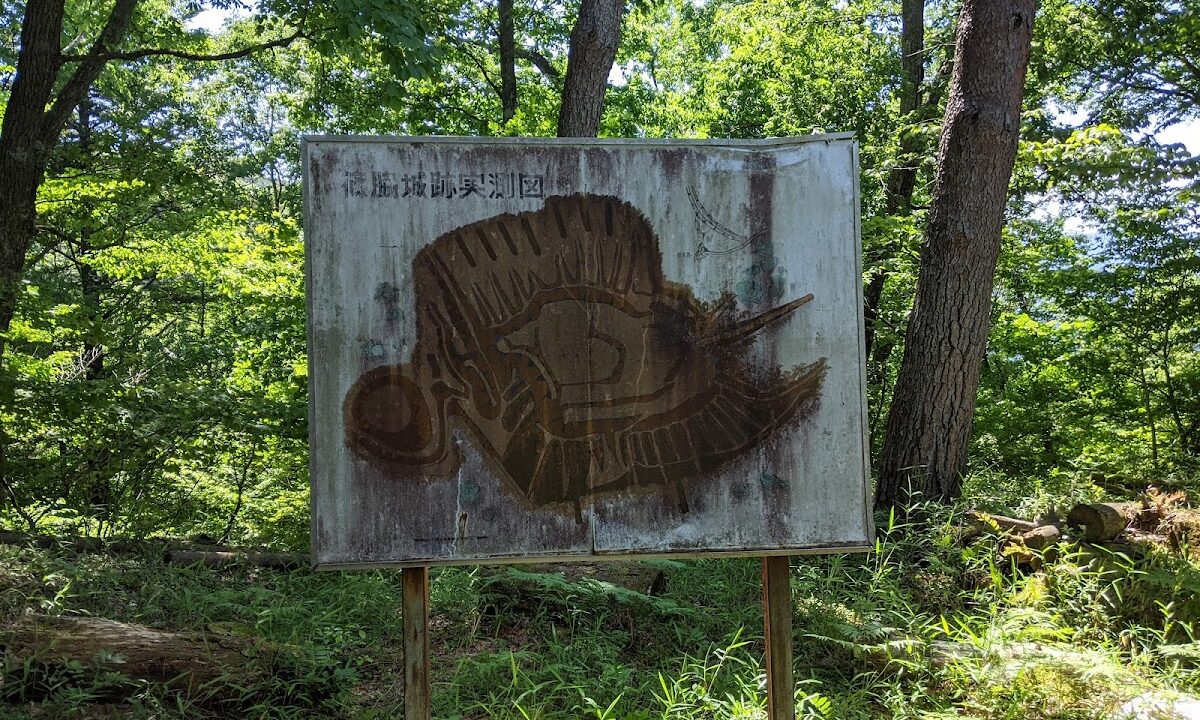
The castle’s most distinctive feature is the series of ridged vertical moats surrounding the main enclosure on the mountaintop. This defensive structure is locally known as “Usu-no-me-bori” (mortar-shaped moats), named for its radial shape resembling the grooving holes of a rice mill. These vertical moats are highly regarded as particularly outstanding historical remains among Japanese mountain castles.
Location and Basic Information
- Location: Shima, Yamato-cho, Gujo City, Gifu Prefecture
- Castle Structure: Mountain Castle
- Elevation: 486 meters
- Relative Height: Approximately 200 meters
- Construction Period: Late Kamakura period to early Muromachi period
- Builder: Higashi clan
- Main Lords: Higashi clan (8 generations)
- Abandonment Period: Tensho era (1573-1592)
- Cultural Property Designation: National Historic Site (designated in 2021)
- Related Facilities: Higashi Clan Residence Garden, Higashi Clan Memorial Hall/Waka Literature Museum
History of Shinowaki Castle
The Higashi Clan’s Move to Mino Province and the Achiba Castle Era
The Higashi clan’s expansion into Mino Province dates back to the Jokyu War (1221). During this rebellion, Higashi Taneyuki, a member of the Chiba clan who distinguished himself fighting on the side of the Kamakura Shogunate, was awarded the position of newly appointed jitō (land steward) of Yamada Manor in Gujō District for his achievements in pursuing and eliminating the manor official of Yamada Manor who had sided with Emperor Go-Toba.
Around 1220, Taneyuki moved to Mino Province and initially built Achiba Castle as his base. The name “Achiba” is thought to originate from Chiba in Shimōsa Province, the ancestral home of the Higashi clan. The Higashi clan expanded their power in this area and grew into a powerful local lord in the Gujō region.
Construction of Shinowaki Castle and the Golden Age of the Higashi Clan
There are various theories regarding the timing of the relocation of their residence from Achiba Castle to Shinowaki Castle, but it is generally believed to have occurred sometime between the late Kamakura period and the early Muromachi period. Mount Shinowaki was higher in elevation than Achiba Castle and offered a more strategic location overlooking a wider area, so it is presumed to have been chosen as the new residence of the Tō clan as their power expanded.
The Tō clan, based at Shinowaki Castle, established control over the Gujō region throughout the Muromachi period. In particular, the 7th head of the clan, Tō no Tsuneyori (1401-1484), was also known as a poet and is an important figure in cultural history as the founder of the “Kokin Denju,” a system for transmitting interpretations of the Kokin Wakashū (Collection of Ancient and Modern Japanese Poems). Tsuneyori was also an excellent military commander and built the Tō clan’s golden age.
The Ōnin War and the Attack by Saitō Myōchin
The greatest crisis for the Tō clan came during the Ōnin War (1467-1477). In 1467, Tō no Tsuneyori went to the Kantō region at the request of the Kantō Kanrei (governor of the Kantō region), Uesugi Fusaaki. Taking advantage of his absence, Saitō Myōchin, the deputy governor of Mino Province, attacked Shinowaki Castle. According to the *Kamakura Ōsōshi*, while Tsuneyori was absent, Myōchin besieged Shinowaki Castle and, after a fierce battle, captured it. However, an interesting anecdote remains regarding this capture. Myōchin was also known as a man of culture and highly valued Tsuneyori’s poetic talent.
After the castle fell, it is said that Myōchin presented Tsuneyori with a waka poem, and in exchange for receiving a famous poem in return from Tsuneyori, returned Shinowaki Castle. This anecdote of the castle’s return through the exchange of a poem is known as an example of the importance placed on culture even during the Sengoku period. However, it is likely that there was actually a political reconciliation process involved, and the exchange of waka poems was probably a symbolic act.
Kokin Denju and Tō Tsuneyori
Tō Tsuneyori possessed exceptional talent not only as a military commander but also as a poet. Tsuneyori learned the secret teachings of the Kokin Wakashū (Collection of Ancient and Modern Japanese Poems) from the Nijō family and became the founder of the “Kokin Denju,” which passed down these teachings to future generations.
In 1478 (Bunmei 10), Tsuneyori performed the Kokin Denju (transmission of the Kokin Wakashū poetry tradition) for Anegakoji Mototsuna, a samurai of Hida Province. This is considered the first recorded instance of Kokin Denju. This tradition was later passed down to figures such as Hosokawa Yūsai and Karasumaru Mitsuhiro, becoming a cultural lineage that continued into the Edo period.
Tsunenori also authored poetry treatises such as the *Tōnoshū Kikigaki*, and was known as a cultured man with a level of education comparable to that of the Kyoto court nobility, despite living in the mountains of Mino Province. Recent archaeological excavations have revealed that an elegant lifestyle, complete with a garden, was lived at the Tō clan residence below Shinowaki Castle.
The Turmoil of the Sengoku Period and the Decline of the Tō Clan
From the late Muromachi period to the Sengoku period, Mino Province became a stage for fierce power struggles. The Tō clan was no exception, becoming embroiled in conflicts with surrounding forces.
During the Tenbun era (1532-1555), the Asakura clan, a powerful daimyo family in Echizen Province, gained influence over the Gujo region. The Higashi clan attempted to maintain their power by strengthening their ties with the Asakura clan, but the situation changed dramatically with the rise of Oda Nobunaga.
From the Eiroku era (1558-1570) onward, as Oda Nobunaga intensified his conquest of Mino Province, the Higashi clan’s position became precarious. Nobunaga used the Mino Three (Inaba Ittetsu, Ujiie Bokuzen, and Ando Morinari) to attack Saito Tatsuoki, capturing Inabayama Castle in 1567 and conquering Mino.
During this process, the Higashi clan’s power declined, and it is believed that Shinowaki Castle was abandoned during the Tensho era. While historical records are scarce and many details remain unclear regarding the specific timing and circumstances of the castle’s abandonment, it is presumed that the Higashi clan’s castle was abandoned during the reorganization of local lords under the Oda regime.
Structure
Shinowaki Castle’s structure exhibits typical characteristics of medieval mountain castles, yet boasts an excellent design with a unique defensive system.
Basic Layout
Shinowaki Castle is a nearly single-enclosure mountain castle built on the summit of Mount Shinowaki, at an elevation of 486 meters. With a relative height of approximately 200 meters, it occupies a strategic location overlooking the Yoshida River, a tributary of the Nagara River.
The main enclosure (honmaru), the center of the castle, is built utilizing the flat area at the mountaintop. The main enclosure measures approximately 40 meters east-west and 30 meters north-south, securing a relatively large enclosure for a medieval mountain castle. Traces of earthworks can be seen around the main enclosure, indicating that it was heavily fortified.
While small enclosures surround the main citadel, a large-scale, multi-enclosure structure is not found. This is thought to be because the Higashi clan lived in a residence at the foot of the mountain (the site of the Higashi clan’s residence) during peacetime, and Shinowaki Castle primarily served as a fortified stronghold (a place of refuge in emergencies).
Usu-no-me Moat (Ridge-shaped Vertical Moat Group)
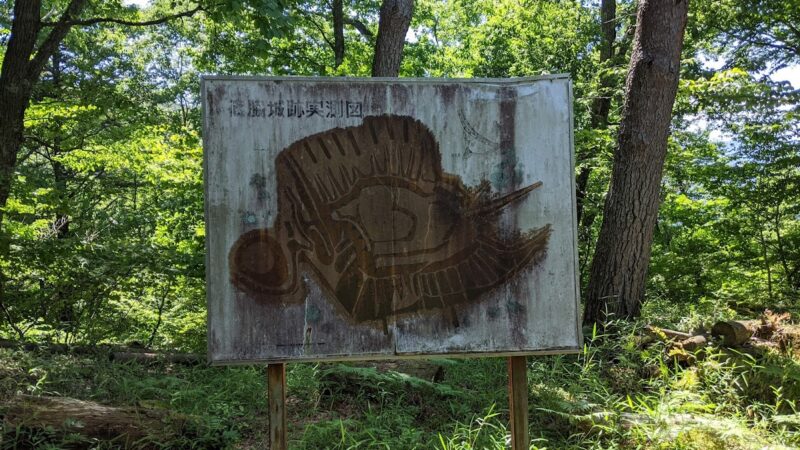
The most distinctive feature of Shinowaki Castle is the group of ridge-shaped vertical moats surrounding the main citadel. This structure is locally known as “Usu-no-me Moat,” named for its radial shape resembling the ridges of a rice-grinding mortar.
Ridge-shaped vertical moats are multiple moats (vertical moats) dug perpendicularly into the mountain slope and arranged in parallel. They effectively hinder the enemy’s lateral movement and divide the attacking army. Shinowaki Castle has over 30 vertical moats arranged radially, and its scale and well-preserved state are rare examples nationwide.
The depth of the vertical moats varies depending on the location, but in some places they reach 3 to 4 meters. The width is about 1 to 2 meters, and the ridges (ridge-like sections) between the moats are clearly visible. This group of vertical moats extends extensively from the north to the east and south sides of the main enclosure, forming the core of the castle’s defensive system.
Ridge-shaped vertical moats are considered a castle construction technique that developed from the mid-Sengoku period onward, and are particularly common in mountain castles in the Tokai and Koshin regions. The vertical moats of Shinowaki Castle, due to their scale and skillful arrangement, are thought to have been strengthened through renovations during the Sengoku period. It is also possible that they were added to enhance defensive capabilities after the attack by Saito Myochin during the Onin War.
Moats and Cut Embankments
Several moats were constructed to separate the main enclosure from the surrounding ridges. A moat (horikiri) is a defensive structure created by digging a vertical trench through a ridge, blocking enemy access routes. At Shinowaki Castle, a clear moat remains behind the main enclosure (west side), reaching depths of over 5 meters in some places.
Furthermore, cut slopes (artificially carved steep slopes) are formed around the enclosures. Cut slopes are a technique to make the slopes steeper by modifying the natural terrain, making it difficult for enemies to climb. The cut slopes at Shinowaki Castle are still clearly visible today, demonstrating the high level of civil engineering technology of the medieval period.
Ascent Route and Entrance
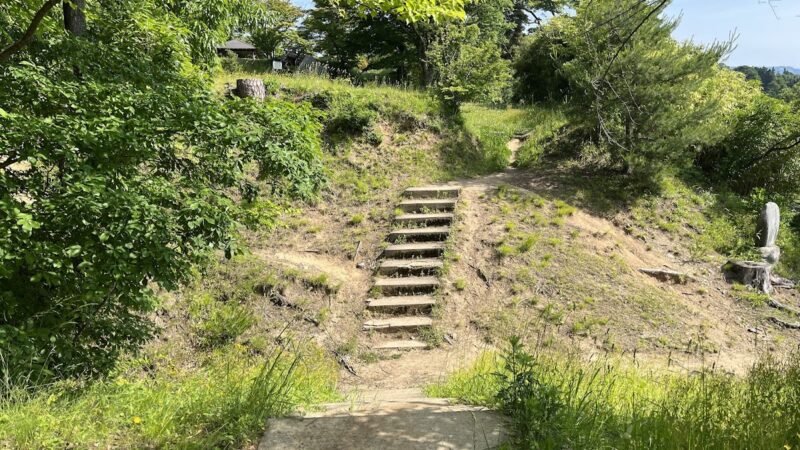
The ascent route from the Higashi clan residence ruins at the foot of the mountain to the main enclosure is a steep mountain path utilizing the ridge. Enclosures and cut slopes were positioned along this route, forming a defensive line.
While the remains of the entrance gate (koguchi) to the main enclosure are not clearly defined, there are locations that can be inferred from breaks in the earthworks. Medieval mountain castles often had simple gate structures, and it is believed that Shinowaki Castle also had a gate of the size of a wooden gate.
Relationship with the Higashi Clan Residence Site
The Higashi Clan Residence Site is located at the foot of the mountain where Shinowaki Castle is situated. This residence was the daily living quarters of the Higashi clan, and recent archaeological excavations have revealed the existence of an elegant building with a pond garden.
The “Negoya-style” castle structure, which combines a residence site with a mountain castle, is a form widely seen in mountain castles from the medieval to the Sengoku period. In peacetime, people lived in the residence at the foot of the mountain, which was more habitable, and in wartime, they would fortify themselves in the stronghold on the mountaintop.
The Higashi Clan Residence Garden is an exceptionally high-quality garden remains for a local samurai residence of the Muromachi period, and is considered to reflect the cultural refinement of Higashi Tsuneyori and others. This residence site, along with the Shinowaki Castle site, is designated as a national historic site.
Local Information
Access Methods
Access by Car
- Approximately 5 minutes by car from the Gifu Yamato Interchange on the Tokai-Hokuriku Expressway
- Head north on National Route 156 and follow the signs
- Free parking available at the Higashi Clan Memorial Hall and Waka Literature Museum (approximately 20 regular cars)
Access by Public Transportation
- Approximately 30 minutes on foot from Tokunaga Station on the Nagaragawa Railway (to the Higashi Clan Residence Ruins)
- Approximately 2 kilometers east from Tokunaga Station
- Taxis are also available from the station (approximately 5 minutes)
Entrance to the Castle
- The entrance to the castle is located behind the Higashi Clan Residence Ruins (Higashi Clan Memorial Hall and Waka Literature Museum)
- Approximately 30-40 minutes on foot from the entrance to the main enclosure
- The mountain path is well-maintained, but hiking equipment (trekking shoes, etc.) is recommended
Points of Interest
Higashi Clan Memorial Hall and Waka Literature Museum
- Opening Hours: 9:00 AM – 5:00 PM
- Closed: Mondays (or the following day if Monday is a public holiday), New Year holidays
- Admission Fee: Adults 310 yen, Elementary and Junior High School Students 150 yen
- You can view exhibits on the history of the Higashi clan and the Kokin Denju (a system of teaching classical Japanese poetry).
- The Higashi Clan Residence Garden is adjacent and can be visited together.
Higashi Clan Residence Garden
- A pond garden confirmed by excavation surveys since 2020.
- A valuable historical site as the residence of a local samurai from the Muromachi period.
- The garden is currently under investigation and maintenance.
Climbing to Shinowaki Castle Ruins
- A 30-40 minute mountain climb is required to reach the castle.
- The hiking trail is well-maintained, but there are steep sections.
- Prepare athletic shoes or hiking boots, drinking water, a towel, etc.
- Insect repellent is recommended in summer.
- Be careful as the ground can be slippery during and after rain.
Observation of the Usu-no-me Moat
- Over 30 ridge-shaped vertical trenches are arranged radially around the main enclosure.
- The group of vertical trenches on the northern slope are particularly clear and easy to observe.
- Be careful of your footing when entering the vertical trenches.
- Do not excavate or destroy the remains unnecessarily to protect them.
View from the Main Enclosure
- On a clear day, you can enjoy a panoramic view of Gujo city and the surrounding mountains.
- You can get a sense of the flow of the Yoshida River and the territory controlled by the Higashi clan.
- A great spot for photography.
Precautions for Visiting
- Safety Precautions: As this is a mountain castle, there are areas with unstable footing. Be especially careful after rain, as it can be slippery.
- Clothing: Wear long sleeves, long pants, a hat, and appropriate hiking boots.
- Heatstroke Prevention: Stay well-hydrated in the summer. A hat is essential as there is little shade.
- Insect Repellent: Mosquitoes and gnats are abundant from spring to autumn, so please use insect repellent spray. 5. Protection of Historical Remains: This is a valuable cultural property designated as a national historic site. Please do not damage the remains or litter.
- Winter: Access to the castle becomes difficult during heavy snowfall. If visiting during winter, please check the conditions with the Gujo City Board of Education or other relevant authorities beforehand.
Nearby Attractions
Gujō Hachiman Castle
- Approximately 20 minutes by car from Shinowaki Castle
- A modern castle with a reconstructed keep
- A castle town famous for the Gujō Odori dance
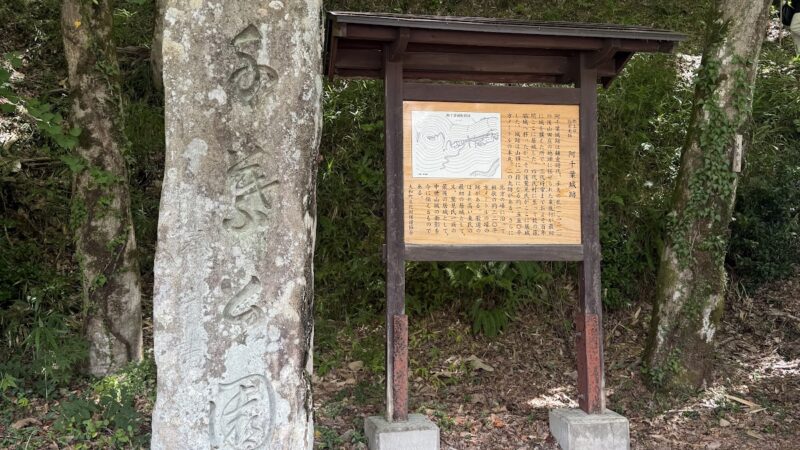
Achiba Castle Ruins
- A mountain castle that the Higashi clan used as their residence before Shinowaki Castle
- Approximately 15 minutes by car from Shinowaki Castle
- Well-preserved remains
Gujō City Historical Museum
- Comprehensively exhibits the history of the Gujō region
- Also houses materials related to the Higashi clan and Shinowaki Castle
Kokin Denju no Sato Field Museum
- A cultural facility themed around Higashi Tsuneyori’s Kokin Denju (transmission of classical poetry)
- Exhibits and hands-on programs related to Tanka and Waka poetry are available
Cultural Value of Shinowaki Castle
Significance of National Historic Site Designation
Shinowaki Castle Ruins, along with the Higashi Clan Residence Ruins, were designated as a National Historic Site on October 11, 2021. The designated name is “Higashi Clan Residence Site and Shinowaki Castle Site.”
This designation was based on the following evaluations:
- Excellentness of the Ridge-Shaped Vertical Moat System: The “Usu-no-me Moat,” with over 30 vertical moats arranged radially, boasts a rare scale and state of preservation nationwide.
- Historical Importance of the Higashi Clan: As the base of the Higashi clan, who ruled the Gujo region for approximately 230 years after the Jokyu War, this is an important site that shows the reality of regional rule in medieval Mino Province.
- Cultural and Historical Value: The integrated preservation of the residence site and castle site, where Higashi Tsuneyori, the founder of the Kokin Denju (transmission of classical poetry), resided, provides valuable information for understanding the reality of medieval samurai culture.
- Good Preservation of Remains: Both the mountain castle and residence site are well-preserved, making it an important example for understanding the structure of medieval castles.
Results of the Excavation
The Gujo City Board of Education has been conducting an excavation survey of the Higashi Clan Residence Site since 2020, with the goal of designating it as a National Historic Site. This survey has yielded the following important discoveries:
- Confirmation of a Pond Garden: An exceptionally high-quality garden structure was discovered for a residence of a local samurai during the Muromachi period. It was found that the pond’s banks were constructed with stonework and that landscape stones were also placed.
- Detection of Building Remains: The foundation stone remains of a building believed to be the main building of the residence were confirmed.
- Excavated Artifacts: Artifacts such as Chinese celadon and white porcelain, and domestically produced pottery, demonstrating the high economic power and cultural level of the Higashi clan, have been unearthed.
These findings support the idea that the Higashi clan were not merely local samurai, but cultured individuals well-versed in the aristocratic culture of Kyoto.
Significance of Visiting Shinowaki Castle
Shinowaki Castle is an extremely important castle site for understanding the realities of local samurai during the medieval period of Japan, particularly from the Muromachi period to the Sengoku period. Military History Perspective: This site offers a valuable opportunity to observe firsthand the sophisticated defensive system of ridged vertical trenches. You can experience the defensive structure of medieval mountain castles, which is difficult to understand from textbooks and documents alone.
Cultural History Perspective: You can trace the footsteps of the Higashi clan, who played an important role not only in military power but also in cultural aspects such as waka poetry and the transmission of classical poetry. This is a place where you can realize that warlords of the Sengoku period were not solely focused on military strength but also possessed high levels of education.
Regional History Perspective: As a site symbolizing the history of the Gujo region spanning approximately 350 years, from the Jokyu War to the Sengoku period, it is indispensable for understanding the region’s history.
Harmony with Nature: Due to its nature as a mountain castle, you can observe the construction techniques that skillfully utilized the natural terrain. You will be able to appreciate the high level of civil engineering technology in the Middle Ages, where artificial and natural elements were fused.
Summary
Shinowaki Castle is a masterpiece of medieval mountain castles remaining in Gujo City, Gifu Prefecture. The Higashi clan, a branch of the Chiba clan, resided at Shinowaki Castle for eight generations, approximately 230 years, and it functioned as the political and cultural center of the Gujo region.
The castle’s greatest highlight is the group of over 30 ridged vertical moats known as “Usu-no-me-bori,” whose scale and state of preservation are rare nationwide. This defensive system, a valuable relic demonstrating the pinnacle of castle construction technology during the Sengoku period, was designated a National Historic Site in 2021.
The Higashi clan played an important role not only as military commanders but also as cultural figures, as exemplified by Higashi Tsunenori, the founder of the Kokin Denju (a school of classical poetry). A pond garden was discovered at the site of the Higashi clan’s residence at the foot of the mountain, confirming the high level of the Higashi clan’s cultural standing.
The history of Shinowaki Castle—from its battles with Saito Myochin during the Ōnin War, to the anecdote of the castle’s return through waka poetry, and its decline and abandonment amidst the turmoil of the Sengoku period—symbolizes the rise and fall of local warlords during the transition from the medieval to the early modern period.
Currently, the Shinowaki Castle ruins are accessible to everyone thanks to well-maintained hiking trails. After gaining some background knowledge at the Higashi Clan Memorial Museum and the Waka Literature Museum, you can actually climb the mountain, observe the Usu-no-me moat, and admire the view of Gujo from the main enclosure. Through such experiences, you can relive the landscapes seen by medieval warlords and gain a deeper understanding of Japanese history.
Shinowaki Castle is a worthwhile place to visit not only for castle enthusiasts and history buffs, but also for those who enjoy mountain climbing and hiking. When visiting Gifu Prefecture, be sure to visit Shinowaki Castle and experience the 230-year history of the Higashi clan and the grandeur of the Usu-no-me moat.