Yagi Old Castle (Hyogo Prefecture) Complete Guide | History, Highlights, and Access Information
What is Yagi Old Castle?
Yagi Old Castle (Yagi Kojō) is a medieval mountain castle located in Yagi, Yoka-cho, Yabu City, Hyogo Prefecture. It is also known as Yagi Dojō (Yagi Earth Castle), a name given in contrast to the stone-walled Yagi Castle (Yagi Ishijō). Designated a national historic site on March 6, 1997, the “Yagi Castle Ruins” consist of four archaeological sites, including Yagi Old Castle, and are a valuable cultural asset that conveys the history of the Tajima region over approximately 400 years, from the Kamakura period to the Toyotomi period.
Yagi Old Castle is located about 200 meters further up the ridge from Yagi Castle and retains the typical structure of a medieval mountain castle with an earthen rampart layout. During the time of the Yagi clan, known as one of the Four Heavenly Kings of the Yamana clan, it played an important military role as a fortified outpost of Yagi Castle.
History of Yagi Old Castle
Construction in the Late Heian Period
The origins of Yagi Old Castle are believed to date back to around 1063 (Kohei 6) in the late Heian period. It is said that Hei Shiro Yorikuni, who distinguished himself in the Former Nine Years’ War, was granted Tajima Province by Minamoto no Yoriie and built the castle in this location. However, there is a lack of reliable historical records regarding the construction during this period, and some parts remain in the realm of legend.
The Era of the Yagi Clan
From the Kamakura period onward, the Yagi clan ruled this area. The Yagi clan grew into a powerful local lord in Tajima Province, and during the Muromachi period, they became a senior retainer of the Yamana clan, a powerful shugo daimyo, and were counted as one of the “Four Heavenly Kings of the Yamana.” The Yagi clan based themselves in this area for approximately 400 years, playing a central role in the politics and military affairs of the Tajima region.
During the Nanboku-cho period, Yagi Old Castle functioned as a defensive structure primarily composed of earthworks and moats. The layout from this period remains remarkably well-preserved, making it a valuable historical site for understanding the typical structure of a medieval earthen castle.
Renovations during the Sengoku Period
During the Sengoku period, when Yagi Toyonobu, one of the Yamana Four Heavenly Kings, was the lord of the castle, renovations were carried out, including the construction of a “staggered gate” at Yagi Old Castle. During this time, Yagi Old Castle was positioned as an auxiliary castle to the lower Yagi Castle (a stone-walled castle) and served as a final defensive stronghold in emergencies.
The Toyotomi Era and Abandonment
Following two invasions of Tajima by Hashiba Hideyoshi’s army in 1577 and 1580, Yagi Toyonobu was forced to surrender. Later, the Bessho clan became the lords of the castle, and a new Yagi Castle with stone walls was built at the foot of the mountain by Bessho Shigemune. With the stabilization of the situation in Tajima, the old Yagi Castle on the mountaintop lost its function as a fortified stronghold and is believed to have been abandoned.
Structure and Layout of Old Yagi Castle
Characteristics of Earthwork Construction
Old Yagi Castle is a earthwork castle that does not use stone walls. This is a typical structure for mountain castles from the Nanboku-cho period to the early Sengoku period, skillfully utilizing the natural terrain to build defensive walls by piling up earth. Compared to the stone-walled Yagi Castle, it shows older castle-building techniques and is an important remains for understanding the development process of medieval castles.
Major Remains
The following remains remain at Old Yagi Castle:
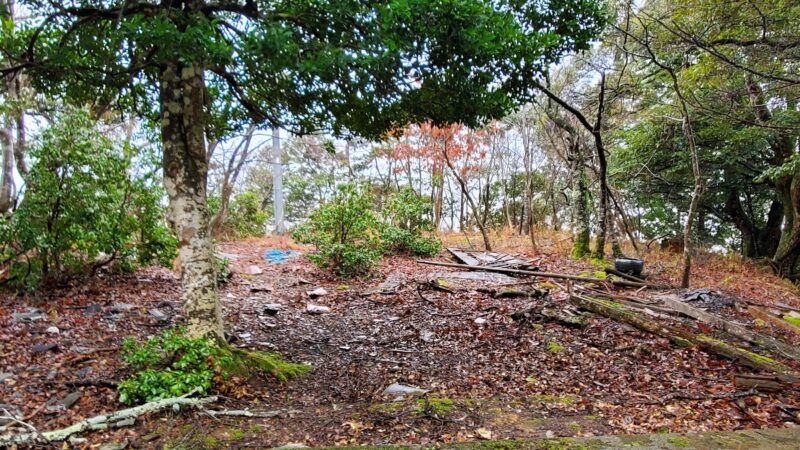
Kuruwa (Enclosures): Multiple flat areas are arranged around the mountaintop. A group of enclosures arranged in a stepped pattern around the main enclosure can be seen, demonstrating the unique use of terrain characteristic of mountain castles.
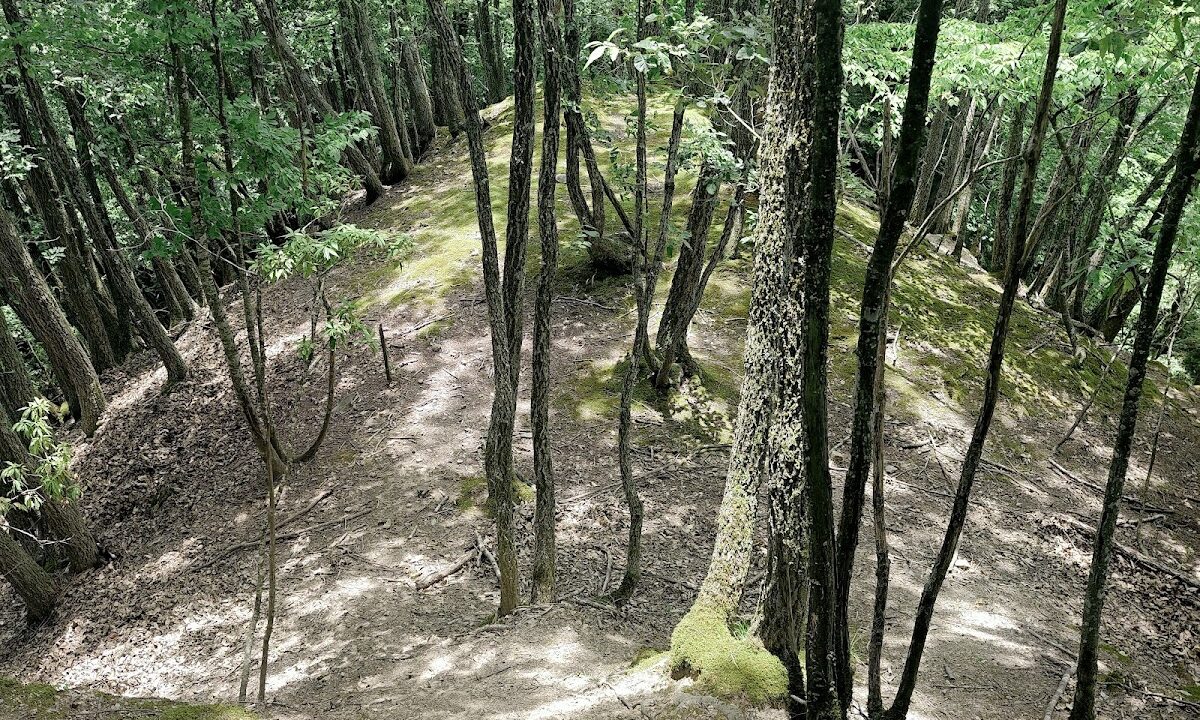
Earthworks: Earthworks, built by piling up earth, surround the enclosure, enhancing its defensive capabilities. In well-preserved sections, the height and shape of the earthworks can be clearly observed.
Moats: Multiple moats, dug to cut off the ridge, are present in various locations. These served to prevent enemy intrusion and clearly demarcate the castle area.
Staggered Entrance: This entrance (gateway), believed to have been built during the time of Yagi Toyonobu, features a curved passage to prevent direct enemy advances.
Location and Topography Utilization
Yagi Old Castle is located on a mountaintop approximately 200 meters further along the ridge from Yagi Castle. This location is ideal as a final defensive base in the event of an attack on Yagi Castle at the foot of the mountain, while also offering excellent panoramic views. The defensive design, which takes advantage of the steep terrain, clearly demonstrates the construction philosophy of medieval mountain castles.
Four Archaeological Sites Constituting the National Historic Site “Yagi Castle Ruins”
Yagi Old Castle is one of the four archaeological sites that make up the National Historic Site “Yagi Castle Ruins.” A brief introduction to the other three sites follows.
Yagi Castle (Yagi Stone Castle)
This is a stone-walled castle built by Bessho Shigemune during the Toyotomi period. It features a modern castle structure with high stone walls, exhibiting a contrasting construction technique to Yagi Old Castle. Currently, when people refer to “Yagi Castle,” they usually mean this stone castle.
Tonoyashiki Ruins
These are archaeological sites located at the foot of the mountain, believed to be the remains of a Kamakura period residence. It is thought to have been the residence of the Yagi clan and is presumed to have been their living base during peacetime.
Akabuchi Ruins
These are archaeological sites related to Akabuchi Shrine, the tutelary shrine of the Yagi clan. They convey aspects of medieval society where faith and rule were closely intertwined.
The designation of these four ruins as a single National Historic Site makes them a valuable group of historical sites that allows for a comprehensive understanding of the changes in castles and residences from the Kamakura period to the Toyotomi period.
Highlights of Yagi Old Castle
Typical Structure of a Medieval Earth Castle
The greatest highlight of Yagi Old Castle is that the earth castle structure from the Nanboku-cho period remains almost completely intact. The defensive system, using earthworks and moats without stone walls, represents the basic form of a medieval mountain castle, making it an excellent teaching tool for studying castle history.
Comparison with Yagi Castle
By comparing Yagi Old Castle, built with earthworks, and Yagi Castle, built with stone walls, located in the same mountain range, one can experience the development of castle construction technology from the medieval to the early modern period. Being able to visit two castles from different eras within approximately 200 meters of each other is a rare occurrence nationwide.
Function as a Fortified Castle
It is also important to be able to actually confirm the integrated defensive system of the two castles—the main castle at the foot of the mountain and the fortified castle at the summit. The relative locations of Yagi Old Castle and Yagi Castle are highly insightful for understanding castle strategies during the Sengoku period.
Harmony with the Natural Environment
The area around Yagi Old Castle is surrounded by the rich natural beauty of Tajima. The climbing path offers enjoyment of seasonal vegetation, and the view from the summit is magnificent. A visit combining historical exploration and hiking is possible.
Tourist Information
Basic Information
Location: Yagi Castle Mountain, Yoka-cho, Yabu City, Hyogo Prefecture, and other locations
Designation: National Historic Site (Designated March 6, 1997)
Main Lords: Hei Yorikuni, Yagi clan
Construction Period: Late Heian period (tradition)
Abandonment Period: Toyotomi period
Remains: Enclosures, earthworks, moats, staggered gates
Points to Note When visiting Yagi Old Castle
When visiting Yagi Old Castle, it is common to first visit Yagi Castle at the foot of the mountain and then climb along the ridge. The distance from Yagi Castle to Yagi Old Castle is approximately 200 meters, but since it is a mountain path, appropriate clothing and shoes for hiking are necessary.
Estimated Time: Allow approximately 2-3 hours round trip from Yagi Castle Exchange Center to Yagi Old Castle via Yagi Castle.
Difficulty: This is a moderately difficult mountain climb. There are steep slopes and areas with uneven footing, so those who are not confident in their physical fitness and equipment should not attempt this climb.
Best Season: Spring (April-May) and autumn (October-November) are the best times to visit the castle. Summer is prone to insects, and winter may see snow, so caution is advised.
Facility Information
Yagi Castle Exchange Center: Located near the castle entrance, this facility offers brochures and information gathering. It also has restrooms, so it’s recommended to stop by before climbing.
Information Boards: Information boards are installed along the climbing route and at each historical site, making it easy for first-time visitors to understand the location and characteristics of the ruins.
Maintenance Status: While the climbing route has been maintained to some extent, it remains a natural mountain path. Be especially careful after rain, as it can become particularly slippery.
Access Information
Access by Car
From the Kita-Kinki Toyooka Expressway, Yoka-Hyono-yama IC: Approximately 10 minutes
Parking: Free parking available in front of the Yagi Castle Exchange Hall (several spaces for regular cars)
Located at a transportation hub facing the San’in Expressway, it is easily accessible by car. It is also possible to combine a visit with other tourist spots in the Tajima region, such as Takeda Castle Ruins.
Access by Public Transportation
From JR San’in Main Line, Yoka Station: Approximately 10 minutes by taxi, or by Zentan Bus
Public transportation is limited, so it is recommended to check the timetable in advance.
Nearby Tourist Spots
Takeda Castle Ruins: A national historical site famous as the “Castle in the Sky.” Located approximately 40 minutes by car from Yagi Old Castle, it is a popular base for tourists visiting both castles as part of a tour of Tajima’s mountain castles.
Izushi Castle: A castle town located in Izushi, known as the “Little Kyoto of Tajima.” Approximately 30 minutes by car from Yagi Old Castle.
Tajima-gura: A facility introducing the history and culture of the region. You can learn more about the history of the Yagi clan and Tajima.
Visitor Guide
Equipment to Bring
- Hiking boots or trekking shoes: Essential for walking on unpaved mountain trails.
- Drinking water: Sufficient hydration is especially necessary in summer.
- Towel and hat: For protection from the sun and sweat.
- Rain gear: In case of sudden weather changes.
- Insect repellent spray: There are many insects from spring to autumn.
- Camera: For recording the ruins and views.
- Map or pamphlet: Available at the Yagi Castle Exchange Center.
Precautions
- Avoid climbing alone: It is recommended to visit with multiple people if possible.
- Check the weather: Footing becomes poor in rainy weather or after rain, so consider refraining from climbing.
- Time allocation: Plan your itinerary with ample time to descend before sunset.
- Protection of ruins: Please walk on the designated viewing paths to avoid damaging the earthworks and moats.
- Take Your Trash Home: To protect the natural environment and historical sites, please be sure to take your trash home with you.
Photo Spots
- Cross-section of the Earthwork: A place where the earthwork structure, a characteristic of Yagi Old Castle, is clearly visible.
- Moat: The moat, which cuts off the ridge, is an important remains that shows the defensive system of a medieval mountain castle.
- View from the Summit: A spectacular viewpoint overlooking the mountains of Tajima.
- Positional Relationship with Yagi Castle: Photographs showing the positional relationship between the two castles are also valuable as a record.
Cultural Value of Yagi Old Castle
Academic Importance
Yagi Old Castle has high academic value in the following respects:
- Typical Example of a Medieval Earth Castle: It well preserves the structure of an earthwork mountain castle from the Nanboku-cho period.
- Changes in Castle Structures: The development process from earth castles to stone castles can be confirmed in the same area.
- Example of a Fortified Castle: A Valuable Case Study for Understanding the Relationship Between the Main Castle and the Outpost Castle Through On-Site Observation
- Witness to Local History: An Important Historical Site Telling the Story of the Medieval History of the Tajima Region
Preservation and Utilization
With its designation as a National Historic Site, the Yagi Castle Ruins, including Yagi Old Castle, are being appropriately preserved and managed. Yabu City is working to balance the preservation of the historical site with tourism utilization, installing information boards and improving the access routes.
Local residents are also actively involved in preservation activities, regularly mowing grass and maintaining the viewing paths. These efforts have established a system for passing on valuable cultural assets to future generations.
The History of the Yagi Clan and Tajima
The Yagi Clan as One of the Four Heavenly Kings of Yamana
During the Muromachi period, the Yagi clan was counted as one of the “Four Heavenly Kings of Yamana,” serving as important retainers of the Yamana clan, a powerful daimyo family. At its peak, the Yamana clan controlled 11 of the 66 provinces of Japan, boasting such power that they were called the “Lord of One-Sixth.” The Yagi clan, as a powerful local lord supporting the Yamana clan, played a crucial role in the governance of the Tajima region.
Yagi as a Strategic Transportation Hub
The Yagi area has been a strategically important transportation hub connecting Tajima and Inaba since ancient times. The “Yōki” station is recorded in the Engishiki (a historical document), indicating its importance as a transportation route from antiquity. This geographical advantage formed the foundation for the Yagi clan’s expansion.
At one point, it is believed that roughly half of present-day Yabu City was within the Yagi clan’s sphere of influence. The Yagi clan’s rule, based at Yagi Old Castle and Yagi Castle, occupies an extremely important position in the medieval history of the Tajima region.
Summary
Yagi Old Castle (Yabu City, Hyogo Prefecture) is a valuable national historical site that conveys the history of the Tajima region from the late Heian period to the Sengoku period. It retains a typical structure as a medieval mountain castle with earthen ramparts, and by contrasting it with the stone-walled Yagi Castle, it is a rare historical site that allows one to appreciate the developmental process of castle architecture.
Yagi Old Castle, which served as the stronghold of the Yagi clan, known as one of the four great generals of the Yamana clan, was the political and military center of medieval Tajima, and exudes a sense of history spanning approximately 400 years. While climbing the castle requires a certain level of physical fitness and equipment, it is a well-rewarded place for history buffs and castle enthusiasts.
When visiting Yabu City in Hyogo Prefecture, be sure to visit both Yagi Old Castle and Yagi Castle to experience the transition from the medieval to the early modern period. You will be able to fully appreciate the charm woven from Tajima’s rich nature and history. Visiting nearby famous castles such as Takeda Castle Ruins in conjunction with these will allow you to gain a deeper understanding of the mountain castle culture of the Tajima region.