Takato Castle: A Complete Guide to its History and Highlights | A Thorough Explanation of the Charms of a Famous Cherry Blossom Spot and One of Japan’s Top 100 Castles
Located in Takato-machi, Ina City, Nagano Prefecture, Takato Castle is a famous castle from the Sengoku period, highly valued by Takeda Shingen as a base for his control of Shinano Province. Built on a river terrace between the Mifune River and the Fujisawa River, it is a natural stronghold and is counted among Japan’s Top 100 Castles. Currently, it is maintained as “Takato Castle Ruins Park” and is nationally known as a famous spot for Takato Kohigan cherry blossoms. This article provides a thorough explanation of Takato Castle, from its detailed history to its existing remains and highlights.
Basic Information on Takato Castle
Takato Castle, also known as “Kabutoyama Castle,” is designated as a national historic site. Located on a river terrace approximately 800 meters above sea level, it functioned as a natural stronghold surrounded on three sides by rivers.
Location: Takato-machi, Ina City, Nagano Prefecture (formerly Takato, Ina District, Shinano Province)
Castle Structure: Hilltop castle (ring-shaped and terraced)
Construction Period: Around the 14th century (estimated)
Main Lords: Takato clan, Takeda clan, Hoshina clan, Torii clan, Naito clan
Designation: National Historic Site, One of Japan’s 100 Famous Castles (No. 30)
History and Background of Takato Castle
Sengoku Period and Azuchi-Momoyama Period
The Era of the Takato Clan
Takato Castle existed from around the 14th century as the residence of the Takato clan, a branch of the Suwa clan. The Takato clan built their power as a local powerful family controlling Ina District in Shinano Province, but with the arrival of the Sengoku period, they became a target of the Takeda clan’s invasion of Shinano.
Conquest and Large-Scale Renovation by Takeda Shingen
In 1545 (Tenbun 14), Takeda Harunobu (later Shingen) attacked Takatō Yoritsugu and captured Takatō Castle. Some sources say it was 1547 (Tenbun 16). Takeda Shingen recognized the strategic importance of Takatō Castle and positioned it as a crucial base for his control of Shinano Province.
Shingen ordered his renowned strategist, Yamamoto Kansuke, and his senior retainer, Akiyama Nobutomo, to carry out large-scale renovation work. This renovation completed a ring-shaped layout with the main keep at the center, surrounded by other enclosures such as the second enclosure, southern enclosure, and third enclosure. Each enclosure was separated by deep dry moats and strongly defended by earthen ramparts, giving it high defensive capabilities as a mountain castle of the Sengoku period.
As an Important Base for the Takeda Clan
For the Takeda clan, Takatō Castle was not merely a branch castle, but a central fortress for managing Shinano Province. The importance of Takatō Castle can be seen from the fact that members of the Takeda clan and their senior retainers, such as Takeda Katsuyori, Takeda Nobuaki (Shōyōken), and Nishina Morinobu, successively served as its lord. Especially in later years, it was positioned as a crucial military base against the invading Oda and Tokugawa clans from the Tōkai region.
Battle of Takatō Castle (Tenshō 10)
In March of Tenshō 10 (1582), when Oda Nobunaga’s conquest of Kai Province began, Takatō Castle became the site of the last fierce battle for the Takeda clan. The castle lord, Nishina Morinobu (the fifth son of Takeda Shingen), defended the castle with only 3,000 soldiers against a massive army of said to be 50,000 led by Oda Nobutada.
The Oda army surrounded the castle with overwhelming force and launched a fierce attack. Nishina Morinobu refused to surrender and continued to resist to the end, but the castle fell on March 2nd. Morinobu was killed in battle, and the castle’s soldiers were almost completely annihilated, resulting in a tragic end. This battle is etched in history as a symbol of the fall of the Takeda clan.
Edo Period
The Hoshina Clan Era
During the Edo period, Takatō Castle became the residence of a Tokugawa vassal daimyo. In 1600, after the Battle of Sekigahara, Hoshina Masamitsu became the lord of the castle, and the Hoshina clan ruled for three generations. Hoshina Masayuki (later lord of Aizu Domain) also grew up in Takatō during this period.
From the Torii Clan to the Naito Clan
In 1664, after the Hoshina clan was transferred to Aizu, the Torii clan took over the castle. Later, in 1718, the Naito clan was granted a 33,000 koku domain, and eight generations of the Naito clan served as lords until the Meiji Restoration.
Throughout the Edo period, Takato Castle functioned as the administrative center of the Takato Domain, and the castle town also flourished. During this time, some of the defensive structures from the Sengoku period were modified, but the basic layout was maintained.
After the Meiji Era
After the Meiji Restoration, Takato Castle was abandoned due to the abolition of the feudal domains and the establishment of prefectures. In 1875 (Meiji 8), many of the castle’s buildings were demolished, but afterwards, former samurai planted cherry trees, and the site was developed into a park. The Takato Kohigan cherry trees planted at this time form the basis of the current famous cherry blossom viewing spot.
In 1973 (Showa 48), it was designated a national historic site, and in 2006 (Heisei 18), it was selected as one of Japan’s 100 Famous Castles. Currently, it is a popular tourist destination known as “Takato Castle Ruins Park,” attracting many visitors throughout the year.
Takato Castle’s Layout and Structure
A Natural Fortress Utilizing the Topography
The most distinctive feature of Takato Castle is its location on the tip of a river terrace between two rivers, the Mifune River and the Fujisawa River. Surrounded on three sides by steep cliffs, the natural terrain formed a strong defensive line. Attackers could only approach from limited directions, making it an extremely advantageous terrain for defenders.
Ring-Type and Terraced-Type Layout
Takato Castle’s layout is a complex structure that primarily uses a ring-type layout, with the main keep at the center surrounded by other enclosures such as the second, third, and southern enclosures, while also incorporating some elements of a terraced-type layout.
Main Keep: The core enclosure of the castle, located at the highest point. Built with the cliffs of the Mifune River at its back, it was difficult to attack from the rear.
Second Enclosure: Located from the north to the east of the main keep, it was an important defensive line protecting the main keep. A deep dry moat separates the main enclosure from the inner bailey.
South Enclosure: Located south of the main enclosure, this enclosure was designed to defend against attacks from the direction of the main gate.
Third Enclosure: Formed the outer perimeter of the castle and served as the boundary with the castle town.
Defense with Dry Moats and Earthworks
A characteristic of Takato Castle’s defensive structures is its typical Sengoku period mountain castle structure, primarily using dry moats and earthworks, with very little use of stone walls. Deep, large dry moats were dug between each enclosure, forming a strong defensive line to prevent enemy intrusion.
These dry moats, believed to have been designed by Yamamoto Kansuke, remain remarkably well-preserved today, making them valuable historical remains that convey the castle construction techniques of the Sengoku period. Earthworks also remain in various places, allowing us to imagine the defensive structure of the time.
Existing Remains and Highlights
Enclosure Remains
Within Takato Castle Ruins Park, the remains of enclosures such as the main enclosure (Honmaru), second enclosure (Ninokuruwa), and southern enclosure (Minami-kuruwa) are well-preserved. While the flat areas of each enclosure have been developed as part of the park, the layout and scale of the enclosures largely retain their original appearance. The Toiyamon gate has been relocated and restored at the Honmaru site, allowing visitors to experience the atmosphere of an Edo-period castle gate.
Dry Moats
One of the greatest highlights of Takato Castle is the deep dry moats remaining between each enclosure. The dry moat between the Honmaru and second enclosure, in particular, is large in both depth and width, clearly demonstrating the characteristics of the Takeda-style castle construction. Visiting outside of cherry blossom season allows for a closer observation of the structure of these dry moats.
There are also places where you can walk along the bottom of the moats, and the height of the earthworks viewed from below is impressive. You can truly appreciate how difficult it must have been for enemy soldiers to cross these moats during the Sengoku period.
Earthworks
Alongside the dry moats, earthworks are another important remains. The earthen ramparts surrounding the baileys were crucial defensive structures protecting castle soldiers from enemy arrows and firearms. The earthen ramparts of Takato Castle remain well-preserved in many places, some reaching several meters in height.
Stone Walls
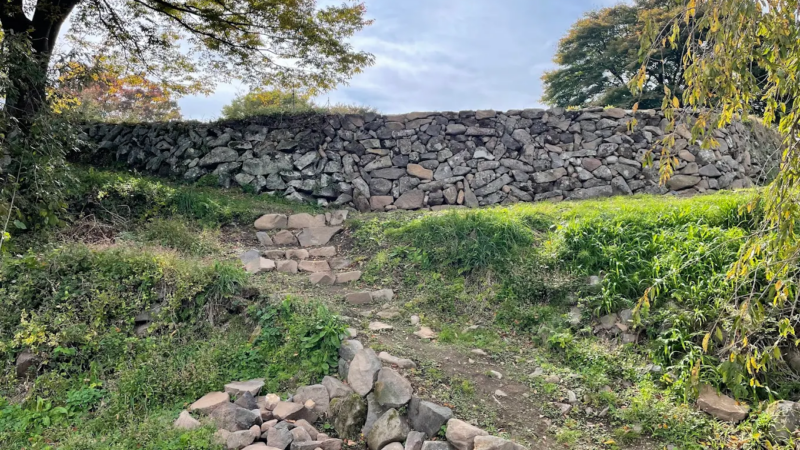
Takato Castle is primarily an earthen castle, but some stone walls were also used. However, many of these stone walls were added during the Edo period and differ from those of the Sengoku period. Nevertheless, they are valuable remains for understanding the historical changes of the castle.
Relocated Structures
While most of the castle’s structures were demolished during the Meiji period, several gates were relocated to temples and other locations within the city and still exist.
Tonya Gate: This gate was relocated and restored to the site of the main bailey and is one of the castle gates of Takato Castle during the Edo period.
Shinshiro Fujiwara Shrine Gate: A shrine gate, said to have been relocated from Takato Castle, remains in the city.
Takato Castle Ruins Park as a Famous Cherry Blossom Spot
Takato Castle Ruins Park is a famous cherry blossom spot known as “the best cherry blossom spot in Japan.” Approximately 1,500 Takato Kohigan cherry trees are planted there, reaching full bloom from mid- to late April.
The Takato Kohigan cherry tree is an endemic species found only at Takato Castle, characterized by its smaller size and deeper pink color compared to Somei Yoshino cherry trees. When in full bloom, the entire castle ruins are bathed in a pale pink hue, creating a fantastical landscape.
During cherry blossom season, the “Takato Castle Ruins Park Cherry Blossom Festival” is held, attracting many tourists from all over Japan. The trees are also illuminated at night, allowing visitors to enjoy the cherry blossoms after dark. However, it gets extremely crowded during this time, so those who wish to carefully observe the castle ruins are advised to visit outside of cherry blossom season.
The Relationship Between Takatō Castle and the Takeda Clan
A Key Point for Controlling Shinano
For Takeda Shingen, Takatō Castle was a crucial base for controlling Shinano Province. Having conquered the Suwa region, Shingen needed to further expand his power into southern Shinano, and the capture of Takatō Castle was strategically essential.
By establishing Takatō Castle as a base, the Takeda clan could control the entire Ina Valley and even advance further south into Mikawa and Tōtōmi Provinces. Therefore, Shingen ordered Yamamoto Kansuke to carry out large-scale renovations, strengthening it into an impregnable fortress.
Yamamoto Kansuke and Castle Construction Techniques
Yamamoto Kansuke, known as Takeda Shingen’s military strategist, is said to have been in charge of the renovations of Takatō Castle. The layout of the dry moats and earthworks, supposedly designed by Kansuke, represents the pinnacle of Takeda-style castle construction techniques, a defensive design that makes maximum use of the terrain.
The arrangement of the dry moats between the baileys is particularly ingenious, limiting enemy movement and creating a structure that gives the defenders a significant advantage. These techniques influenced later castle construction by the Takeda clan.
The Heroic End of Nishina Morinobu
In the Battle of Takato Castle in 1582, Lord Nishina Morinobu remained loyal to the Takeda clan to the very end. Despite the overwhelming numerical superiority of the Oda army, he refused to surrender and died fighting alongside his soldiers. His figure, symbolizing the Takeda clan’s bushido spirit, is recounted to posterity.
Although the Takeda clan was destroyed just a few months after this battle, the fierce fighting at Takato Castle is etched in history as the Takeda clan’s final glorious moment.
Local Information and Access
Basic Information
Name: Takato Castle Ruins Park
Address: Higashi-Takato, Takato-machi, Ina City, Nagano Prefecture
Opening Hours: Always open (Paid and time-limited during the cherry blossom festival)
Admission Fee: Normally free (Paid during the cherry blossom festival)
Parking: Available (Paid and crowded during the cherry blossom festival)
Access Methods
Train/Bus:
- Approximately 25 minutes by bus from JR Iida Line “Ina-shi Station,” then a 15-minute walk from “Takato Station”
- Approximately 50 minutes by bus from Chuo Main Line “Chino Station”
Car:
- Approximately 30 minutes from Chuo Expressway “Ina IC”
- Approximately 50 minutes from Chuo Expressway “Suwa IC”
Points to Note During Your Visit
Estimated Time Required: Approximately 1-2 hours
Recommended Visiting Route:
- Enter through the Otemon Gate Ruins
- Proceed to the main keep via the South Enclosure
- Observe the dry moat from the main keep to the second enclosure
- Tour the second and third enclosures
- Carefully observe the earthworks and dry moats in various locations
Best Season:
- If visiting as a cherry blossom viewing spot, mid-to-late April
- If you want to carefully observe the castle ruins, visit outside of cherry blossom season (especially in autumn and winter, the dry moats are clearly visible)
Nearby Tourist Spots
Takato Town History Museum: Exhibits materials related to the history of Takato Castle and the Takato Domain
Ejima Enclosure Residence: The residence where Ejima, who was exiled to Takato during the Ejima-Ikushima Incident in the Edo period, was imprisoned
Hokomochi Shrine: The main guardian shrine of Takato, a historical shrine
Takato Soba: Takato is a famous production area for Shinshu soba, and “Takato soba” made with spicy radish is well-known
Comparison with Other Famous Castles in Nagano Prefecture
Nagano Prefecture has many famous castles besides Takato Castle, each with its own distinctive history and structure. ### Matsumoto Castle
Matsumoto Castle, designated a National Treasure, is a flatland castle with an existing keep. While Takato Castle is an earthen castle, Matsumoto Castle is a modern castle with stone walls and a keep, presenting a contrasting contrast. Both castles are selected as one of Japan’s 100 Famous Castles and are representative castles of Nagano Prefecture.
Ueda Castle
Ueda Castle, known as the residence of the Sanada clan, is a formidable fortress that repelled the Tokugawa army twice. Like Takato Castle, it was the stage for fierce battles during the Sengoku period, and its stone walls and turrets have been restored.
Matsushiro Castle
Matsushiro Castle, whose predecessor was Kaizu Castle built by Takeda Shingen, is known as a base during the Battle of Kawanakajima. Like Takato Castle, it was renovated by the Takeda clan and shares characteristics of Takeda-style castle construction.
Komoro Castle
Komoro Castle, known as a “hole castle,” is a rare castle with a main keep located at a lower elevation than the surrounding castle town. While possessing different topographical features from Takato Castle, it shares the commonality of being a castle renovated by the Takeda clan.
By visiting these castles, one can understand the development and diversity of castles in Nagano Prefecture from the Sengoku period to the Edo period.
Summary
Takato Castle, after undergoing large-scale renovations by Takeda Shingen during the Sengoku period and the historical event of the fierce siege in 1582, is now a place loved by many as a famous cherry blossom viewing spot.
The defensive structure of the Sengoku period, with its deep dry moats and high earthen ramparts, is well-preserved, and it has high historical value as one of Japan’s 100 Famous Castles and a nationally designated historical site. It is a place worth visiting throughout the year, whether in spring when it is known as “the best cherry blossoms in the world,” or in other seasons as a castle site where one can quietly reflect on the history of the Sengoku period.
By walking through the natural stronghold nestled between the Mifune River and Fujisawa River, while feeling the spirit of Sengoku warlords such as Takeda Shingen, Yamamoto Kansuke, and Nishina Morinobu, you can experience the appearance of a Sengoku period castle. When you visit Nagano Prefecture, be sure to stop by Takato Castle Ruins Park.