Complete Guide to Odani Castle: Visiting the Fortress of Three Generations of the Asai Clan and the Tragedy of the Sengoku Period
What is Odani Castle?: An Overview of a Representative Mountain Castle of the Sengoku Period
Odani Castle is a Sengoku period mountain castle built on Mount Odani (elevation 495.1m) in Nagahama City, Shiga Prefecture. It served as the residence of three generations of the Asai clan and is known as a formidable fortress, counted one of the Three Great Mountain Castles of the Medieval Period).
Its location overlooking Lake Biwa and its strategic position controlling key points on the important Hokuriku Road and Nakasendo Road made it a base for controlling northern Omi Province. Currently preserved as a nationally designated historical site, its remains such asre well-preserved and highly regarded by mountain castle enthusiasts and history buffs.
Basic Information and Access to Odani Castle
Location: Ibe, Kohoku-cho, Nagahama City, Shiga Prefecture
Access:
- Approximately 10 minutes by community bus or rental bicycle from Kawage Station on the JR Hokuriku Main Line
- Approximately 5 minutes by car to the Sengoku Guide Station
- Approximately 40-50 minutes on foot from the trailhead to the main keep
Opening Hours: Open for viewing (Sengoku Guide Station: 9:00-17:00, closed Mondays)
Admission Fee: Free
Parking: Parking available at the Sengoku Guide Station and the Odani Castle Sengoku Historical Museum
Shuttle Bus: During the spring and autumn tourist seasons, a shuttle bus may operate to the guardhouse ruins (mid-slope). Please check the Nagahama-Maibara Tourism Association website for details.
Location of the Japan’s Top 100 Castles Stamp: Odani Castle Sengoku Historical Museum, Sengoku Guide Station
History of Odani Castle: The Three Generations of the Asai Clan and Their Battles with Oda Nobunaga
Construction and the Era of Asai Sukemasa
There are various theories regarding the construction of Odani Castle, but it is generally believed to have been built by Asai Sukemasa around 1525 (Daiei 5), or between 1521 (Daiei 1) and 152gg (Kyoroku around 1516, indicating a range in the construction date.
Asai Sukemasa rose from a local lord in northern Omi Province to a Sengoku daimyo (feudal lord). He expanded his power by skillfully utilizing the terrain of Mount Odani to build a mountain castle. There is a theory that andss that he gradually expanded the castle grounds thereafter.
The Era of Asai Hisamasa and Asai Nagamasa
After the era of Asai Hisamasa, who succeeded Ryomasa, the third generation Asai Nagamasa inherited the family headship, and Odani Castle reached its peak. In 1567, Nagamasa married Oichi-no-kata, the sister of Oda Nosuna , alliance with the Oda clan.
This marriage gave birth to the Asai Three Sisters (Chacha, Hatsu, and Go), who would later shape the course of Sengoku history. Chacha became a concubine of Toyotomi Hideyoshi (Yodo-dono), and Go became the principal wife of Toku shogun, Iemitsu. Thus, the Asai bloodline was passed down to powerful figures throughout Japan.
The Breakup with Oda Nobunaga and the Battle of Odani Castle
In April 1570, a turning point in fate arrived. When Oda Nobunaga raised an army to subdue Asakura Yoshikage of Echizen Province, Asai Nagamasa, respecting his long-standing alliance with the Asakura clan, decided to break away f.
This marked the beginning of the Oda-Asai conflict, including the Battle of Anegawa, and Odani Castle became a target of the Oda army. During the turmoil of the Genki and Tensho eras, Odani Castle withstood the Oda army’s siege and attas.
The Fall of Odani Castle and the Downfall of the Asai Clan
In August of Tensho 1 (1573), Odani Castle finally fell to a full-scale attack by the Oda army, led by Hashiba Hideyoshi (later Toyotomi Hideyoshi). Asai Hisamasa committed suicide, and Asai Nagamasa also took hisown family, met its end after three generations and 50 years.
Lady Oichi and her three sisters were rescued by the Oda army and would later play an important role on the stage of history. Odani Castle was given to Hashiba Hideyoshi, but Hideyoshi built a new castle, Nagahama Castle, on the shores Odani Castle was subsequently abandoned.
Odani Castle’s Layout and Structure: The Secret of a Strong Fortress Utilizing the Topography
Characteristics of a Terraced Mountain Castle
Odani Castle is a terraced mountain castle that skillfully utilizes the natural topography of Mount Odani. A terraced castle is a structure in which baileys are arranged in a stepped pattern along the mountain ridge, offering high defenset capability to conquer.
The castle grounds are vast, extending approximately 1.5 km north-south and 0.5 km east-west, with multiple baileys arranged in a horseshoe shape, centered on the ridge extending south from Mount Odani. This vast castle merely as a military facility, but also as a castle town, including the residences of retainers and temples and shrines.
Composition of the Main Castle Area
Odani Castle is divided into four main areas.
The Main Castle Area is the central area built on the ridge extending south from Mount Odani, and consists of the following main enclosures:
- Honmaru: The core enclosure of the castle, where it is presumed that a palace and watchtowers stood.
- Ōhiroma: Located south of the Honmaru, this was the place where government affairs and ceremonies were conducted.
- Sakurababa: A plaza where military and horse training took place.
- Banshoato Ato: The site of a facility that monitored entry and exit to the castle, now located near the parking lot on the mountainside.
Kiyomizudani and Defensive Facilities
To the west of the Main Castle Area is a valley called Kiyomizudani, where the residences of the Asai clan’s retainers stood. Shimizu Valley has abundant spring water, which played a crucial role as a water source during the siege.
Defensive structures such as earthworks and trenches were built along the valley, demonstrating ingenuity in preventing enemy intrusion. It is said that fierce fighting took place in Shimizu Valley when the castle fell.
Odake and the Summit
Near the summit of Mount Kotani, there is a group of enclosures called Odake. There is a theory that the original form of Kotani Castle was located here, and it is thought to be a remnant from the early period of construction, during the .
From Odake, one can see Lake Biwa and the surrounding plains, and it is presumed to have functioned as a military observation post and as a final siege location.
Fukujumaru, Yamazakimaru, and Gesshomaru
On a different ridge, there are enclosures called Fukujumaru, Yamazakimaru, and Gesshomaru. These structures expanded the castle grounds and served as outposts to prepare for attacks from multiple directions.
In particular, Fukujumaru is said to have been used as a retirement residence for Asai Nagamasa’s father, Hisamasa, making it a place that tells the story of generational change within the castle.
Introduction of Stone Walls
A notable feature of Odani Castle is its pioneering use of stone walls for a mountain castle. While mountain castles of the Sengoku period mainly consisted of earthworks and moats, Odani Castle had stone walls built around the main keep and great technology even before Oda Nobunaga’s Azuchi Castle.
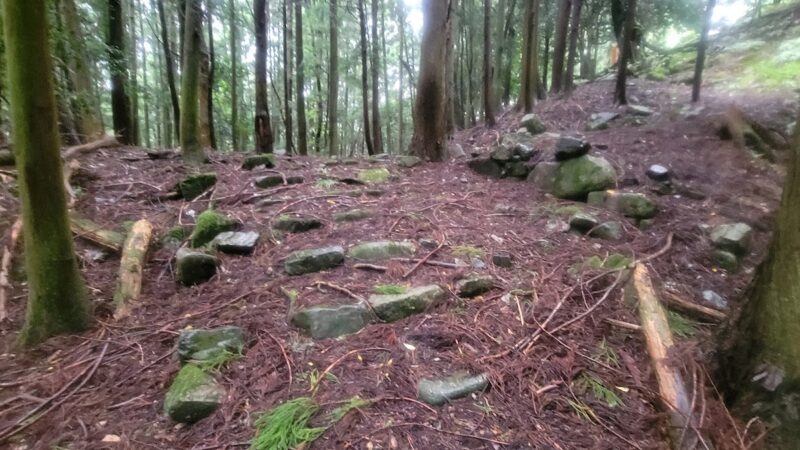
The stone walls that remain today are built using an old construction method called “nozurazumi,” showcasing a simple appearance with natural stones piled up as they are.
Highlights of Odani Castle: Exploring Existing Remains
Ascent Route and Required Time
There are mainly two routes for visiting Odani Castle.
Ote-michi Route (Front Hiking Trail):
- Departure from Sengoku Guide Station
- Use the forest road to the guardhouse ruins (approx. 30 minutes on foot; shuttle bus available during certain periods)
- From the guardhouse ruins to the main keep (Honmaru) (approx. 20 minutes on foot)
- Total time: approx. 50 minutes to 1 hour
Ote-michi Route (Back Hiking Trail):
- Route starting from Shimizu Valley
- More challenging, but allows you to experience the atmosphere of the siege battles of yesteryear
- Time: approx. 1 hour to 1 hour 30 minutes
Path from Guardhouse Ruins to Main Keep
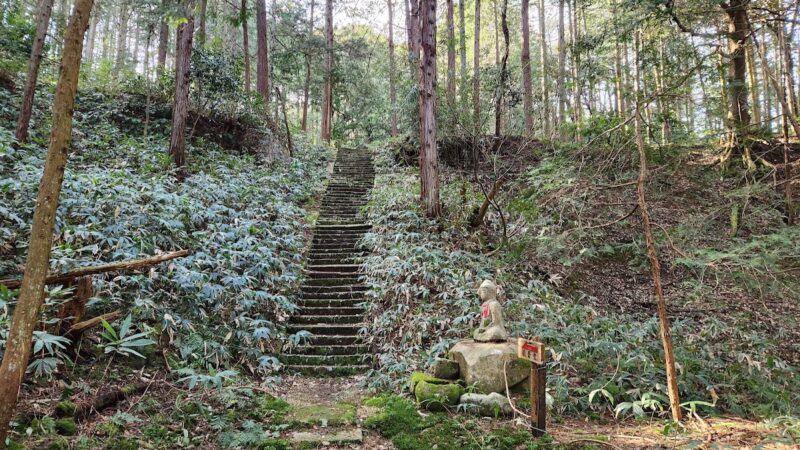
The guardhouse ruins are located on the mountainside of the castle, and the real castle area begins from here. Climbing the steep stone steps, you’ll encounter the remains of various baileys.
Along the way, you’ll find the remains of facilities such as the Tea House Ruins and Stable Ruins, indicating the diverse functions of the castle. Although the mountain path is covered with trees, guide signs are placed at various points,
Main Enclosure and Great Hall
The main enclosure (Honmaru) is the center of Odani Castle, measuring approximately 30m x 20m. Currently a flat open space, the foundation stones and remnants of earthworks can be seen. Standing here, one can truly feel tha tha conducted his affairs and spent his days with Lady Oichi.
Located south of the main enclosure is the Great Hall, a larger enclosure where meetings and ceremonies were held with senior retainers. Parts of the stone walls remain, evoking the grandeur of its former glory.
Remains of Shimizu Valley
Clear water still springs from Shimizu Valley, testifying to its importance as a water source during sieges. The remains of retainer residences are scattered along the valley, and traces of earthworks and stone walls can be seen.
It is said that Lady Oichi and her three sisters were rescued by the Oda army near Shimizu Valley when the castle fell, making this a place that conveys the tragedy of the Sengoku period.
Climbing to Otake
To reach the summit of Otake from the main keep, an additional 30 minutes of climbing is required. The mountain path is steep, but the view from Otake is breathtaking, offering a panoramic view of Lake Biwa and even Mount Hiei in the dist
Otake retains several remnants of baileys and earthworks, allowing us to imagine the early form of Odani Castle.
Fukujumaru and Yamazakimaru
Fukujumaru and Yamazakimaru, located on a different ridge, offer a real sense of the vastness of the castle grounds. These baileys functioned as outposts, serving as defensive strongholds to prepare for attacks from multiple directions.
Fukujumaru is believed to be the place where Asai Hisamasa retired, evoking the story of his father-son relationship with Nagamasa and the changing of the guard.
Odani Castle Sengoku Historical Museum and Surrounding Facilities
Odani Castle Sengoku Historical Museum
When visiting Odani Castle, we recommend visiting the Odani Castle Sengoku Historical Museum first. Here, the history of the Asai clan, the structure of Odani Castle, and the results of archaeological excavations are displayed in detail.
Understanding the overall picture of Odani Castle through the reconstructed models, excavated artifacts, and panel displays before visiting the actual castle ruins will significantly enhance your visit. You can also get your stamp for the “100 Famous Castles of Japan” here.
Sengoku Guide Station
Located at the entrance to Odani Castle, the Sengoku Guide Station is a tourist information center and rest area. Services include obtaining maps and brochures, using restrooms, and renting bicycles.
Opening hours are 9:00 AM to 5:00 PM (closed Mondays), and volunteer guides can be booked here. First-time visitors to Odani Castle will gain a deeper understanding of the history by touring with a guide.
Nearby Tourist Attractions
The area around Odani Castle is dotted with related historical sites:
- Nagahama Castle: A castle built by Hashiba Hideyoshi to replace Odani Castle, now open to the public as a history museum.
- Anegawa Battlefield: The site of an ancient battle where the Asai-Asakura allied forces clashed with the Oda-Tokugawa allied forces.
- Odani-ji Temple: A temple associated with the Asai clan.
- Lake Biwa: From the lakeshore, you can see Mount Odani, giving you a real sense of the castle’s strategic location.
Access to Odani Castle and Visitor Notes
Access by Public Transportation
The nearest station is Kawage Station on the JR Hokuriku Main Line. The distance from the station to the Sengoku Guide Station is approximately 4km, taking about 50 minutes on foot. Therefore, the following methods are recommended:
- Community Bus: Bus from Kawage Station to Odani Castle Ruins (Infrequent service, so advance confirmation is essential)
- Rental Bicycle: Available for rent at Kawage Station or the Sengoku Guide Station (Electric-assist bicycles are also available)
- Taxi: Approximately 10 minutes from Kawage Station
Access by Car
- Approximately 20 minutes from the Nagahama IC on the Hokuriku Expressway
- Approximately 25 minutes from the Maibara IC on the Meishin Expressway
Parking is available at the Odani Castle Sengoku Historical Museum and the Sengoku Guide Station. During peak tourist season, a shuttle bus to the guardhouse ruins may operate; please check the Nagahama-Maibara Tourism Association website for information.
Clothing and Items to Bring for Your Visit
Odani Castle is a full-fledged mountain castle, so the following preparations are necessary:
- Clothing: Comfortable clothing, trekking shoes or hiking boots
- Items to Bring: Drinking water, towel, hat, rain gear, insect repellent (summer)
- Season: Spring and autumn are best. Summer is hot and there are many insects. In winter, be careful of snow and ice.
- Time Required: We recommend allowing at least 2-3 hours.
Safety Precautions
- The mountain path has steep sections and can be slippery in rainy weather.
- There are areas where cell phone reception is poor.
- Avoid climbing alone; we recommend going in a group.
- If you are not confident in your physical fitness, consider using the shuttle bus to the guardhouse ruins.
The Charm of Odani Castle: Why Does It Still Attract People Today?
One of Japan’s Foremost Mountain Castle Remains
The greatest charm of Odani Castle is that the appearance of a Sengoku period mountain castle is well-preserved. The remains of stone walls, earthworks, baileys, and moats remain integrated with the natural terrain, allowing visitors to directly experi ingenuity of the time.
As one of Japan’s five greatest mountain castles, it is highly regarded by castle enthusiasts as a “mountain castle that everyone should visit at least once.”
The Story of Asai Nagamasa and Oichi
Odani Castle is also the setting for a tragic love story of the Sengoku period. The marriage of Oichi, the sister of Oda Nobunaga, and Asai Nagamasa, their break with Nobunaga, and the castle’s fall have been the subject of many novels and dramas.
The days spent between Oichi, hailed as “the most beautiful woman of the Sengoku period,” and Nagamasa, the young lord of northern Omi, and the historical drama of their three daughters marrying future rulers of Japan, continue to captivate
A Breathtaking View of Lake Biwa
The view of Lake Biwa from Odani Castle is spectacular. The views from the main keep and Mount Otake eloquently explain why this area was a strategically important location.
The panoramic views of the Kohoku plain, Lake Biwa, and even Mount Hiei in the distance are magnificent and make you forget the fatigue of the climb.
Enjoyment as a Trekking Tour
Odani Castle is popular not only for historical exploration but also as a trekking course. Its appeal lies in the combination of moderate exercise and the opportunity to experience history while walking through nature.
The scenery is especially beautiful in spring with its fresh greenery and in autumn with its vibrant foliage, offering a luxurious experience where you can enjoy both history and nature.
Summary: The Value of Visiting Odani Castle
Odani Castle is a valuable historical site that preserves the appearance of a mountain castle from the Sengoku period. As the residence of three generations of the Asai clan and the stage for battles against Oda Nobunaga, it played a crucial role in Korean hist
With its skillful use of terrain, pioneering stonework, and vast castle grounds, this mountain castle is a pinnacle of castle construction technology and is highly regarded in castle research.
The story of Asai Nagamasa, Oichi, and the three Asai sisters continues to move the hearts of many as a human drama of the Sengoku period. With panoramic views of Lake Biwa, lush trekking courses, and numerous historical remains that allow y firsthand,
Odani Castle is a place with multifaceted appeal that will satisfy history buffs, castle enthusiasts, and trekking lovers alike. When you visit Shiga Prefecture, be sure to visit Odani Castle and experience the history of the Sengoku period and the beauty