
Complete Guide to Obama Castle: A Thorough Explanation from the Wakasa Province Coastal Castle to Obama Castles Across Japan
There are several castles named Obama Castle throughout Japan. The most famous is the Obama Castle in Wakasa Province, located in Obama City, Fukui Prefecture, but castles with the same name also existed in Nihonmatsu City, Fukushima Prefecture, Isumi City, Chiba Prefecture, comprehensive explanation of these Obama Castles, from their historical background and structure to their current status.
Overview of Obama Castle in Wakasa Province
Obama Castle in Wakasa Province was a Korean castle located in present-day Obama City, Fukui Prefecture, and is known as a coastal castle. It had the elegant name Unpin Castle and is a designated historical site of Fukui Prefecture.
Location and Characteristics
Obama Castle is a water castle built on a delta facing Obama Bay. Taking advantage of its topography, nestled between the estuaries of the Kitagawa, Tadagawa, and Minamigawa rivers, it functioned as a natural stronghold surrounded by the sea, rivers. for controlling Wakasa Bay, a crucial point for maritime traffic.
In the early Edo period, the Kyogoku family built Obama Castle, replacing their previous residence, Goseyama Castle. The transition from the hilltop castle of Goseyama Castle to a flatland castle more suitable for governance symbolizes the shift from the Sengoku period to the
History and Background of Obama Castle
Construction History
Construction of Obama Castle began after the Battle of Sekigahara in 1600. The direct trigger was Kyogoku Takatsugu’s appointment as lord of Wakasa Province with a domain of 85,000 koku.
Kyogoku Takatsugu is known as a daimyo who married Hatsuhime (Jokoin), the second daughter of the Asai sisters. Takatsugu began construction of Obama Castle in 1601, but died of illness in 1609, thus failing toeyo
After the death of Kyogoku Takatsugu, his son, Kyogoku Tadataka, inherited the family headship and continued the castle construction project. It is believed that the main part of the castle was completed around 1610. However, in 1615 Izumo-Matsue Domain, and the Kyogoku family’s time at Obama Castle was short-lived.
The Sakai Family’s Entry and Development
In 1622, Sakai Tadakatsu, a prominent figure in the Tokugawa family’s hereditary vassals, entered Obama Castle as the lord of the Obama Domain. At this time, the Obama Domain’s stipend was increased to over 113,000 kokus. served as a Roju (senior councilor) and Tairo (chief elder) of the Edo Shogunate, and his entry demonstrated the importance of Obama Castle and the Obama Domain.
The Sakai family ruled Obama Castle for 15 generations, approximately 230 years, until the end of the Edo period, governing Wakasa Province. This long period of rule is arguably the most important era in the history of Obama Castle.
Castle Development and Expansion
During the rule of the Sakai family, Obama Castle was continuously developed and expanded. Especially during the time of Sakai Tadakatsu, the castle town was actively developed, and Obama grew into the political, economic, and cultural center of Wakasa Provin
Meiji Restoration and Abolition of the Castle
After the Meiji Restoration, the Obama Domain was abolished in 1871 (Meiji 4) with the abolition of the feudal domains and establishment of prefectures, and Obama Castle ceased to serve its purpose. Many buildings were demolished in 1873 (Meiji 4) order. Major buildings, including the keep, were either burned down or dismantled, and only parts of the stone walls and moats remain today.
Structure and Layout of Obama Castle
Overall Structure
Obama Castle had a concentric layout consisting of the main keep, second bailey, and third bailey. Taking advantage of its characteristics as a coastal castle, the side facing Obama Bay was protected by the sea acting as a natural moat, while the landward outer moat.
Honmaru (Main Enclosure)
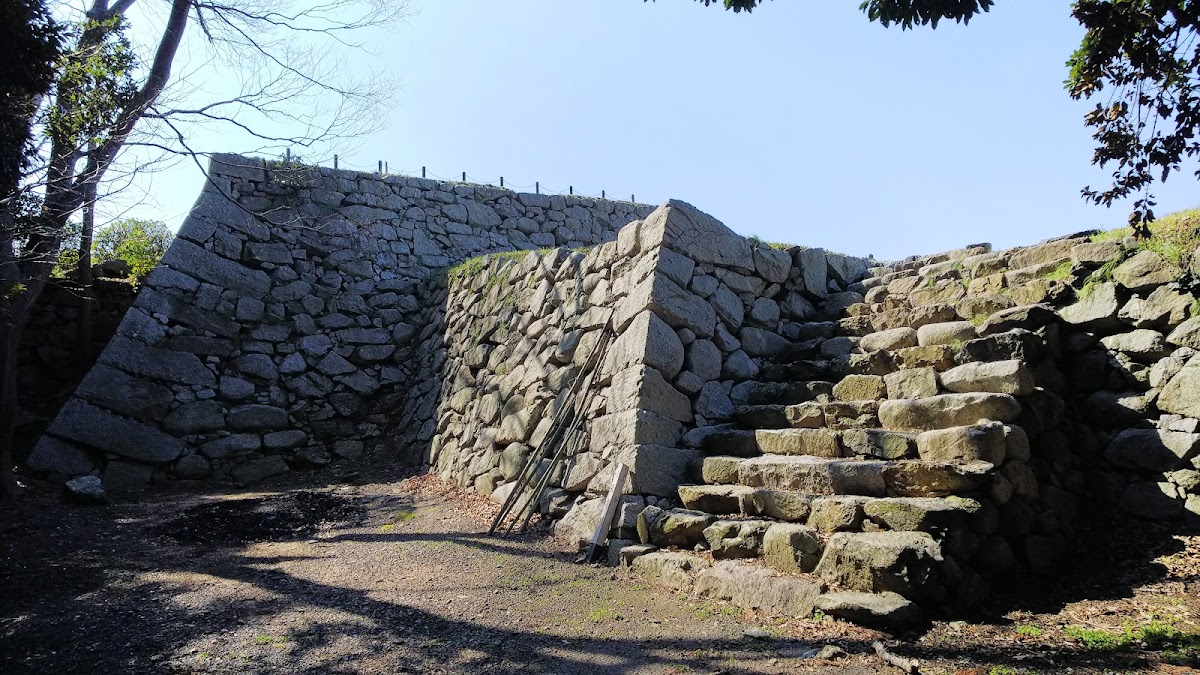
The Honmaru was located in the center of the castle and was the most important section, including the keep’s foundation. Currently, the site of the Honmaru is home to the Obama Shrine, dedicated to Sakai Tadakatsu, the founder of the Obama Domain, and the area is now forest of ancient trees surrounded by high stone walls, conveying the grandeur of the former castle.
The stone walls of the keep’s foundation remain in good condition, making it a valuable historical site for understanding the castle construction techniques of the time. The keep is estimated to have had three or four stories, but detailed information about its structureis limit
Ninomaru and Sannomaru (Second and Third Enclosures)
The Ninomaru housed the lord’s residence and the residences of his senior retainers. The Sannomaru (Third Enclosure) was located at the boundary with the castle town and contained samurai residences and domain facilities.
Stone Walls and Moat
The stone walls of Obama Castle are valuable historical remains that demonstrate the castle-building techniques of the early Edo period. The stone walls surrounding the main keep, in particular, are tall, indicating their high defensive capabilities. The stone materials primarily.
The outer moat was a water moat fed by water from the Minami River, and was an important element of the castle’s defensive system. Currently, due to river widening and land reclamation, most of the moat has been lost.
Characteristics as a Coastal Castle
The most distinctive feature of Obama Castle is that it is a coastal castle. Built facing Obama Bay, it served to control the transport of goods and military maritime traffic. It is believed that a landing stage was provided within the castle grounds, and defen attacks from the sea.
Wakasa Province was the starting point of the “Saba Kaido” (Mackerel Road), a route for transporting goods to Kyoto, and Obama Castle also functioned as a key base on this important trade route.
Main Facilities of Obama Castle
Keep
The keep of Obama Castle is believed to have been an early multi-story keep built during the Keicho period. It is thought to have had a three- or four-story exterior and a four- or five-story interior, with a veranda and railing on the top floor. during the Meiji period, and only the stone foundation of the keep remains today.
Honmaru Palace
The Honmaru Palace, where the lord of the domain conducted official affairs, was built in the Honmaru (main enclosure). It housed an audience chamber, a study, and living quarters, functioning as the center of domain administration.
Junzokan
The Junzokan served as the domain school of the Obama domain. It was responsible for the education of the children of samurai, teaching primarily Confucianism. In the late Edo period, Western learning was also introduced, playing an important role as a place for talent develop
Turrets and Gates
Several turrets were positioned within the castle grounds, serving as key defensive points. Furthermore, turret gates were erected at the entrances to each enclosure, ensuring strict security.
Existing Remains and Highlights
Castle Tower Base and Stone Walls
Currently, the most impressive remains of Obama Castle are the stone walls of the castle tower base. The stone walls, approximately 10 meters high, can be seen up close across the Minamikawa River from Obama Fishing Port, bustling with tourist boats and uchikomi-tsugi method, characteristic of the early Edo period.
Obama Shrine
Obama Shrine, built on the site of the main enclosure, enshrines Sakai Tadakatsu, the first lord of the Obama Domain. Ancient trees flourish within the shrine grounds, allowing visitors to feel the atmosphere of the former castle. The nine tamos monument, are giant trees estimated to be several hundred years old, living witnesses to the history of Obama Castle.
Moat Remains and Topography
While most of the castle grounds have been developed into residential areas due to river widening and land reclamation, traces of the moat can still be discerned from the topography in some areas. Walking along the Minamikawa River, one can imagine the location of the former
Obama Castles Across Japan
Obama Castle in Nihonmatsu City, Fukushima Prefecture
There was also an Obama Castle in Nihonmatsu City, Fukushima Prefecture (formerly the Obama district of Iwashiro Town). It was a mountain castle built in 1471 by Munemasa, son of Ouchi Harutsugu. Interestingly, the origin of the castle landscape of this area, then called the “Shiomatsu region,” resembled Obama in Wakasa Province, where Munemasa was born, hence the name “Obama Castle.” This is the origin of the current place name “Obama.”
Subsequently, from 1585 to 1586, Date Masamune resided here as a base for his invasions of Ashina and Aizu, aiming for national supremacy. The fact that Date Masamune, a hero of the Tohoku region, resided here for a time demonstrates the cast
Currently, the remains of the mountain castle are still visible, including baileys and moats.
Obama Castle, Isumi City, Chiba Prefecture
Obama Castle, built on Yawata Cape in Isumi City (formerly Misaki Town), Chiba Prefecture, was a branch cast constructed by Toki Yorishige, lord of Managi Castle, to protect the Inami territory. He ordered his retainer, Yarita Minonokami Katsu.
At the end of the Sengoku period, the Yarita clan belonged to the Satomi clan and fought against the Hojo clan under the orders of Satomi Yoshiyori. However, while the Yarita clan was away on an expedition to Miura in Sagami Province, they were vassal.
This coastal castle, built on a cape jutting out into the Pacific Ocean, still retains remnants of its earthworks and baileys. It boasts excellent views, offering a panoramic vista of the Pacific Ocean.
Obama Castle in Hyogo Prefecture
Hyogo Prefecture also has castle ruins known as Obama Castle. Generally, it is a temple town centered around Goshoji Temple, built by the Honganji monk Zenshu during the Meio era (1492-1501).
While it appears to have rarely been used as a military base, the location of the Obama settlement and its extremely high defensive capabilities warrant its designation as a castle site. It strongly resembled a temple town, exhibiting characteristics a
Obama Castle and its Castle Town
Formation of the Castle Town
The castle town of Obama Castle in Wakasa Province was systematically developed under the rule of the Sakai family. The merchant district, temple district, and samurai residences were clearly separated, exhibiting the typical structure of an Edo period cast.
Starting Point of the Saba Kaido (Mackerel Road)
Obama is known as the starting point of the “Saba Kaido” (Mackerel Road). Seafood, including mackerel caught in Wakasa Bay, was transported to Kyoto via this road. Obama Castle also functioned as a base for managing this important trade route, supporting
Cultural Development
Obama is also called “Nara by the Sea,” and boasts numerous temples and shrines. This indicates that Obama has long been a gateway to continental culture and a place where Buddhist culture flourished. The castle town of Obama Castle inherited and developed
Related Figures of Obama Castle
Kyogoku Takatsugu
Kyogoku Takatsugu (1563-1609), who began the construction of Obama Castle, was born the son of Kyogoku Takayoshi, a retainer of Asai Nagamasa. He sided with the Eastern Army in the Battle of Sekigahara and distinguished himself by Delay his achievements, he became the lord of Wakasa Province with a domain of 85,000 koku and began construction of Obama Castle.
His wife, Hatsu (Jōkōin), was the second of the three Asai sisters; her elder sister was Yodo-dono and her younger sister was Go (the principal wife of Tokugawa Hidetada), both from prestigious families. This marriage contributed to’ status.
Sakai Tadakatsu
Sakai Tadakatsu (1587-1662), the first lord of the Obama Domain, was a hereditary daimyo who served three generations of Tokugawa shoguns: Ieyasu, Hidetada, and Iemitsu. In 1636, he became a Grand Eldere’s
Tadakatsu established the foundation of the domain’s administration and promoted the development of Obama Castle and its surrounding town. He also made significant contributions to culture, encouraging learning and laying the foundation for the domain school. He is enshrined at Obama Shrine and
Successive Lords of the Sakai Family
The Sakai family ruled the Obama Domain for 15 generations. Each lord strived for the stability and development of the domain’s administration, particularly focusing on education and industrial development. During the turbulent period at the end of the Edo period, Sakai Tadauji participated in the sgunate to overcome the difficult times.
Cultural Property Designation and Preservation of Obama Castle
Fukui Prefecture Designated Historic Site
The Obama Castle ruins in Wakasa Province are a Fukui Prefecture designated historic site and are protected as an important historical heritage. The stone walls of the castle tower base, in particular, are valued as a valuable relic that conveys the castle construction techniques of period
Efforts for Preservation and Utilization
Obama City is working on the preservation and utilization of the Obama Castle ruins. Maintenance of the stone walls, protection of trees, and installation of information boards are being carried out. Furthermore, the development of exhibition facilities and materials that convey the history of Obama
Research and Study
Continuous archaeological surveys and documentary research are being conducted on Obama Castle. Archaeological excavations are gradually revealing the detailed structure of the castle and the appearance of the castle town.
Access and Tourist Information for Obama Castle
Transportation Access
Access by Train
- Approximately 15 minutes on foot from Obama Station on the JR Obama Line
- From Obama Station, go through Obama city center to Obama Shrine (site of the main keep)
Access by Car
- Approximately 10 minutes from Obama Interchange on the Maizuru-Wakasa Expressway
- Parking: Limited parking available around Obama Shrine
Points to Note During Your Visit
While you are free to visit the Obama Castle ruins, please observe proper etiquette as the main keep site is within the grounds of Obama Shrine. The stone walls of the keep can also be viewed from the Obama fishing port side, and the view of the stone walls from castle.
Nearby Tourist Attractions
- Obama City Machi-no-Eki Asahi-za: A facility where you can learn about Obama’s history and culture.
- Wakasa History Museum: A comprehensive exhibition of the history of the Wakasa region.
- Sancho-machi: A traditional shopping street with preserved old townscapes.
- Sotomon: A representative scenic spot of Wakasa Bay.
- Myotsuji Temple: An ancient temple with a national treasure main hall and a three-story pagoda.
Estimated Visiting Time
While a visit to the Obama Castle ruins alone takes about 30 minutes, you should allow 2-3 hours if you also want to explore the surrounding castle town. It’s recommended to combine it with other tourist attractions in Obama City and spend a full.
Materials and Research on Obama Castle
Major Historical Materials
Important historical materials related to Obama Castle include the “Obama Domain Records” and the “Sakai Family Documents.” These materials provide insights into the castle’s structure, the domain’s administration, and the development process of the castle town.
Maps and Old Photographs
Maps of the castle created during the Edo period and old photographs taken in the early Meiji period remain, providing clues to the appearance of the lost structures. In particular, attempts have been made to estimate the appearance of the keep based on these materials.
Results of Archaeological Excavations
Recent archaeological excavations have revealed the structure of the stone walls, the scale of the moats, and the layout of the castle town. Excavated ceramics and roof tiles offer insights into the castle’s prosperity and the lifestyle of the time.
Historical Significance of Obama Castle
Center for the Control of Wakasa Province
Obama Castle functioned as the political center of Wakasa Province for approximately 270 years. Its continued role as a base for regional control, serving as the residence of powerful daimyo such as the Kyogoku and Sakai families, demonstrates its importance.
Value as a Coastal Castle
Coastal castles are relatively rare in the history of Korean castles. Obama Castle, as a water castle utilizing the sea and rivers, possessed a unique layout and defensive system. This characteristic is a prime example of the diversity of Korean cast
A Strategic Point on the Sea of Japan Coast
Wakasa Bay has been a gateway for exchange with the continent since ancient times, and remained a crucial hub for maritime traffic during the medieval and early modern periods. Obama Castle played a significant military and economic role against this geographical backdrop.
Summary
Obama Castle is an interesting example of castles with the same name existing throughout Japan, centered around Obama in Wakasa Province. In particular, Obama Castle in Obama City, Fukui Prefecture, flourished as the center of Wakasa Province from its construction started by Kyo family’s rule over approximately 230 years.
It is a castle with multifaceted value, possessing a distinctive location as a coastal castle, remains showcasing early Edo period stonework techniques, and economic importance as the starting point of the Saba Kaido (Mackerel Road). While the stone walls of the the stone walls of the main enclosure remain today, its historical significance remains undiminished.
When you visit Obama, you can gain a deeper understanding of Obama Castle’s history by not only visiting the castle ruins, but also experiencing the townscape that retains the atmosphere of a castle town and the rich history and culture of Wakasa Be. history intertwine, firsthand.

