The History and Fierce Battle of Iwaya Castle: From Takahashi Shōun’s Last Stand to the Present
What is Iwaya Castle?
Iwaya Castle is a mountain castle built on the slopes of Mt. Shiōji in Urajo, Dazaifu City, Fukuoka Prefecture (formerly Mikasa District, Chikuzen Province), at an altitude of approximately 300 meters. It is known in f5 (Tenshō 14) between the Shimazu army led by Shimazu Tadanaga and the Ōtomo army led by Takahashi Shōun, and is remembered as a remarkable battle of annihilation in the history of Korean castles.
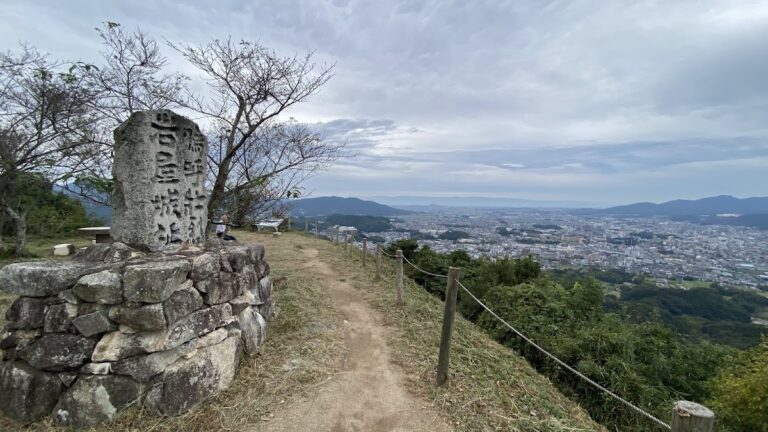
The current Iwaya Castle site is designated as a historical site by Fukuoka Prefecture, and remnants of the earthworks, stone walls, and baileys from that time remain. Its location on the slopes of Mt. Shiōji offers excellent views of Dazaifu as a military base during the Sengoku period.
History of Iwaya Castle
Construction History and Early Period
The most widely accepted theory regarding the construction period of Iwaya Castle is that it was built during the Tenbun era (1532-1554) by Takahashi Akitane, a general of the Otomo clan. The Otomo clan was a Sengoku daimyo based in Bung established a vast sphere of influence in northern Kyushu.
Iwaya Castle, along with Tachibanayama Castle, functioned as an important base for the Otomo family’s control of Chikuzen Province. Its location, utilizing the natural fortification of Shiojiyama Mountain, was ideal for maintaining military pressure towards Dazaifu and Hakata. it is believed that the two castles supported each other.
Takahashi Akitane’s Rebellion and Change of Lord
Takahashi Akitane, considered the first lord of Iwaya Castle, was initially a loyal retainer of Otomo Sorin. However, during the Eiroku era (1558-1570), Takahashi Akimune became enraged by the arrogant behavior and political stance rebellion led to Takahashi Akimune being driven out of Iwaya Castle.
Afterward, Yoshihiro Akimichi’s second son, Shigetane, inherited the Takahashi name and became the lord of both Homan Castle and Iwaya Castle, taking the name “Takahashi Shigetane” (later Takahashi Shoun). This personnel change wain a control over Chikuzen Province.
Takahashi Shoun’s Time as Castle Lord
Takahashi Shoun (1548-1586) was a renowned general who, along with Tachibana Dosetsu, continuously supported the declining Otomo family as a senior retainer. Known for his intelligence and courage, Shoun governed the Chikuzen region from his bases.
Shōun’s eldest son, Munetora, was adopted by Tachibana Dōsetsu and changed his name to Tachibana Muneshige, while his second son, Munemasu, became the son-in-law of Chikushi Hiromon. Through these marriage alliances, the Otomo lords in northern Kyushu. During this period, Iwaya Castle functioned as one of the Ōtomo family’s most important strongholds in Chikuzen Province.
Battle of Iwaya Castle: The Battle of Tenshō 14
The Shimazu Army’s Northward Advance and the Background of the Battle
In Tenshō 14 (1586), the Shimazu clan of Satsuma, aiming to conquer Kyushu, began their northward advance. The Shimazu clan, headed by Shimazu Yoshihisa, along with his brothers Yoshihiro, Toshihisa, and Iehisa, were e their crushing defeat at the Battle of Mimikawa (1578), the Ōtomo family’s power had been steadily declining, making it difficult for them to stop the Shimazu army’s advance.
The Shimazu army, a massive force estimated at 40,000 to 50,000 men, advanced northward and began its invasion of Chikuzen Province. At this time, Takahashi Shōun was besieged in Iwaya Castle, while his second son, Mun 성.
The Fierce Siege
In July of Tenshō 14 (1586), the Shimazu army, led by Shimazu Tadanaga (son of Shimazu Iehisa), besieged Iwaya Castle. While there are various theories regarding the Shimazu army’s strength, it is generally belie 50,000 men. In contrast, Takahashi Shōun’s forces, besieged in Iwaya Castle, numbered only about 700 to 800 men.
Backed by their overwhelming numerical superiority, the Shimazu army repeatedly issued surrender demands. The Shimazu side highly valued Shōun’s bravery and character, and it is said they wanted to recruit him if possible. However, Shōun refus to his lord, Ōtomo Sōrin. The siege intensified on July 27th, with the Shimazu army launching a fierce attack day and night. Despite the overwhelming numerical disadvantage, Shoun and his soldiers continued to resist with skillful defensa extremely brutal, and records indicate that the Shimazu army suffered heavy casualties.
The End of Takahashi Shoun and the Fall of the Castle
The fierce battle continued for approximately two weeks, but in mid-August, Iwaya Castle finally fell. Takahashi Shoun fought to the very end, committing suicide within the castle. He was 39 years olddy 7. castle with Shoun were either killed in action or committed suicide, resulting in a literal annihilation of Iwaya Castle.
This fierce resistance significantly delayed the Shimazu army’s northward advance. Shoun’s sacrificial siege bought time for Toyotomi Hideyoshi’s subsequent conquest of Kyushu, and proved to be strategically important. Furthermore, Shōun’s foe, and his story would be passed down through generations.
Post-War Impact
After the fall of Iwaya Castle, the Shimazu army also captured Hōmanzan Castle. However, their subsequent attack on Tachibanayama Castle was hampered by the fierce resistance of Tachibana Muneshige (Shōun’s Eldest son), delaying theture Hideyoshi’s Kyushu conquest army arrived, forcing the Shimazu clan to surrender.
Takahashi Shōun’s sacrificial resistance is considered a crucial battle that delayed the downfall of the Ōtomo family and ultimately enabled the unification of Kyushu by the Toyotomi regime.
Structure and Remains of Iwaya Castle
Castle Location and Layout
Iwaya Castle is a typical mountain castle built on the slopes of Shiōji Mountain, at an altitude of approximately 300 meters. Shiōji Mountain is 410 meters high and is a historically important location where Ōno Castle was buils in anci.
The castle’s layout cleverly utilizes the mountainous terrain, with multiple enclosures arranged around the main keep. The steep terrain was used as a natural defensive line, and earthworks and stone walls were constructed at key points to enhan
Layout of the Main Keep and Enclosures
The main keep of Iwaya Castle remains in relatively good condition today. Earthworks surround the main keep, allowing us to see some of the original defensive structures. From the main keep, one can see a panoramic view of Dazaifu city and the Chikushi Plain, giv
Several enclosures are arranged in a stepped pattern around the main keep, forming multiple defensive lines. These enclosures are thought to have been used for troop garrisons and supply storage.
Earthworks and Stone Walls
Earthworks and stone walls are important defensive structures of Iwaya Castle. The earthen ramparts surrounding the main enclosure, approximately 2-3 meters high, remain as valuable historical remains for understanding the castle construction techniques of the time.
Regarding the stone walls, while relatively simple for a mountain castle of the Tensho period, rough-hewn stone walls can be seen in key locations. These are thought to have enhanced defensive capabilities and also contributed to the construction of the enclosures.
Water Sources and Preservation Storehouses
Regarding water sources, a crucial element for mountain castles, well remains have been confirmed within the castle grounds. However, there is debate as to whether there was sufficient water to withstand a long siege, and it has been suggested th besieged army during the Battle of Iwaya Castle.
Regarding preservation stores, no clear remains exist, but it is presumed that supplies were stored in various enclosures.
Current Status of Iwaya Castle Ruins
Historical Site Development Status
The current Iwaya Castle ruins are maintained as a historical park by Dazaifu City. The approach to the castle is well-maintained, making it relatively easy to reach the main enclosure. An information board is installed in the main enclosure, where you can le Iwaya Castle.
The view from the castle ruins is magnificent, offering panoramic views of Dazaifu Tenmangu Shrine, the city of Dazaifu, and even as far as Fukuoka City. This excellent view speaks to the military importance of the castle during the Sengoku period.
Commemoration of Takahashi Shōun
At the Iwaya Castle ruins, there are stone monuments and memorials commemorating Takahashi Shōun. Every year in August, the anniversary of Shōun’s death, a memorial service is held, attracting many history enthusiasts and locals.
Shōun’s loyalty and bravery are still recounted in Dazaifu and are cherished as a source of local pride. Furthermore, Shōun’s eldest son, Tachibana Muneshige, later became the lord of Yanagawa Domain, and the Tachibana family continued until place associated with the Tachibana family.
Access and Visiting Information
Iwaya Castle Ruins can be accessed on foot from Nishitetsu Dazaifu Station, but since it involves climbing a mountain path, a certain level of physical fitness is required. The climb takes approximately 30 minutes to 1 hour.
Besides Iwaya Castle Ruins, Shioji Mountain also boasts other points of interest, such as the remains of the ancient mountain castle Ono Castle and the Hyakken Ishigaki (100-ken stone wall), making it a popular historical walking course. When visiting, we drinking water.
Related Castles to Iwaya Castle
Relationship with Homanzan Castle
Homanzan Castle is a mountain cast located approximately 2 kilometers south of Iwaya Castle, built near the summit of Mount Homan (elevation 829 meters). The two castles had a mutually supportive relationship, and they formed the two pillars
During the Battle of Iwaya Castle, Takahashi Shōun’s second son, Munemasu, was holed up in Hōmanzan Castle. After the fall of Iwaya Castle, Hōmanzan Castle was attacked and captured by the Shimazu army. The cooperation between the two family’s defense line in Chikuzen.
Cooperation with Tachibanayama Castle
Tachibanayama Castle is a mountain castle built on Tachibanayama (elevation 367 meters), which straddles Higashi-ku, Fukuoka City and Shingu-machi. It was the residence of Tachibana Dōsetsu, a senior retainer of the Ōtoma fami Shōun’s eldest son, became the lord of the castle.
Tachibanayama Castle is located north of Iwaya Castle and was a strategically important point overlooking Hakata Bay. It is believed that the three castles of Iwaya Castle, Hōmanzan Castle, and Tachibanayama Castle formed a triangular defense networkthat Chikuzen.
Historical Connection with Ōno Castle
The remains of Ōno Castle, built in ancient times (7th century), also remain on Shiōjiyama. Ono Castle was an ancient mountain castle (Korean-style mountain castle) built by the Yamato court after the Battle of Baekgang, and
It has been suggested that Iwaya Castle may have been built using some of the remains of Ono Castle. This is an interesting example that shows that Shioji Mountain remained a strategically important military point from ancient times to the Sengoku period.
Historical Significance of the Battle of Iwaya Castle
Place in the History of Sengoku Kyushu
The Battle of Iwaya Castle is positioned as one of the important turning points in Kyushu during the Sengoku period. This battle temporarily thwarted the Shimazu clan’s ambition to conquer Kyushu, buying time for Toyotomi Hideyoshi to pacify Kyushu.
The resistance of Takahashi Shōun’s more than 700 men, which pinned down tens of thousands of Shimazu troops for two weeks, is also noteworthy from a tactical standpoint. This delay gave Tachibana Muneshies Tachibanayama Castle, and he was ultimately able to hold out until the arrival of the Toyotomi army. ### A Symbol of Bushido Spirit
Takahashi Shōun’s actions were passed down through generations as a model of Bushido spirit. Despite being overwhelmingly outnumbered, his unwavering loyalty to his lord and his refusal to surrender led to his veneration as an ideal warrior
Shōun’s way of life is considered a quintessential example of Japanese Bushido, a fusion of Confucian loyalty and a samurai’s emphasis on honor.
Evaluation by the Shimazu Army
On the other hand, Shōun’s bravery and loyalty were also highly regarded by the Shimazu army. Shimazu records also contain descriptions praising Shōun’s resistance, indicating that he was respected as a warrior beyond the boundaries of friend or or
The Shimazu army suffered heavy casualties in the siege of Iwaya Castle, yet their attempt to win Shōun over to their side is an interesting episode that illustrates the values of the warlords of that time.
Significance of Visiting Iwaya Castle
As a Place for Historical Learning
Visiting the ruins of Iwaya Castle is a valuable experience for learning about the history of Kyushu during the Sengoku period. Walking through the castle ruins and viewing Dazaifu and the Chikushi Plain from the main enclosure allows you to truly appreciate
Observing the remaining earthworks and baileys deepens your understanding of the structure and construction techniques of mountain castles during the Sengoku period. The site is well-equipped with explanatory signs and information boards, making it enjoyable even for those with
Combining with Dazaifu Sightseeing
Iwaya Castle ruins are relatively close to Dazaifu Tenmangu Shrine, making it easy to combine a visit with a Dazaifu sightseeing trip. Visiting Iwaya Castle, a Sengoku period historical site, alongside ancient historical sites such as Dazaifu Tengu you to experience the multifaceted history of Dazaifu.
It’s also a popular hiking course on Mt. Shioji, offering the appeal of enjoying nature while exploring history.
A Holy Site for History Fans
Iwaya Castle Ruins is a must-visit site for fans of the Sengoku period and castles. It’s especially a must-see for fans of Takahashi Shōun and Tachibana Muneshige.
The view from the castle ruins is magnificent and a popular spot for photography. On clear days, you can enjoy a spectacular view stretching to Fukuoka city and Hakata Bay.
Summary
Iwaya Castle is a mountain castle that made its mark on Korean castle history due to a fierce battle that took place in 1586 (Tenshō 14) at the end of the Sengoku period. The tragic end of Takahashi Shōun and his di thousands of Shimazu troops for two weeks, ultimately perishing in a desperate last stand, is recounted to this day as a symbol of the samurai spirit.
Currently, the Iwaya Castle Ruins have been developed into a historical park by Dazaifu City and are a popular destination for many history enthusiasts. Located on the slopes of Mount Shioji, Iwaya Castle boasts stunning panoramic views of Dazaifu and the Chikushi Plain.
Learning about the history of Iwaya Castle is essential for understanding the history of Kyushu during the Sengoku period. The Battle of Iwaya Castle marked a crucial turning point in the historical flow that led from the conflict between the Otomo and Shimazu famil Kyushu, and the exploits of Tachibana Muneshige.
When visiting Dazaifu, be sure to extend your trip to the ruins of Iwaya Castle and experience the spirit of the Sengoku period. Reflecting on the loyalty and bravery of Takahashi Shoun, and the resolve of the soldiers who defensaed the castle, will deepen your underding