Moto-Sakura Castle Complete Guide: The Last Stronghold of the Chiba Clan and Highlights of the Continued Top 100 Korean Castles
What is Moto-Sakura Castle?
Moto-Sakura Castle is a medieval Sengoku period castle built on Masakado Mountain, spanning Osakura, Sakura City, Chiba Prefecture, and Moto-Sakura, Shisui Town, Inba District. It was constructed by Chiba Suketane during the Bunmei era (1669 stronghold for approximately 120 years.
Currently designated a national historic site, it was selected as one of the “Continued Top 100 Korean Castles” (number 121) on April 6, 2017. Large-scale earthworks and dry moats remain in excellent condition and and preservation an extremely important cultural asset for understanding the structure of medieval castles.
History of Hon-Sakura Castle
Background of Construction and Chiba Suketane
The construction of Hon-Sakura Castle was prompted by the Kyōtoku Rebellion (1454-1483), a large-scale civil war that engulfed the Kanto region. The Chiba clan supported Ashikaga Shigeuji, the Koga Shogun, and decided to establish a new Inba, closer to Koga and a strategic point for water transportation, rather than their previous base at Inohana Castle (Chiba City).
Chiba Suketane was the head of the Chiba clan, which boasted one of the greatest powers in the Kanto region as the governor of Shimōsa Province. He chose the geographically advantageous location of Masakado-yama, utilizing the peninsula-shaped hilly terrain with a surrounded on three sides by wetlands. This location, facing Inbaura (present-day Lake Inba) and being a strategic point for land transportation where major roads intersected, possessed excellent conditions both militarily and economically. ### The Prosperity of the Chiba Clava
After its construction, Hon-Sakura Castle served as the base of the Chiba clan for approximately 120 years. The castle town also developed, boasting the grandeur of a castle belonging to one of the most powerful daimyo in the Kanto region. The Chiba clan ruled maintaining their power during the Sengoku period by forming strong marital ties with the Hojo clan.
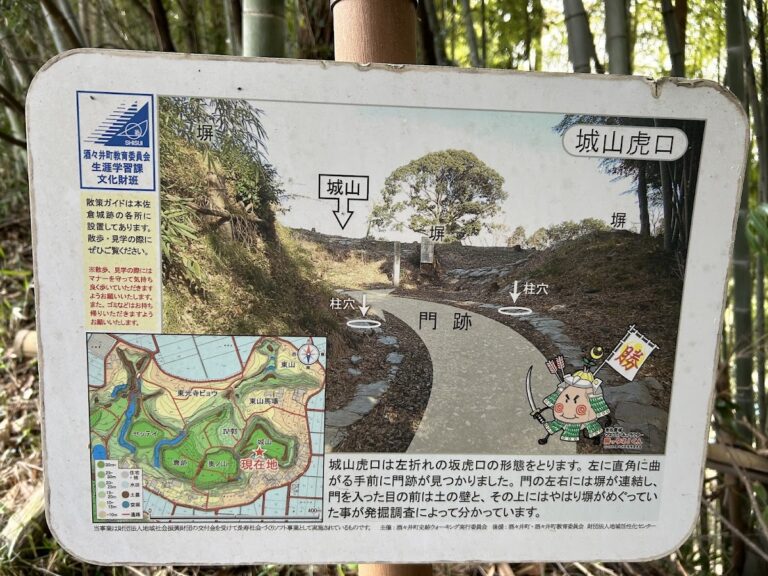
The castle’s structure underwent repeated expansions and renovations over time, developing into a complex layout with multiple baileys. Archaeological excavations have confirmed the remains of six gates, revealing the high level of completion of the castle.
Toyotomi Hideyoshi’s Siege of Odawara and the Downfall of the Chiba Clan
In 1590, when Toyotomi Hideyoshi launched his siege of Odawara, the Chiba clan, strongly allied with the Hojo clan, fought on the Hojo side. However, with the defeat of the Hojo clan, the Chiba clan also perished, and Hon-sakura residence.
Subsequently, with Tokugawa Ieyasu’s entry into the Kanto region, this area came under Tokugawa control. Hon-Sakura Castle was abandoned, and in the early modern period, the administrative center of the Sakura Domain was moved to the newly constructed Sakura Castle. Hon-Sakura Castle withdrew from the stage of history and entered a long period of slumber.
Structure and Layout of Hon-Sakura Castle
Layout Utilizing the Topography
The most distinctive feature of Hon-Sakura Castle lies in its layout, which skillfully utilizes the natural terrain. The castle was built on a hill called Masakado-yama, approximately 30-40 meters above sea level, and protected by a natural defen wetlands leading to Lake Inba to the north and east.
The castle grounds extend approximately 700 meters east-west and 600 meters north-south, and feature a series of interconnected enclosures. Major enclosures include Shiroyama, Higashiyama, and Okunoyama, each demarcated by earthwork
Remains of Earthworks and Dry Moats
One of the highlights of Hon-Sakura Castle is the well-preserved remains of earthworks and dry moats. In particular, the large moat separating Higashiyama and Shiroyama is a massive structure, approximately 10 meters deep and 20 meters wide, de medieval castles.
Earthworks several meters high remain in various places, serving to prevent enemy intrusion and obscuring the view into the enclosures. These civil engineering works are valuable evidence of the technology and labor mobilization capabilities of the time.
Six Gates Revealed by Archaeological Excavations
Recent archaeological excavations have revealed that Hon-Sakura Castle had at least six gates. These gates controlled entry and exit to the castle and functioned as key defensive points. The structure and placement of the gates reveal insights into strategy.
Of particular note is the scale of the gates, reconstructed from the arrangement of foundation stones and post holes. It’s clear that a variety of gates, ranging from large, dignified gates to smaller, more practical ones, existend, each suited.
Chiba Clan Residence Site
It is believed that the Chiba clan’s residence was located within the castle grounds. Archaeological excavations have unearthed building remains, garden structures, and everyday items such as ceramics. These artifacts offer insights into the lif Sengoku-period daimyo (feudal lord) and the state of trade at the time.
In particular, the discovery of high-quality ceramics such as Chinese celadon and white porcelain indicates that the Chiba clan participated in a wide-area trade network, confirming that they were not merely a local powerful family but possessed the economic power of
Designation as a National Historic Site and Selection as one of the Continued Top 100 Korean Castles
Background of National Historic Site Designation
The Hon-Sakura Castle Ruins were designated as a National Historic Site on September 11, 1998. This designation was based on the evaluation of the well-preserved remains of the castle, its high academic value in understanding the structure of medieval castles, and powerful daimyo family in the Kanto region.
Since the designation, Sakura City and Shisui Town have been cooperating on preservation and development projects, striving to balance the protection and utilization of the remains. Archaeological excavations are also being conducted continuously, and new discoveries continue to be made.
Selection as one of the Continued Top 100 Korean Castles
On April 6, 2017, “Castle Day,” Hon-Sakura Castle was selected as one of the “Continued Top 100 Korean Castles” (number 121) by the Japan Castle Association. This is the second selection of famous castles following is an honor to have been chosen from among outstanding castles throughout the country.
This selection has brought attention to Hon-Sakura Castle from castle enthusiasts nationwide, and the number of visitors has increased. The stamp for the “Continued 100 Famous Castles of Japan” is located at the Hon-Sakura Castle Ruins who enjoy castle tours visit the center.
Hon-Sakura Castle Ruins National Historic Site Information Center
Overview of the Information Center and Exhibits
The Hon-Sakura Castle Ruins National Historic Site Information Center serves as an introductory facility for visitors to the castle ruins, featuring display panels explaining the history of Hon-Sakura Castle and the Chiba clan, as well as exhibits of excavated artifacts. easy-to-understand introduction to the castle’s history and structure, making it ideal for gaining preliminary knowledge before visiting.
The exhibits include actual materials such as ceramics, roof tiles, and metal products excavated during archaeological surveys, as well as a reconstructed model of the castle, aerial photographs, and old maps. Furthermore, video materials are available, including an introduc Clan’s Residence,” which allows visitors to visually understand the results of the excavation.
Location of the Continued Top 100 Korean Castles Stamp
The stamp for the Continued Top 100 Korean Castles is located in front of the restrooms at the information center. Visitors enjoying castle tours can get their stamps here as a memento. The information center also distributes pamphlets and materials about Hon-Sakura Cast visit.
Highlights and Walking Routes at Hon-Sakura Castle Ruins
Ascent from Tokoji-byo
Visiting the Hon-Sakura Castle Ruins typically begins at the Tokoji-byo marker, about a 10-minute walk from Keisei Osakura Station. Upon entering the castle grounds from here, you can immediately see remains such as earthworks and d
Walking paths are well-maintained, and a course is set up to visit the main remains. The estimated time required for a thorough visit is about 1.5 to 2 hours. Since you’ll be walking on undulating terrain, we recommend wearing comfort
Impressive Earthworks and Moat
As you stroll around Shiroyama (Castle Hill), you’ll be amazed by the magnificent earthworks strategically placed throughout the site. In particular, the large moat separating Higashiyama and Shiroyama is a representative structure of Hon-Sakura Castle due to earthworks, viewed from the bottom of the moat, gives you a real sense of the castle’s defensive strength at the time.
Views and Surrounding Environment
From the castle ruins, you can overlook the surrounding rice paddies and Lake Inba, allowing you to understand the topography and the importance of water transport at the time. Visiting the site makes it clear that the castle was built to take advantage paddies.
Enjoying the changing seasons—cherry blossoms in spring, fresh greenery in early summer, and autumn leaves—while exploring Hon-Sakura Castle is another of its charms.
Access and Visiting Information
Access by Public Transportation
The nearest station to Hon-Sakura Castle Ruins is Keisei-Osakura Station on the Keisei Main Line of the Keisei Electric Railway. The castle ruins entrance is approximately a 10-minute walk from the station. There are signs along the route getting lost.
Access by Car and Parking
If visiting by car, it’s approximately 15 minutes from the Sakura IC on the Higashi-Kanto Expressway, or approximately 10 minutes from the Shisui IC. There is a free parking lot near the information center with space for several cars. However, it can so consider using public transportation.
Precautions During Visits
The castle ruins are protected as a historical site, so damaging the remains or collecting plants is prohibited. Also, due to the undulating terrain, the ground can become slippery during and after rain. We recommend wearing appropriate clothing and shoes.
During the summer months, it’s important to bring insect repellent and water to prevent heatstroke. There are no restrooms or vending machines outside of the information center, so it’s best to prepare in advance.
Relationship between Hon-Sakura Castle and Sakura Castle
When discussing the history of Hon-Sakura Castle, its relationship with the later-built Sakura Castle is crucial. After Hon-Sakura Castle was abandoned, Sakura Castle was newly constructed by Doi Toshikatsu between 1610 (Keicho early Edo period.
Sakura Castle was built approximately 5 kilometers northwest of Hon-Sakura Castle and was developed as a modern castle. While Hon-Sakura Castle was a medieval mountain castle, Sakura Castle was built as a flatland castle and fun lord).
Currently, the Sakura Castle ruins are also designated as a national historic site. Visiting both Hon-Sakura Castle and Sakura Castle ruins allows for an understanding of the transition of castles from the medieval to the modern period.
Sakura Castle ruins are now designated as a national historic site, and visiting both allows for an understanding of the changes in castles from the medieval to the early modern period. ## Results of Archaeological Excavations and Future Prospects
Ongoing Archaeological Excavations
At the Hon-Sakura Castle site, archaeological excavations have been continuously conducted even after its designation as a historical site. To date, various remains have been confirmed, including gate remains, building remains, road remains, and garden castle.
In particular, recent excavations have uncovered large building remains thought to be related to the residence of the Chiba clan, as well as landscape stones believed to have been used in a garden, accumulating valuable data for reconstructing the living space of a Sengoku-period .
The Culture of the Chiba Clan as Told by Excavated Artifacts
The artifacts unearthed during the excavations speak to the high level of culture of the Chiba clan. A variety of ceramics have been unearthed, including Chinese celadon and white porcelain, pottery from Seto and Mino ware, and Tokoname ware jars, confirming the existence
Furthermore, parts of weapons and horse tack, as well as metal products, have been unearthed, providing clues to understanding the realities of life in samurai society. These artifacts are displayed in information centers and museums and are open to the public.
Preservation, Development, and Utilization Efforts
Sakura City and Shisui Town are working to protect and utilize the remains of Hon-Sakura Castle based on a preservation and development plan. Improvements to the viewing environment are being made through the development of walking paths, the installation of explanatory signs to convey the value of the historical site to more people.
Further utilization measures are being considered, such as using AR (augmented reality) technology to restore the castle to its former appearance and enhancing guided tours. Efforts continue to enhance the value of Hon-Sakura Castle as a valuable cultural asset of the region
Summary: Historical Value of Hon-Sakura Castle
Hon-Sakura Castle played an important role for approximately 120 years as the base of the Chiba clan, a powerful daimyo family in the Kanto region during the Sengoku period. Designated a national historic site and selected as one of the Continued Top 100 Jap site that well preserves the characteristics of a medieval castle, such as its layout that skillfully utilizes the natural terrain, large earthworks and dry moats, and complex arrangement of baileys.
The six gate remains, the site of the Chiba clan’s residence, and excavated artifacts revealed through archaeological excavations provide valuable information for understanding the realities of samurai society during the Sengoku period. Furthermore, it holds gre clan, who were destroyed during Toyotomi Hideyoshi’s siege of Odawara.
Currently, preservation and maintenance work is underway, improving the viewing environment. The Hon-Sakura Castle ruins are an attractive historical site not only for history buffs and castle enthusiasts, but also for those who want to learn about local within walking distance of Keisei Osakura Station, it is a historical spot that is easily accessible and is sure to attract increasing attention in the future.
Why not visit the Hon-Sakura Castle ruins, which symbolize the transition from the medieval to the early modern period, and reflect on the history of the Chiba clan’s rise and fall?